Global Long-Term Bonds Break Down: The Fiscal Illusion of the Low-Interest Era is Collapsing

marsbitPublicado a 2026-05-19Actualizado a 2026-05-19

Resumen

Global long-term bonds are experiencing a widespread breakdown, as the fiscal illusion of the low-interest-rate era collapses. Sovereign yields are hitting multi-year highs in the US, UK, Japan, and France, signaling a market repricing driven by a common reality: unsustainable debt and deficits outpacing economic growth, compounded by renewed inflationary pressures from energy shocks. The direct trigger is the blockade of the Strait of Hormuz, which has pushed oil prices higher and reignited inflation fears. This squeezes central bank policy space, with expectations shifting from future rate cuts to potential hikes. The core "fiscal Ponzi scheme" is becoming evident—governments rely on new debt to service existing obligations, but as growth lags and borrowing costs rise, investors demand higher yields. Key developments include the US 30-year yield surpassing 5% for the first time since 2007, with tepid auction demand; Japan's 30-year yield reaching 4%, threatening its long-standing low-rate financial system; and political paralysis in the UK and France making meaningful fiscal consolidation unlikely. The marginal buyer for US debt is also shifting from foreign central banks to more price-sensitive private investors. While debt managers may adjust issuance, fundamental drivers—deteriorating fiscal paths, persistent inflation, and constrained central banks—remain. The market is conclusively repricing the end of the low-interest-rate financing model for highly indebted develo...

Author: Claude, Shenchao TechFlow

Shenchao Insight: Long-term bonds in developed countries are collectively faltering. The market is no longer repricing the fiscal surprise of a single country, but rather the reality of high debt, high deficits, and even higher interest rates coexisting in the long term. As debt growth persistently outpaces economic growth, energy shocks rekindle inflation, and central banks' room for rate cuts is compressed, the "low-interest rollover model" that has supported developed countries' financing for over a decade is developing cracks.

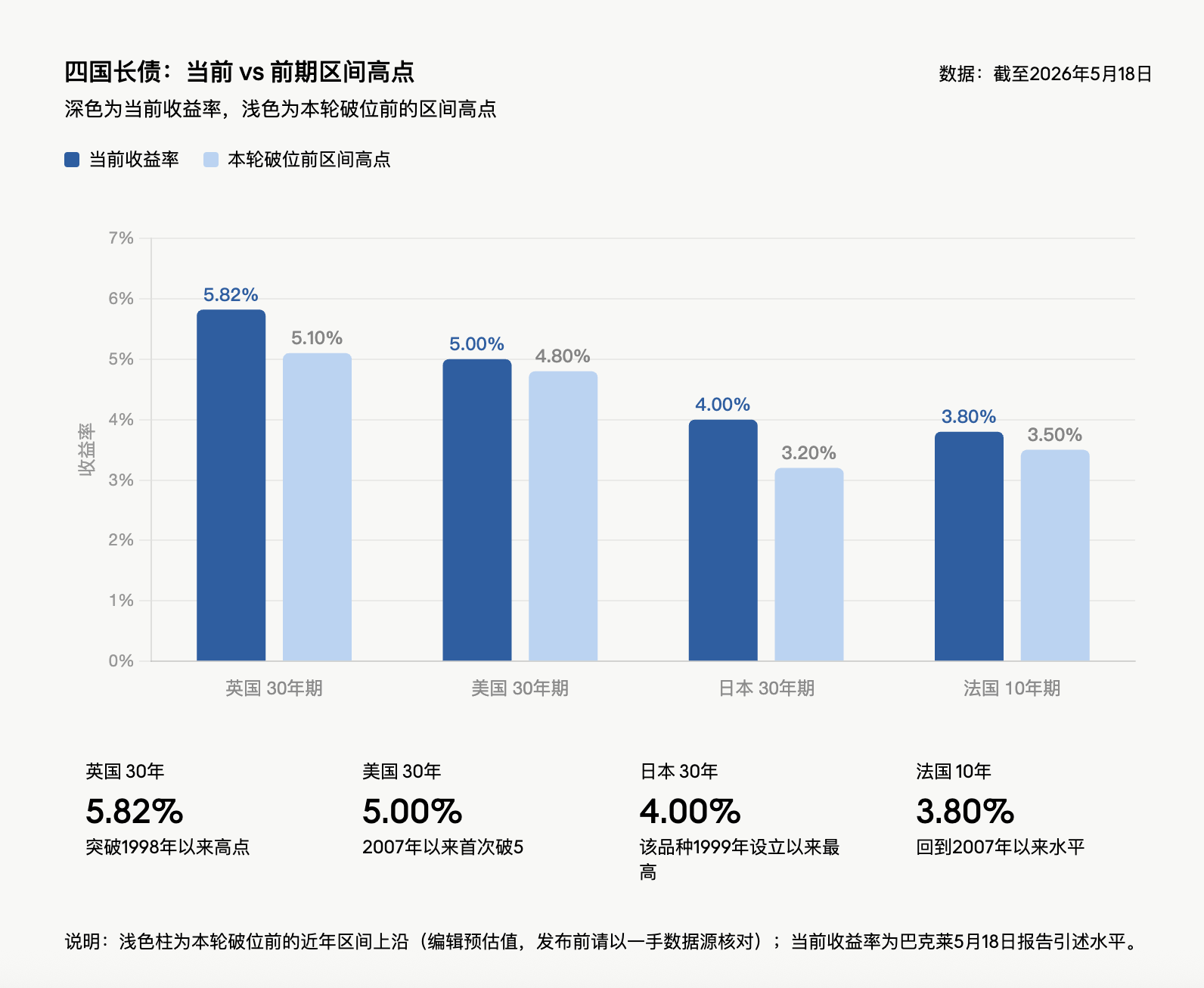
Over the past week, the yield on the UK 30-year government bond rose to 5.82%, the highest since 1998; Japan's 30-year government bond yield hit 4%, a record high since its inception in 1999; the US 30-year Treasury yield surpassed 5% for the first time since 2007; France's 10-year bond yield climbed above 3.8%, also returning to levels last seen in 2007. This sell-off has already weighed on global stock markets, prompting G7 finance ministers to specifically discuss this bond rout at their meeting this week.

According to a report dated May 18 by Ajay Rajadhyaksha, head of Fixed Income, FX, and Commodities Research at Barclays, "Long bonds didn't just sell off last week, they broke out of ranges everywhere." The core judgment is that with debt growing faster than the economy, inflation paths worsening, and no political will for fiscal reform, there is insufficient reason to extend duration even as long bonds have already sold off.

Priya Misra, Portfolio Manager at J.P. Morgan Asset Management, issued a similar warning: "Rates are rising in unison across the long end of the globe, and they tend to reinforce each other, and expectations of Fed rate hikes are now entering the market narrative."

Multi-Country Bond Markets Break Down Simultaneously, Collective "Fiscal Ponzi Scheme" Comes to Light

A decline in a single country's bond market can often be attributed to local inflation, fiscal policies, politics, or central bank communication. However, the near-simultaneous breakdowns in the UK, Japan, the US, and France indicate the market is now trading more than just local risks.

The commonality is clear: major developed economies generally have debt-to-GDP ratios above 100%, and fiscal deficits are not covered by nominal growth. The US deficit is approximately $2 trillion, about 6.5% of GDP, with nominal growth around 4.5% to 5%; France's nominal GDP grew 2.2% year-on-year for the quarter ending March 2026, with a deficit around 5%; the UK's deficit exceeds 4%.

This is the core contradiction pointed to by the "fiscal Ponzi scheme": governments continuously rely on new debt and rollover financing to sustain spending, but the pace of debt expansion exceeds economic growth, while interest costs are becoming more expensive again. As long as this combination persists, long-term bonds require higher yields to attract buyers.

New spending is adding further pressure. NATO agreed in The Hague last year to raise its defense spending target to 5% of GDP by 2035; European defense spending already grew by double-digit percentages last year and may continue for a decade; the US government is requesting a $1.5 trillion defense budget for the next fiscal year. These expenditures lack corresponding offsetting cuts.
Strait of Hormuz Blockade, Oil Price Shock Reignites Inflation

Debt and deficits were already fragile; an energy price shock is further tightening the policy space. The blockade of the Strait of Hormuz is the direct trigger for this bond market turmoil. The disruption of the world's most crucial oil shipping chokepoint has continuously pushed oil prices higher, reigniting inflation expectations.

Barclays' base case assumes Brent crude will average $100 in 2026, a 50% increase from the 2025 average. This would directly worsen the inflation outlook, compress central banks' room for rate cuts, and could even force them to hike rates. Higher rates mean existing debt interest payments will continue to rise, which in turn makes reducing deficits even more difficult. This resembles a fiscal ratchet mechanism—with each forward turn, the government's maneuvering room shrinks, and bond investors demand greater compensation.

J.P. Morgan Managing Director Priya Misra stated bluntly: "Unless the strait reopens, the rate range has shifted higher overall."

Looking at short-term data, the US 2-year yield briefly rose to 4.09%, the highest since February 2025; the 10-year yield stood at 4.58%, near a one-year high; US Treasuries overall have recorded negative returns year-to-date, whereas gains were nearly 2% as of late February.

Inflation Narrative Dominates the Market, Term Premium Being Repriced

The judgment from Karen Manna, Fixed Income Strategist and Portfolio Manager at Federated Hermes, is: "We are seeing a world that is truly dealing with a new inflation wave."

Kevin Flanagan, Head of Investment Strategy at WisdomTree, anticipates the next Consumer Price Index report may show annual inflation reaching 4%, the highest level since 2023. He directly points out the market logic: "The inflation narrative is dominating the market. The bond market is demanding a higher premium to hold newly issued Treasuries."

Last week's Treasury auctions confirmed this pricing: The 30-year auction rate hit 5%, the first since 2007, but demand was tepid; investor demand for the 3-year and 10-year auctions was also lukewarm. Even the rise in long-term bond yields to year-to-date highs is not, in itself, a sufficient reason to add duration.

Fed Path Completely Reverses, Bets Shift from Two Cuts to a March Hike

The inflation storm is reshaping expectations for the Federal Reserve's policy path. The environment facing incoming Fed Chairman Kevin Warsh is far from the "easing channel" envisioned by the market at the start of the year.

Traders now see a March hike next year as highly probable, with the odds of a hike by December around three-quarters; back at the end of February, the market was expecting two rate cuts in 2026. US Treasury yields are now about 50 basis points or more higher than their late-February levels.

Official commentary has further cemented hawkish pricing. Chicago Fed President Austan Goolsbee said last week that broad price pressures might even signal an overheating economy; Fed Governor Michael Barr called inflation the "overwhelming" risk facing the economy. The Fed's April meeting minutes will be released this Wednesday, and the market will closely watch how much support dissenting members garnered among officials.

The latest J.P. Morgan US Treasury Client Survey shows net short positions on Treasuries have risen to their highest level in 13 weeks, indicating a clear increase in market bets for further bond market declines.

Japan's Low-Rate System Being Repriced

Japan's 30-year government bond yield touching 4% may not be extreme in the US or UK, but it holds different significance for the Japanese market. For the past 20 years, Japan's long-term interest rates have hovered near zero, and the balance sheet structures of pension funds, insurance companies, and regional banks were built around this environment.

The Bank of Japan's policy rate is currently 0.75%. At the April policy meeting, three out of nine board members opposed the current stance; market pricing shows a 77% probability of a June rate hike. Even if the BOJ raises rates to 1%, real rates would remain significantly negative.

The rise in Japan's long-term yields can be interpreted as monetary policy normalization: the end of deflation, real wage growth, and the economy returning to a more normal state. However, the issue is that normalization may not be gentle for an economy with debt exceeding twice its GDP. A 4% yield on a 30-year Japanese bond is not just a change in a yield figure; it signifies the repricing of the entire low-interest-rate financial system.

UK, France: Political Structures Make Deficit Reduction Almost Impossible

The UK Labour government has a working majority of over 150 seats in the 650-seat parliament, theoretically possessing the capacity for fiscal adjustment. However, last summer, proposed savings of just £1.4 billion related to winter fuel subsidies sparked a backlash within the Labour parliamentary party.

Political pressure is mounting. Ninety-seven Labour MPs have demanded the Prime Minister resign or provide a departure timeline; main challenger Andy Burnham once argued fiscal policy should not submit to the bond market, later clarifying he would not completely ignore investors. The UK has had four prime ministers and five chancellors of the exchequer in the past four years. Bond market pricing indicates over 60 basis points of further rate hike potential for the Bank of England by year-end, although Governor Bailey may prefer to wait and see.

France's problem is less eye-catching than UK gilts, but its fiscal structure is equally tricky. France has had five prime ministers in less than three years. The current government has survived two no-confidence votes to push through a budget targeting a 5% of GDP deficit. The 2023 reform raising the retirement age to 64 is under attack, even though 64 is still below most Western economies. France's deficit is already significantly higher than its nominal GDP growth, voters will harshly punish austerity attempts, and constitutional arrangements make it easier for parliament to block spending cuts. Everyone knows the deficit must fall, but no one is willing to bear the political cost of reducing it.

US Buyer Structure Has Changed: Foreign Central Banks Turn to Gold, Private Investors Demand Higher Prices

The US 30-year Treasury yield surpassing 5% is the first time since 2007. The direct causes are rising inflation, fiscal expansion, and high deficits, but this is not new. The deeper change lies in the shifting marginal buyers.

The US federal deficit is approximately $2 trillion. The Congressional Budget Office projects that federal debt held by the public will rise from its current level of over 100% of GDP to 120% by 2036. However, this forecast may still be optimistic. A key variable is tariff revenue: The US effective tariff rate has fallen from a peak of 12% to between 7% and 8%, below the CBO's assumption of 15%. Even if it eventually rises to 10%, tariff revenue over the next decade would only be about 60% of the roughly $3 trillion deficit reduction assumed in its projections. Assumptions for defense spending and interest costs may also be too low.

The dollar's reserve currency status remains a structural advantage for the US, allowing it to finance at rates that peer debtors struggle to obtain. However, this does not mean a 6.5% deficit ratio is sustainable. Foreign central banks were once stable buyers of duration assets, but since the West froze Russia's foreign reserves, central bank allocations have shifted towards gold. Last year, gold's share in central bank reserves surpassed that of US Treasuries. Japan, the largest holder of US Treasuries, finds its domestic market rates more attractive. The Fed is still in quantitative tightening mode. Those stepping in to buy long-term bonds are price-sensitive private investors demanding higher term premiums.

The Fed is Not a "Fuse" for Long Bonds

Debt management offices have relatively reduced long-term bond issuance in recent years and may continue adjusting issuance structures, but this can only ease supply pressure, not change the fiscal and inflation direction.

Some in the market discuss whether the Fed might be forced to restart large-scale asset purchases to prevent long-end rates from rising further. However, Warsh's previous statement regarding the Fed's balance sheet was, "A bloated balance sheet could be meaningfully reduced," which is not language suggesting preparation for a US version of Yield Curve Control.

Faced with the ongoing sell-off, some investors choose to stay on the sidelines. WisdomTree analyst Kevin Flanagan said he currently maintains holdings in floating rate notes and keeps interest rate exposure low, "preferring to buy later rather than too early." He views the 4.5% level on the 10-year yield as "more of a psychological barrier," and if Middle East tensions escalate again and push oil prices higher, yields could retest last year's high of 4.62%. Hank Smith, Head of Investment Strategy at Haverford Trust, holds a more cautious view, stating that it remains an unresolved question whether the rise in consumer and producer prices is temporary "or will persist into 2027."

The forces driving the sell-off—fiscal deterioration, increased defense spending, sticky inflation, and constrained central banks—are not disappearing in a week or two. Unless economic data weakens significantly or credible changes emerge in fiscal paths, developed market long bonds are still trading on the same issue: the low-interest financing model of the high-debt era is being repriced by the market.


Preguntas relacionadas

QWhat is the core reason for the simultaneous sell-off in long-term bonds across major developed economies like the US, UK, Japan, and France, according to the article?

AThe article argues the core reason is a market reassessment of the 'low-interest-rate rolling model' due to a common reality of high debt, high deficits, and persistent higher interest rates. Key drivers are debt growing faster than economic growth, energy shocks reigniting inflation, and central banks having less room to cut rates, which forces markets to demand higher yields to compensate.

QHow did the blockade of the Strait of Hormuz contribute to the bond market turmoil described in the article?

AThe blockade of the Strait of Hormuz, a critical global oil transit route, pushed oil prices higher, reigniting inflation expectations. This energy price shock further compressed the policy space for central banks, potentially forcing them to raise rates. Higher interest rates increase government debt servicing costs, widening deficits and forcing bond investors to demand even higher yields, creating a vicious cycle.

QWhat significant shift has occurred in the market's expectation for Federal Reserve policy, as mentioned in the text?

AThe market's expectation for the Federal Reserve's policy path has completely reversed. At the end of February, the market anticipated two rate cuts in 2026. Now, traders view a rate hike in March of the coming year as highly likely, with about a 75% probability of a hike by December. This shift is driven by renewed and persistent inflation pressures.

QWhy is Japan's 30-year government bond yield reaching 4% considered particularly significant, despite being lower than similar yields in the US or UK?

AA 4% yield for Japan's 30-year bond is highly significant because Japan's financial system has been built around near-zero interest rates for over two decades. Pensions, insurers, and regional banks structured their balance sheets based on this environment. Therefore, this rise represents a fundamental repricing of Japan's entire low-interest-rate financial architecture, which is challenging for an economy with debt exceeding 200% of GDP.

QAccording to the article, what are the two key changes in the buyer structure for US Treasury bonds that are contributing to higher long-term yields?

ATwo key changes in the US Treasury buyer structure are: 1) Foreign central banks, traditional stable buyers of duration, are shifting reserves towards gold and away from US Treasuries, partly due to geopolitical factors like the freezing of Russian reserves. 2) The marginal buyers are now more price-sensitive private investors who demand higher term premiums (compensation for holding long-term debt), as opposed to less price-sensitive official buyers. The Fed is also reducing its balance sheet (quantitative tightening).

Lecturas Relacionadas

IOSG: After the Number of Developers Halved, Crypto Did Not Die

The crypto development community has undergone a significant transformation, with monthly active developers on GitHub halving from 45K in 2022 to approximately 23K by 2026. This decline is largely attributed to the departure of newcomers, whose roles were often tied to market-driven hype cycles like NFTs and forked DeFi protocols, leading to a 52% churn rate among those with less than a year of experience. However, the core of the industry has strengthened. Established developers with over two years of experience have reached a record high, contributing about 70% of the code. They are consolidating around ecosystems with genuine users and revenue, such as Bitcoin and Solana, while moving away from narrative-driven projects. The talent shift represents a "deleveraging" and an increase in core density. This core group has developed a unique skillset by operating in an environment of "code is law," with zero tolerance for error and no external recourse. They have learned to build trust and functional systems from the ground up without central authorities, as demonstrated by protocols like Uniswap and MakerDAO. These capabilities are now being repriced and leveraged in the AI era. The structural challenges of AI scaling—such as trust, coordination, and verification—mirror those long addressed in crypto. Examples include CoreWeave pivoting from GPU mining to AI compute, OpenSea's founder applying NFT market logic to AI model routing with OpenRouter, and projects like NEAR and Catena Labs transitioning crypto-native architectural and financial insights into AI infrastructure and agent banking. Key areas where crypto-bred skills are directly applicable to AI include: 1. **Compute Aggregation & Optimization**: Using token incentives and cryptographic verification (e.g., Proof of Sampling & Privacy) to create trusted, decentralized GPU networks, as seen with Hyperbolic. 2. **AI Governance & Incentive Design**: Applying economic mechanism design from DAOs and tokenomics to align the goals of multiple, fast-acting AI agents, a direction explored by EigenLayer's EigenCloud. 3. **AI Agent Autonomous Payments**: Leveraging stablecoins and programmable, permissionless blockchains to enable the micro-transactions required for AI agent economies, exemplified by protocols like x402. The role of the crypto builder is evolving from writing smart contracts to designing trust mechanisms for autonomous AI systems. This convergence is reflected in hiring trends at major firms and significant capital allocation from funds like Paradigm and a16z crypto, which are investing at the intersection of crypto and AI. Regional differences exist, with the US favoring foundational protocol innovation and Asia focusing on compliant application-layer integration, but the underlying trend is clear. The industry's "deleveraging" has not signaled its demise but rather a maturation, positioning its core builders to solve critical trust and coordination problems in the age of AI.

marsbitHace 27 min(s)

IOSG: After the Number of Developers Halved, Crypto Did Not Die

marsbitHace 27 min(s)

Currency and Stock Market Barometer: Strategy Invested Over $2 Billion to Buy Over 24,800 BTC Last Week; Bitmine's ETH Holdings Increase to 4.37% of Total Supply (May 19)

Crypto & Stock Market Watch: Institutional BTC Buying Surges, ETH Holdings Grow Major listed companies aggressively accumulated Bitcoin last week, with net purchases skyrocketing over 44x to $2.03 billion. Strategy (formerly MicroStrategy) led the charge, spending approximately $2.01 billion to buy 24,869 BTC, bringing its total holdings to 843,738 BTC. Overall, listed firms (excluding miners) now hold 1,113,841 BTC, valued at ~$86.16 billion. On the Ethereum front, Bitmine purchased 71,672 ETH in the past week. It now holds 5,278,462 ETH, worth $11.56 billion and representing 4.37% of ETH's total supply. A significant portion (4,712,917 ETH) is staked, generating an annualized yield of $289 million. Industry leaders note a divergence from the MicroStrategy model, with ETH treasury firms increasingly focusing on staking yields and simpler balance sheets. In traditional markets, Morgan Stanley warns of a potential significant U.S. stock market correction if bond yields and volatility continue rising. Investment giants like Berkshire Hathaway and Bridgewater adjusted portfolios in Q1, with Bridgewater notably increasing its stakes in chipmakers like Nvidia, Broadcom, and Micron while shedding software stocks. Among other crypto-focused public companies, Solana treasury firm Upexi reported a widened net loss of $109 million for its fiscal Q3, driven by a decline in its crypto holdings' value. Meanwhile, Hyperion DeFi, a HYPE token treasury company, reported a Q1 net profit of $8.8 million and increased its HYPE holdings past 2 million tokens.

marsbitHace 28 min(s)

Currency and Stock Market Barometer: Strategy Invested Over $2 Billion to Buy Over 24,800 BTC Last Week; Bitmine's ETH Holdings Increase to 4.37% of Total Supply (May 19)

marsbitHace 28 min(s)

Following the KelpDAO Hack: $40 Billion in Assets Flee LayerZero, Chainlink Emerges as the Primary 'Beneficiary'

Following a major security breach in April where KelpDAO's bridge using LayerZero was attacked for approximately $292 million, a significant shift is underway in the cross-chain infrastructure landscape. An estimated $40 billion in assets is in the process of migrating or has already migrated from LayerZero to Chainlink's Cross-Chain Interoperability Protocol (CCIP). The attack exploited a single-point-of-failure vulnerability due to KelpDAO's 1-of-1 validator configuration within the LayerZero network. Attackers corrupted RPC nodes and used DDoS attacks to force the system to rely on compromised nodes, allowing fraudulent messages. While LayerZero acknowledged a serious error in allowing its validator network to service high-value transactions with such a configuration, the incident highlighted critical security risks. This triggered a rapid migration wave. Starting with KelpDAO on May 6th, several major protocols—including Solv Protocol, Re, Tydro, Kraken, and Lombard—announced switching their cross-chain infrastructure exclusively to Chainlink CCIP. The combined value of these migrations is estimated to be around $40 billion. This movement followed earlier major adoptions by Coinbase (in late 2025) and Circle (in early 2024). Market sentiment reflected this shift, with LINK's price showing relative stability while ZRO (LayerZero's token) declined significantly. Data indicates a net outflow of approximately $20.1 billion from the LayerZero network over 30 days. The migration is largely driven by perceived security differences. Chainlink CCIP employs a decentralized oracle network as its default consensus layer, featuring multiple independent node operators, a separate Risk Management Network, and built-in safeguards like rate limits. In contrast, LayerZero's highly modular architecture offers flexibility but places more responsibility on application developers to configure security settings, a risk underscored by the KelpDAO incident. LayerZero has since apologized for its communication handling post-attack and stated the protocol itself was not compromised, but rather its Labs DVN's internal RPC was poisoned. An official post-mortem report with external security partners is forthcoming.

marsbitHace 1 hora(s)

Following the KelpDAO Hack: $40 Billion in Assets Flee LayerZero, Chainlink Emerges as the Primary 'Beneficiary'

marsbitHace 1 hora(s)

Trading

Spot
Futuros

Artículos destacados

Cómo comprar ERA

¡Bienvenido a HTX.com! Hemos hecho que comprar Caldera (ERA) sea simple y conveniente. Sigue nuestra guía paso a paso para iniciar tu viaje de criptos.Paso 1: crea tu cuenta HTXUtiliza tu correo electrónico o número de teléfono para registrarte y obtener una cuenta gratuita en HTX. Experimenta un proceso de registro sin complicaciones y desbloquea todas las funciones.Obtener mi cuentaPaso 2: ve a Comprar cripto y elige tu método de pagoTarjeta de crédito/débito: usa tu Visa o Mastercard para comprar Caldera (ERA) al instante.Saldo: utiliza fondos del saldo de tu cuenta HTX para tradear sin problemas.Terceros: hemos agregado métodos de pago populares como Google Pay y Apple Pay para mejorar la comodidad.P2P: tradear directamente con otros usuarios en HTX.Over-the-Counter (OTC): ofrecemos servicios personalizados y tipos de cambio competitivos para los traders.Paso 3: guarda tu Caldera (ERA)Después de comprar tu Caldera (ERA), guárdalo en tu cuenta HTX. Alternativamente, puedes enviarlo a otro lugar mediante transferencia blockchain o utilizarlo para tradear otras criptomonedas.Paso 4: tradear Caldera (ERA)Tradear fácilmente con Caldera (ERA) en HTX's mercado spot. Simplemente accede a tu cuenta, selecciona tu par de trading, ejecuta tus trades y monitorea en tiempo real. Ofrecemos una experiencia fácil de usar tanto para principiantes como para traders experimentados.

356 Vistas totalesPublicado en 2025.07.17Actualizado en 2025.07.17

Cómo comprar ERA

Discusiones

Bienvenido a la comunidad de HTX. Aquí puedes mantenerte informado sobre los últimos desarrollos de la plataforma y acceder a análisis profesionales del mercado. A continuación se presentan las opiniones de los usuarios sobre el precio de ERA (ERA).

活动图片