24-Year-Old "Wall Street Newcomer" Portfolio Adjustments Revealed: Shorts Chips Heavily in Q1, Bullish on Energy and AI Infrastructure

marsbitPublicado a 2026-05-19Actualizado a 2026-05-19

Resumen

A 24-year-old Wall Street prodigy, Leopold Aschenbrenner, has disclosed the Q1 portfolio adjustments for his fund, Situational Awareness LP. The fund's assets under management skyrocketed from $5.52 billion to $13.7 billion. The most significant move was a massive bearish bet on the semiconductor sector. The fund established $8.46 billion in put options, targeting chipmakers like NVIDIA ($1.6B in puts) and the VanEck Semiconductor ETF (SMH, $2B in puts). This bearish stance extended to Broadcom, Oracle, AMD, Micron, ASML, Intel, Corning, and TSMC. However, the fund made a selective bullish exception, adding shares and call options for memory chip maker SanDisk. The fund maintained its core bullish thesis on energy and AI infrastructure. Bloom Energy remained its largest long equity holding. It also increased stakes in cryptocurrency mining/data center firms like CleanSpark, Riot Platforms, Applied Digital, and IREN Limited, viewing them as providers of critical ready-to-use infrastructure—land, power, and grid permits—for AI expansion. The 13F filing was submitted one day late. Overall, the fund's strategy involves substantial bearish semiconductor bets while maintaining concentrated, high-volatility investments in selective tech, computing, and infrastructure plays aligned with AI growth.

Source: Cailian Press

On Monday Eastern Time, the eagerly awaited Q1 US stock portfolio adjustment report (13F) for the fund "Situational Awareness LP," managed by the much-watched Wall Street newcomer, 24-year-old Leopold Aschenbrenner, was finally released. (Related Reading: Liquidated NVIDIA, Frenzied Buying of Fuel Cells: The 'Physical Arbitrage' Logic of a 24-Year-Old Investment Prodigy)

As described in our previous report, as the world's youngest manager of a mega-fund, Leopold Aschenbrenner foresaw the importance of AI infrastructure "logistics" as early as 2024, making significant investments in power, land, and infrastructure, propelling his fund to massive expansion in less than two years since its inception.

This belated report shows that the market value of the fund managed by Leopold Aschenbrenner has surged from $5.52 billion in the previous quarter to $13.7 billion—and just under two years ago, the fund's initial AUM was only $255 million.
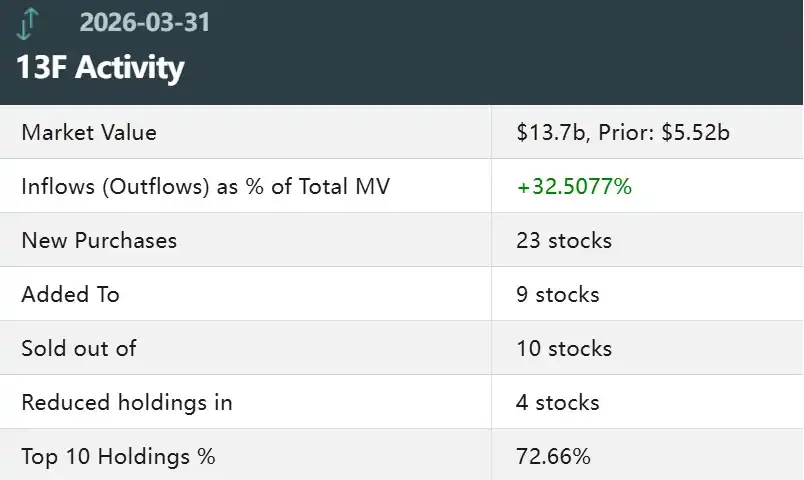
Such a rocket-like surge in assets under management indicates that the "Situational Awareness" fund has clearly become a star fund highly sought after on Wall Street—in fact, Leopold Aschenbrenner's portfolio moves have already become one of the most closely watched sources for "copying homework" among Wall Street institutions and retail investors in recent quarters.

Let's take a closer look at what this Wall Street star has done in the first quarter of this year.

Heavily Buys Short Positions in Chipmakers

From this adjustment report, the most significant move made by Leopold Aschenbrenner in Q1 was heavily shorting chipmakers.

As of the end of Q1, the fund aggressively purchased put options with a notional value of up to $8.46 billion, covering numerous chipmaker stocks, including a $2 billion put option on the VanEck Semiconductor ETF (ticker: SMH) and a $1.6 billion put option on AI giant NVIDIA.
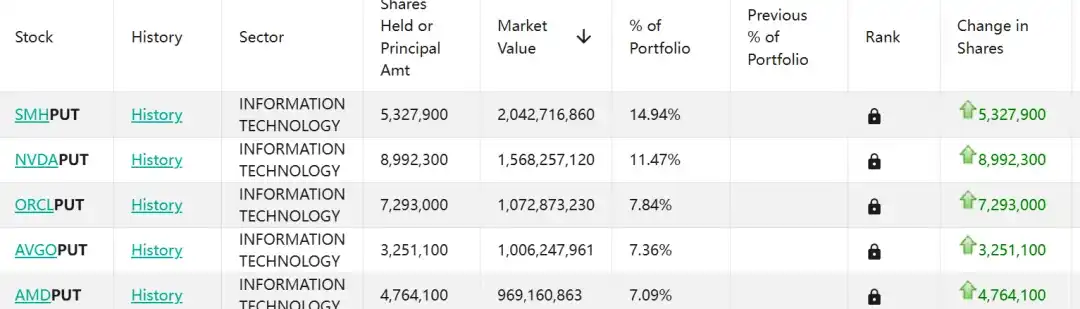
Massive Purchase of Chip Put Options

Additionally, the fund established put option positions on Broadcom, Oracle, AMD, Micron Technology, ASML, Intel, Corning, and TSMC.

These bearish options are not only among the fund's top five purchases for Q1 but also rank among its top five holdings. This undoubtedly highlights Leopold Aschenbrenner's pessimistic outlook on the prospects of chip stocks.

However, Leopold Aschenbrenner is not bearish on all chip stocks.

In Q1, the fund slightly increased its holdings of memory giant SanDisk by 80,000 shares and established a SanDisk call value option position worth $380 million, possibly hinting that it expects the memory boom to continue and that the fund is making selective bets within the semiconductor industry.

Still Heavily Betting on Energy and AI Infrastructure

As of the end of Q1, US biofuel company Bloom Energy (ticker: BE) remained Aschenbrenner's largest bullish bet on an individual stock. His fund holds 6.5 million shares of Bloom Energy, valued at $879 million, and holds 409,000 Bloom Energy call options with a notional value of $55 million.

Furthermore, Situational Awareness increased its holdings in cryptocurrency mining/data center operators CleanSpark (ticker: CLSK), Riot Platforms (ticker: RIOT), Applied Digital (ticker: APLD), and IREN Limited (ticker: IREN).

As we previously analyzed, Aschenbrenner's bet on Bitcoin miners is not for cryptocurrency speculation but for the ready-to-use land, power, and grid permits held by these miners. In the era of massive AI infrastructure expansion, these resources are equivalent to "ready-made" AI infrastructure, saving years of approval time.

A Belated 13F Report

It is worth noting that Aschenbrenner's 13F filing was originally due last Friday—according to regulations, all institutional investment management companies holding securities over $100 million must submit this disclosure document to the U.S. Securities and Exchange Commission within 45 days after the quarter ends—but Situational Awareness did not submit the report until Monday morning.

Typically, late or missed 13F filings can lead to civil penalties at the SEC's discretion, ranging from small fines to a maximum of $750,000.

However, investors' attention is certainly focused on Aschenbrenner's specific portfolio adjustments.

Overall, while he aggressively established semiconductor put option positions in Q1, his fund still holds a significant amount of highly volatile tech stocks and continues to make selective investments in computing, memory, and data center infrastructure. This adjustment trend might be worth investors' reference.

Preguntas relacionadas

QWho is the 24-year-old fund manager mentioned in the article and what is the name of his fund?

AThe fund manager is Leopold Aschenbrenner, and his fund is called 'Situational Awareness LP'.

QWhat was the most significant action taken by Situational Awareness LP in Q1 regarding the semiconductor industry?

AThe fund's most significant action was establishing a large short position in chipmakers by purchasing put options with a notional value of $8.46 billion against companies like Nvidia and the VanEck Semiconductor ETF (SMH).

QDespite the broad short position, which specific semiconductor stock did the fund show bullish sentiment towards in Q1?

AThe fund showed selective bullishness towards SanDisk by increasing its stock holdings by 80,000 shares and establishing $380 million in call options on the company.

QWhat is the fund's largest long stock position as of the end of Q1?

AThe fund's largest long stock position is in Bloom Energy (BE), holding 6.5 million shares valued at $879 million.

QWhy does the fund invest in Bitcoin mining companies like CleanSpark and Riot Platforms, according to the article's analysis?

AThe fund invests in Bitcoin mining companies not for cryptocurrency speculation, but for their valuable physical infrastructure assets like land, power supply, and grid permits, which are seen as 'ready-made' AI infrastructure that can save years of approval time.

Lecturas Relacionadas

Pax Silica vs. WAICO: The US Wants to Prohibit Europe from Using Chinese Artificial Intelligence

The United States is preparing to demand that European and other partners abandon Chinese artificial intelligence initiatives, threatening exclusion from the American-led "Pax Silica" coalition, according to a leaked U.S. State Department document. This ultimatum forces signatories of the "AI Opportunity Statement" to choose between the Western technological ecosystem and alternative frameworks, with China not explicitly named but clearly targeted. Pax Silica is a U.S. strategy for AI and semiconductor hegemony, launched in late 2025. Its European presence expanded significantly in mid-2026. Concurrently, China, Russia, and 27 other nations established the World AI Cooperation Organization (WAICO) in July 2026 as an independent intergovernmental platform promoting AI governance based on UN principles. This situation creates a difficult choice, especially for European nations balancing strategic autonomy with dependence on U.S. tech and security. It also pressures Global South countries with pragmatic ties to both Washington and Beijing. The formation of competing blocks risks fragmenting the global tech landscape, forcing companies to split supply chains, increasing costs, and potentially leading to incompatible standards and protocols. The era of open globalization in AI may be ending, replaced by geopolitical confrontation where technological sovereignty trumps economic efficiency. The decisions made will shape the global digital economy for decades.

cryptonews.ruHace 35 min(s)

Pax Silica vs. WAICO: The US Wants to Prohibit Europe from Using Chinese Artificial Intelligence

cryptonews.ruHace 35 min(s)

Robert Kiyosaki Shares His Mentor's Predictions About the Emergence of Bitcoin and AI

American entrepreneur and author of "Rich Dad Poor Dad," Robert Kiyosaki, discussed the influence of futurist R. Buckminster Fuller on his worldview, linking Fuller's past technological predictions to the emergence of Bitcoin and the development of artificial intelligence. In an X post, Kiyosaki also reflected on personal purpose, sharing his journey from the music business—where he worked with bands like The Police and Iron Maiden—to creating the "Cashflow" board game and writing his famous book. He described feeling an inner emptiness despite his success, a turning point that came after meeting Fuller, whom he studied with for three summers. Kiyosaki described Fuller as a "friendly genius" who foresaw world-changing developments like Bitcoin and AI. However, the core of his post focused on Fuller's philosophical impact, particularly a quote about belonging to the universe and finding purpose by dedicating one's life to the maximum benefit of others. The entrepreneur remains a vocal advocate for cryptocurrencies. He regularly advises buying Bitcoin during market panics, viewing it and assets like Ethereum, gold, and silver as hedges against traditional financial system failures. Kiyosaki has predicted a major market crash by 2026, seeing it as an opportunity for prepared investors, with long-term price targets including $750,000 for Bitcoin and $95,000 for Ethereum.

cryptonews.ruHace 2 hora(s)

Robert Kiyosaki Shares His Mentor's Predictions About the Emergence of Bitcoin and AI

cryptonews.ruHace 2 hora(s)

Etherealize CEO Calls Wall Street's Private Blockchains a 'Race to the Bottom'

Etherealize co-founder and CEO Vivek Raman criticized Wall Street's growing interest in private, permissioned blockchains, calling them a "race to the bottom." In an interview with CoinDesk, Raman argued that consortium networks fragment liquidity and return the industry to the siloed systems that blockchain technology was meant to overcome. He stated that closed networks do not interoperate, undermining two key advantages of the technology: system compatibility and liquidity concentration. Etherealize promotes Ethereum as an open, foundational layer for institutional players. Raman insists that privacy and access restrictions should be built on top of public infrastructure—at the application or L2 level—rather than creating separate, closed networks. He compared Ethereum to HTTP as a base layer, with additional permissioned and private layers akin to HTTPS. Examples of this new wave of "closed" solutions mentioned include Canton Network from Digital Asset, Circle's Arc project, and Stripe's Tempo. Raman termed this trend "consortium chains 2.0," recalling earlier initiatives like the R3 interbank consortium and the Hyperledger corporate ecosystem from 2016 that failed to gain significant traction. He reiterated his firm belief that a global, open, permissionless infrastructure is necessary as a foundational base layer. Raman previously noted in June that traditional financial institutions had begun implementing Ethereum-based solutions into real business processes.

cryptonews.ruHace 2 hora(s)

Etherealize CEO Calls Wall Street's Private Blockchains a 'Race to the Bottom'

cryptonews.ruHace 2 hora(s)

Trading

Spot
活动图片