Geopolitical Tensions Push Bitcoin Lower, Driving Market Sentiment Into Extreme Fear

bitcoinistPublicado a 2026-02-19Actualizado a 2026-02-19

Resumen

Escalating geopolitical tensions and a broader risk-off sentiment in traditional markets are driving Bitcoin's price decline, with BTC falling below $70,000. The cryptocurrency is mirroring the weakness in equity futures, with Nasdaq 100 and S&P 500 contracts also dropping. This has led to a fourth consecutive week of outflows from US-listed Bitcoin ETFs, totaling over $360 million last week, pushing the market sentiment into "extreme fear" with a reading of 10 on the CryptoQuant index. Analysts warn that if the current bearish trend continues, Bitcoin could test key support at $60,000, with further macro shocks potentially pushing it toward $50,000. On-chain analysis reveals that short-term holders are currently under significant stress and capitulating, while long-term holders have not yet undergone a true capitulation phase, a typical precursor to a new market uptrend.

The waning cryptocurrency market momentum, coupled with ongoing geopolitical tensions, continues to hamper Bitcoin’s price trajectory, pushing it downward. With BTC’s price and sentiment dropping significantly, the market appears to have entered a phase of heightened uncertainty and caution as investors look for alternative assets to hedge against geopolitical risks.

Bitcoin Weakness Reflects Broader Risk-Off Move

Bitcoin remains on a downward trajectory as its price trades below the $70,000 mark, bolstered by the geopolitical tensions around the world. Following the unfavorable conditions of Bitcoin and the sector, the market is now positioned at a critical moment, where the bearish action could either flip or continue.

Walter Bloomberg shared that Bitcoin is sliding as geopolitical risks spur risk-off trade after examining the cryptocurrency’s price against Nasdaq Futures. Such synchronous decrease indicates that market behavior across asset classes is once again being driven by macro variables like changing interest-rate expectations and a generalized feeling of risk aversion.

The report shows that Bitcoin fell by 1.7% to about $67,000 ahead of the United States Open, tracking weaker equity futures. Meanwhile, Nasdaq 100 Futures experienced a drop of 0.9% and S&P 500 contracts fell by 0.6%.
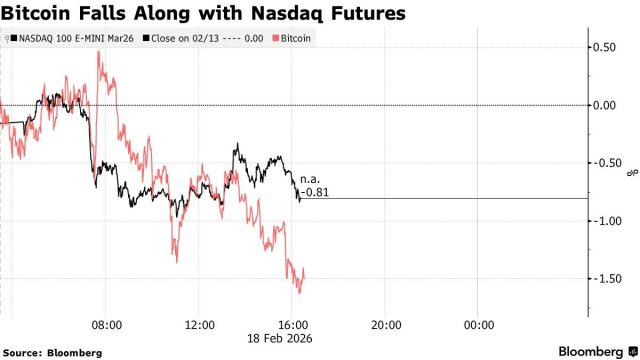
BTC and Nasdaq in the same downward trajectory | Source: Chart from Walter Bloomberg on X

This development has impacted investors’ sentiment and focus. Currently, investors are becoming more cautious due to growing tensions over Iran, renewed discussions about AI’s broader economic effects, and uncertainty about a potential Fed rate cut following recent inflation data.

In the midst of the geopolitical tension, flows, especially from Exchange-Traded Funds (ETFs), have stayed negative. US-listed Bitcoin ETFs recorded a fourth consecutive week of outflows, with over $360 million withdrawn just last week. These outflows point to weakening sentiment as indicated by CryptoQuant’s Fear and Greed Index, which is positioned at 10, classified as extreme fear.

While the market has shifted into extreme fear levels, analysts believe that BTC might extend its ongoing consolidation phase, with $60,000 considered as the main support. However, further macro shocks are expected to push BTC’s price back toward the $50,000 threshold.

Which BTC Investors Are Under Stress

During increased bearish phases, investors’ action and activity are crucial to gauging the current market state and its next possible direction. In a recent analysis, Anil, an on-chain researcher and investor, has outlined a key divergence between Bitcoin short-term holders and long-term holders.

With the market’s current state, BTC short-term holders are going through a stress period driven by capitulation. Meanwhile, long-term Bitcoin holders have yet to undergo a true stress or capitulation process.

It is worth noting that long-term holders eventually go through a phase of capitulation in every cycle, and then a fresh uptrend starts after a period of accumulation. However, it is hard to determine whether the group will capitulate again this time. Should this occur, Anil noted that the area below 1 on the LTH Unrealized Profit/Loss Ratio chart would be the decisive point for the market.

BTC trading at $68,134 on the 1D chart | Source: BTCUSDT on Tradingview.com

Preguntas relacionadas

QWhat is the main reason for Bitcoin's recent price decline according to the article?

AThe main reason for Bitcoin's recent price decline is ongoing geopolitical tensions, which are spurring a risk-off trade among investors.

QWhat is the current reading of CryptoQuant's Fear and Greed Index, and what does it signify?

AThe current reading of CryptoQuant's Fear and Greed Index is 10, which is classified as 'extreme fear,' signifying very weak market sentiment.

QHow did US-listed Bitcoin ETFs perform last week in terms of investor flows?

AUS-listed Bitcoin ETFs recorded a fourth consecutive week of outflows, with over $360 million withdrawn just last week.

QAccording to the on-chain analysis, which group of Bitcoin investors is currently under stress and experiencing capitulation?

AAccording to the on-chain analysis, short-term Bitcoin holders are currently under stress and experiencing capitulation.

QWhat are the two key support levels mentioned for Bitcoin's price if the bearish trend continues?

AThe two key support levels mentioned are $60,000 as the main support and the $50,000 threshold if further macro shocks occur.

Lecturas Relacionadas

In Jinjiang, Fujian, a Storage Super Unicorn Lies Quiet

In Fujian's Jinjiang, a city known for sportswear, lies a quiet semiconductor giant: Fujian Jinhua Integrated Circuit Co. (JHICC). Once a promising domestic DRAM manufacturer alongside Yangtze Memory and ChangXin Memory Technologies (CXMT), its journey was derailed in 2018 when the U.S. placed it on an Entity List and filed criminal charges for alleged trade secret theft. This halted production for years. A turning point came in February 2024 when a U.S. federal court found JHICC not guilty. However, it had lost crucial time. While CXMT soared to become a top-valued A-share company in 2024, JHICC, with an estimated valuation of 80 billion RMB, was just restarting. Its current output is primarily customized DDR4 chips, not the advanced DDR5/HBM demanded for AI, but it still benefits from the broader memory chip upcycle. JHICC's story is tied to Chen Zhengkun, a veteran engineer who left Micron to lead the venture. Founded in 2016 with state-backed funding, JHICC partnered with Taiwan's UMC to develop DRAM technology. Rapid progress was cut short by the U.S. actions, which Micron initiated, partly due to its heavy reliance on the Chinese market. Post-sanctions, Chen's team worked to rebuild the production line with reduced reliance on U.S. technology. According to its records, JHICC achieved small-scale production and revenue growth under immense pressure. It now focuses on the stable "niche" DRAM market (e.g., TVs, routers) with a monthly capacity of ~40,000 wafers, aiming for 60,000 by 2026. It holds over 1,000 patents but remains on the Entity List. For Jinjiang, investing in JHICC was a bold industrial leap. The local government provided unwavering financial and logistical support during the crisis, helping the company survive. JHICC has become the anchor for a growing local semiconductor cluster. Though its scale lags behind domestic peers, JHICC's persistence symbolizes a hard-won foothold in a global market long dominated by Samsung, SK Hynix, and Micron. Having missed one boom, it seeks a place in the new AI-driven memory supercycle.

marsbitHace 27 min(s)

In Jinjiang, Fujian, a Storage Super Unicorn Lies Quiet

marsbitHace 27 min(s)

Must-Watch Events Next Week|CLARITY Act Could Face Senate Vote; SpaceX, Circle to Report Earnings (8.3-8.9)

**Summary: Key Events and Developments to Watch (August 3-9)** The upcoming week is marked by significant financial disclosures, key legislative deadlines, and notable product updates. **Major Financial Events:** Several companies are scheduled to release their Q2 2026 earnings. American Bitcoin (ABTC) will report on August 3, followed by SpaceX and Hut 8 Mining Corp. on August 4, and Circle on August 5. Notably, a significant portion of SpaceX shares (up to 12% of total shares) will be unlocked on August 6 following their earnings release. **Key Legislative Deadline:** The U.S. Senate faces an August 7 deadline to secure 60 votes for the CLARITY Act, a bipartisan bill aiming to establish a federal regulatory framework for cryptocurrencies. The Senate may hold a full vote on the bill during the week. **Economic Data:** The U.S. July Non-Farm Payrolls report will be released on August 7, providing crucial labor market data. **Technology & Product Updates:** * **Shutdowns:** DeFi portfolio tracker Zapper and wallet app Ctrl Wallet will cease operations on August 3. * **Upgrades:** LayerZero will deprecate its v1 relayers on August 3. XRP Ledger's new version 3.3.0, featuring five new functions, is expected next week. * **AI:** Elon Musk announced that the advanced Grok 4.6 AI model is set for release around August 7. * **Bitcoin:** The BIP-110 forced signaling for a potential Bitcoin network change is scheduled to begin around August 8. **Other Notable Events:** Chinese robotics firm Unitree Tech has set its preliminary price inquiry for its IPO for August 5. South Korean exchange Upbit will delist AQT and AERGO tokens on August 3.

marsbitHace 2 hora(s)

Must-Watch Events Next Week|CLARITY Act Could Face Senate Vote; SpaceX, Circle to Report Earnings (8.3-8.9)

marsbitHace 2 hora(s)

Trading

Spot
活动图片





