From the Fringe to a 500x Surge: The Month White Whale Was 'Retold'

比推Publicado a 2025-12-30Actualizado a 2025-12-30

Resumen

From obscurity to a staggering 500x surge, White Whale (a Solana-based meme coin) defied expectations after initially appearing destined to fail. Launched on October 13, 2025, as an unauthorized fan-made token parodying crypto influencer @TheWhiteWhaleV2, it quickly faded into near-zero trading activity. The dramatic turnaround began on December 7, 2025, when @TheWhiteWhaleV2 unexpectedly took control of the project to protect his reputation. He committed to transparent management, locking his own purchased tokens until 2063, reinvesting all creator revenue back into the community, and personally funding liquidity and incentives. Chain data revealed early signals of revival, including a sharp drop in top-holder supply and "smart money" inflows days before the official announcement. While initial gains were modest, the narrative of responsible stewardship fueled a viral community-driven rally, pushing its market cap from under $100,000 to $57 million in under a month. White Whale became an unlikely anti-rug success story in a high-risk ecosystem.

Original: Odaily Planet Daily

Author: Ding Dang

Original Title: A 500x Surge in One Month: How Did a Crypto KOL Revive a White Whale with 'Responsible Narrative'?


This is the story of a Meme coin that "should have died in theory" but unexpectedly revived from the bottom after being nearly forgotten by the market.

White Whale surged nearly 500 times in less than a month, rising from a market cap of less than $100,000 to a current market cap of $57 million. The community is now calling for the next target: $100 million.

The Familiar Meme Coin Routine: From Start to Finish

White Whale was launched on Pump.fun on October 13, 2025. It was originally created by a fan "borrowing" the avatar and image of crypto KOL @TheWhiteWhaleV2 as a joke. @TheWhiteWhaleV2 is a crypto OG on X with 828,000 followers. His avatar is a stern-looking whale wearing armor, often sharing trading philosophies and market insights. Perhaps for this reason, fans see it as a symbol of positive "whale" energy.
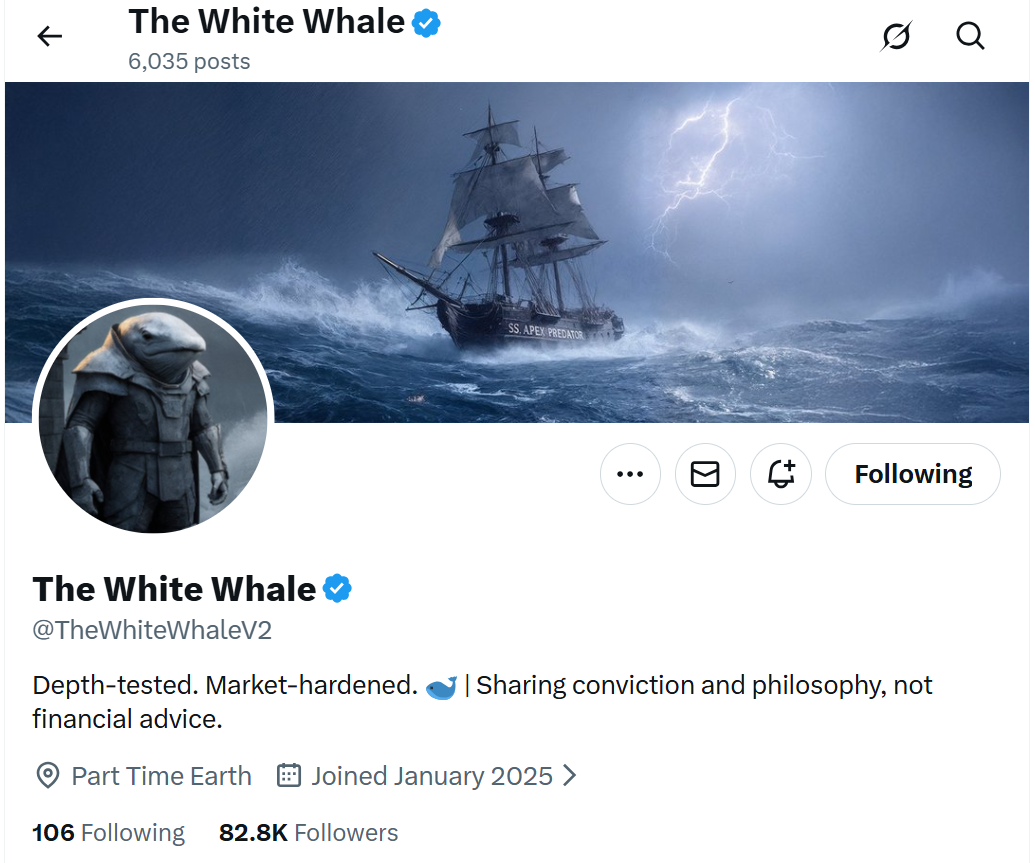
The initial narrative was "The People's Whale," intended to satirize and resist manipulation by big whales or institutions in the crypto market, positioning itself as a community counterattack tool. But this was purely a fan's mischievous creation, without authorization from @TheWhiteWhaleV2 himself. He even later tweeted that "this thing will die in 48 hours." Similar incidents of "borrowing avatars to issue coins" have happened to him before.

This is exactly why it was originally "supposed" to die. On Pump.fun, thousands of Meme coins are born every day, and 99.9% of them die quickly. This coin was no exception. Shortly after its launch, its market cap briefly surged to around $100,000 during the bonding curve phase, then quickly cooled. From mid-October to early December, the price mostly flatlined, with trading volume near zero, almost forgotten. This is an ending the market has seen countless times.

Dramatic Turnaround: The Whale's "Redemption" and Community Takeover

The turning point came on December 7, 2025.

@TheWhiteWhaleV2 himself suddenly posted an announcement: he officially took over the Treasury and control of this Meme coin. The reason was simple: fans used his image and reputation without permission. He initially ignored it, but seeing the coin gain some (albeit small) traction, he worried that if a Rug Pull happened in the future, it would damage his reputation. So he decided to "step in personally" to protect his brand.

He emphasized that this was not a coin he created and that he even initially advised people not to buy it. But to control his own image and portrait rights, he had to take over.

Of course, that's not the important part.
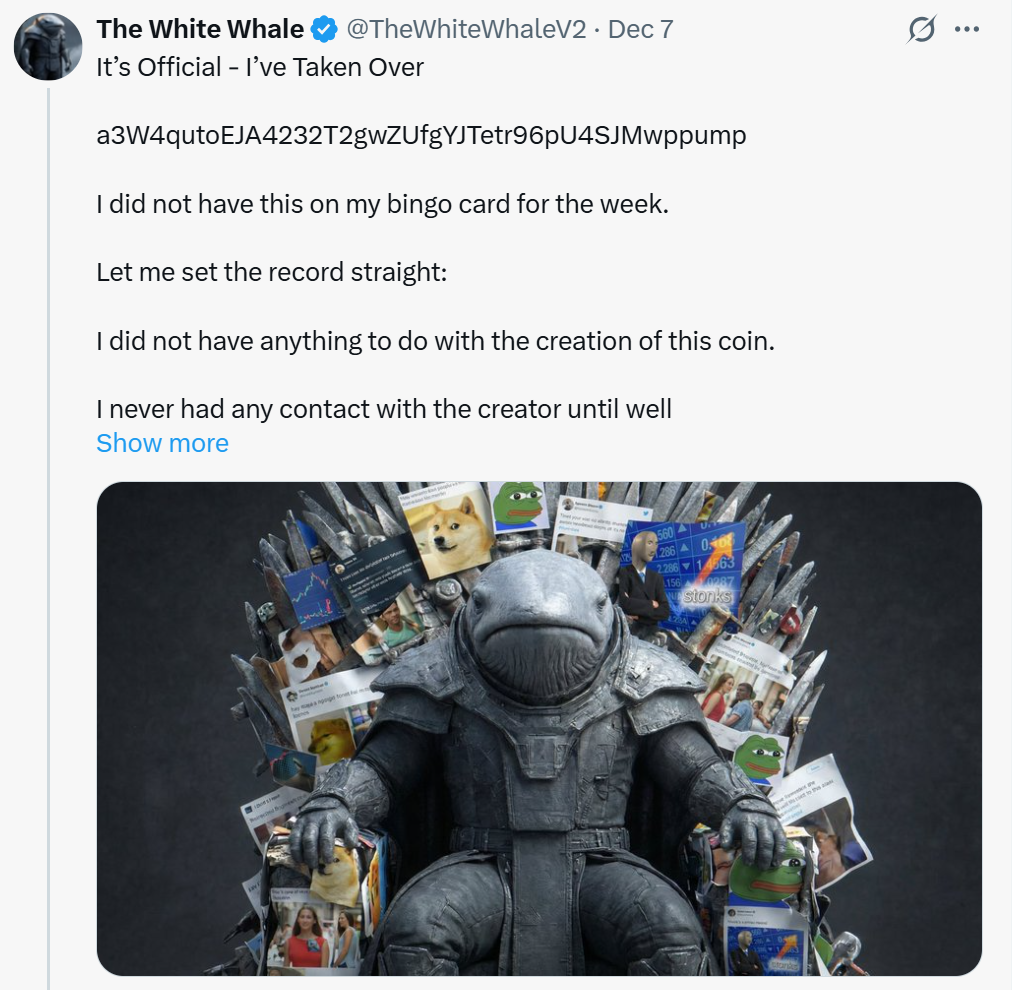
The important part is that he promised that 100% of the creator revenue would be returned to the community, and he also bought some tokens as a memento, with his own purchased portion never to be sold.

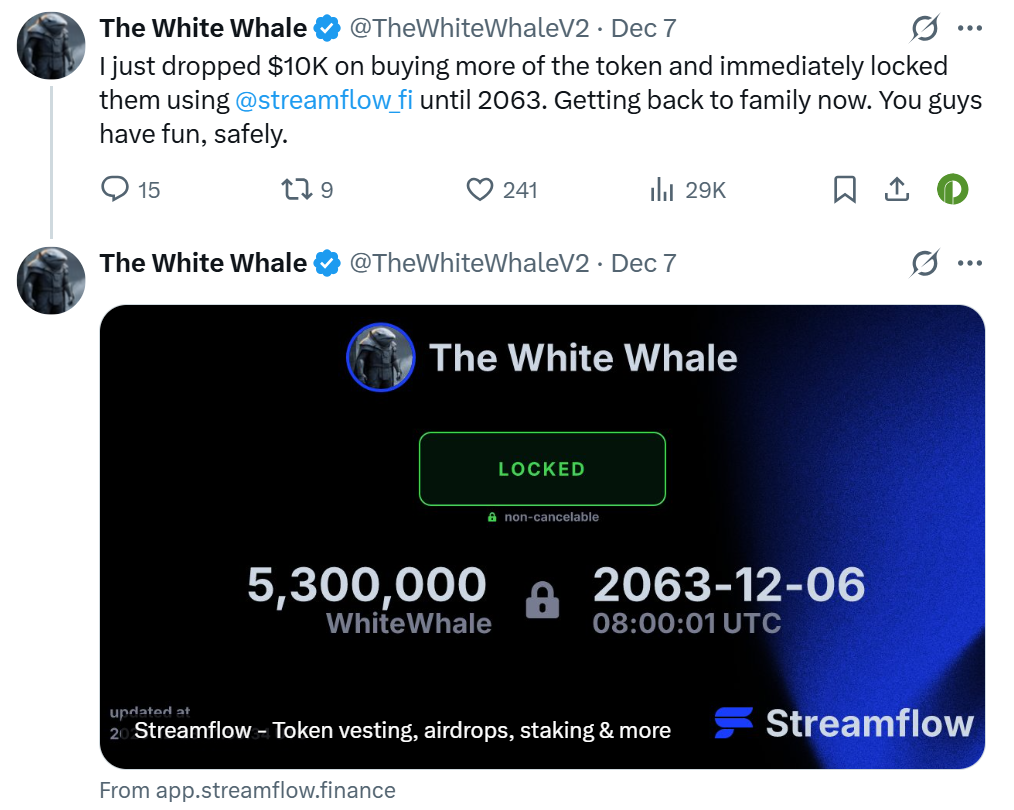
And he proved his sincerity with actions. On the day he announced the takeover, he spent $10,000 to buy 5.3 million tokens and locked them via the Streamflow protocol, with an unlock date set for 2063.
After that, he disclosed that he had already spent $130,000 to support the community, building a pool on Wasabi and adjusting LP bandwidth to reduce volatility for holders, and using personal funds to incentivize community contributors.

It was these actions that gradually transformed the original "fan prank" into a narrative sample about "good management" as understood by the community.

What Story Does the On-Chain Data Tell?

After White Whale surged 100x, on-chain analyst @cryptorinweb3 revisited the token's metrics. According to the investigation, on December 2nd, @nansen_ai data showed that the token supply held by the top 100 holders suddenly dropped from 870 million to 140 million tokens. After checking the exchange labels, he found this drop was mainly due to a large amount of funds flowing back to the main liquidity pool (LP). He reminded that when you see such a change in the top 100 holdings, it is always a signal worth further investigation.

Subsequently, on December 4th, the "smart money inflow" indicator he set up in Discord was triggered, accompanied by an increase in trading volume.

On December 7th, @TheWhiteWhaleV2 himself announced the official takeover. Starting from December 8th, after excluding CEX/DEX wallets, the real top 100 holders increased their holdings by over 80%, while exchange supply remained stable.

Let's revisit White Whale token's performance: from the "smart money movement" on December 4th to the official takeover on December 7th, White Whale's increase was only about 6x, and it subsequently experienced a pullback; the real explosion happened in late December.

This was certainly driven by sentiment and capital, but on the other hand, the responsible attitude and transparent on-chain operations demonstrated by @TheWhiteWhaleV2 himself formed the foundation of the project.
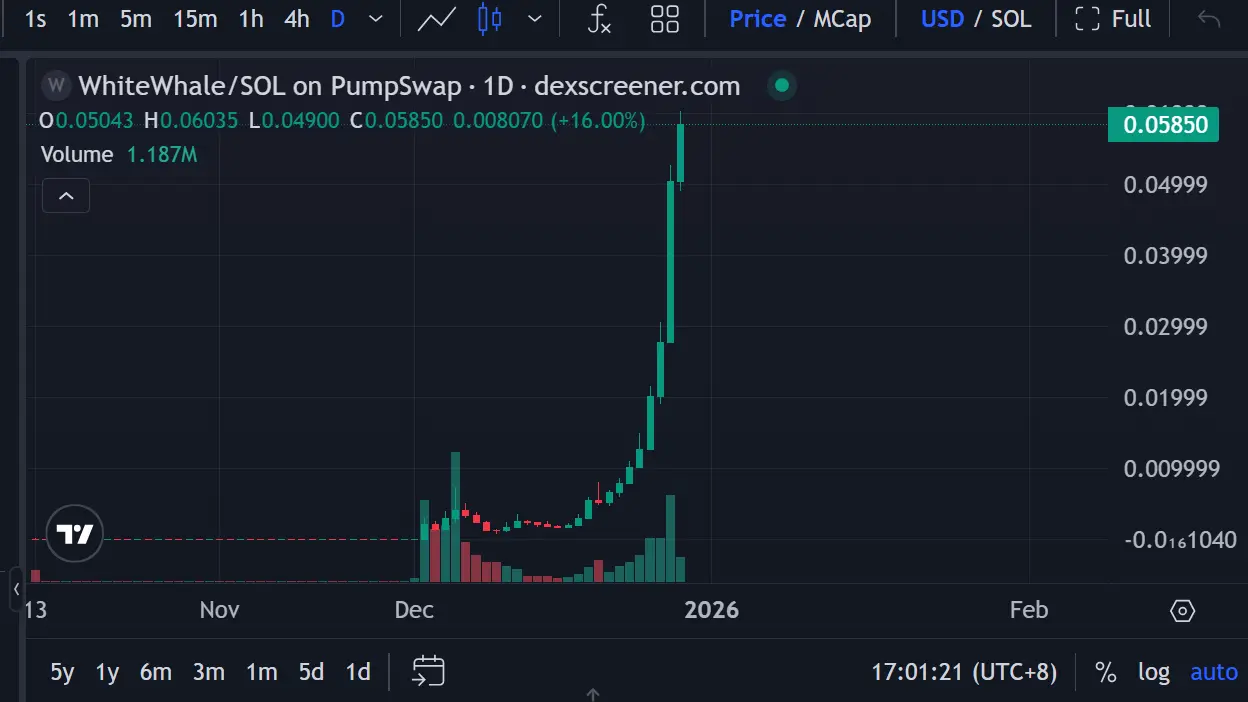
White Whale is essentially a microcosm of the Solana Meme coin ecosystem: random, chaotic, high-risk. But the reason it survived and became popular was due to an unexpected positive turn: a dying joke coin was taken over by its inspiration in a "responsible, well-managed" manner, rebuilding trust and creating the most inspirational "anti-Rug" case at the end of 2025. Although we don't know how far it can go, in a market notorious for short-term games, this in itself is rare enough.


Twitter:https://twitter.com/BitpushNewsCN

Bitpush TG Discussion Group:https://t.me/BitPushCommunity

Bitpush TG Subscription: https://t.me/bitpush

Original link:https://www.bitpush.news/articles/7599100

Lecturas Relacionadas

Fed's Internal Doves Flock to Hawkish Stance, Warsh's Debut "Between a Rock and a Hard Place"

U.S. Federal Reserve officials who previously advocated for rate cuts, including Governor Christopher Waller, have recently shifted their stance, with many now not ruling out the possibility of future rate hikes. This sets a challenging stage for new Fed Chair Kevin Warsh's first policy meeting. Appointed by President Trump based on his dovish views, Warsh now faces a committee where the debate has pivoted from "when to cut" to "whether to hike," driven by persistent inflation above 3%, a strong labor market, and supply-side pressures from AI infrastructure demands and geopolitical tensions. Key figures illustrate the shift. Governor Waller, once concerned about employment, now says data has pushed him toward considering rate increases. Even moderate voices like Governor Lisa Cook, while expecting inflation to ease, have indicated readiness to hike if it fails to do so. Long-time hawks such as regional Fed presidents Beth Hammack, Lorie Logan, and Neel Kashkari have grown more vocal, arguing that the real policy rate is effectively falling and that action may soon be needed. The upcoming Fed meeting is expected to keep rates steady but will likely remove the "easing bias" from its statement, signaling a neutral stance between cuts and hikes. The quarterly "dot plot" is anticipated to show most officials projecting no cuts this year, with some potentially indicating hikes. Chair Warsh, a critic of the Fed's reliance on forward guidance like the dot plot, must navigate communicating this pivot using tools he has questioned, all while steering policy in a direction counter to the preferences of the president who appointed him. The consensus suggests the Fed's next move could well be a rate increase.

marsbitHace 5 min(s)

Fed's Internal Doves Flock to Hawkish Stance, Warsh's Debut "Between a Rock and a Hard Place"

marsbitHace 5 min(s)

The Trillion-Yuan Market Cap 'Yi Zhong Tian': Who is the True Value King?

The article analyzes the three leading Chinese optical module companies, collectively nicknamed "Yi Zhong Tian": Xinyisheng, Zhongji Innolight, and TFC Optical Communication. It evaluates their "cost-performance" not by current stock price, but through three lenses: PEG ratio (growth vs. valuation), earnings quality, and premium/discount for certainty. Xinyisheng shows the most attractive PEG ratio and high profitability, but its valuation reflects discounts for risks like high customer concentration and reliance on overseas markets. Zhongji Innolight, the most expensive, commands a premium for its market leadership, dominant share in key products like 800G/1.6T modules, and higher earnings certainty, though it faces geopolitical risks. TFC Optical, as an upstream component supplier ("water seller"), has the highest gross margin and bets on the long-term CPO/NPO architecture trend, but trades at a high valuation with more stable, less explosive growth. The core argument is that while these companies dominate module assembly, the true profit pool and technological moat lie upstream in laser and switch chips, currently controlled by U.S. firms like Lumentum and Coherent. The long-term "cost-performance" for these Chinese leaders hinges on whether the domestic industry, exemplified by companies like Yuanjie Technology, can successfully move up the value chain into high-power laser chips. Otherwise, their high growth may remain confined to the lower-margin assembly segment.

marsbitHace 15 min(s)

The Trillion-Yuan Market Cap 'Yi Zhong Tian': Who is the True Value King?

marsbitHace 15 min(s)

Has the Crypto Market Bottomed? Here's What Institutions Think

The crypto market is in a period of significant debate, with leading institutions offering differing views on whether a bottom has been reached. Three prominent firms have published detailed analyses: * **Galaxy Digital** argues Bitcoin has **not yet bottomed**. Their analysis of 13 historical indicators across six dimensions (valuation, profit-taking, miner pressure, etc.) shows only four are fully met. They project a potential bottom range between $30k and $54k. * **NYDIG** states a bottom is **possible but not likely**. While metrics are close to historic bear market extremes, they note the absence of a classic panic-selling event. They also suggest increased institutional adoption may have structurally altered the market cycle, potentially leading to a shallower downturn. * **Standard Chartered Bank** asserts the **bottom has already occurred** at around $59k. They cite two key factors: potential US-Iran diplomatic progress and the anticipated SpaceX IPO, which they believe absorbed capital and caused ETF selling pressure that is now subsiding. They forecast a year-end price target of $100k. Despite the surface-level disagreement, the reports share critical common ground more valuable for long-term investors: 1. All three believe the market bottom will form **within this year**. 2. All agree the current price is **closer to the bottom than to previous highs**. 3. All maintain a **bullish long-term outlook** for Bitcoin and a new cycle. The core takeaway is that while the exact bottom price ($40k, $50k, or $60k) is debated, the consensus is that a bottom is imminent. For long-term holders, the primary focus should not be pinpointing the absolute low, but on the future potential for prices to reach $100k, $200k, or higher. The fundamental thesis for Bitcoin—sovereign debt accumulation, inflation, declining trust in centralized institutions, global digitization, and improved accessibility—remains intact and is arguably strengthening. The overall landscape is viewed as more favorable than in previous crypto winters.

marsbitHace 25 min(s)

Has the Crypto Market Bottomed? Here's What Institutions Think

marsbitHace 25 min(s)

The 'Chip' Challenge and Breakthroughs in China's Optical Industry Chain

China's Photonics Industry: Bottlenecks and Breakthroughs In the global AI race, computing chips dominate the narrative, but the underlying bottleneck increasingly defining the scale of AI clusters is light—or more specifically, optical connectivity. Optical modules, which translate electrical signals to light and vice versa, are crucial for connecting thousands of GPUs in AI data centers, preventing data congestion and ensuring efficient model training. High-speed modules (800G, 1.6T) are now standard, with performance hinging on advanced DSP (Digital Signal Processor) chips. This is where a critical dependency lies. Two US giants—Marvell and Broadcom—collectively dominate over 90% of the high-end DSP chip market. Chinese optical module leaders like Zhongji Innolight and Eoptolink rely on these chips to manufacture modules for overseas AI customers, primarily in North America. While this creates a supply chain vulnerability, complete decoupling is difficult. Marvell derives over half its revenue from Greater China, and the US firms depend on Chinese partners for chip packaging and optical components. The risk from laser chips (e.g., from Lumentum), another key component, is considered more manageable due to multiple global suppliers and faster progress in domestic alternatives from companies like YOFC and Accelink. To mitigate risks, China's industry is pursuing a multi-pronged strategy: diversifying supply chains and locking in long-term orders; fostering a domestic market ecosystem to adopt homegrown DSPs from firms like Huawei HiSilicon and CETC; accelerating R&D in high-speed DSPs and advanced packaging; and investing in next-gen technologies like silicon photonics and Co-Packaged Optics (CPO) to reduce reliance on discrete DSPs. The ultimate solution lies not in short-term博弈 but in persistent advancement of domestic high-end chip R&D and manufacturing. While challenges remain in performance, certification, and ecosystem building, China's vast domestic market and manufacturing base provide a crucial buffer, buying time for the industry to achieve greater technological independence.

marsbitHace 39 min(s)

The 'Chip' Challenge and Breakthroughs in China's Optical Industry Chain

marsbitHace 39 min(s)

Behind SpaceX's $2 Trillion Market Cap: Why Does Musk Always Have the Next Move Planned?

On June 12th, SpaceX debuted on the Nasdaq, reaching a valuation that briefly touched $2 trillion. This marked the culmination of a 24-year journey from its founding in 2002, driven by Elon Musk's frustration at the high cost of buying rockets. The company's path was defined by early failures, with its first three Falcon 1 launches ending in explosions before a successful 2008 flight opened the era of commercial spaceflight. Key to its model was a fixed-price NASA contract, incentivizing cost reduction. SpaceX mastered rocket reusability, first achieving a Falcon 9 landing in 2015, which drastically cut launch costs. This enabled its profitable Starlink satellite internet constellation, envisioned years before reusability was proven, to create an internal market for frequent launches. Similarly, the next-generation Starship rocket was in development long before its first flight, with its business case evolving from Mars colonization to supporting the emerging concept of in-orbit data centers for AI—a story now central to its valuation. The company's recent IPO, a reversal of its long-standing "no IPO" stance, is funding this ambitious "space-based compute" vision. While major tech players like Google, Blue Origin, and others are investing heavily, significant technical and cost hurdles remain. Ultimately, SpaceX's history is one of creating its own demand: first with Starlink and now with space-based AI compute, betting that its next rocket will enable its next giant market.

marsbitHace 41 min(s)

Behind SpaceX's $2 Trillion Market Cap: Why Does Musk Always Have the Next Move Planned?

marsbitHace 41 min(s)

Trading

Spot
Futuros

Artículos destacados

Qué es ATWO

I. Introducción al ProyectoArena Two es una plataforma interactiva descentralizada que permite a los fanáticos jugar un papel activo y tokenizado en los resultados de eventos en tiempo real. A diferencia de los modelos de transmisión tradicionales que reducen a los fanáticos a espectadores pasivos, Arena Two aprovecha la tecnología blockchain para permitir que los fanáticos voten directamente en tiempo real e influyan en los resultados en el campo.II. Información del TokenNombre del token: ATWO (Arena Two)III. Enlaces RelacionadosSitio web: https://arenatwo.com/Exploradores: https://basescan.org/token/0x499D35eBE6cEe9B2Ac35Fd003fcBbeeB9CFc7B32Twitter: https://x.com/arenatwoXNota: La introducción del proyecto proviene de los materiales publicados o proporcionados por el equipo oficial del proyecto, que es solo para referencia y no constituye asesoramiento de inversión. HTX no se hace responsable de ninguna pérdida directa o indirecta resultante.

183 Vistas totalesPublicado en 2026.05.18Actualizado en 2026.06.02

Qué es ATWO

Cómo comprar ATWO

¡Bienvenido a HTX.com! Hemos hecho que comprar Arena Two (ATWO) sea simple y conveniente. Sigue nuestra guía paso a paso para iniciar tu viaje de criptos.Paso 1: crea tu cuenta HTXUtiliza tu correo electrónico o número de teléfono para registrarte y obtener una cuenta gratuita en HTX. Experimenta un proceso de registro sin complicaciones y desbloquea todas las funciones.Obtener mi cuentaPaso 2: ve a Comprar cripto y elige tu método de pagoTarjeta de crédito/débito: usa tu Visa o Mastercard para comprar Arena Two (ATWO) al instante.Saldo: utiliza fondos del saldo de tu cuenta HTX para tradear sin problemas.Terceros: hemos agregado métodos de pago populares como Google Pay y Apple Pay para mejorar la comodidad.P2P: tradear directamente con otros usuarios en HTX.Over-the-Counter (OTC): ofrecemos servicios personalizados y tipos de cambio competitivos para los traders.Paso 3: guarda tu Arena Two (ATWO)Después de comprar tu Arena Two (ATWO), guárdalo en tu cuenta HTX. Alternativamente, puedes enviarlo a otro lugar mediante transferencia blockchain o utilizarlo para tradear otras criptomonedas.Paso 4: tradear Arena Two (ATWO)Tradear fácilmente con Arena Two (ATWO) en HTX's mercado spot. Simplemente accede a tu cuenta, selecciona tu par de trading, ejecuta tus trades y monitorea en tiempo real. Ofrecemos una experiencia fácil de usar tanto para principiantes como para traders experimentados.

201 Vistas totalesPublicado en 2026.05.18Actualizado en 2026.06.02

Cómo comprar ATWO

Qué es ZEST

I. Introducción al ProyectoEl Protocolo Zest es un protocolo de préstamos en Bitcoin que permite a los proveedores de liquidez de Bitcoin ganar rendimiento en Bitcoin a través de fondos de préstamos gestionados profesionalmente.II. Información del TokenNombre del token: ZEST (Protocolo Zest)III. Enlaces RelacionadosSitio web: https://www.zestprotocol.com/Exploradores: https://bscscan.com/token/0x5506599c722389a60580b5213ea1da60d64754a1Twitter: https://twitter.com/ZestProtocolNota: La introducción al proyecto proviene de los materiales publicados o proporcionados por el equipo oficial del proyecto, que es solo para referencia y no constituye asesoramiento de inversión. HTX no se hace responsable de ninguna pérdida directa o indirecta resultante.

225 Vistas totalesPublicado en 2026.05.19Actualizado en 2026.06.02

Qué es ZEST

Discusiones

Bienvenido a la comunidad de HTX. Aquí puedes mantenerte informado sobre los últimos desarrollos de la plataforma y acceder a análisis profesionales del mercado. A continuación se presentan las opiniones de los usuarios sobre el precio de A (A).

活动图片














