From 'Scientist' to 'Prophet': How Did OpenClaw Help Him Earn $100,000 in 10 Days?

比推Publicado a 2026-03-16Actualizado a 2026-03-16

Resumen

This article features an interview with Kevin, a trader who used OpenClaw to turn $30,000 into over $100,000 in just 10 days on the prediction market platform Polymarket. Originally an ERP architect and later a developer of sports betting systems, Kevin entered the crypto space in 2018. He made his first significant profit during the 2023 "inscription summer" with ORDI. In summer 2025, he shifted to Polymarket, attracted by its improved liquidity and user experience. Initially, he used automated arbitrage strategies between betting odds, doubling his initial $100,000 investment. Since late February, he integrated OpenClaw into his strategy. While 60% of his funds still run automated arbitrage, 40% are now managed with OpenClaw-assisted subjective betting. OpenClaw helps by gathering and weighting factors like smart money movements, public sentiment, and team lineups—even uncovering new influencing factors. It also automates backtesting and execution. Kevin highlights Polymarket’s AI-friendly API as a key advantage. Currently, OpenClaw is experimenting mainly in sports betting with small automated bets (~$1,000). Kevin plans to develop and sell packaged OpenClaw "Skills" based on his strategy in the future.

Author: Golem

Original Title: Earning $100,000 in 10 Days: An Interview with OpenClaw's Practical Experience in Prediction Markets


Currently, "raising lobsters" is no longer difficult, but how to master OpenClaw and actually use it to make money still troubles many lobster farmers.

Last week, I spoke with some deep users of OpenClaw in the crypto circle. Some mentioned that OpenClaw's heartbeat mechanism and scheduled tasks can improve the efficiency of news trading, but more interviewees believe that using OpenClaw to trade cryptocurrencies for profit is challenging. (Related reading: Odaily Editorial Team Tea Party)

However, where there's a will, there's a way. A trader named Kevin, with the assistance of OpenClaw, turned a $30,000 principal into a fourfold increase in 10 days, with a net profit of $100,000 (currently slightly retraced to $82,000). Kevin himself stated that this was initially just an experiment, but he didn't expect to actually make money.
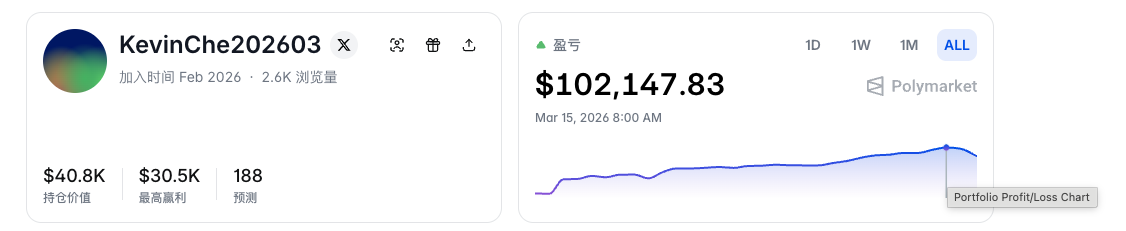
So how did Kevin transform OpenClaw from a toy that only burns tokens into a money-making machine? Odaily Planet Daily spoke with Kevin, who shared his personal crypto journey and how he leveraged OpenClaw in prediction markets, hoping readers can gain some inspiration.

The Transition from 'Scientist' to 'Prophet'

Kevin's early career primarily involved designing ERP architectures for enterprises. Later, he joined a Top 3 domestic internet company to build a sports betting software system from scratch. This professional experience laid the foundation for Kevin's current achievements in prediction markets. After 2018, Kevin entered the Web3 investment sector, mainly incubating and accelerating startups.

However, Kevin's first real bucket of gold was earned five years after entering the circle. In 2023, ordi emerged, ushering in the "Inscription Summer" for the crypto market. With a background in computers and code, Kevin became one of the highly sought-after "scientists" at the time (Odaily Note: Scientists refer to those who can write programs and code to quickly participate in new asset deployments during inscription launches).

"The period when ordi was listed on Binance was when my account assets were at their highest. I eventually cashed out about over 2 million RMB," Kevin said, noting that he was also among the first batch of people to participate in the ordi launch, with a cost of less than 1 RMB per coin, later enjoying a thousand-fold increase.

After inscriptions completely cooled down, Kevin began searching for other opportunities and finally started seriously researching and participating in the prediction market Polymarket in the summer of 2025. "I had played Polymarket before, but the liquidity was poor, so I ignored it," said Kevin, who had previously worked in traditional sports betting. For him, the early Polymarket's trading depth fell far short of requirements.

However, after Polymarket successfully predicted Trump becoming the 47th President of the United States in 2025, Kevin's attention returned to Polymarket. "After 2025, Polymarket's reputation grew, its liquidity could handle large orders, and more importantly, deposits and withdrawals became very convenient," so Kevin began experimenting with algorithms on Polymarket, becoming a "prophet."

Kevin's journey in prediction markets is divided into two stages: before using OpenClaw assistance and after using OpenClaw assistance. For clarity, Odaily Planet Daily has condensed Kevin's sharing as follows, enjoy~

How to Play Prediction Markets Before Using OpenClaw

Odaily Planet Daily: In the summer of 2025 when you started playing Polymarket, how much money did you invest, and what was the final profit?

Kevin: I invested about $100,000 at that time, and the total profit by this year was roughly double the principal.

Odaily Planet Daily: What strategy did you mainly adopt?

Kevin: I don't bet directly; I made profits through automated arbitrage using programs. When I worked on the sports betting system at the Web3 internet company, I was also involved in the design of order matching. This experience was very helpful for understanding Polymarket's order book. So I used programs to capture spreads between order books, especially in sports events, where a lot of emotional arbitrage can be done.

Odaily Planet Daily: Do you have a dedicated team, and is someone providing you with funds?

Kevin: I'm doing this alone; AI assistance is enough. Initially, I was afraid Polymarket might have withdrawal issues, so I ran dozens of accounts. But later, I found the deposit and withdrawal process very smooth, so I reduced the number of accounts. I mainly use my own money to run strategies, but indeed, some people provide funds for me to run strategies for them. However, this is just one way of making money.

How to Play Prediction Markets After Using OpenClaw

Odaily Planet Daily: When did you start using OpenClaw to play prediction markets?

Kevin: At the end of February. This was itself an experiment to see how much money OpenClaw could make at the trading level, but I didn't expect to actually make money. For example, the account KevinChe202603, I used $30,000 in cost and made up to $100,000 at its peak, in just 10 days.

Odaily Planet Daily: So what is your specific strategy?

Kevin: Frankly, this account's strategy is mixed. Currently, 60% is still running the previous automated arbitrage algorithm, and 40% is using the "lobster" for subjective betting. Compared to market making arbitrage, betting is a complex decision that requires considering factors such as smart money in prediction markets, public sentiment, lineups, player form, etc. OpenClaw's role here is to actively collect various factors that determine the outcome of events and turn them into an indicator. After training several times, it can also find other influencing factors that I might overlook, saving me a lot of time and mental effort.

Odaily Planet Daily: But isn't this just AI predicting events? Conversational AI can do that too, and some developers have even specifically created AI prediction tools for events. What's special about OpenClaw?

Kevin: Having an information advantage is just one of OpenClaw's strengths. It can also dig up new strategies by itself, conduct backtests on its own, and place automated bets during events. If the strategy is good, we just need to give the money to OpenClaw; everything else is automated, which AI prediction tools cannot do. For example, it can actively discover some smart money addresses and foolish addresses, either following the smart money's bets or using the foolish addresses as contrarian indicators.

Additionally, this is why Polymarket, among all prediction markets, integrates particularly well with OpenClaw—because Polymarket's API is the most AI-friendly, making data access very convenient for AI.

Odaily Planet Daily: In which areas is OpenClaw currently placing bets, and is it fully automated already?

Kevin: Based on my areas of expertise, OpenClaw is currently mainly experimenting in the field of sports competitions. But once mature, I will consider expanding OpenClaw to other areas. Right now, I give OpenClaw small amounts of funds for automated betting, around $1000. I still don't dare to put too much money into fully automated accounts.

Odaily Planet Daily: Is your strategy replicable, or will you write a Skills for the market in the future?

Kevin: I'm also trying because there is indeed user demand for this, to see if my methodology can be combined to allow everyone to build a money-making lobster. Later, I also plan to package some Skills for the market to use, which will definitely be paid, of course.



Original link:https://www.bitpush.news/articles/7620106

Preguntas relacionadas

QWhat was Kevin's initial investment and profit using OpenClaw in the prediction market?

AKevin started with a $30,000 investment and achieved a peak profit of $100,000 within 10 days, though it later retraced to $82,000.

QHow did Kevin's background contribute to his success in prediction markets?

AKevin's experience in ERP architecture design and building sports betting systems for a top internet company provided the foundation for his understanding of prediction markets and automated arbitrage strategies.

QWhat specific role does OpenClaw play in Kevin's prediction market strategy?

AOpenClaw collects factors influencing event outcomes, transforms them into indicators, discovers new strategies, performs backtesting, and automates betting, including identifying smart money and foolish addresses for informed decisions.

QWhy does Kevin prefer Polymarket for using OpenClaw?

APolymarket offers improved liquidity since 2025, facilitates large orders, has convenient deposit and withdrawal processes, and provides an AI-friendly API for easy data access and integration with OpenClaw.

QWhat are Kevin's future plans regarding his OpenClaw strategy?

AKevin plans to expand OpenClaw's automation to other domains beyond sports, develop and sell paid Skills based on his methodology, and allow users to build their own profitable setups using OpenClaw.

Lecturas Relacionadas

Stuck Polymarket: The Real Test After Riding the Traffic Boom Has Arrived

Polymarket, a leading prediction market platform, is facing significant technical challenges as its growth outpaces its current infrastructure on Polygon. Users are experiencing laggy transactions, unresponsive orders, and delayed confirmations, severely impacting the trading experience. In response, DeFi Engineering VP Josh Stevens outlined a comprehensive engineering overhaul. The plan includes reducing on-chain data delays, fixing order cancellation issues, rebuilding the central limit order book (CLOB), improving website performance, and developing a unified SDK and API. A major revelation was the ongoing "chain migration," indicating a potential move away from Polygon. The core issue is that Polymarket has evolved from a simple prediction market into a high-frequency trading platform, making Polygon's limitations—such as block space, gas fees, and block time—a ceiling for further growth. The migration is not just a simple chain switch but a fundamental rebuild of its trading system to support more complex products like perpetual contracts (Perps). This announcement has sparked competition among chains like Solana, Sui, and Algorand, all vying to host Polymarket. For Polygon, losing this key application, which contributes significantly to its gas fee revenue, would be a major setback. The real test for Polymarket is no longer attracting users but proving it can provide a stable, reliable trading environment that retains them.

Odaily星球日报Hace 19 min(s)

Stuck Polymarket: The Real Test After Riding the Traffic Boom Has Arrived

Odaily星球日报Hace 19 min(s)

Lowering Expectations for BTC's Next Bull Market

The author, Alex Xu, explains his decision to significantly reduce his Bitcoin holdings (from full to ~30% of his portfolio) during the current bull cycle, citing a lowered long-term outlook for BTC's price appreciation in the next cycle. He outlines six key reasons for this reduced expectation: 1. **Diminished Growth Drivers:** The narrative of exponential user adoption has largely played out with institutional ETF adoption. The next major growth phase—adoption by sovereign national reserves or central banks—seems unlikely in the near future. 2. **Personal Opportunity Cost:** More attractive investment opportunities have emerged in other assets, such as undervalued companies. 3. **Industry-Wide Contraction:** The broader crypto industry is struggling, with most Web3 business models (SocialFi, GameFi, DePIN) failing. This overall萧条 (depression) reduces the fundamental demand and consensus for Bitcoin. 4. **Strain on Major Buyer:** MicroStrategy, a major corporate buyer of BTC, faces rising financing expenses for its debt, which could slow its purchasing rate and create significant marginal pressure on the market. 5. **Increased Competition from Gold:** The emergence of "tokenized gold" has closed the functional gap (portability, divisibility) between physical gold and Bitcoin, offering a strong competitor in the non-sovereign store-of-value space. 6. **Security Budget Concerns:** The block reward halving continues to exacerbate the long-standing issue of funding Bitcoin's network security, with new fee source explorations like Ordinals and L2s largely failing. The author's decision to hold a significant (though reduced) position reflects a cautious, not bearish, outlook. He remains open to increasing his exposure if the fundamental reasons for his skepticism change or if new positive catalysts emerge.

marsbitHace 57 min(s)

Lowering Expectations for BTC's Next Bull Market

marsbitHace 57 min(s)

Can Iran 'Control' the Strait of Hormuz?

Iran has announced a comprehensive plan to assert control over the strategic Strait of Hormuz, a critical global oil shipping chokepoint. The proposed measures include requiring all vessels to obtain Iranian permission for passage, imposing fees for security, environmental protection, and navigation management—preferably paid in Iranian rials—and absolutely banning Israeli ships. Vessels from countries deemed hostile by Iran’s top security bodies may also be barred. Analysts suggest Iran’s motives are multifaceted: increasing pressure on the U.S. and Israel by leveraging control over oil transit to influence global prices and inflation; creating a new revenue stream, potentially exceeding $7.7 billion annually, to counter Western sanctions and support postwar reconstruction; and using transit permissions as bargaining chips in future negotiations, notably with the U.S. However, the plan faces significant practical and diplomatic challenges. Enforcing comprehensive interception and fee collection in the busy waterway, patrolled by international military forces, would be difficult. The U.S. has already countering with a blockade of Iranian ports and threats to intercept any ship paying fees, potentially strangling Iran’s oil exports and fee revenue. Broad international opposition, led by European and Gulf states, and legal controversies further complicate implementation. The proposal may ultimately serve more as a negotiating tactic than a feasible policy, with its execution remaining highly uncertain.

marsbitHace 2 hora(s)

Can Iran 'Control' the Strait of Hormuz?

marsbitHace 2 hora(s)

Trading

Spot
Futuros
活动图片



