From Robinhood to Polymarket: Is the Era of Integrating All Assets on a Single Platform Coming?

marsbitPublicado a 2026-04-24Actualizado a 2026-04-24

Resumen

From Robinhood to Polymarket: The Era of All-in-One Asset Platforms Is Coming Asset classes are rapidly converging. Platforms that once specialized in single categories—such as stocks, cryptocurrencies, or prediction markets—are now moving toward offering all three. Robinhood pioneered this model, starting with equities, adding crypto in 2018, and prediction markets in 2025. This strategy has proven resilient: when crypto revenues fell, other segments like options and stocks filled the gap. Now, prediction market leaders Polymarket and Kalshi are moving in the same direction, both announcing perpetual futures trading on April 21, 2026, pending regulatory approval. These futures will cover assets like Bitcoin, gold, and stocks such as Nvidia. This trend mirrors the consolidation seen in consumer tech, like smartphones replacing dedicated cameras and MP3 players. Younger users, accustomed to interacting with multiple asset types from an early age, will increasingly demand unified platforms. A key competitive advantage in prediction markets is collateral utilization—idle assets locked during betting periods. Polymarket’s move into perpetuals may be a strategy to generate yield from that capital, similar to earlier DeFi integrations like PolyAave. As the regulatory landscape evolves, traditional finance is also likely to incorporate crypto and prediction markets, further accelerating this convergence.

Written by: Tiger Research

Compiled by: AididiaoJP, Foresight News

Key Points

Different asset classes are accelerating their integration: Stocks, cryptocurrencies, and prediction markets were once independent. Today, the trend of integrating all assets on a single platform is accelerating. Robinhood has proven this model with data; Polymarket and Kalshi are moving in the same direction.

In prediction markets, collateral utilization will become a core competitive advantage: In prediction markets, collateral is locked until the outcome is determined. Polymarket's launch of perpetual futures trading is likely an effort to generate returns from idle assets.

Traditional finance is also moving toward the same integration: The new generation of users has grown up accustomed to interacting with multiple asset classes simultaneously. As generations shift, the demand for integrated platforms will only grow, and large financial institutions will gradually incorporate crypto spot trading and prediction markets as the environment opens up to regulation.

On April 21, 2026, the two leading prediction market platforms, @Polymarket and @Kalshi, announced the launch of perpetual futures trading on the same day. The trading targets are expected to include cryptocurrencies like Bitcoin, commodities like gold, and stocks like Nvidia. Both platforms stated that they will officially launch after receiving regulatory approval.

Why Now

This can be understood through the "Robinhood model." The trend of integrating previously independent asset classes into a single platform has long been underway; the announcements from Polymarket and Kalshi are merely a continuation of this trend.

Robinhood started as a stock trading app, added cryptocurrency trading in 2018, and incorporated prediction markets in 2025, pioneering the model of consolidating fragmented trading markets under one platform.
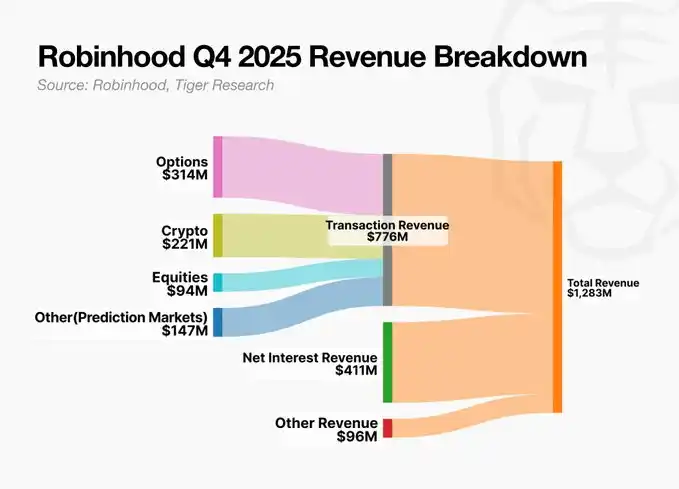
This model has been validated by data. After expanding its crypto business, crypto trading revenue became Robinhood's largest single revenue source in Q4 2024. Although crypto revenue fell 38% year-over-year in Q4 2025, total revenue remained stable, with options, stocks, and prediction markets filling the gap. A structure of resilience through diversification has taken shape.

Polymarket and Kalshi are starting from the opposite direction but heading toward the same endpoint. They originated in prediction markets and are now adding futures trading. The starting points differ, but the destination is the same. As the Robinhood model proves successful, traditional finance is likely exploring the same path.

A Simple Analogy

Smartphones integrated cameras, MP3 players, and navigation into a single device; the era of carrying separate devices for each function is over. The same transformation is happening in finance.

Brokerage accounts, crypto exchanges, and prediction markets are merging into a single platform. Robinhood started as a stock app and gradually added cryptocurrencies and prediction markets; Polymarket started with prediction markets and is now adding crypto perpetual contracts. The starting points differ, but the direction is the same.

The Generalization of the Robinhood Model

As generations shift, this trend will accelerate further. The new generation of users has grown up simultaneously exposed to stocks, cryptocurrencies, and prediction markets. Just as smartphone users would not accept separate devices for a camera, MP3 player, and map, this generation finds the idea of using separate apps for each asset class unfamiliar from the start. The demand for an integrated platform that handles all assets within a familiar interface will grow naturally with each generation.

This is the generalization of the Robinhood model.

Polymarket and Kalshi have a particular advantage in this model. Because collateral in prediction markets is locked until the outcome is determined, how to utilize these idle assets will become a key competitive differentiator.

On December 3, 2025, a developer proposed the concept of PolyAave: depositing Polymarket's outcome tokens into an Aave liquidity pool to earn interest. This was an early attempt to convert prediction market collateral into DeFi yields. Polymarket's launch of perpetual futures is likely an extension of this logic. The strategy of not letting locked capital sit idle is sound.

Polymarket and Kalshi are moving first, but traditional finance faces the same pressure. As the regulatory environment gradually opens up, large financial institutions will directly support crypto spot trading and gradually incorporate new asset classes, including prediction markets.

Criptos en tendencia

Preguntas relacionadas

QWhat is the main trend discussed in the article regarding asset trading platforms?

AThe main trend is the convergence of different asset classes—such as stocks, cryptocurrencies, and prediction markets—into single, integrated platforms, as exemplified by Robinhood, Polymarket, and Kalshi.

QHow did Robinhood validate the integrated platform model according to the article?

ARobinhood validated the model by expanding from stocks to cryptocurrencies in 2018 and prediction markets in 2025, with crypto trading becoming its largest revenue source in Q4 2024. Despite a crypto revenue drop in Q4 2025, total revenue remained stable due to diversification into options, stocks, and prediction markets.

QWhy are Polymarket and Kalshi adding perpetual futures trading?

AThey are adding perpetual futures trading to utilize idle collateral locked in prediction markets, turning it into yield and enhancing their competitive advantage by not letting capital remain idle.

QWhat generational shift is driving the demand for integrated financial platforms?

AYounger generations, who have grown up simultaneously exposed to stocks, cryptocurrencies, and prediction markets, naturally prefer a single platform for all assets, similar to how smartphones integrate multiple devices into one.

QHow might traditional financial institutions respond to this trend?

AAs regulatory environments open up, large financial institutions are likely to gradually adopt crypto spot trading and incorporate new asset classes like prediction markets, following the same convergence path.

Lecturas Relacionadas

The Verdict in Choi Tae-won's Divorce Case: Revealing the Inheritance Undercurrent Behind SK Hynix's Trillion-Won Empire

SK Group Chairman Chey Tae-won's high-profile divorce case, involving a record 1.38 trillion won settlement, has drawn attention to the succession plans for Korea's second-largest conglomerate, especially its crown jewel, SK hynix. Unlike traditional chaebol scripts centered on the eldest son, Chey's three children from his marriage to former President Roh Tae-woo's daughter, Roh Soh-yeong, are carving distinct, non-traditional paths. Eldest daughter Chey Yun-jung (b. 1989) is seen as the most evident successor. With a scientific and consulting background, she holds executive roles at SK bioscience and SK Inc.'s growth support department, focusing on future strategy and biopharma. Her marriage is to an AI infrastructure entrepreneur, not a traditional business alliance. Second daughter Chey Min-jung (b. 1991) took a unique route, voluntarily serving as a South Korean naval officer, including an anti-piracy deployment. She later worked on policy and strategy for SK hynix in Washington D.C. before co-founding an AI-driven healthcare startup. She married a former U.S. Marine Corps officer, connecting her to U.S. defense and policy circles—networks crucial for a global semiconductor giant. The only son, Chey In-geun (b. 1995), who studied physics like his father, worked briefly at SK E&S before joining McKinsey. Despite fitting the traditional "heir" profile as the eldest son, he remains silent and holds no public position or shares in SK, suggesting the old succession playbook is obsolete. As SK hynix's valuation soars, becoming a geopolitical asset in the AI era, the heirs' legitimacy is no longer automatic. They must prove themselves in fields like AI biotech, global policy, and strategic consulting. Their marriages also reflect new elite networks in tech and defense, not old political alliances. Their inheritance is the complex challenge of navigating a globalized, tech-driven world, not just a corporate throne.

marsbitHace 4 hora(s)

The Verdict in Choi Tae-won's Divorce Case: Revealing the Inheritance Undercurrent Behind SK Hynix's Trillion-Won Empire

marsbitHace 4 hora(s)

From OpenSea to OpenRouter: Is Alex Atallah Repeating His 'Exit at the Peak' Playbook?

From OpenSea to OpenRouter: Is Alex Atallah Repeating His "Exit at the Peak" Playbook? According to the Wall Street Journal, payments giant Stripe is in talks to acquire the AI model aggregation platform OpenRouter in a potential deal valuing the company near $100 billion. This would mark founder Alex Atallah's second creation of a company reaching a $100 billion valuation, following his co-founding of NFT marketplace OpenSea. OpenRouter, founded just over three years ago, has grown rapidly by acting as a unified gateway for developers to access over 400 AI models. It currently has about 10 million users and processes over 200 trillion tokens monthly. While the platform's annualized revenue is around $50 million, its valuation has skyrocketed from $1.3 billion in March 2026. The potential acquisition by Stripe, a company OpenRouter's founder once likened it to, represents a major expansion into AI infrastructure for the payments leader. This move echoes Atallah's previous timing with OpenSea, where he departed before the NFT market's significant downturn. For OpenRouter, selling now may be strategic. Despite its scale, its business model—charging a 5-5.5% fee on AI inference calls—faces pressure from competition, open-source models, and potential price wars among model providers, limiting its profitability narrative for an IPO. A key asset for potential acquirers like Stripe is OpenRouter's vast repository of real-world AI usage data, which offers unique insights into model performance and developer preferences that are difficult to replicate. Whether this potential deal signifies a new valuation benchmark for AI infrastructure or another market peak signal remains to be seen.

链捕手Hace 5 hora(s)

From OpenSea to OpenRouter: Is Alex Atallah Repeating His 'Exit at the Peak' Playbook?

链捕手Hace 5 hora(s)

Trading

Spot

Artículos destacados

Cómo comprar ERA

¡Bienvenido a HTX.com! Hemos hecho que comprar Caldera (ERA) sea simple y conveniente. Sigue nuestra guía paso a paso para iniciar tu viaje de criptos.Paso 1: crea tu cuenta HTXUtiliza tu correo electrónico o número de teléfono para registrarte y obtener una cuenta gratuita en HTX. Experimenta un proceso de registro sin complicaciones y desbloquea todas las funciones.Obtener mi cuentaPaso 2: ve a Comprar cripto y elige tu método de pagoTarjeta de crédito/débito: usa tu Visa o Mastercard para comprar Caldera (ERA) al instante.Saldo: utiliza fondos del saldo de tu cuenta HTX para tradear sin problemas.Terceros: hemos agregado métodos de pago populares como Google Pay y Apple Pay para mejorar la comodidad.P2P: tradear directamente con otros usuarios en HTX.Over-the-Counter (OTC): ofrecemos servicios personalizados y tipos de cambio competitivos para los traders.Paso 3: guarda tu Caldera (ERA)Después de comprar tu Caldera (ERA), guárdalo en tu cuenta HTX. Alternativamente, puedes enviarlo a otro lugar mediante transferencia blockchain o utilizarlo para tradear otras criptomonedas.Paso 4: tradear Caldera (ERA)Tradear fácilmente con Caldera (ERA) en HTX's mercado spot. Simplemente accede a tu cuenta, selecciona tu par de trading, ejecuta tus trades y monitorea en tiempo real. Ofrecemos una experiencia fácil de usar tanto para principiantes como para traders experimentados.

422 Vistas totalesPublicado en 2025.07.17Actualizado en 2026.06.02

Cómo comprar ERA

Discusiones

Bienvenido a la comunidad de HTX. Aquí puedes mantenerte informado sobre los últimos desarrollos de la plataforma y acceder a análisis profesionales del mercado. A continuación se presentan las opiniones de los usuarios sobre el precio de ERA (ERA).

活动图片