From Madison Square Garden to Kalshi: Prediction Markets Break into the NBA Finals

marsbitPublicado a 2026-06-06Actualizado a 2026-06-06

Resumen

From Madison Square Garden to Kalshi: Prediction Markets Break into the NBA Finals Prediction markets are playing a significant role in the 2026 NBA Finals, particularly around the New York Knicks' unexpected 2-0 series lead. Platforms like Kalshi and Polymarket have seen massive trading volumes, exceeding hundreds of millions of dollars on championship and related markets. Their influence extends beyond online trading. Kalshi's official partnership with Madison Square Garden has given it prominent physical branding at the arena. Furthermore, local businesses like The Jeffrey bar are using prediction market contracts to hedge the risk of game-result-based promotions, turning potential losses into manageable costs—a concept similar to the famous "Mattress Mack" strategy from traditional sports betting. These markets differentiate themselves by offering a wider, more entertainment-focused range of "event contracts" beyond typical game outcomes, such as predicting celebrity attendance. They also have broader accessibility across the U.S. compared to age- and location-restricted traditional sportsbooks. However, their rapid integration into sports raises regulatory and ethical questions. The NBA is cautiously engaging, discussing integrity frameworks with regulators like the CFTC. While the league permits minor investments like Giannis Antetokounmpo's stake in Kalshi, it advocates for strict rules to prevent insider trading. Many fans express concern on platforms like Reddit,...

Author: Zen, PANews

On June 6th, the visiting New York Knicks narrowly defeated the San Antonio Spurs 105-104 in Game 2 of the NBA Finals. The Knicks, who were not favored before the series began, had already upset the Spurs 105-95 on the road in Game 1. Winning both road games to start the series was an unexpected outcome for virtually everyone.

For a franchise returning to the Finals for the first time since 1999 and last winning a championship in 1973, this dream 2-0 start, bringing the series back to their home court at Madison Square Garden, has undoubtedly pushed generations of New York fans' fervor to its peak.

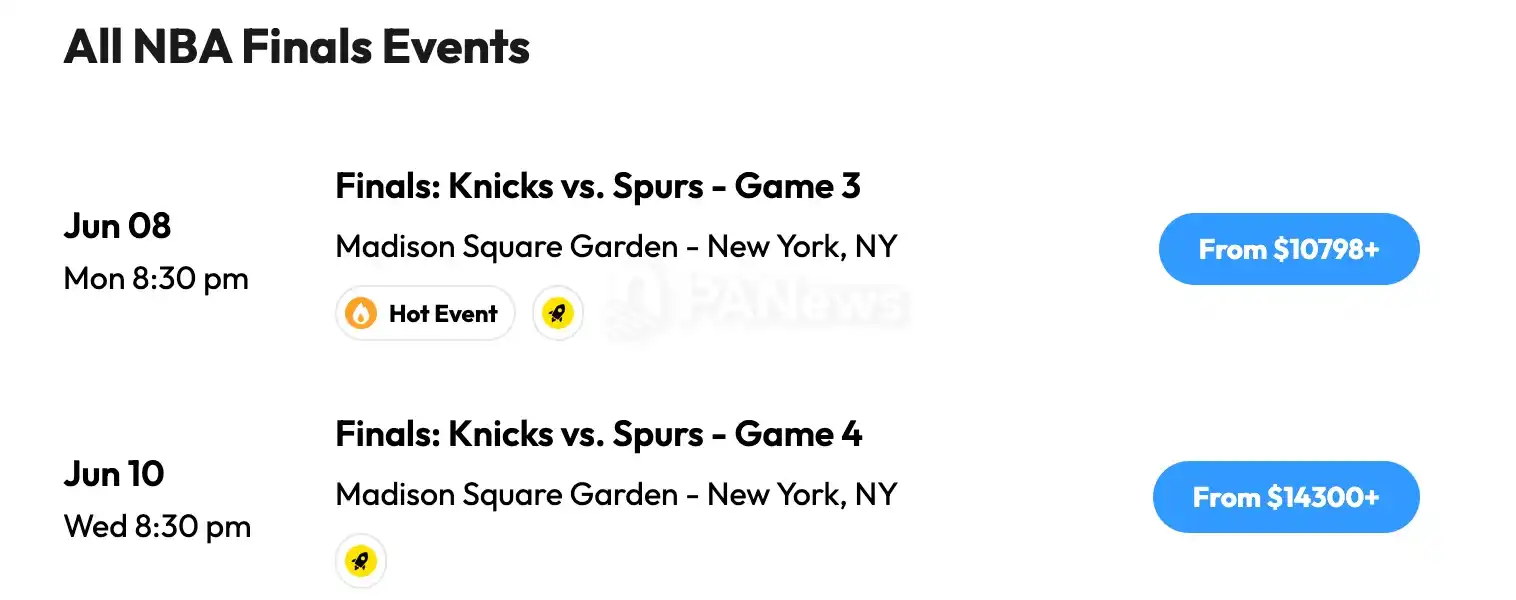
According to the latest data from ticket site TickPick, after Game 2, the lowest price for a ticket to Game 3 at Madison Square Garden has exceeded $10,000, with Game 4 prices soaring above $14,000. With the first NBA championship in 52 years seemingly within reach, the frenzy in the 'World's Capital,' New York, has been completely ignited, making this Finals series one of the most expensive live sporting events in NBA history.
What's different this time is the increasingly visible presence of prediction markets in this New York celebration. From prediction market platform Kalshi partnering with Madison Square Garden as an official partner, gaining massive exposure, to widespread fan and merchant participation in betting around probabilities, attention, and entertainment consumption. This NBA Finals is not just a major sporting event; it's also a celebration for prediction market platforms.

Prediction Markets Enter Arenas, Bars, and Fans' Daily Lives

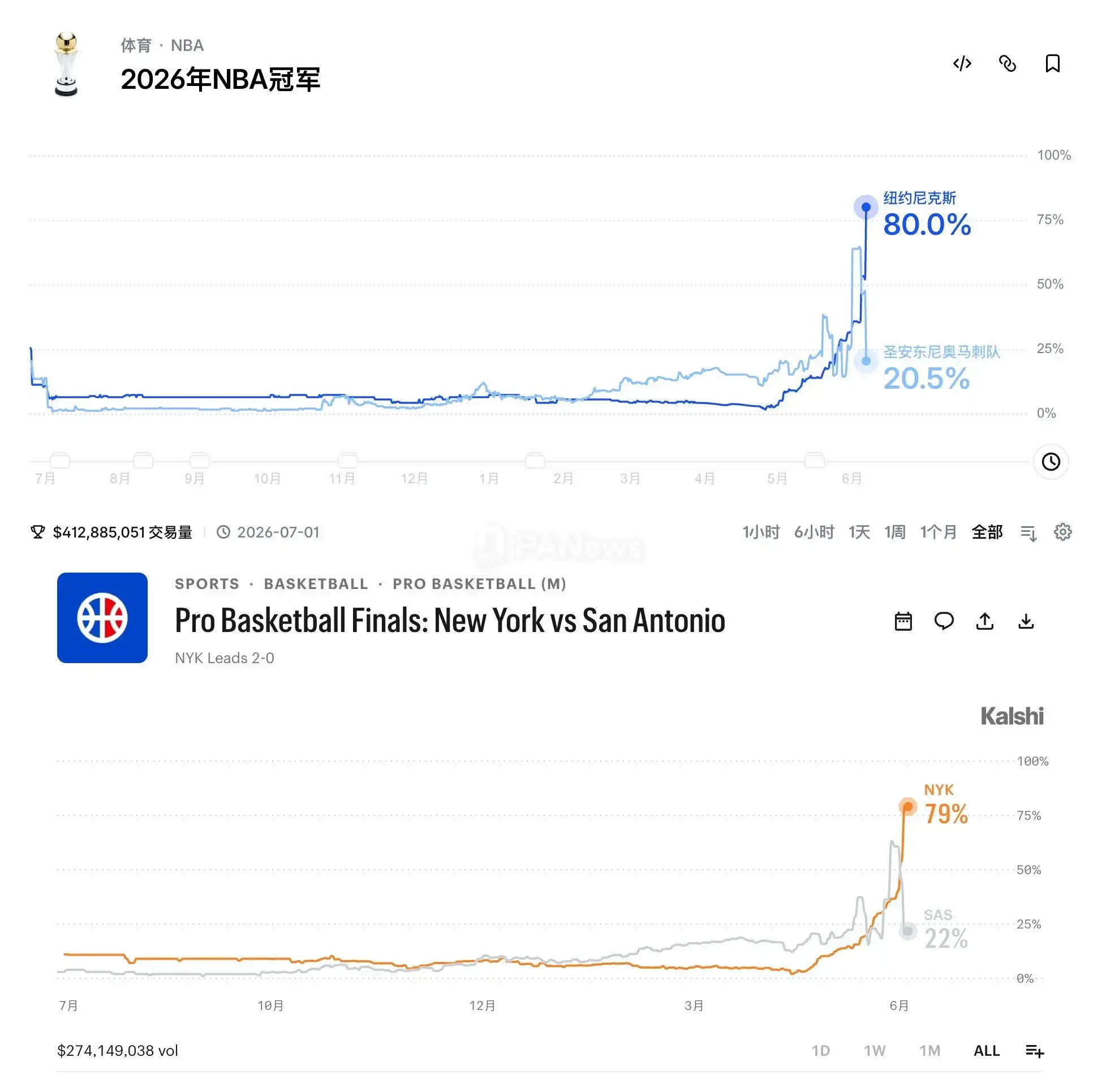
After the Finals began, prediction markets themselves became part of the game's hype. As of June 6th, Polymarket's '2026 NBA Champion' market page shows a cumulative trading volume exceeding $413 million, with a daily volume of around $2 million. Kalshi's trading volume for NBA Finals-related markets reached approximately $274 million. Additionally, derivative markets around Finals MVP, series score, player statistics, celebrity attendance, etc., continue to attract traders.
The influence of prediction markets isn't limited to online. As the Knicks' playoff run heated up, prediction markets also entered bars, arenas, and offline viewing scenarios, becoming new tools for businesses to design promotions and manage cost risks. Before Game 1 of the Finals, the Upper East Side Manhattan bar The Jeffrey launched a promotion: if the Knicks won, drinks for customers that night would be on the house.

For a small business, fulfilling such a major promotion could create significant cost pressure. The Jeffrey's approach was to buy $5,000 worth of Knicks-related contracts on Kalshi. If the Knicks won, the contract payout would cover the cost of the free drinks. Conversely, if the Knicks lost, the bar wouldn't have to provide free drinks, and the customer traffic attracted by the promotion, along with increased consumption, could offset or even cover the cost of the wager.

From an industry perspective, this case demonstrates that prediction markets aren't just tools for fans to trade on game outcomes; they can also serve as a means for businesses to manage event risk. The Jeffrey tied post-win fan enthusiasm and increased traffic to the cost of free drinks, while the Kalshi contract transformed the uncertainty of the promotion into a quantifiable, hedgeable risk. It doesn't change or rely on the game's outcome but alters how businesses design promotions around the game. It also shows the "insurance"-like utility of prediction markets.
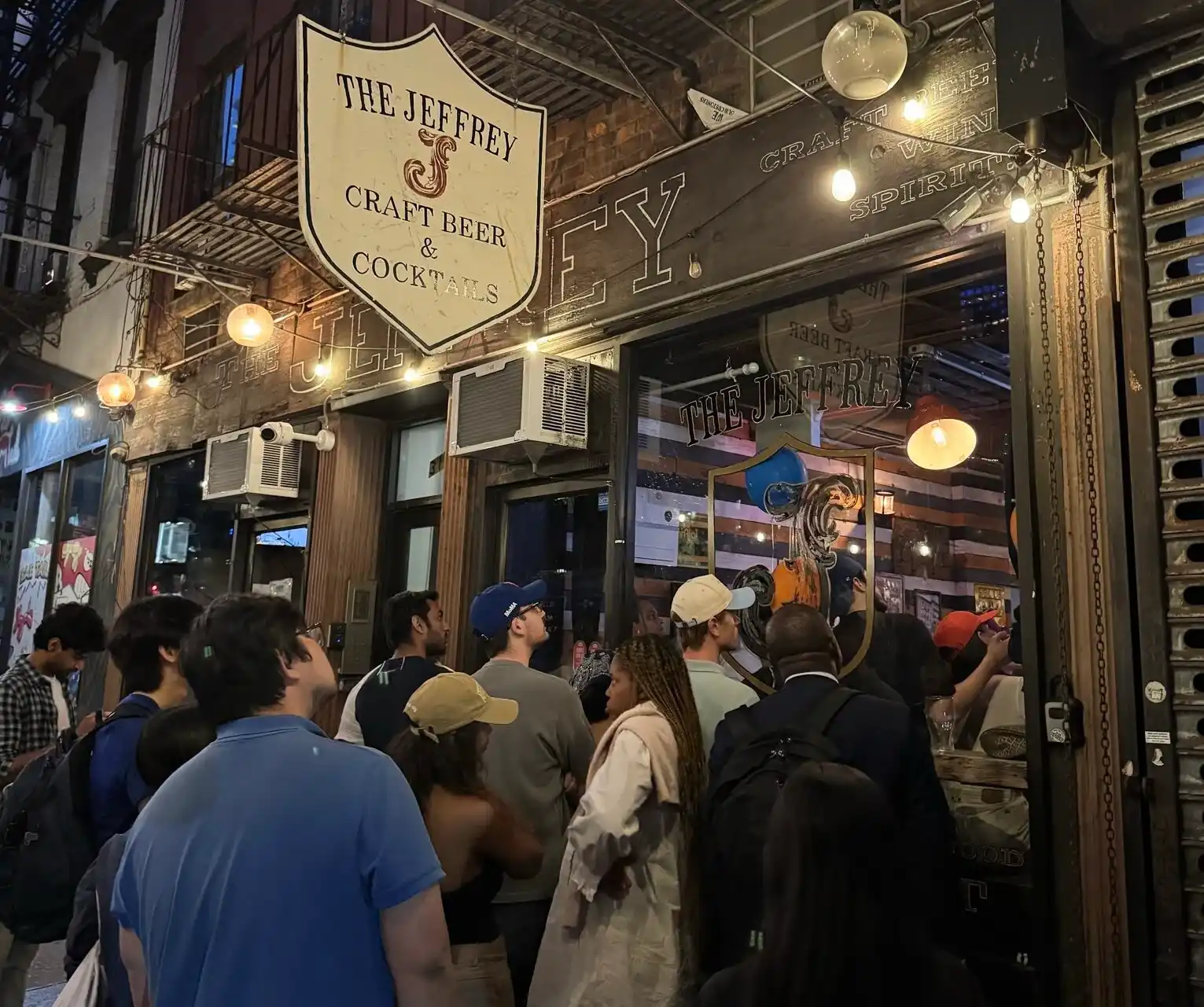
The Jeffrey's marketing strategy attracted a large number of customers

Beyond indirect marketing by small businesses, Kalshi's official partnership with Madison Square Garden has placed prediction market platforms in an even more prominent position.

In early May, Kalshi and Madison Square Garden (MSG) announced a multi-year partnership, making Kalshi the official prediction markets partner. Additionally, the MSG Concourse on the 6th floor was named the "Kalshi Concourse," and Kalshi gained exposure on in-arena and out-of-home digital screens, in-arena LEDs, MSG Networks advertising, and branded content.
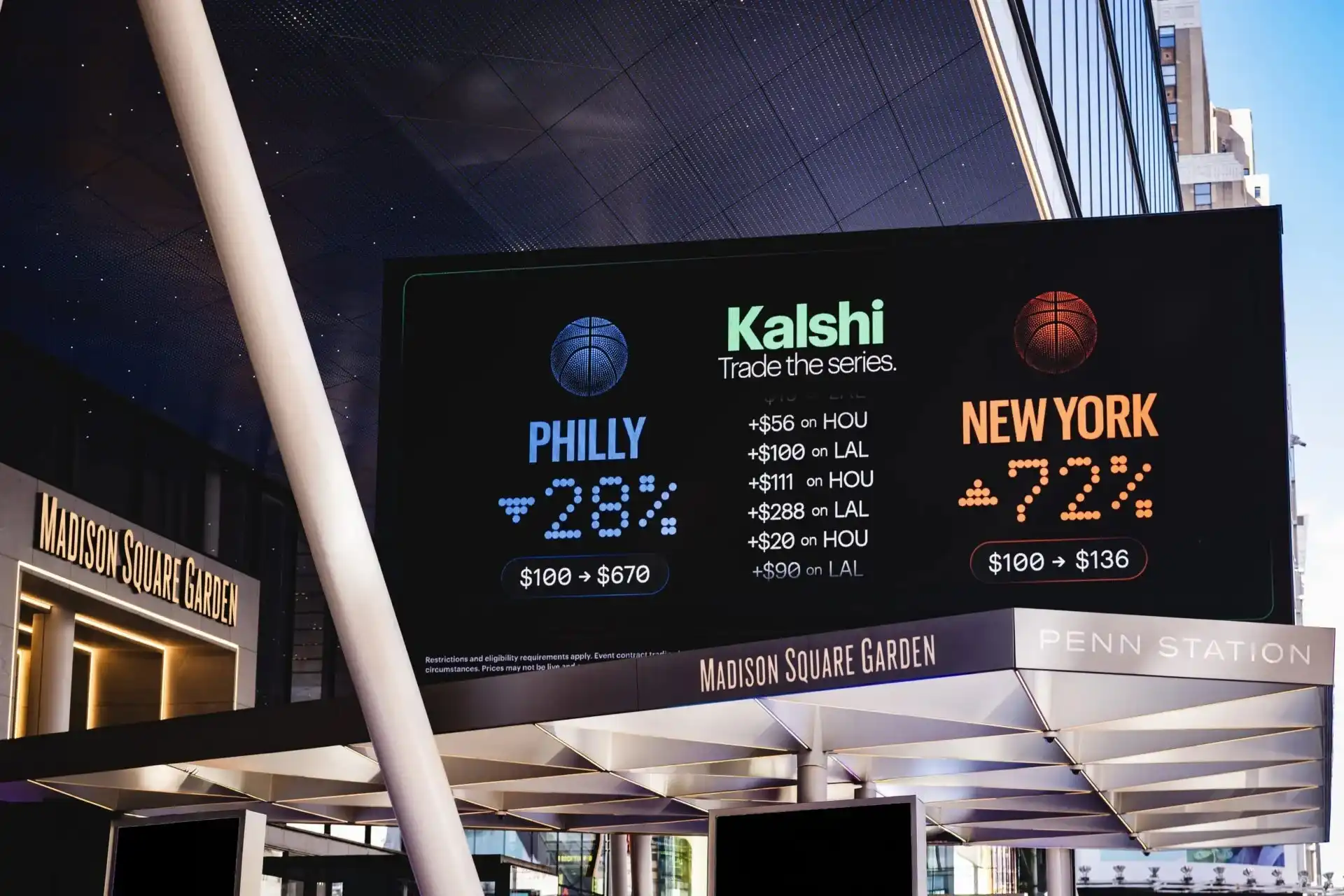
Kalshi, whose core business is predicting future events, seems to have also 'called' its own offline expansion this time. Securing the MSG partnership rights just weeks ago has now, with the Knicks reaching the Finals, rapidly become a highly representative offline branding investment. Kalshi almost perfectly timed its move. When Madison Square Garden became the focal point of national sports media and the epicenter of New York City's emotions, Kalshi had already secured a position in one of America's most iconic sports venues, moving from online trading pages to a higher-density offline exposure environment.

The Boundaries of Sports Betting Are Being Pushed Further by Prediction Markets

In reality, turning sports hype into a commercial hedging tool is not an original idea from prediction markets.

The most classic precedent is Houston furniture merchant Jim McIngvale, known as "Mattress Mack." His promotional tactic is to offer customers a refund on furniture purchases above a certain amount if a local Houston team wins a championship. Before the games, he places large bets on traditional sportsbooks supporting his hometown team.
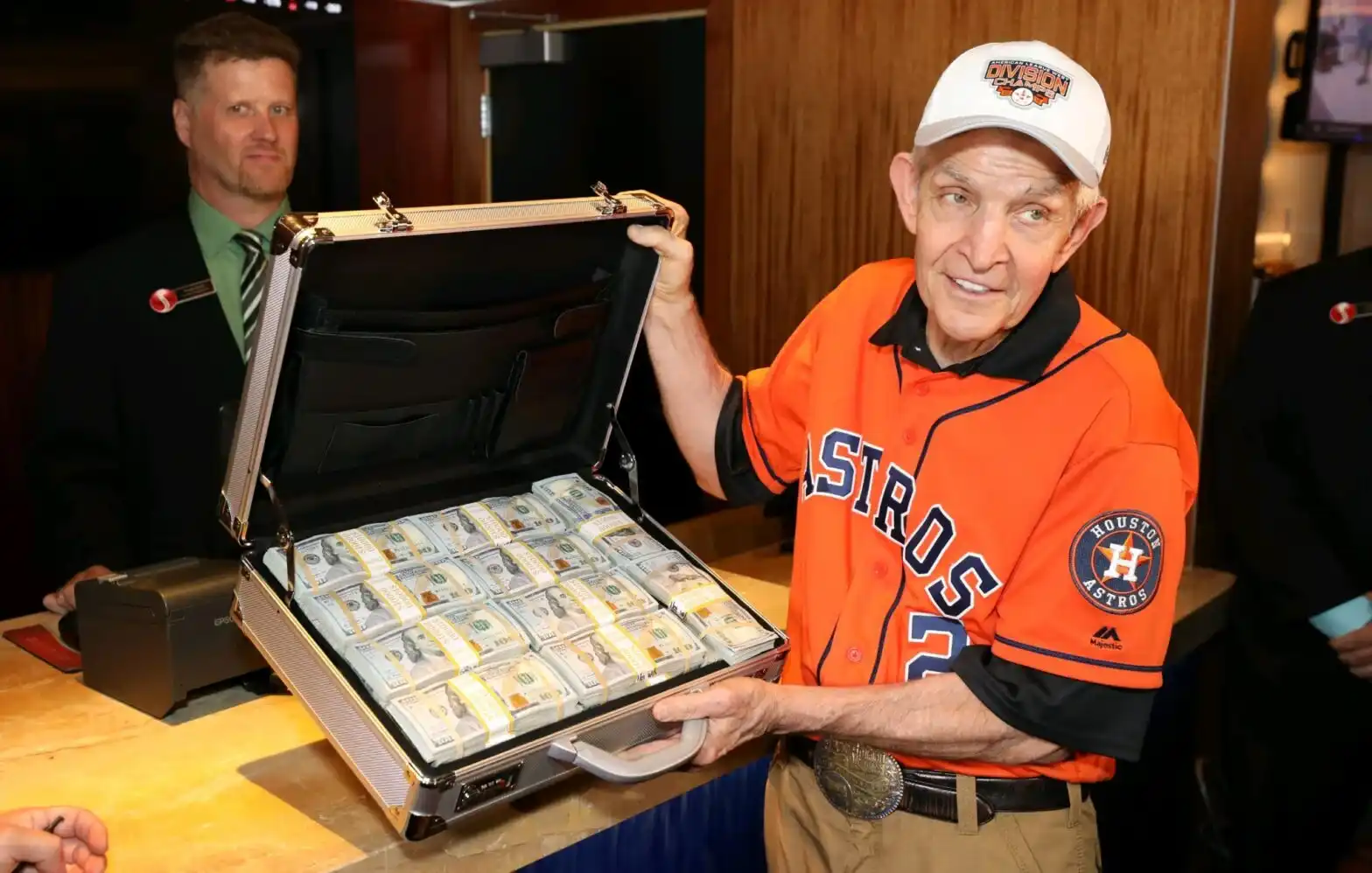
"Mattress Mack" carrying a suitcase with $3.5 million to bet on the Houston Astros

The logic behind bar The Jeffrey and Mattress Mack is essentially the same. If the team wins, Mattress Mack refunds customers, but the sportsbook payout covers that cost. If the team loses, he loses his bet, but no refunds are issued for furniture sales, and the promotion itself has already generated sales and media exposure. When the Astros won the World Series in 2022, Mattress Mack received a payout of approximately $75 million, making this model a classic case in American sports marketing.

Compared to traditional sportsbooks, prediction markets also expand the ways fans can engage with games.

Sports markets on Polymarket and Kalshi allow fans to trade around the broader narratives spilling out from a game, covering more entertaining, fragmented topics. Of course, traditional sports betting doesn't only offer win/loss markets. For example, platforms like FanDuel and DraftKings release numerous novelty bets around the Super Bowl each year, including "entertainment props" like the length of the national anthem or songs performed during the halftime show. However, restrictions on such markets vary by state, with some legal sports betting jurisdictions prohibiting them.

The difference with prediction markets is that they further expand this fun, entertainment-focused play. Traditional sportsbooks typically still revolve around the game itself and official statistics; even with novelty props, they're concentrated around a few mega-events like the Super Bowl.

Prediction markets are better at breaking down "verifiable real-world events" into contracts, making "any event priceable." For example, whether Trump will attend NBA Finals Game 3, or whether actor 'Timothee Chalamet' will attend all Knicks home games, clearly pushes the boundaries of novelty markets.
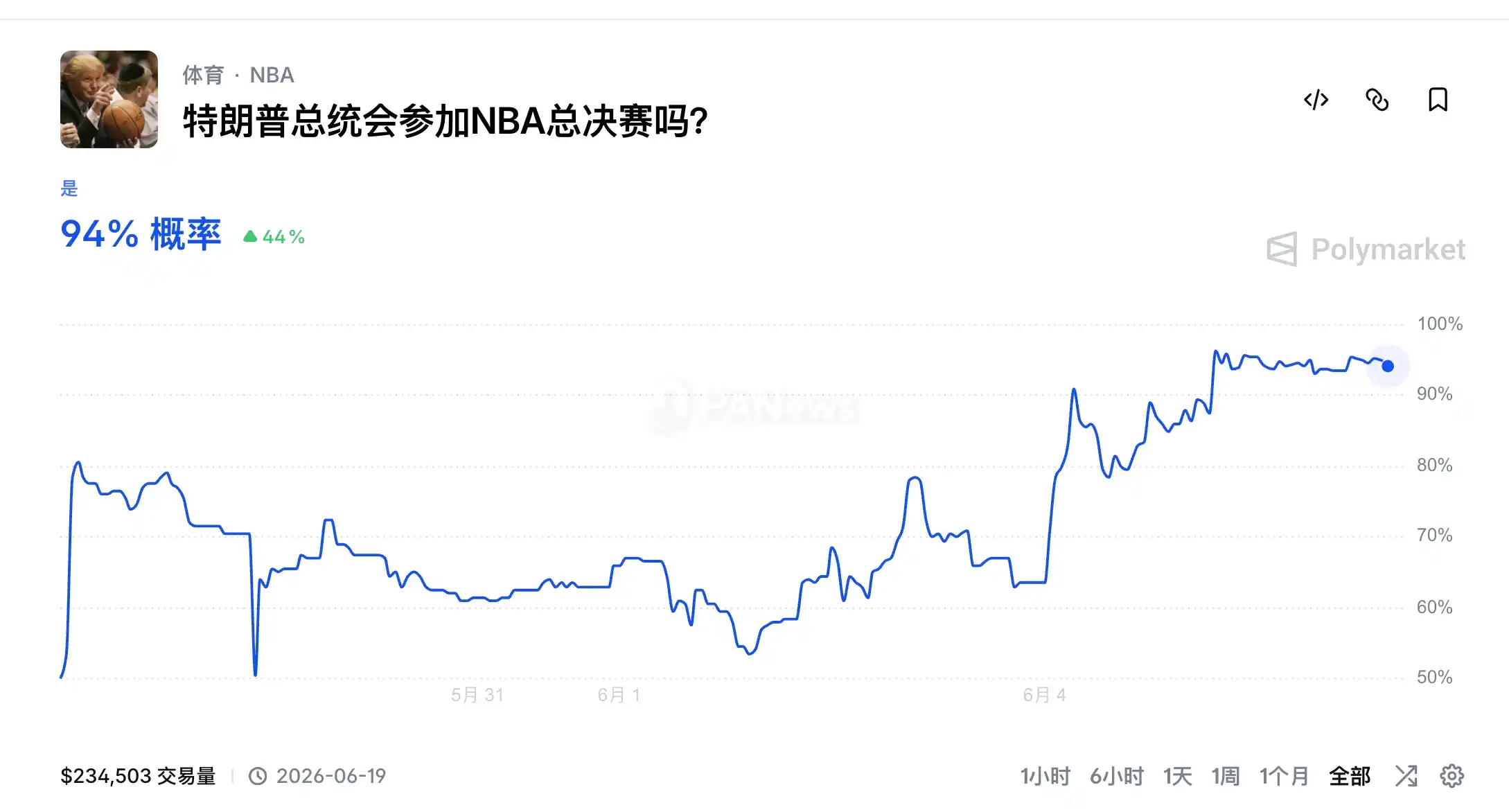
Beyond the variety of events, there are also differences in geographic and user demographic reach between the two types of platforms. Prediction markets in the U.S. can reach users 18 and older, while traditional sports betting typically requires users to be 21+. Simultaneously, prediction markets are available in all 50 states, while sports betting is currently legal in only 39 states. To some extent, the expansion of prediction markets in sports isn't just due to richer market offerings but also their ability to reach demographics and geographies that traditional sportsbooks cannot.

This is also a source of regulatory controversy. Prediction market platforms emphasize they are trading event contracts, with users buying and selling among themselves, a form closer to derivatives trading. Critics argue that when these contracts revolve around the NBA, NFL, elections, or celebrity events, the user experience is already highly similar to gambling. Especially when platforms attract younger users through social media, memes, and sports marketing, the boundaries between financial trading, entertainment, and gambling become increasingly blurred.

Players Get Involved First, NBA League Approaches Cautiously

With the rise of prediction markets, the NBA league has recognized that these platforms are becoming a new variable beyond traditional sports betting. Therefore, for the commercially-driven NBA, its attitude towards prediction markets has historically been ambiguous, characterized by cautious engagement.

At the player level, Giannis Antetokounmpo, who has become a Kalshi shareholder and will participate in the platform's marketing and offline activities, is the most representative case. This has sparked controversy. Fans worry that when an NBA superstar becomes a shareholder in a prediction market platform that can create markets around player trades, team performance, and game outcomes, even if the player themselves cannot trade NBA-related contracts, ethical boundaries are continually being nudged.

Related reading: "After $23.3 Million Bet on His Future, Why Did NBA Star Giannis Investing in Kalshi Spark Outrage?"

At the official league level, the NBA has engaged in in-depth discussions with the CFTC regarding an integrity framework for prediction markets. In its filing to the CFTC, the NBA emphasized that sports event contracts require comprehensive regulation to protect game integrity and public trust. The NBA also argued that athletes, referees, league and team personnel should be prohibited from trading contracts related to their league's games and events, that platforms should provide specific trader identities to the league during suspicious transaction investigations, and that official league data should be used for settlement.

NBA Commissioner Adam Silver's public statements reflect this stance. Discussing Giannis's investment in Kalshi during All-Star Weekend, he said the league is viewing prediction markets similarly to how it views sportsbooks. He noted that under the collective bargaining agreement, players can make minimal investment percentages in sports betting companies, and the league applies this rule to prediction markets. Silver further stated that Giannis's investment in Kalshi, being below 1%, did not violate relevant rules. However, he acknowledged that prediction markets are developing rapidly, and their ultimate permissible form may depend on courts and Congress.
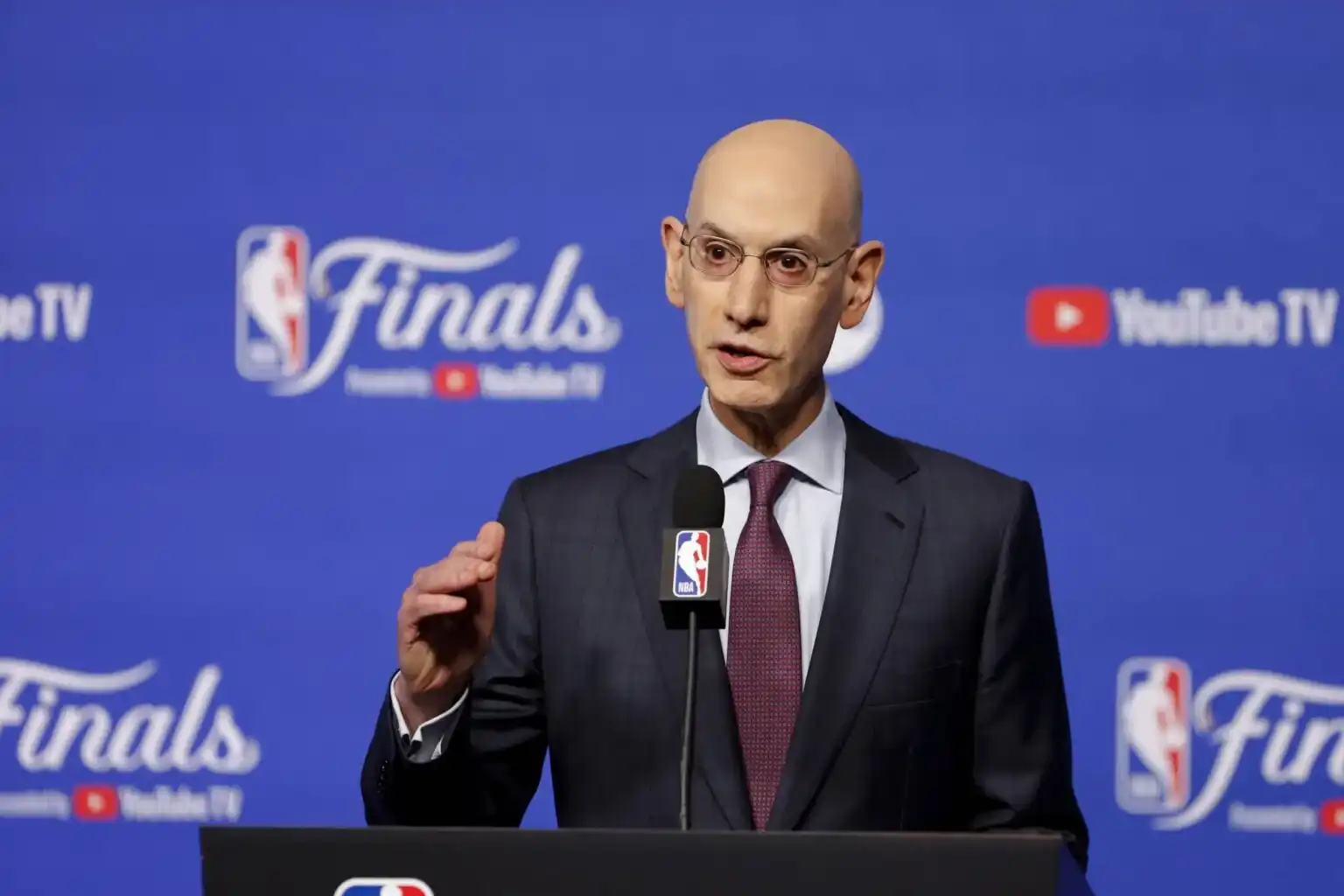
NBA Commissioner Adam Silver tried to quell controversy over Giannis becoming a Kalshi shareholder, calling the investment "minuscule"

But among fan communities, the NBA's increasingly close ties with prediction markets have drawn strong opposition. On the r/nba subreddit, numerous posts about the potential for insider trading risks involving Kalshi, Polymarket, and the NBA have sparked extensive discussion and criticism.

Many fans believe that if player investment or endorsement of prediction markets becomes normalized, future games could become "untrustworthy" due to insider trading and conflicts of interest. Many users also express concerns about league commercialization, younger user addiction, and game integrity. Comments on news about Giannis now almost invariably include fan jabs suggesting he'll participate in betting on prediction markets.
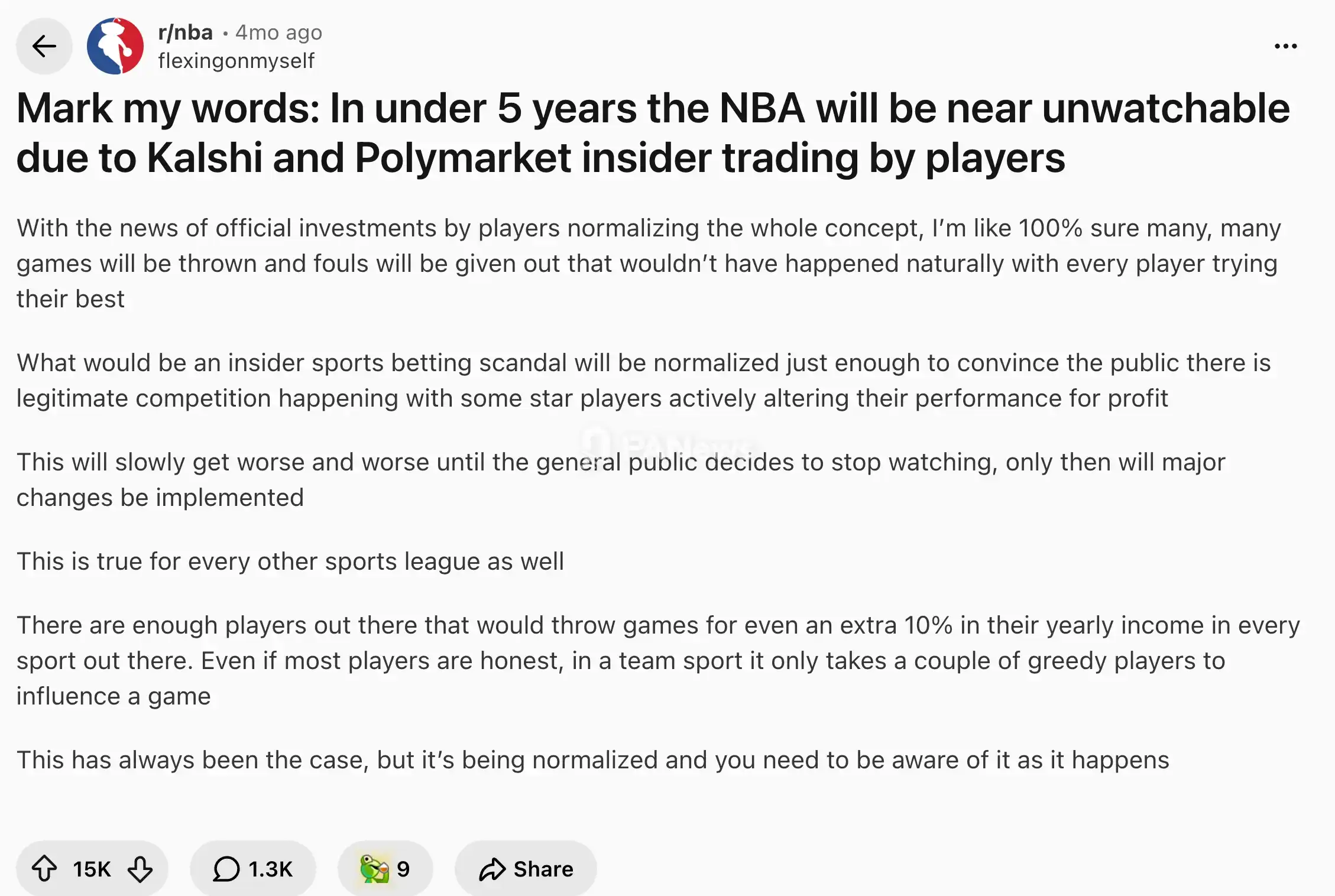
These Reddit discussions don't represent all NBA fans, but they reflect a very real sentiment. Many fans aren't just objecting to 'betting'; they worry that the NBA's official, extensive cooperation with betting companies and prediction markets might increasingly influence games and players through odds and trading contracts.

This concern isn't entirely unfounded. Recently, former U.S. Representative George Santos was investigated for allegedly engaging in suspicious trading on Kalshi related to whether he would attend the State of the Union address. While not a sports case, it highlights the most sensitive risk of prediction markets: when event outcomes can be influenced by a few insiders, market trading is no longer just 'prediction' but can become an incentive for the behavior itself.

And the NBA Finals are becoming a stress test for prediction markets entering mainstream sports. For both the platforms and the NBA, this represents both a new commercial opportunity and a new test of trust.


Criptos en tendencia

Preguntas relacionadas

QWhat are the main examples of how prediction markets are being used during the 2026 NBA Finals, according to the article?

APrediction markets like Kalshi and Polymarket are being used in several ways: first, Kalshi is the official partner of Madison Square Garden, gaining major offline exposure. Second, venues like the bar The Jeffrey use prediction market contracts to hedge the financial risk of promotional offers tied to the Knicks' performance. Third, the platforms themselves have attracted billions in trading volume on outcomes like the champion and Finals MVP. Finally, prediction markets offer more diverse and accessible entertainment-focused contracts than traditional sportsbooks, such as betting on celebrity appearances at games.

QHow did the bar 'The Jeffrey' use a prediction market to manage the risk of its promotion?

ABefore Game 1, The Jeffrey offered a promotion: if the Knicks won, drinks for the night would be free. To hedge the potential cost of this promotion, the bar purchased $5,000 worth of Knicks-related contracts on Kalshi. If the Knicks won, the payout from the contracts would cover the free-drinks cost. If the Knicks lost, the bar wouldn't have to offer free drinks, and the increased traffic and sales from the promotion would likely offset the cost of the initial contract purchase.

QWhat is a key regulatory and public perception concern regarding prediction markets in sports, as mentioned in the article?

AA key concern is the blurring line between financial trading, entertainment, and gambling, especially regarding the integrity of the game. Critics argue that when contracts are based on NBA games or player-related events, it closely resembles sports betting. There is particular worry about conflicts of interest if players, like Giannis Antetokounmpo (a Kalshi investor), have a stake in these markets, even if they don't bet on NBA events directly. The article cites the case of former Congressman George Santos, whose alleged trading on his own attendance at an event shows the risk of 'insider' actions influencing market outcomes.

QWhat is the traditional marketing model that 'Mattress Mack' represents, and how does it compare to The Jeffrey's use of prediction markets?

AJim 'Mattress Mack' McIngvale represents the traditional model of using sports betting to hedge business promotions. He would offer customers refunds on furniture purchases if a local Houston team won a championship. Simultaneously, he would place large bets on that team winning with traditional sportsbooks. The payout from a win would cover the refund costs; a loss meant he lost his bet but kept the sales revenue. The Jeffrey's model is similar in concept but uses prediction market contracts instead of traditional sportsbooks to hedge its promotional risk, demonstrating a new tool for achieving the same risk management goal.

QWhat advantages do prediction markets like Kalshi and Polymarket have over traditional sports betting platforms in the US, according to the article?

APrediction markets have two main advantages over traditional sports betting platforms in the US. First, they offer greater accessibility: they are available to users 18 and older (vs. 21+ for most sports betting) and are accessible in all 50 states (vs. only 39 states where sports betting is legal). Second, they offer a wider and more granular range of event contracts. While traditional sportsbooks may offer novelty bets for mega-events like the Super Bowl, prediction markets can create contracts on virtually any verifiable real-world event, such as whether a specific celebrity will attend a game, expanding the boundary of entertainment-focused 'bets'.

Lecturas Relacionadas

human.tech Launches Clean SDK for Privacy-First Web3 Apps

human.tech has launched the Clean SDK, a toolkit enabling developers to build privacy-first Web3 applications with transparent accountability. Released alongside Aztec's version 5, the SDK provides components for integrating zero-knowledge identity verification, sanctions screening, and private transactions, without developers handling sensitive user data or building compliance infrastructure from scratch. It uses zero-knowledge proofs and programmable verification to allow apps to confirm user legitimacy and sanctions compliance while keeping identities confidential. The first application built on the SDK, Shield, a privacy bridge to Aztec, also launched. It allows users to transfer assets privately while proving a unique human is behind each transfer and that funds have passed sanctions checks, as verified by a May 2026 audit. The SDK offers three core verification techniques: Proof of Innocence (sanctions screening against 23 sources), Proof of Personhood (simpler verification via Human Passport), and Proof of Clean Hands (higher-assurance zero-knowledge government ID checks). This allows apps to authenticate users and transactions without exposing personal data. Designed for Aztec builders, the SDK lets developers add programmable privacy to decentralized apps, eliminating the need to create their own verification and ZK infrastructure. Shield demonstrates its practical use for private bridges, but the SDK aims to enable a wider ecosystem of private, accountable financial apps and services. The launch addresses growing demand for infrastructure that balances privacy and accountability. The SDK avoids traditional identity databases, storing encrypted data off-chain, screening at both entry and exit points, and including a gated disclosure mechanism for legal requests. human.tech's products, including the Clean SDK, focus on using zero-knowledge technology to enable verifiable personhood and privacy in digital systems.

TheNewsCryptoHace 29 min(s)

human.tech Launches Clean SDK for Privacy-First Web3 Apps

TheNewsCryptoHace 29 min(s)

Unlocking $100 Million in Liquidity? Pump.fun's New Policy Tests the 5-Minute Pump Technique

Pump.fun, a popular meme coin launchpad, has introduced a new standard mechanism called BOOST. It aims to address a significant capital efficiency issue: when a newly launched token graduates from its initial bonding curve to a liquidity pool (LP), roughly 20% of its liquidity becomes permanently locked as "dead liquidity," estimated to waste over $100 million annually. Instead of locking these funds permanently, BOOST repurposes them. Upon a token's migration, approximately 20% of the settlement funds (e.g., 17.6 SOL or ~$2516 USDC) are used to buy back the token on the open market over a 5-minute period via a Time-Weighted Average Price (TWAP) mechanism. All purchased tokens are immediately burned. This creates a brief, systematic buy pressure immediately after migration, potentially generating a short-term price surge ("pump") while permanently reducing the token's circulating supply. The goal is to enhance the immediate post-launch trading experience, potentially increasing trader retention and sustainable protocol revenue, which funds ongoing token buybacks. However, concerns exist that this artificial 5-minute boost could lower the barrier for launching low-quality tokens and lead to steeper price crashes once the buy pressure stops, if followed by large sell-offs. The feature automatically applies to tokens migrating after July 21, 2024, but not to previously migrated tokens or those launched via the Mayhem AI Agent lab.

marsbitHace 36 min(s)

Unlocking $100 Million in Liquidity? Pump.fun's New Policy Tests the 5-Minute Pump Technique

marsbitHace 36 min(s)

Podcast Notes | Conversation with GSR Asset Management Head: To Determine if This Crypto Rally is Real, Just Watch the Lending Rates on Aave

Podcast Summary: Dialogue with GSR's Head of Asset Management: To Determine if This Crypto Rally is Real, Just Check Lending Rates on Aave Andy Baehr, Managing Director of Asset Management at GSR, discusses the current crypto market, characterizing it as stuck in a state of "ambivalence" with short-lived, unsustainable rallies. He outlines a simple framework: the market moves between "ambivalence" and "conviction" (sustained upward momentum). Currently, every rally resembles a single-stage rocket booster that quickly fizzles out. Baehr identifies three key signals to watch: 1) DeFi lending rates, 2) the potential passage of the CLARITY Act, and 3) the market forming a consensus on the "Fed hawkish peak." He emphasizes that the most immediate indicator for the sustainability of the recent CPI-triggered rally is the USDC borrowing rate on Aave, currently around 3.75%—close to U.S. Treasury yields. The absence of a credit spread indicates low leverage demand and a lack of market energy. He explains that a healthy, sustained rally requires layered buying pressure. Last year's rally progressed from an ETH short squeeze to crypto-native trader influx and finally to ETF inflows. Currently, this structure is missing. Other potential structural buyers like Digital Asset Treasury (DAT) companies are absent, and ETF flows have proven transient. Baehr notes that while small-cap crypto tokens outperformed large caps in Q2—a potential sign of capitation in major assets—capital is also flowing to more exciting opportunities like AI stocks and tech IPOs, leaving crypto sidelined. Regarding DeFi, he highlights that platforms like Aave provide a clear, real-time signal of leverage demand through their supply/demand-driven interest rates. A significant, sustained rate increase would signal genuine market conviction. He also observes the quiet emergence of fixed-income-like products and vaults in DeFi. On regulation, the probability of the CLARITY Act passing before the August 7th deadline has dropped linearly from 75% to below 40% on Polymarket. Baehr suggests its passage would be treated as a bullish surprise, a potent driver for price movement. However, political hurdles, including ethical clause debates and disclosures about the First Family's crypto profits, remain significant obstacles. Ultimately, the market awaits clarity on the Fed's terminal rate under Chair Warsh. Until the "Fed Solstice"—the point where the market collectively understands the peak of hawkish policy—sustained conviction will be difficult to achieve.

marsbitHace 1 hora(s)

Podcast Notes | Conversation with GSR Asset Management Head: To Determine if This Crypto Rally is Real, Just Watch the Lending Rates on Aave

marsbitHace 1 hora(s)

Trading

Spot

Artículos destacados

Cómo comprar ZEN

¡Bienvenido a HTX.com! Hemos hecho que comprar Horizen (ZEN) sea simple y conveniente. Sigue nuestra guía paso a paso para iniciar tu viaje de criptos.Paso 1: crea tu cuenta HTXUtiliza tu correo electrónico o número de teléfono para registrarte y obtener una cuenta gratuita en HTX. Experimenta un proceso de registro sin complicaciones y desbloquea todas las funciones.Obtener mi cuentaPaso 2: ve a Comprar cripto y elige tu método de pagoTarjeta de crédito/débito: usa tu Visa o Mastercard para comprar Horizen (ZEN) al instante.Saldo: utiliza fondos del saldo de tu cuenta HTX para tradear sin problemas.Terceros: hemos agregado métodos de pago populares como Google Pay y Apple Pay para mejorar la comodidad.P2P: tradear directamente con otros usuarios en HTX.Over-the-Counter (OTC): ofrecemos servicios personalizados y tipos de cambio competitivos para los traders.Paso 3: guarda tu Horizen (ZEN)Después de comprar tu Horizen (ZEN), guárdalo en tu cuenta HTX. Alternativamente, puedes enviarlo a otro lugar mediante transferencia blockchain o utilizarlo para tradear otras criptomonedas.Paso 4: tradear Horizen (ZEN)Tradear fácilmente con Horizen (ZEN) en HTX's mercado spot. Simplemente accede a tu cuenta, selecciona tu par de trading, ejecuta tus trades y monitorea en tiempo real. Ofrecemos una experiencia fácil de usar tanto para principiantes como para traders experimentados.

252 Vistas totalesPublicado en 2024.12.12Actualizado en 2026.06.02

Cómo comprar ZEN

Discusiones

Bienvenido a la comunidad de HTX. Aquí puedes mantenerte informado sobre los últimos desarrollos de la plataforma y acceder a análisis profesionales del mercado. A continuación se presentan las opiniones de los usuarios sobre el precio de ZEN (ZEN).

活动图片












