From Hunyuan to WeChat AI: Tencent's Slow Paced Journey Reaches the Delivery Juncture

marsbitPublicado a 2026-06-08Actualizado a 2026-06-08

Resumen

On June 8, 2026, WeChat's developer platform announced the internal testing of "WeChat AI," an AI assistant integrated into the WeChat ecosystem. It allows users to invoke, access, and operate Mini Programs through natural language conversation. The platform offers two access modes: an "Automatic Mode" where developers authorize platform access to their source code for zero-configuration AI operation, and a "Developer Mode" for building custom skills. While the name "WeChat AI" is provisional, this marks WeChat's first step in opening its vast Mini Program ecosystem—comprising over 400,000 developers and hundreds of millions of daily active users—to AI-driven conversational interaction. This move represents the latest step in Tencent's deliberate AI strategy, moving from technical R&D and standalone product validation to integration within its super-app. The underlying foundation is Tencent's self-developed Hunyuan large language model. Ranked first domestically in application-oriented capabilities like Agent task execution in 2025, Hunyuan's focus on stability and precision over raw parameter count aligns with WeChat AI's need for reliable, low-latency operations involving sensitive tasks like payments and bookings. Prior C-side validation came from "Yuanbao," a standalone AI app whose Monthly Active Users (MAU) surpassed 114 million during the 2026 Chinese New Year红包 campaign, though daily activity later subsided. This "pulse growth" highlighted the challenge of user rete...

On June 8, 2026, the WeChat Developer Platform announced that WeChat AI entered its internal testing phase. This AI assistant, integrated within the WeChat ecosystem, supports users in directly invoking, accessing, and operating Mini Programs through natural language dialogues. The Open Platform offers two access modes: Automatic Mode, which allows authorized platform access to read Mini Program source code, enabling AI to directly operate pages without additional development; and Developer Mode, where developers independently build skills for AI invocation after platform review. The Terms of Service also note that 'WeChat AI' may be a temporary name, the final naming is yet to be determined, and access is optional, not affecting the normal operation of existing Mini Programs.
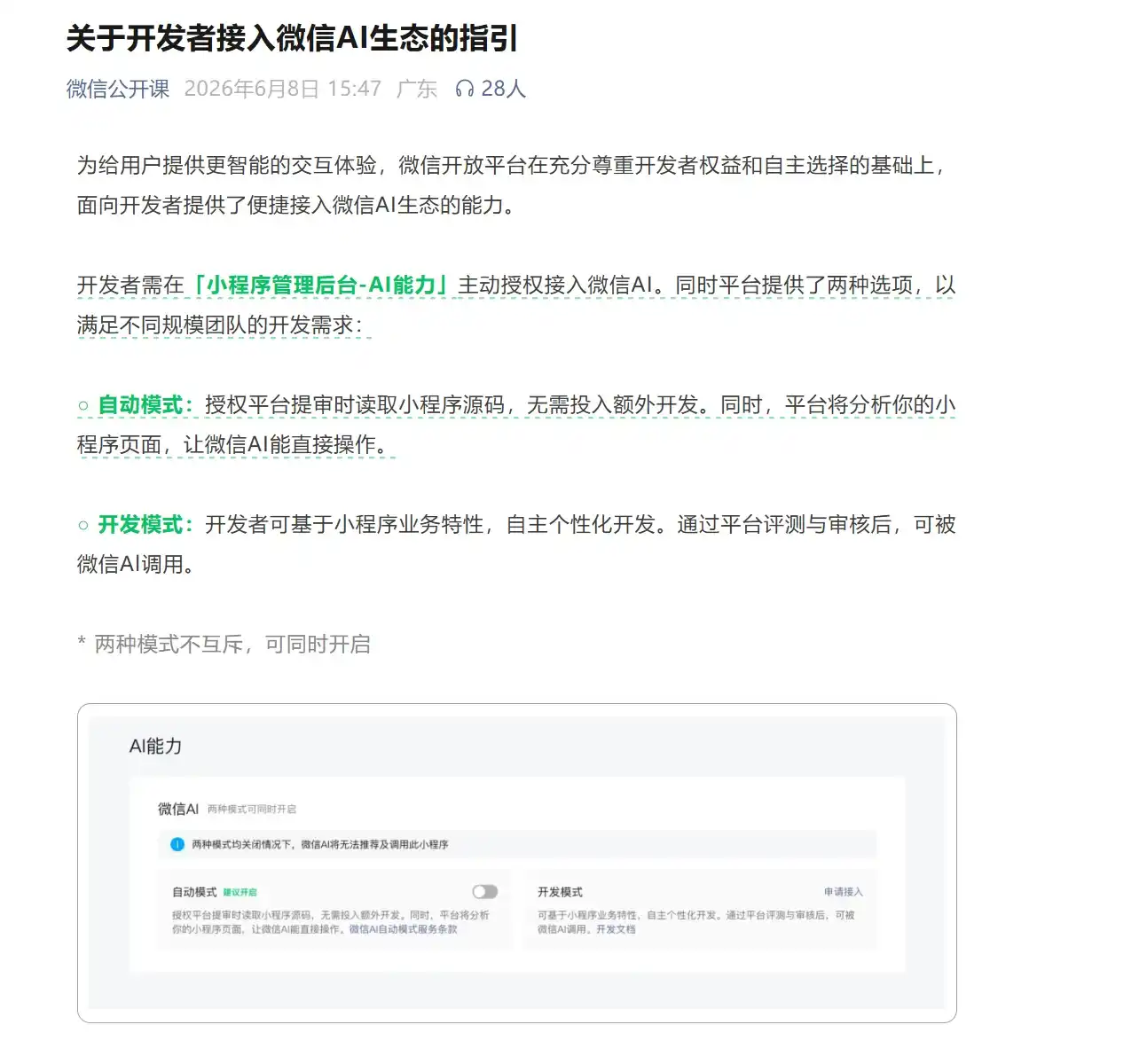
This marks the first time WeChat has opened its Mini Program ecosystem to AI at the conversational entry layer. The context at this time: Tencent's self-developed Hunyuan large model has joined the top tier in China in public benchmark tests; the Yuanbao App, following its explosive growth during the 2026 Spring Festival red envelope campaign, surpassed 100 million monthly active users (MAU). The WeChat AI internal test represents the latest step in Tencent's AI journey—from technology reserve and independent product validation towards delivery within a super app. The requirement for developers to hand over source code in Automatic Mode raises questions: how many developers will this low-threshold path attract, and what ecosystem interest conflicts will it encounter? These are questions to be answered during the internal testing phase.

An Opening at the Conversation Layer for the Mini Program Ecosystem

The two access modes for WeChat AI target entirely different developer groups.

The design logic of Automatic Mode is straightforward: authorize the platform to read the Mini Program source code during the review submission. The platform automatically analyzes the page structure, allowing AI to directly operate the pages without requiring additional development. A small game team with only two or three people, without needing an AI engineer or understanding Agent protocols, can simply check the authorization box. Their ordering Mini Program or tool application can then be invoked by WeChat AI.

According to data disclosed by WeChat Open Class in January 2026, the WeChat Mini Game ecosystem has gathered over 400,000 developers, 80% of whom are small teams of 30 people or fewer. The overall daily active users (DAU) exceeded 100 million in 2025, with MAU surpassing 500 million. This scale on the supply side is a unique moat for WeChat AI. ByteDance's Doubao or Alibaba's Tongyi Qianwen can create a standalone app or open APIs, but they lack a Mini Program ecosystem with over 100 million DAU to integrate directly. In essence, WeChat AI's Automatic Mode trades technical convenience for large-scale access, allowing the vast majority of the 400,000 developers to board this train at zero cost.

Developer Mode preserves customization space for service providers with complex business logic. Developers can autonomously build skills based on their business characteristics, which, after platform evaluation and review, become available for WeChat AI to call. The two modes can be enabled simultaneously and are not mutually exclusive.

The phrasing 'name undetermined' and 'optional behavior' indicates that the WeChat team still holds reservations regarding the product's positioning. The main tasks during the internal testing phase are to verify the technical pipeline and observe developer reactions. However, Automatic Mode has already touched upon a sensitive point: source code authorization. Some developers have expressed concerns in the WeChat Open Community, with core questions focusing on several aspects—how the platform guarantees code asset security after reading the source code; whether AI's direct page operation will invalidate existing tracking points and advertising display logic; and how responsibility is allocated if AI misoperations cause user losses. There are currently no public detailed rules explaining these issues.

After Achieving Second Place in Foundational Capabilities, Hunyuan Chooses to Go Deeper

What WeChat AI needs is not just a model that can chat; it needs an Agent foundation capable of understanding page structures and accurately executing operational instructions. This foundation is Tencent's Hunyuan large model.

In March 2025, the Chinese large model evaluation benchmark SuperCLUE released a report. Tencent's Hunyuan flagship version ranked second domestically in foundational model rankings, behind ByteDance's Doubao. However, it ranked first domestically in application capability dimensions, leading in sub-items such as text understanding & creation, instruction following, and Agent capability. Science Net, when summarizing the report, noted that Hunyuan performed better in the 'practical application' dimension than its foundational capability ranking suggested. Around the same time, Hunyuan Turbo S was included in the global Top 15 of the international evaluation Chatbot Arena for the first time.

Hunyuan's version iterations maintain a quarterly rhythm. An update to hunyuan-turbo was released in April 2025, followed by the flagship version TurboS in July, which enhanced reasoning capabilities. In April 2026, the Hy3 preview version was released, with official claims of a 40% improvement in inference efficiency. According to Tencent Cloud product documentation, older versions like HY 2.0 are scheduled to be discontinued starting June 26, 2026.

This pace is significantly slower than that of ByteDance and Alibaba. Over the past year, ByteDance's Doubao and Alibaba's Tongyi Qianwen have maintained a model release frequency approaching 'weekly updates,' while Hunyuan has remained stable with one major version update per quarter. Tencent management has previously made public statements about 'slow work yielding fine results.' The technical explanation is: the Agent era demands far higher stability and lower latency than the conversational era. Frequent switching of underlying models would prevent developers from engineering effective adaptations. The scenarios WeChat AI needs to invoke include placing orders, making payments, booking appointments—operations involving funds and sensitive information. Deterministic model output is much more critical than creativity.

Regarding resource investment, Tencent President Martin Lau disclosed during the 2025 annual report communication meeting that R&D investment for new AI products in 2025 was 18 billion RMB, and this investment would at least double in 2026. Content from the meeting, as relayed by The Paper, also showed that Lau stated the next core plan is to build dedicated AI agents within WeChat, integrating the full chain of Mini Programs, social features, and payments. The doubling of investment without accelerating the version release pace suggests funds are flowing more towards infrastructure reconstruction and data quality improvement, rather than competing for release windows.

Hunyuan's lead in application capabilities resonates with the scenario demands of WeChat AI. A model with a higher foundational ranking but weaker Agent capabilities might actually be less useful in WeChat AI's scenarios than Hunyuan. Tencent has chosen a path that does not chase parameter competition but focuses on practical application dimensions. This path is beginning to show its logical coherence with the launch of the WeChat AI internal test.

Daily Active Users Surpassed 50 Million During Spring Festival, Then What?

Prior to the WeChat AI internal test, the task of C-end validation for Tencent AI was undertaken by the Yuanbao App.

Yuanbao's growth curve exhibits a distinct pulse-like characteristic. According to QuestMobile monitoring data relayed by China National Radio, in January 2025, Yuanbao's MAU ranked 12th in the industry. By December 2025, it had climbed to 3rd place, behind only Doubao (MAU 226 million) and DeepSeek (MAU 135 million), with a full-year compound growth rate of 27.8%.

During the 2026 Spring Festival, Yuanbao experienced explosive growth. Data disclosed by Tencent officially shows Yuanbao's DAU peak exceeded 50 million, reaching 40.54 million on New Year's Eve, with MAU hitting 114 million. The Shanghai Securities News reported that this growth primarily came from social chain-driven user acquisition through red envelope activities.

However, post-Spring Festival, the data quickly declined. QuestMobile monitoring indicated that in April 2026, Yuanbao's normalized DAU was around 9 million. In the same period, Doubao's DAU was approximately 140 million, and Qianwen's was around 30 million. The peak-to-trough difference approached 5 times, highlighting the pulse-like growth characteristic. No public data is available for the DAU/MAU ratio, making it impossible to definitively judge user stickiness.

Yuanbao's role in Tencent's AI path is that of 'C-end validation for an independent product.' It has proven two things: First, Tencent has the ability to leverage WeChat's social chain to push an AI product in front of hundreds of millions of users. Second, users acquired via red envelopes are not retained. Martin Lau stated in the earnings call that Yuanbao's Spring Festival promotion effect exceeded expectations, and the next focus is optimizing core capabilities like voice dialogue. This statement itself indicates the team understands retention is the core proposition for the next stage.

The experience of Yuanbao's pulse growth, in turn, explains why WeChat AI chose to natively integrate directly within the super app rather than continue pushing a standalone app. A standalone app requires users to actively open it, relying on push notifications and activities for retention. Native integration relies on scenarios to bind users—when users need to order food, pay bills, or check courier status, WeChat AI is right there in the conversation flow. These are two completely different retention logics.

Every Mini Program Can Become 'Lobsterized,' But Service Providers Fear Being Bypassed

The product direction for WeChat AI was already clearly outlined in Pony Ma's public remarks in March 2026.

During the 2025 annual report communication meeting, Ma Huateng first discussed the concept of 'raising shrimp.' The 'lobster' type applications he referred to are AI Agents that possess a 'sense of a living person,' capable of autonomously executing tasks rather than merely answering questions. Ma stated that such applications provided inspiration for the WeChat AI under planning: in the future, every Mini Program could potentially undergo intelligent, 'lobsterized' transformation.

The core of this metaphor is pushing AI from a dialogue tool to a task executor. If WeChat AI were merely a chatbot, it wouldn't need to read source code or operate pages. The existence of Automatic Mode indicates its positioning is to complete cross-Mini Program tasks for users: ordering a cup of coffee, paying a utility bill, booking a hospital appointment, launching a mini-game. Users wouldn't need to know which Mini Program provides which service; they would just need to say one sentence to WeChat AI.

However, in the same meeting, Ma proactively addressed ecosystem interest conflicts. He pointed out that ecosystem service providers are concerned about being 'bypassed' or 'channelized' by AI agents. If a user says to WeChat AI, 'Help me order a latte,' and the AI directly invokes an atomic service from a coffee Mini Program to complete the transaction without the user ever entering the merchant's page, then the merchant's ad placements, brand exposure, and user retention efforts all go to zero. Service providers would not accept this outcome.

This is the core contradiction in WeChat AI's product design. The more efficient the centralized scheduling, the weaker the decentralized traffic sovereignty of merchants. The two access modes themselves do not solve this contradiction; they are merely an entry design. The real balancing mechanisms—such as traffic distribution rules, the relationship between atomic services and merchant pages, and data visibility in service provider backends—have not been publicly disclosed at all. Ma's exact words were that 'a balance must be struck between centralized scheduling and protection of decentralized traffic,' but specifically how this balance will be achieved has not been answered during the internal testing phase.

Three Lines Are in Position, But the Third Step Has Just Begun

With the parallel advancement of the three lines—Hunyuan, Yuanbao, and WeChat AI—Tencent's gradual AI path is logically coherent.

The bottom layer doesn't pursue the fastest model but builds the most stable Agent foundation. Hunyuan's domestic #1 ranking in SuperCLUE's application capability dimension supports WeChat AI's demand for precise operations. The middle layer uses a standalone app to validate social chain-driven user acquisition and basic user experience; Yuanbao's Spring Festival MAU surpassing 100 million verifies the leveraging effect of WeChat's traffic pool for AI products. The top layer pursues native integration within the super app, using scenarios to reduce retention pressure; the WeChat AI internal test directly faces 400,000 developers and a Mini Program ecosystem with over 100 million DAU.

However, whether C-end perception has been reversed can currently only be judged as 'partially complete.' Yuanbao's hundred-million-level MAU primarily came from the red envelope pulse; its normalized DAU of around 9 million remains a significant gap from Doubao's 140 million. WeChat AI has just entered internal testing; ordinary users cannot yet perceive it. There remains a noticeable gap between Tencent AI's share of public mindshare and its technical level.

Whether WeChat AI can bridge this gap depends on three variables. First, whether the source code trust issue in Automatic Mode can be resolved on the developer side, which determines the scale of access from the supply side. Second, whether the traffic distribution rules between centralization and decentralization can gain acceptance from service providers, which determines whether ecosystem interests can be balanced. Third, whether the accuracy of AI operations and the clarity of responsibility allocation can give users confidence to place orders, which determines the depth of C-end usage.

The positioning of the three lines is a prerequisite, but whether they can form a chain where 'Hunyuan ensures reliability, Yuanbao validates user habits, and WeChat AI delivers the final experience' requires at least two more quarters of public data to verify. Ma Huateng said in the earnings call that 'AI is a marathon, not a sprint.' The WeChat AI internal test is merely a marker point as this marathon reaches its mid-course; the finish line is still a long way off.


Preguntas relacionadas

QWhat are the two access modes provided by WeChat AI for developers to integrate their Mini Programs, and what are their key differences?

AWeChat AI offers two access modes: Automatic Mode and Development Mode. In Automatic Mode, developers authorize the platform to read their Mini Program's source code. The platform automatically analyzes the page structure, allowing the AI to operate pages without requiring additional development from the team. Development Mode allows developers to build custom skills based on their business logic, which are then reviewed and made available for the AI to call. The former is designed for low-effort, large-scale adoption, while the latter offers customization for complex services.

QAccording to the article, what are the three core variables that will determine whether WeChat AI can successfully bridge the gap between Tencent's AI technical capability and public perception?

AThe success of WeChat AI in bridging this gap depends on three core variables: 1) Whether the source code trust issue in Automatic Mode can be resolved with developers, determining the scale of supply-side adoption. 2) Whether the traffic distribution rules balancing centralization and decentralization can be accepted by service providers, determining if ecosystem interests can be balanced. 3) Whether the accuracy of AI operations and clarity of liability can make users confident enough to place orders, determining the depth of consumer usage.

QHow did the performance of Tencent's Hunyuan large model differ in the SuperCLUE benchmark rankings, and why is this relevant for WeChat AI?

AIn the SuperCLUE benchmark report, Tencent's Hunyuan flagship model ranked second domestically in basic model capability but first domestically in application ability. It led in sub-dimensions like text understanding/creation, instruction following, and Agent capability. This is highly relevant for WeChat AI because it requires a stable Agent base capable of understanding page structures and executing operational commands precisely, rather than just conversational prowess. Hunyuan's strength in practical application directly supports WeChat AI's scenario needs.

QWhat role did the Yuanbao App play in Tencent's AI strategy, and what key lessons did its growth trajectory demonstrate?

AThe Yuanbao App served the role of 'C-end validation for an independent AI product' within Tencent's strategy. Its growth, particularly a surge to over 50 million DAU during the 2026 Spring Festival红包 campaign, demonstrated Tencent's ability to leverage WeChat's social chain to push an AI product to a massive user base (reaching 114 million MAU). However, the post-festival rapid decline to a常态 DAU of around 9 million revealed the 'pulse growth' characteristic and poor user retention from promotional拉新. This experience highlighted the challenge of sustaining an independent app and informed the strategic shift towards natively integrating AI within the super-app WeChat for better user retention through场景 binding.

QWhat is the core ecosystem contradiction identified by Ma Huateng regarding the 'lobsterization' (intelligent Agent transformation) of Mini Programs via WeChat AI?

AThe core ecosystem contradiction is the tension between centralization and decentralization. Ma Huateng noted that service providers fear being 'short-circuited' or 'channelized' by the AI Agent. If WeChat AI directly completes a transaction (e.g., ordering coffee) by调用 an atomic service from a Mini Program without the user ever entering the merchant's page, the merchant loses all benefits of广告位 exposure, brand building, and user沉淀. Efficient centralized scheduling by the AI potentially weakens the流量 sovereignty of decentralized merchants. The challenge is designing mechanisms to balance this centralization with protection for decentralized traffic.

Lecturas Relacionadas

Is AI Creating a New Class of 'Information Poor'?

AI is generating a new kind of "information poverty." The core issue isn't that AI denies answers to the poor; it's that it provides abundant, cheap, and plausible-sounding answers to everyone. This availability shifts the true scarcity from obtaining answers to possessing the **judgment to evaluate them** and the access to turn them into real-world opportunities. New information poverty thus describes those who have AI tools and outputs, but lack the complementary skills, authorization, and contextual experience to critically assess and act on them. Research reveals a multi-layered divide: access to AI is stratified by income and platform design (e.g., premium vs. free, embedded tools). In workplaces, usage heavily favors higher-paid, more experienced, or formally trained employees, with AI often automating entry-level tasks that were traditional stepping stones. Crucially, the heaviest users are often mid-career professionals whose existing expertise allows them to effectively judge and leverage AI outputs, while novices risk over-relying on them without building judgment. While controlled experiments show AI can significantly boost low-skilled workers' performance, real-world adoption and benefit are constrained by unequal social and organizational structures. Historically, general-purpose technologies first reward those with existing complementary capital. AI, by affecting judgment-based work, may accelerate and deepen this initial inequality gap, even if it narrows over decades. The danger lies in the illusion of competence it creates, potentially stunting the very critical thinking needed in an era where judgment is paramount.

marsbitHace 2 min(s)

Is AI Creating a New Class of 'Information Poor'?

marsbitHace 2 min(s)

Jensen Huang 'Saves' South Korean Stock Market: Locks In SK Hynix Memory, Chip Shortage to Continue

On June 5th, South Korea's stock market experienced a sharp decline, with major chipmakers like Samsung and SK Hynix dropping nearly 10%. Amidst the turmoil, NVIDIA CEO Jensen Huang's visit to Seoul played a dramatic role in boosting market sentiment. Following a dinner meeting with SK Group Chairman Chey Tae-won and SK Hynix CEO Kwak Noh-Jung, Huang confirmed that NVIDIA's new Vera CPU will utilize SK Hynix DRAM. The companies announced a multi-year technical partnership to co-develop next-generation memory for NVIDIA's AI infrastructure, covering products from data centers to personal AI and robotics. This collaboration extends beyond memory supply. SK Hynix is integrating NVIDIA's AI and Omniverse platform into its own semiconductor design and manufacturing processes, including computational lithography and creating digital twins of its fabrication plants for autonomous operation. While strengthening ties with SK Hynix, NVIDIA is diversifying its supply chain for the upcoming HBM4 memory, with Samsung, SK Hynix, and Micron all certified as suppliers for its Vera Rubin platform. Despite this, Huang warned that the global chip shortage, driven by relentless demand from AI factory construction, is expected to persist for several years across the entire supply chain. His visit underscores NVIDIA's systematic effort to deepen integration with South Korea's broader tech industry.

marsbitHace 54 min(s)

Jensen Huang 'Saves' South Korean Stock Market: Locks In SK Hynix Memory, Chip Shortage to Continue

marsbitHace 54 min(s)

Nasdaq Plunges 4.2% in a Single Day: Does "Black Friday" Burst the U.S. Stock Market Bubble?

The Nasdaq plunged 4.18% on June 5, 2026, its worst single-day drop in over a year, as a much stronger-than-expected US jobs report triggered fears of economic overheating and delayed Federal Reserve interest rate cuts. The selloff, centered on high-valuation tech and AI stocks like Nvidia and Broadcom, spread across major indices. The article examines whether this signals a market top. The strong May non-farm payrolls data, nearly double expectations, pushed bond yields higher, directly hurting rate-sensitive tech stocks. This exposed vulnerabilities in the crowded AI trade, where valuations had soared on narratives of infinite growth, despite emerging signs of slowing order momentum and corporate AI monetization challenges. Prior to the drop, market indicators flashed warning signs: historically high valuations (e.g., Shiller CAPE ratio near 39.5), extreme bullish sentiment, and high levels of leverage. Technical charts showed key support levels being breached. Wall Street is divided on the outlook. Bears, citing risks of "stagflation" and AI bubble comparisons to the dot-com era, warn of a potential significant correction. Bulls view the drop as a healthy correction within a bull market, underpinned by a strong economy and expected corporate earnings growth of around 7% in 2026. The immediate future hinges on upcoming key events: the May CPI inflation data and the mid-June FOMC meeting. Their outcomes will critically shape market expectations for the Fed's rate path. The article concludes that conditions for a major market top are aligning, marking a fragile transition from narrative-driven gains to a phase demanding validation from macroeconomic data and corporate fundamentals. Caution is advised.

marsbitHace 58 min(s)

Nasdaq Plunges 4.2% in a Single Day: Does "Black Friday" Burst the U.S. Stock Market Bubble?

marsbitHace 58 min(s)

Nasdaq Plunges 4.2% in a Single Day, Did 'Black Friday' Pop the U.S. Stock Bubble?

The Nasdaq Composite plummeted 4.18% on June 5, its biggest single-day drop since April 2025, triggering widespread debate over whether the U.S. stock market has peaked. The sell-off was sparked by a stronger-than-expected U.S. non-farm payrolls report, which fueled fears of economic overheating and pushed back market expectations for Federal Reserve rate cuts, leading to a sharp rise in Treasury yields. The AI sector, the primary driver of the recent bull market, suffered severe losses, with the Philadelphia Semiconductor Index crashing over 10%. Stocks like Nvidia, Broadcom, and Micron led the decline. Concerns are mounting about the sustainability of AI capital expenditures and high valuations, with signs of order cuts for next-generation chips emerging. Analyses point to several warning signs: historically high market valuations (e.g., elevated Shiller CAPE ratio, Buffett Indicator), extreme bullish sentiment indicators, and significant insider selling. The sell-off also caused a key technical breakdown, with the S&P 500 breaking below its short-term moving average and testing its 200-day moving average. Wall Street is divided on the outlook. Bears warn this could be the start of a bubble deflation or a "stagflation" scenario, while bulls view it as a healthy, overdue correction within a bull market driven by solid corporate earnings growth. A more moderate view suggests the easy liquidity-driven rally is over, and markets are entering a phase of fundamental stock-picking with potential for consolidation. The immediate future hinges on key upcoming events: the May CPI report and the mid-June FOMC meeting. Their outcomes will be critical in determining whether this is a temporary pullback or the beginning of a more significant trend reversal. The consensus is that the era of one-directional market gains may be ending, requiring increased investor caution.

Odaily星球日报Hace 1 hora(s)

Nasdaq Plunges 4.2% in a Single Day, Did 'Black Friday' Pop the U.S. Stock Bubble?

Odaily星球日报Hace 1 hora(s)

The First Case on AI Agents: What Was Adjudicated?

"The First 'Agent' Ruling: What Was Decided?" On April 30, the Guangzhou Internet Court issued a ruling—China's first behavior preservation order in the intelligent agent (AI agent) field. The defendant, an open-source AI agent software, was ordered to stop downloads, cease actions that bypassed a platform's technical protection measures, and delete related tutorials and data. The core issue: the software used the operating system's "accessibility service" permissions to automate user interactions within other apps without those platforms' authorization. This mirrors a recent US case where Amazon sued Perplexity for similar reasons—bypassing Amazon's API to directly scrape and interact with its pages—and won a preliminary injunction. Both rulings establish a crucial legal boundary for the AI agent era: agents cannot operate unchecked. The article argues the fundamental legal principle emerging is one of **dual authorization**. An AI agent requires both **user consent** AND **platform consent** to operate legitimately within that platform's ecosystem. Bypassing platform rules through system-level permissions, even with user permission, undermines platform responsibilities for content moderation, data security, and user privacy, creating liability issues. The piece uses the evolution of "Doubao Phone" (an AI-integrated smartphone) as a case study. Its initial, aggressive version that bypassed platform controls faced roadblocks. Its upcoming 2.0 version is reportedly pivoting to negotiate API access and authorization deals with major platforms (like Alibaba's ecosystem), seen as a strategic adaptation to the new regulatory reality. A global trend is identified: the era of unregulated, "wild west" growth for AI agents is ending, replaced by a **compliance race**. This raises barriers to entry, as securing platform authorizations becomes a new cost. Open-source status is also not a legal shield if the code facilitates bypassing technical protections. In conclusion, these first rulings target not the largest, but the most **aggressive and representative** cases. By setting precedent with them, regulators are efficiently steering the entire industry towards a new, more regulated operating paradigm defined by dual authorization and platform cooperation.

marsbitHace 1 hora(s)

The First Case on AI Agents: What Was Adjudicated?

marsbitHace 1 hora(s)

Trading

Spot
Futuros

Artículos destacados

Qué es $S$

Entendiendo SPERO: Una Visión General Completa Introducción a SPERO A medida que el panorama de la innovación continúa evolucionando, la aparición de tecnologías web3 y proyectos de criptomonedas juega un papel fundamental en la configuración del futuro digital. Un proyecto que ha atraído la atención en este campo dinámico es SPERO, denotado como SPERO,$$s$. Este artículo tiene como objetivo reunir y presentar información detallada sobre SPERO, para ayudar a entusiastas e inversores a comprender sus fundamentos, objetivos e innovaciones dentro de los dominios web3 y cripto. ¿Qué es SPERO,$$s$? SPERO,$$s$ es un proyecto único dentro del espacio cripto que busca aprovechar los principios de descentralización y tecnología blockchain para crear un ecosistema que promueva la participación, la utilidad y la inclusión financiera. El proyecto está diseñado para facilitar interacciones de igual a igual de nuevas maneras, proporcionando a los usuarios soluciones y servicios financieros innovadores. En su esencia, SPERO,$$s$ tiene como objetivo empoderar a los individuos al proporcionar herramientas y plataformas que mejoren la experiencia del usuario en el espacio de las criptomonedas. Esto incluye habilitar métodos de transacción más flexibles, fomentar iniciativas impulsadas por la comunidad y crear caminos para oportunidades financieras a través de aplicaciones descentralizadas (dApps). La visión subyacente de SPERO,$$s$ gira en torno a la inclusividad, buscando cerrar brechas dentro de las finanzas tradicionales mientras aprovecha los beneficios de la tecnología blockchain. ¿Quién es el Creador de SPERO,$$s$? La identidad del creador de SPERO,$$s$ sigue siendo algo oscura, ya que hay recursos públicos limitados que proporcionan información de fondo detallada sobre su(s) fundador(es). Esta falta de transparencia puede derivarse del compromiso del proyecto con la descentralización, una ética que muchos proyectos web3 comparten, priorizando las contribuciones colectivas sobre el reconocimiento individual. Al centrar las discusiones en torno a la comunidad y sus objetivos colectivos, SPERO,$$s$ encarna la esencia del empoderamiento sin señalar a individuos específicos. Como tal, comprender la ética y la misión de SPERO sigue siendo más importante que identificar a un creador singular. ¿Quiénes son los Inversores de SPERO,$$s$? SPERO,$$s$ cuenta con el apoyo de una diversa gama de inversores que van desde capitalistas de riesgo hasta inversores ángeles dedicados a fomentar la innovación en el sector cripto. El enfoque de estos inversores generalmente se alinea con la misión de SPERO, priorizando proyectos que prometen avances tecnológicos sociales, inclusión financiera y gobernanza descentralizada. Estas fundaciones de inversores suelen estar interesadas en proyectos que no solo ofrecen productos innovadores, sino que también contribuyen positivamente a la comunidad blockchain y sus ecosistemas. El respaldo de estos inversores refuerza a SPERO,$$s$ como un contendiente notable en el dominio de proyectos cripto que evoluciona rápidamente. ¿Cómo Funciona SPERO,$$s$? SPERO,$$s$ emplea un marco multifacético que lo distingue de los proyectos de criptomonedas convencionales. Aquí hay algunas de las características clave que subrayan su singularidad e innovación: Gobernanza Descentralizada: SPERO,$$s$ integra modelos de gobernanza descentralizada, empoderando a los usuarios para participar activamente en los procesos de toma de decisiones sobre el futuro del proyecto. Este enfoque fomenta un sentido de propiedad y responsabilidad entre los miembros de la comunidad. Utilidad del Token: SPERO,$$s$ utiliza su propio token de criptomoneda, diseñado para servir diversas funciones dentro del ecosistema. Estos tokens permiten transacciones, recompensas y la facilitación de servicios ofrecidos en la plataforma, mejorando la participación y la utilidad general. Arquitectura en Capas: La arquitectura técnica de SPERO,$$s$ apoya la modularidad y escalabilidad, permitiendo la integración fluida de características y aplicaciones adicionales a medida que el proyecto evoluciona. Esta adaptabilidad es fundamental para mantener la relevancia en el cambiante paisaje cripto. Participación de la Comunidad: El proyecto enfatiza iniciativas impulsadas por la comunidad, empleando mecanismos que incentivan la colaboración y la retroalimentación. Al nutrir una comunidad sólida, SPERO,$$s$ puede abordar mejor las necesidades de los usuarios y adaptarse a las tendencias del mercado. Enfoque en la Inclusión: Al ofrecer tarifas de transacción bajas e interfaces amigables para el usuario, SPERO,$$s$ busca atraer a una base de usuarios diversa, incluyendo a individuos que anteriormente pueden no haber participado en el espacio cripto. Este compromiso con la inclusión se alinea con su misión general de empoderamiento a través de la accesibilidad. Cronología de SPERO,$$s$ Entender la historia de un proyecto proporciona información crucial sobre su trayectoria de desarrollo y hitos. A continuación se presenta una cronología sugerida que mapea eventos significativos en la evolución de SPERO,$$s$: Fase de Conceptualización e Ideación: Las ideas iniciales que forman la base de SPERO,$$s$ fueron concebidas, alineándose estrechamente con los principios de descentralización y enfoque comunitario dentro de la industria blockchain. Lanzamiento del Whitepaper del Proyecto: Tras la fase conceptual, se lanzó un whitepaper completo que detalla la visión, los objetivos y la infraestructura tecnológica de SPERO,$$s$ para generar interés y retroalimentación de la comunidad. Construcción de Comunidad y Primeras Interacciones: Se realizaron esfuerzos de divulgación activa para construir una comunidad de primeros adoptantes y posibles inversores, facilitando discusiones en torno a los objetivos del proyecto y obteniendo apoyo. Evento de Generación de Tokens: SPERO,$$s$ llevó a cabo un evento de generación de tokens (TGE) para distribuir sus tokens nativos a los primeros seguidores y establecer liquidez inicial dentro del ecosistema. Lanzamiento de la dApp Inicial: La primera aplicación descentralizada (dApp) asociada con SPERO,$$s$ se puso en marcha, permitiendo a los usuarios interactuar con las funcionalidades centrales de la plataforma. Desarrollo Continuo y Alianzas: Actualizaciones y mejoras continuas a las ofertas del proyecto, incluyendo alianzas estratégicas con otros actores en el espacio blockchain, han moldeado a SPERO,$$s$ en un jugador competitivo y en evolución en el mercado cripto. Conclusión SPERO,$$s$ se erige como un testimonio del potencial de web3 y las criptomonedas para revolucionar los sistemas financieros y empoderar a los individuos. Con un compromiso con la gobernanza descentralizada, la participación comunitaria y funcionalidades diseñadas de manera innovadora, allana el camino hacia un paisaje financiero más inclusivo. Como con cualquier inversión en el espacio cripto que evoluciona rápidamente, se anima a los posibles inversores y usuarios a investigar a fondo y participar de manera reflexiva con los desarrollos en curso dentro de SPERO,$$s$. El proyecto muestra el espíritu innovador de la industria cripto, invitando a una mayor exploración de sus innumerables posibilidades. Mientras el viaje de SPERO,$$s$ aún se desarrolla, sus principios fundamentales pueden, de hecho, influir en el futuro de cómo interactuamos con la tecnología, las finanzas y entre nosotros en ecosistemas digitales interconectados.

72 Vistas totalesPublicado en 2024.12.17Actualizado en 2024.12.17

Qué es $S$

Qué es AGENT S

Agent S: El Futuro de la Interacción Autónoma en Web3 Introducción En el paisaje en constante evolución de Web3 y las criptomonedas, las innovaciones están redefiniendo constantemente cómo los individuos interactúan con las plataformas digitales. Uno de estos proyectos pioneros, Agent S, promete revolucionar la interacción humano-computadora a través de su marco agente abierto. Al allanar el camino para interacciones autónomas, Agent S busca simplificar tareas complejas, ofreciendo aplicaciones transformadoras en inteligencia artificial (IA). Esta exploración detallada profundizará en las complejidades del proyecto, sus características únicas y las implicaciones para el dominio de las criptomonedas. ¿Qué es Agent S? Agent S se presenta como un marco agente abierto innovador, diseñado específicamente para abordar tres desafíos fundamentales en la automatización de tareas informáticas: Adquisición de Conocimiento Específico del Dominio: El marco aprende inteligentemente de diversas fuentes de conocimiento externas y experiencias internas. Este enfoque dual le permite construir un rico repositorio de conocimiento específico del dominio, mejorando su rendimiento en la ejecución de tareas. Planificación a Largo Plazo de Tareas: Agent S emplea planificación jerárquica aumentada por la experiencia, un enfoque estratégico que facilita la descomposición y ejecución eficiente de tareas complejas. Esta característica mejora significativamente su capacidad para gestionar múltiples subtareas de manera eficiente y efectiva. Manejo de Interfaces Dinámicas y No Uniformes: El proyecto introduce la Interfaz Agente-Computadora (ACI), una solución innovadora que mejora la interacción entre agentes y usuarios. Utilizando Modelos de Lenguaje Multimodal de Gran Escala (MLLMs), Agent S puede navegar y manipular diversas interfaces gráficas de usuario sin problemas. A través de estas características pioneras, Agent S proporciona un marco robusto que aborda las complejidades involucradas en la automatización de la interacción humana con las máquinas, preparando el terreno para una multitud de aplicaciones en IA y más allá. ¿Quién es el Creador de Agent S? Si bien el concepto de Agent S es fundamentalmente innovador, la información específica sobre su creador sigue siendo elusiva. El creador es actualmente desconocido, lo que resalta ya sea la etapa incipiente del proyecto o la elección estratégica de mantener a los miembros fundadores en el anonimato. Independientemente de la anonimidad, el enfoque sigue siendo en las capacidades y el potencial del marco. ¿Quiénes son los Inversores de Agent S? Dado que Agent S es relativamente nuevo en el ecosistema criptográfico, la información detallada sobre sus inversores y patrocinadores financieros no está documentada explícitamente. La falta de información disponible públicamente sobre las bases de inversión u organizaciones que apoyan el proyecto plantea preguntas sobre su estructura de financiamiento y hoja de ruta de desarrollo. Comprender el respaldo es crucial para evaluar la sostenibilidad del proyecto y su posible impacto en el mercado. ¿Cómo Funciona Agent S? En el núcleo de Agent S se encuentra una tecnología de vanguardia que le permite funcionar de manera efectiva en diversos entornos. Su modelo operativo se basa en varias características clave: Interacción Humano-Computadora Similar a la Humana: El marco ofrece planificación avanzada de IA, esforzándose por hacer que las interacciones con las computadoras sean más intuitivas. Al imitar el comportamiento humano en la ejecución de tareas, promete elevar las experiencias de los usuarios. Memoria Narrativa: Empleada para aprovechar experiencias de alto nivel, Agent S utiliza memoria narrativa para hacer un seguimiento de las historias de tareas, mejorando así sus procesos de toma de decisiones. Memoria Episódica: Esta característica proporciona a los usuarios una guía paso a paso, permitiendo que el marco ofrezca apoyo contextual a medida que se desarrollan las tareas. Soporte para OpenACI: Con la capacidad de ejecutarse localmente, Agent S permite a los usuarios mantener el control sobre sus interacciones y flujos de trabajo, alineándose con la ética descentralizada de Web3. Fácil Integración con APIs Externas: Su versatilidad y compatibilidad con varias plataformas de IA aseguran que Agent S pueda encajar sin problemas en ecosistemas tecnológicos existentes, convirtiéndolo en una opción atractiva para desarrolladores y organizaciones. Estas funcionalidades contribuyen colectivamente a la posición única de Agent S dentro del espacio cripto, ya que automatiza tareas complejas y de múltiples pasos con una intervención humana mínima. A medida que el proyecto evoluciona, sus posibles aplicaciones en Web3 podrían redefinir cómo se desarrollan las interacciones digitales. Cronología de Agent S El desarrollo y los hitos de Agent S pueden encapsularse en una cronología que resalta sus eventos significativos: 27 de septiembre de 2024: El concepto de Agent S fue lanzado en un documento de investigación integral titulado “Un Marco Agente Abierto que Usa Computadoras Como un Humano”, mostrando las bases del proyecto. 10 de octubre de 2024: El documento de investigación fue puesto a disposición del público en arXiv, ofreciendo una exploración profunda del marco y su evaluación de rendimiento basada en el benchmark OSWorld. 12 de octubre de 2024: Se lanzó una presentación en video, proporcionando una visión visual de las capacidades y características de Agent S, involucrando aún más a posibles usuarios e inversores. Estos marcadores en la cronología no solo ilustran el progreso de Agent S, sino que también indican su compromiso con la transparencia y la participación comunitaria. Puntos Clave Sobre Agent S A medida que el marco Agent S continúa evolucionando, varios atributos clave destacan, subrayando su naturaleza innovadora y potencial: Marco Innovador: Diseñado para proporcionar un uso intuitivo de las computadoras similar a la interacción humana, Agent S aporta un enfoque novedoso a la automatización de tareas. Interacción Autónoma: La capacidad de interactuar de manera autónoma con las computadoras a través de GUI significa un salto hacia soluciones informáticas más inteligentes y eficientes. Automatización de Tareas Complejas: Con su metodología robusta, puede automatizar tareas complejas y de múltiples pasos, haciendo que los procesos sean más rápidos y menos propensos a errores. Mejora Continua: Los mecanismos de aprendizaje permiten a Agent S mejorar a partir de experiencias pasadas, mejorando continuamente su rendimiento y eficacia. Versatilidad: Su adaptabilidad en diferentes entornos operativos como OSWorld y WindowsAgentArena asegura que pueda servir a una amplia gama de aplicaciones. A medida que Agent S se posiciona en el paisaje de Web3 y criptomonedas, su potencial para mejorar las capacidades de interacción y automatizar procesos significa un avance significativo en las tecnologías de IA. A través de su marco innovador, Agent S ejemplifica el futuro de las interacciones digitales, prometiendo una experiencia más fluida y eficiente para los usuarios en diversas industrias. Conclusión Agent S representa un audaz avance en la unión de la IA y Web3, con la capacidad de redefinir cómo interactuamos con la tecnología. Aunque aún se encuentra en sus primeras etapas, las posibilidades para su aplicación son vastas y atractivas. A través de su marco integral que aborda desafíos críticos, Agent S busca llevar las interacciones autónomas al primer plano de la experiencia digital. A medida que nos adentramos más en los reinos de las criptomonedas y la descentralización, proyectos como Agent S sin duda desempeñarán un papel crucial en la configuración del futuro de la tecnología y la colaboración humano-computadora.

476 Vistas totalesPublicado en 2025.01.14Actualizado en 2025.01.14

Qué es AGENT S

Cómo comprar S

¡Bienvenido a HTX.com! Hemos hecho que comprar Sonic (S) sea simple y conveniente. Sigue nuestra guía paso a paso para iniciar tu viaje de criptos.Paso 1: crea tu cuenta HTXUtiliza tu correo electrónico o número de teléfono para registrarte y obtener una cuenta gratuita en HTX. Experimenta un proceso de registro sin complicaciones y desbloquea todas las funciones.Obtener mi cuentaPaso 2: ve a Comprar cripto y elige tu método de pagoTarjeta de crédito/débito: usa tu Visa o Mastercard para comprar Sonic (S) al instante.Saldo: utiliza fondos del saldo de tu cuenta HTX para tradear sin problemas.Terceros: hemos agregado métodos de pago populares como Google Pay y Apple Pay para mejorar la comodidad.P2P: tradear directamente con otros usuarios en HTX.Over-the-Counter (OTC): ofrecemos servicios personalizados y tipos de cambio competitivos para los traders.Paso 3: guarda tu Sonic (S)Después de comprar tu Sonic (S), guárdalo en tu cuenta HTX. Alternativamente, puedes enviarlo a otro lugar mediante transferencia blockchain o utilizarlo para tradear otras criptomonedas.Paso 4: tradear Sonic (S)Tradear fácilmente con Sonic (S) en HTX's mercado spot. Simplemente accede a tu cuenta, selecciona tu par de trading, ejecuta tus trades y monitorea en tiempo real. Ofrecemos una experiencia fácil de usar tanto para principiantes como para traders experimentados.

969 Vistas totalesPublicado en 2025.01.15Actualizado en 2026.06.02

Cómo comprar S

Discusiones

Bienvenido a la comunidad de HTX. Aquí puedes mantenerte informado sobre los últimos desarrollos de la plataforma y acceder a análisis profesionales del mercado. A continuación se presentan las opiniones de los usuarios sobre el precio de S (S).

活动图片













