From Geopolitical Tensions to Liquidity Tightening: BTC Dragged into Uncontrolled Market Conditions

marsbitPublicado a 2026-01-30Actualizado a 2026-01-30

Resumen

"Bitcoin experienced a sharp decline, dropping from around $88,000 to below $81,200, with a 24-hour loss exceeding 7%. The sell-off was driven by multiple factors converging simultaneously. Escalating geopolitical tensions in the Middle East, particularly involving the U.S. and Iran, increased market uncertainty and risk aversion. Meanwhile, the Federal Reserve's latest FOMC meeting maintained interest rates and dashed hopes for near-term rate cuts, leading to a repricing of liquidity expectations. The downturn was not isolated to crypto; U.S. equities and precious metals like gold and silver also fell, indicating a market-wide reduction in risk exposure. Additionally, Bitcoin ETFs saw sustained outflows, with over $1 billion in net withdrawals in just one week, reducing market liquidity and amplifying downward pressure. This collective 'de-risking' event forced a breakdown of key technical levels, including the 100-week moving average, triggering leveraged liquidations. Market stability now depends on reclaiming these technical supports and the return of risk capital."

Author | Asher(@Asher_ 0210)
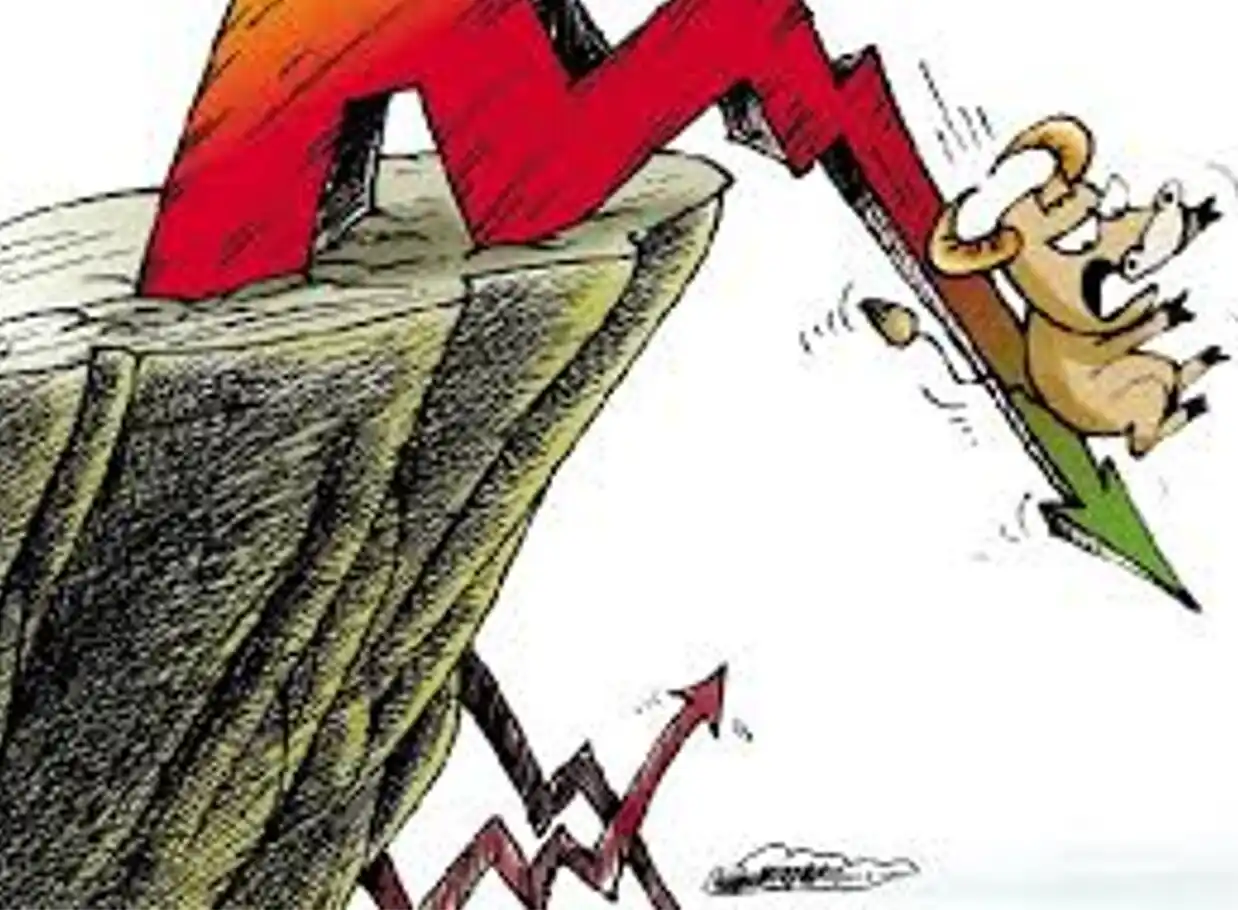
"The big crash" has happened again.

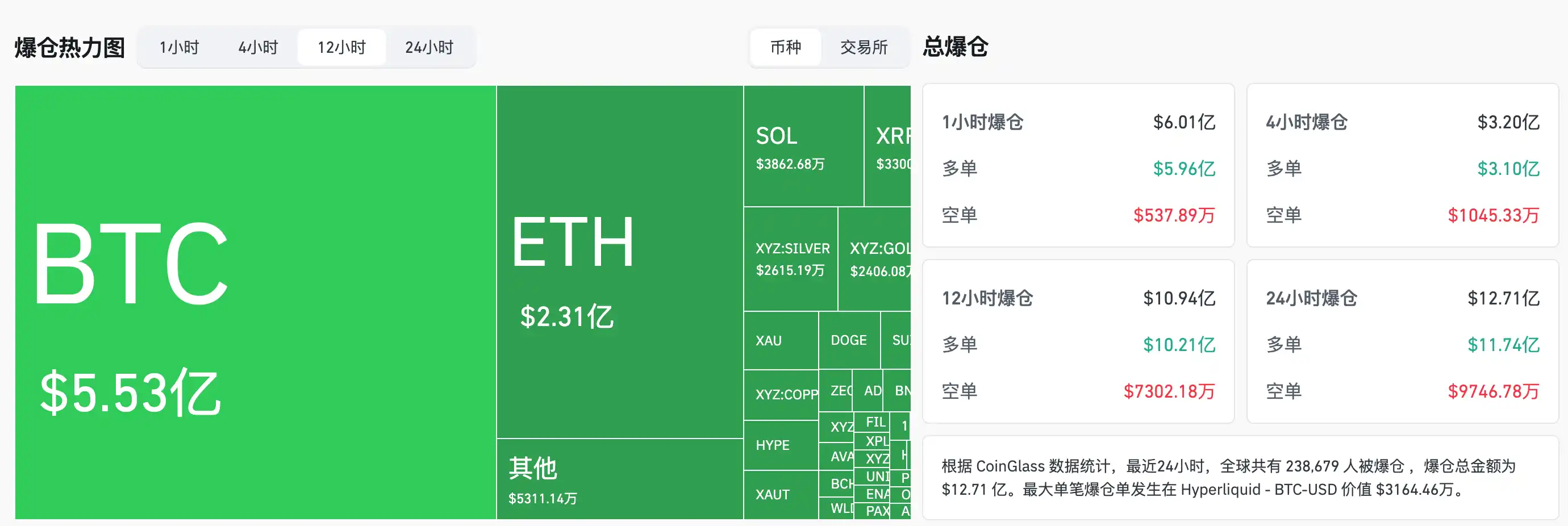
OKX market data shows that from last night to this morning Beijing time, BTC quickly fell from around $88,000, once dropping below $81,200, with a 24-hour decline of over 7%; ETH fell from $2,940 to a low of $2,690, with a 24-hour decline of nearly 10%; SOL dropped from $123 to around $112, with a 24-hour decline of over 8%. Coinglass data shows that in the past 12 hours, the market saw liquidations of $1.094 billion, with long positions accounting for as much as $1.021 billion; nearly 240,000 people were liquidated in 24 hours.
This decline was not triggered by a single negative factor, but rather the result of multiple factors being released simultaneously at the same point in time.

Middle East tensions suddenly escalate, geopolitical risks re-emerge in the market

The sudden escalation of geopolitical risk is one of the earliest important background factors factored into last night's market decline.

Latest news shows that the US aircraft carrier USS Abraham Lincoln and its strike group have entered a state of "lights out" and communication blackout. This move is usually seen as a standard operating procedure before major military actions, leading the market to speculate that actions related to Iran are entering a highly sensitive phase.

At the same time, statements from Iran have also clearly shifted to a posture of readiness for combat. Iran's First Vice President Aref, speaking about the regional situation, stated that Iran has maintained a state of combat readiness since the current administration took office, will not initiate war, but if conflict is provoked, it will defend itself with a firm stance, emphasizing that "the outcome of the war will not be decided by the enemy." He pointed out that it is currently necessary to prepare for a state of war.

Although the situation has not yet evolved into substantive conflict, this state of being "highly opaque, unverifiable, and difficult to predict" is itself enough to influence market behavior. Against a backdrop of already tight liquidity and receding risk appetite, geopolitical uncertainty was quickly priced in, prompting funds to倾向于 reduce directional exposure rather than continue betting on high-volatility assets.

FOMC "hawkish landing," liquidity expectations repriced

The decline in cryptocurrency prices still cannot be separated from the Federal Reserve.

At the January FOMC meeting, the Fed kept the benchmark interest rate unchanged in the range of 3.50% to 3.75%, and emphasized in its statement that the unemployment rate has stabilized and inflation remains at a relatively high level. The stance itself did not significantly exceed market expectations, but it emotionally completed an "expectation finale"—the market's vague幻想 of a near-term rate cut, or even a policy pivot, was officially compressed or even eliminated.

For risk assets, such moments often do not appear in the form of "new negatives," but rather as a realization that "positive factors can no longer be further透支." Since 2025, Bitcoin has seen pullbacks multiple times after FOMC meetings, which is a repeated演绎 of this mechanism: it's not that policy suddenly turned hawkish, but that the market had to admit that liquidity would not arrive as early as anticipated.

When positions are already built up and leverage is already high, this kind of "confirmation" itself is enough to trigger risk release—it is not the first push that topples the dominoes, but rather what causes all the already precarious structures to simultaneously lose their support.

Not just the crypto market falling, US stocks and precious metals also "turn sour" simultaneously

More alarmingly, this decline is not a "solo performance" by the crypto market.

In US stocks, the decline in stock indices became an important signal of weakening market risk appetite. The Nasdaq 100 index fell about 1.6%, the S&P 500 index fell about 0.75%, and the Dow Jones Industrial Average also fell about 0.2%. The three major indices were generally under pressure, with the technology sector performing particularly weakly, dragging down overall market risk appetite.

At the same time, precious metals market, originally seen as "safe-haven assets," also experienced剧烈波动. After a recent strong rally, gold prices saw a sharp short-term pullback last night, with significant profit-taking emerging in the market; silver also retreated rapidly from its highs, with a notable decline. This indicates that funds are not simply switching from risk assets to safe-haven assets, but are rather reducing risk exposure across the board in a high-volatility environment.

When stocks fall, crypto assets are under pressure, and precious metals also pull back simultaneously, the signal sent by the market is quite clear. Funds are simultaneously reducing exposure across multiple asset classes, with overall risk appetite contracting rapidly.

In such an environment, Bitcoin naturally finds it difficult to remain unscathed. It is not truly regarded by the market as a safe-haven asset, and due to its own high volatility, it often becomes one of the first to be sold when sentiment turns risk-averse.

Sustained ETF outflows significantly reduce the crypto market's capacity to absorb selling

Changes in the capital flow provided the final piece of the puzzle for this decline.

Looking at the data for Bitcoin spot ETFs, funds are continuously withdrawing. Data shows that in the past week alone, BTC spot ETFs saw sustained net outflows, with multiple days recording outflows of over $100 million per day, with the cumulative net outflow scale reaching over $1 billion.
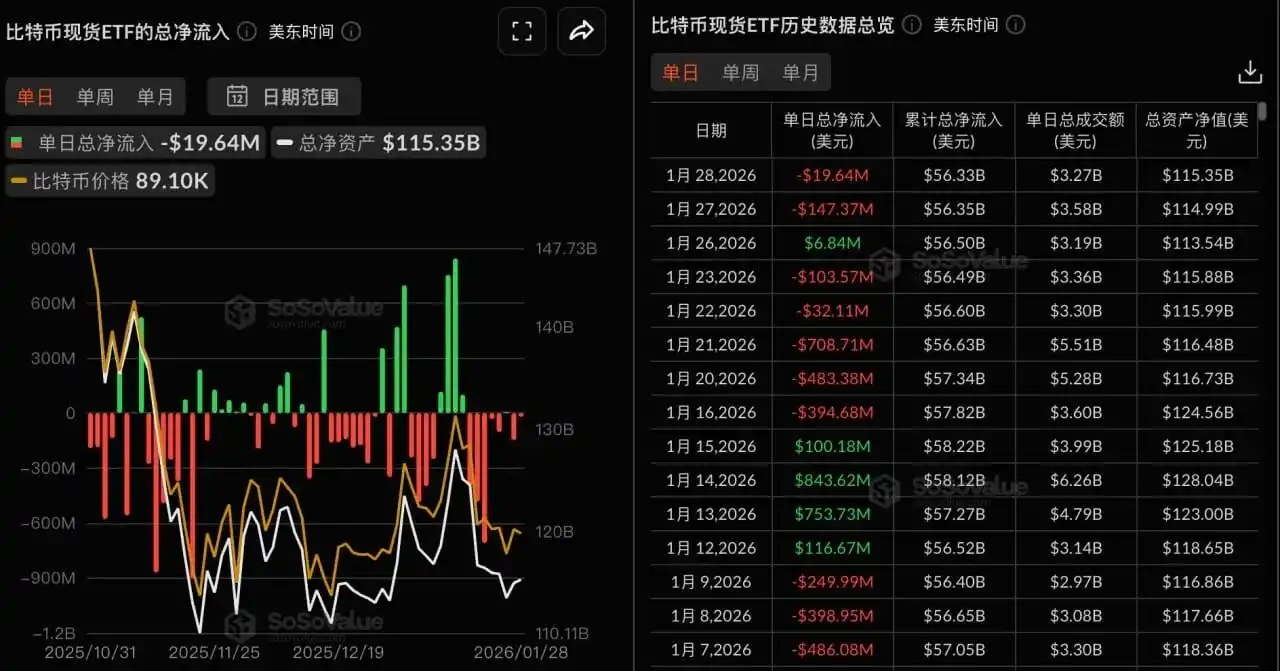
More importantly, the withdrawal of ETF funds is not a one-time宣泄, but rather a continuous, multi-day, trend-driven reduction in positions. This means that institutional funds are not choosing to "buy the dip and provide support" during the pullback, but are more inclined to reduce overall risk exposure and wait for clearer macro and market signals.

In such a capital environment, the market does not have a "buffer." When prices fall, ETFs do not provide sustained buying power; the market relies more on existing funds to消化 selling pressure on their own. Once key price levels are broken, selling behavior quickly dominates, while buying interest明显 lags, forcing prices to rapidly探 lower to find a new balance.

Not a black swan, but a concentrated release of "forced de-risking"

The essence of BTC's current decline is not caused by a single突发 negative factor alone, but is the result of the market's repricing of risk assets overall under the叠加 of multiple risk factors. Geopolitical uncertainty intensified, macro liquidity expectations were修正, and against the backdrop of sustained net outflows from ETFs, the crypto market lacked stable structural support, ultimately triggering the market's主动 "braking" behavior.

When long-term funds and passive buying are absent, the market often completes the first stage of risk clearing by having prices break through key trend levels downward, forcing trend-following strategies and leveraged funds to exit被动, thereby completing the first stage of risk clearing. In this process, Bitcoin broke below the highly watched 100-week moving average (around $85,000), a level that has acted as a "safety net"多次 during adjustments since last year and is also the default defense line for many trend models and leveraged positions.

Judging from the outcome, the market has now completed the first round of rapid deleveraging and emotional clearing, but true stabilization still depends on two conditions: first, whether key technical levels can be recaptured and held firmly, and second, whether risk capital is willing to return to the market to participate in pricing. Before that, high volatility and low confidence may still be the阶段性主旋律.


Preguntas relacionadas

QWhat were the main factors that led to the sharp decline in Bitcoin and other cryptocurrencies as described in the article?

AThe decline was triggered by a combination of factors including escalating geopolitical tensions in the Middle East, a hawkish stance from the Federal Reserve's FOMC meeting leading to repricing of liquidity expectations, and continuous outflows from Bitcoin ETFs which reduced market support.

QHow did geopolitical tensions contribute to the cryptocurrency market downturn?

AGeopolitical risks, particularly the heightened tensions between the US and Iran with military preparations and Iran's readiness for conflict, created uncertainty. This led to reduced risk appetite, prompting investors to lower exposure to high-volatility assets like cryptocurrencies.

QWhat was the Federal Reserve's FOMC meeting's impact on market expectations and crypto prices?

AThe FOMC maintained interest rates and emphasized stable unemployment and high inflation, dashing market hopes for near-term rate cuts or policy easing. This 'hawkish landing' forced a repricing of liquidity expectations, triggering risk-off sentiment and selling pressure on cryptocurrencies.

QWhy did the article mention that the decline was not limited to cryptocurrencies?

AThe downturn was broad-based, affecting not only cryptocurrencies but also US stock indices (like Nasdaq and S&P 500) and precious metals (gold and silver). This indicated a widespread reduction in risk exposure across multiple asset classes, not a isolated crypto market event.

QHow did Bitcoin ETF flows affect the market's ability to handle the sell-off?

ABitcoin ETFs experienced sustained outflows, with over $1 billion in net outflows in a week, indicating institutional investors were reducing risk exposure rather than buying the dip. This lack of buying support weakened market resilience, leading to steeper price declines as sell orders overwhelmed limited demand.

Lecturas Relacionadas

How Many Tokens Away Is Yang Zhilin from the 'Moon Chasing the Light'?

The article explores the intense competition between two leading Chinese AI companies, DeepSeek and Kimi (Moon Dark Side), and the mounting pressure on Yang Zhilin, the founder of Kimi. While DeepSeek re-emerged after 15 months of silence with its powerful V4 model—boasting 1.6 trillion parameters and low-cost, long-context capabilities—Kimi has been focusing on long-context processing and multi-agent systems with its K2.6 model. Yang faces a threefold challenge: technological rivalry, commercialization pressure, and investor expectations. Despite Kimi’s high valuation (reaching $18 billion), its revenue heavily relies on a single product with low paid conversion rates, while DeepSeek’s strategic silence and open-source influence have strengthened its market position and valuation prospects, now targeting over $20 billion. Both companies reflect broader trends in China’s AI ecosystem: Kimi aims for global influence through open-source contributions and agent-based advancements, while DeepSeek prioritizes foundational innovation and hardware independence, notably shifting to Huawei’s chips. Their competition is seen as vital for China’s AI progress, with the gap between top Chinese and U.S. models narrowing to just 2.7% on the Elo rating scale. Ultimately, the article argues that this rivalry, though anxiety-inducing for leaders like Zhilin, is essential for driving innovation and solidifying China’s role in the global AI landscape.

marsbitHace 32 min(s)

How Many Tokens Away Is Yang Zhilin from the 'Moon Chasing the Light'?

marsbitHace 32 min(s)

TechFlow Intelligence Bureau: ChatGPT Helps Amateur Mathematician Crack 60-Year-Old Problem, CFTC Sues New York Regulator Over Coinbase and Gemini

An amateur mathematician, with the assistance of ChatGPT, has solved a combinatorial mathematics puzzle originally proposed by Hungarian mathematician Paul Erdős in the 1960s. This marks another milestone in AI-aided mathematical research, demonstrating the evolving capabilities of large language models in formal reasoning. In other AI developments, OpenAI introduced a new privacy filter tool for enterprise API usage, automatically screening sensitive data. Meanwhile, the Qwen3.6-27B model achieved 100 tokens per second on a single RTX 5090 GPU using quantization, significantly lowering the cost barrier for local AI deployment. In crypto and Web3, the U.S. CFTC sued New York’s financial regulator, challenging its oversight of Coinbase and Gemini—a first-of-its-kind federal-state regulatory clash. Following a vulnerability, KelpDAO and major DeFi protocols established a recovery fund. Tether froze $344 million in assets linked to Iran’s central bank upon U.S. Treasury request, highlighting the centralized control risks in stablecoins. Separately, Litecoin underwent a 3-hour chain reorganization to undo a privacy-layer exploit. In the U.S., former President Trump invoked the Defense Production Act to address power grid bottlenecks affecting AI data centers and dismissed the entire National Science Board, raising concerns over research independence. A retail trader gained 250% on a $600k Intel options bet amid AI-related speculation. Xiaomi announced its first performance electric vehicle, targeting rivals like Tesla. Meanwhile, iPhone users reported devices automatically reinstalling a hidden app daily, suspected to be MDM-related. A Chinese securities report noted that A-share institutional crowding has reached its second-longest streak since 2007, signaling high valuations and potential style rotation. The day’s developments reflect a dual narrative: AI is enabling unprecedented individual breakthroughs, while centralized power structures—whether governmental or corporate—are becoming more assertive, underscoring that decentralization is as much a political-economic challenge as a technical one.

marsbitHace 55 min(s)

TechFlow Intelligence Bureau: ChatGPT Helps Amateur Mathematician Crack 60-Year-Old Problem, CFTC Sues New York Regulator Over Coinbase and Gemini

marsbitHace 55 min(s)

Trading

Spot
Futuros

Artículos destacados

Qué es BITCOIN

Entendiendo HarryPotterObamaSonic10Inu (ERC-20) y Su Posición en el Espacio Cripto En los últimos años, el mercado de criptomonedas ha sido testigo de un aumento en la popularidad de las monedas meme, capturando el interés no solo de los comerciantes, sino también de aquellos que buscan compromiso comunitario y valor de entretenimiento. Entre estos tokens únicos se encuentra HarryPotterObamaSonic10Inu (ERC-20), un proyecto intrigante que mezcla referencias culturales en el tejido de las criptomonedas. Este artículo profundiza en los aspectos clave de HarryPotterObamaSonic10Inu, explorando sus mecanismos, ethos impulsado por la comunidad y su relación con el paisaje cripto más amplio. ¿Qué es HarryPotterObamaSonic10Inu (ERC-20)? Como su nombre sugiere, HarryPotterObamaSonic10Inu es una moneda meme construida sobre la blockchain de Ethereum, clasificada bajo el estándar ERC-20. A diferencia de las criptomonedas tradicionales que pueden enfatizar la utilidad práctica o el potencial de inversión, este token prospera en el valor de entretenimiento y la fuerza de su comunidad. El proyecto tiene como objetivo fomentar un entorno donde los usuarios comprometidos puedan reunirse, compartir ideas y participar en actividades inspiradas por diversos fenómenos culturales. Una característica notable de HarryPotterObamaSonic10Inu es su cero impuestos en las transacciones. Este atractivo elemento tiene como objetivo incentivar el comercio y la participación comunitaria, sin cargos adicionales que puedan disuadir a los comerciantes de pequeña escala. El suministro total de la moneda está establecido en mil millones de tokens, una cifra que marca su intención de mantener una circulación sustancial dentro de la comunidad. Creador de HarryPotterObamaSonic10Inu (ERC-20) Los orígenes de HarryPotterObamaSonic10Inu están algo envueltos en misterio; los detalles sobre el creador siguen siendo desconocidos. El desarrollo de este token carece de un equipo identificable o de un plan explícito, lo cual no es inusual dentro del sector de monedas meme. En cambio, el proyecto ha surgido de manera orgánica, con su progreso muy dependiente del entusiasmo y la participación de su comunidad. Inversores de HarryPotterObamaSonic10Inu (ERC-20) En cuanto a inversiones externas y respaldo, HarryPotterObamaSonic10Inu también sigue siendo ambiguo. El token no lista ninguna fundación de inversión conocida o apoyo organizacional significativo. En cambio, la savia del proyecto es su comunidad de base, que informa su crecimiento y sostenibilidad a través de la acción colectiva y el compromiso en el espacio cripto. ¿Cómo Funciona HarryPotterObamaSonic10Inu (ERC-20)? Como una moneda meme, HarryPotterObamaSonic10Inu opera principalmente fuera de los marcos tradicionales que a menudo rigen el valor de los activos. Hay varios aspectos distintivos que definen cómo funciona el proyecto: Transacciones Sin Impuestos: Sin tarifas impositivas en las transacciones, los usuarios pueden comprar y vender el token libremente sin preocuparse por costos ocultos. Compromiso Comunitario: El proyecto prospera en la interacción comunitaria, aprovechando plataformas de redes sociales para crear entusiasmo y facilitar la participación. Las discusiones, el intercambio de contenido y el compromiso son elementos cruciales que ayudan a expandir su alcance y fomentar la lealtad entre los seguidores. Sin Utilidad Práctica: Cabe señalar que HarryPotterObamaSonic10Inu no ofrece utilidad concreta dentro del ecosistema financiero. Más bien, se clasifica como un token principalmente para actividades de entretenimiento y comunitarias. Referencia Cultural: El token incorpora astutamente elementos de la cultura popular para atraer interés, conectando con entusiastas de los memes y seguidores de las criptomonedas por igual. HarryPotterObamaSonic10Inu ejemplifica cómo las monedas meme operan de manera diferente a los proyectos de criptomonedas más tradicionales, ingresando al mercado como construcciones sociales innovadoras en lugar de activos utilitarios. Cronología de HarryPotterObamaSonic10Inu (ERC-20) La historia de HarryPotterObamaSonic10Inu está marcada por varios hitos notables: Creación: El token surgió de un meme viral, capturando la imaginación de muchos entusiastas de las criptomonedas. Las fechas específicas de creación no están disponibles, subrayando su ascenso orgánico. Listado en Exchanges: HarryPotterObamaSonic10Inu ha llegado a varios exchanges, permitiendo un acceso y comercio más fácil por parte de la comunidad. Iniciativas de Compromiso Comunitario: Actividades continuas destinadas a mejorar la interacción comunitaria, incluyendo concursos, campañas en redes sociales y generación de contenido por parte de fanáticos y defensores. Planes de Expansión Futuros: La hoja de ruta del proyecto incluye el lanzamiento de una colección de NFT, mercancía y un sitio de comercio electrónico relacionado con sus temas culturales, involucrando aún más a la comunidad e intentando añadir más dimensiones a su ecosistema. Puntos Clave Sobre HarryPotterObamaSonic10Inu (ERC-20) Naturaleza Impulsada por la Comunidad: El proyecto prioriza la participación colectiva y la creatividad, asegurando que la involucración de los usuarios esté a la vanguardia de su desarrollo. Clasificación como Moneda Meme: Representa la epítome de las criptomonedas basadas en el entretenimiento, diferenciándose de los vehículos de inversión tradicionales. Sin Afiliación Directa con Bitcoin: A pesar de la similitud en el nombre del ticker, HarryPotterObamaSonic10Inu es distinto y no tiene relación con Bitcoin u otras criptomonedas establecidas. Enfoque en la Colaboración: HarryPotterObamaSonic10Inu está diseñado para crear un espacio para la colaboración y el intercambio de historias entre sus poseedores, proporcionando una vía para la creatividad y el vínculo comunitario. Perspectivas Futuras: La ambición de expandirse más allá de su premisa inicial hacia NFTs y mercancías describe un camino para que el proyecto potencialmente ingrese a avenidas más tradicionales dentro de la cultura digital. A medida que las monedas meme continúan capturando la imaginación de la comunidad de criptomonedas, HarryPotterObamaSonic10Inu (ERC-20) se destaca debido a sus lazos culturales y su enfoque centrado en la comunidad. Si bien puede no encajar en el molde típico de un token impulsado por la utilidad, su esencia radica en la alegría y la camaradería fomentadas entre sus seguidores, destacando la naturaleza en evolución de las criptomonedas en una era cada vez más digital. A medida que el proyecto continúa desarrollándose, será importante observar cómo las dinámicas comunitarias influyen en su trayectoria en el cambiante paisaje de la tecnología blockchain.

1.3k Vistas totalesPublicado en 2024.04.01Actualizado en 2024.12.03

Qué es BITCOIN

Cómo comprar BTC

¡Bienvenido a HTX.com! Hemos hecho que comprar Bitcoin (BTC) sea simple y conveniente. Sigue nuestra guía paso a paso para iniciar tu viaje de criptos.Paso 1: crea tu cuenta HTXUtiliza tu correo electrónico o número de teléfono para registrarte y obtener una cuenta gratuita en HTX. Experimenta un proceso de registro sin complicaciones y desbloquea todas las funciones.Obtener mi cuentaPaso 2: ve a Comprar cripto y elige tu método de pagoTarjeta de crédito/débito: usa tu Visa o Mastercard para comprar Bitcoin (BTC) al instante.Saldo: utiliza fondos del saldo de tu cuenta HTX para tradear sin problemas.Terceros: hemos agregado métodos de pago populares como Google Pay y Apple Pay para mejorar la comodidad.P2P: tradear directamente con otros usuarios en HTX.Over-the-Counter (OTC): ofrecemos servicios personalizados y tipos de cambio competitivos para los traders.Paso 3: guarda tu Bitcoin (BTC)Después de comprar tu Bitcoin (BTC), guárdalo en tu cuenta HTX. Alternativamente, puedes enviarlo a otro lugar mediante transferencia blockchain o utilizarlo para tradear otras criptomonedas.Paso 4: tradear Bitcoin (BTC)Tradear fácilmente con Bitcoin (BTC) en HTX's mercado spot. Simplemente accede a tu cuenta, selecciona tu par de trading, ejecuta tus trades y monitorea en tiempo real. Ofrecemos una experiencia fácil de usar tanto para principiantes como para traders experimentados.

4.7k Vistas totalesPublicado en 2024.12.12Actualizado en 2025.03.21

Cómo comprar BTC

Qué es $BITCOIN

ORO DIGITAL ($BITCOIN): Un Análisis Integral Introducción al ORO DIGITAL ($BITCOIN) ORO DIGITAL ($BITCOIN) es un proyecto basado en blockchain que opera en la red Solana, cuyo objetivo es combinar las características de los metales preciosos tradicionales con la innovación de las tecnologías descentralizadas. Aunque comparte un nombre con Bitcoin, a menudo referido como “oro digital” debido a su percepción como un refugio de valor, ORO DIGITAL es un token separado diseñado para crear un ecosistema único dentro del paisaje Web3. Su meta es posicionarse como un activo digital alternativo viable, aunque los detalles sobre sus aplicaciones y funcionalidades aún están en desarrollo. ¿Qué es ORO DIGITAL ($BITCOIN)? ORO DIGITAL ($BITCOIN) es un token de criptomoneda diseñado explícitamente para su uso en la blockchain de Solana. A diferencia de Bitcoin, que proporciona un papel de almacenamiento de valor ampliamente reconocido, este token parece centrarse en aplicaciones y características más amplias. Aspectos notables incluyen: Infraestructura Blockchain: El token está construido sobre la blockchain de Solana, conocida por su capacidad para manejar transacciones de alta velocidad y bajo costo. Dinámicas de Suministro: ORO DIGITAL tiene un suministro máximo limitado a 100 cuatrillones de tokens (100P $BITCOIN), aunque los detalles sobre su suministro circulante no se han divulgado actualmente. Utilidad: Si bien las funcionalidades precisas no están delineadas explícitamente, hay indicios de que el token podría ser utilizado para diversas aplicaciones, potencialmente involucrando aplicaciones descentralizadas (dApps) o estrategias de tokenización de activos. ¿Quién es el Creador de ORO DIGITAL ($BITCOIN)? En la actualidad, la identidad de los creadores y el equipo de desarrollo detrás de ORO DIGITAL ($BITCOIN) sigue siendo desconocida. Esta situación es típica entre muchos proyectos innovadores dentro del espacio blockchain, particularmente aquellos alineados con las finanzas descentralizadas y fenómenos de monedas meme. Si bien tal anonimato puede fomentar una cultura impulsada por la comunidad, intensifica las preocupaciones sobre la gobernanza y la responsabilidad. ¿Quiénes son los Inversores de ORO DIGITAL ($BITCOIN)? La información disponible indica que ORO DIGITAL ($BITCOIN) no tiene patrocinadores institucionales conocidos ni inversiones destacadas de capital de riesgo. El proyecto parece operar en un modelo de peer-to-peer centrado en el apoyo y la adopción de la comunidad en lugar de rutas de financiamiento tradicionales. Su actividad y liquidez se sitúan principalmente en intercambios descentralizados (DEX), como PumpSwap, en lugar de plataformas de trading centralizadas establecidas, lo que resalta aún más su enfoque de base. Cómo Funciona ORO DIGITAL ($BITCOIN) Los mecanismos operativos de ORO DIGITAL ($BITCOIN) pueden elaborarse en función de su diseño blockchain y atributos de red: Mecanismo de Consenso: Al aprovechar el único proof-of-history (PoH) de Solana combinado con un modelo de proof-of-stake (PoS), el proyecto asegura una validación de transacciones eficiente que contribuye al alto rendimiento de la red. Tokenómica: Si bien los mecanismos deflacionarios específicos no se han detallado extensamente, el vasto suministro máximo de tokens implica que podría atender microtransacciones o casos de uso nicho que aún están por definirse. Interoperabilidad: Existe el potencial de integración con el ecosistema más amplio de Solana, incluyendo varias plataformas de finanzas descentralizadas (DeFi). Sin embargo, los detalles sobre integraciones específicas permanecen no especificados. Cronología de Eventos Clave Aquí hay una cronología que destaca hitos significativos relacionados con ORO DIGITAL ($BITCOIN): 2023: El despliegue inicial del token ocurre en la blockchain de Solana, marcado por su dirección de contrato. 2024: ORO DIGITAL gana visibilidad al estar disponible para trading en intercambios descentralizados como PumpSwap, permitiendo a los usuarios comerciar contra SOL. 2025: El proyecto presencia actividad de trading esporádica y potencial interés en compromisos liderados por la comunidad, aunque no se han documentado asociaciones notables o avances técnicos hasta el momento. Análisis Crítico Fortalezas Escalabilidad: La infraestructura subyacente de Solana soporta altos volúmenes de transacciones, lo que podría mejorar la utilidad de $BITCOIN en varios escenarios de transacción. Accesibilidad: El potencial bajo precio de trading por token podría atraer a inversores minoristas, facilitando una participación más amplia debido a oportunidades de propiedad fraccionada. Riesgos Falta de Transparencia: La ausencia de patrocinadores, desarrolladores o un proceso de auditoría conocidos públicamente puede generar escepticismo sobre la sostenibilidad y confiabilidad del proyecto. Volatilidad del Mercado: La actividad de trading depende en gran medida del comportamiento especulativo, lo que puede resultar en una volatilidad de precios significativa y en incertidumbre para los inversores. Conclusión ORO DIGITAL ($BITCOIN) surge como un proyecto intrigante pero ambiguo dentro del ecosistema de Solana en rápida evolución. Si bien intenta aprovechar la narrativa del “oro digital”, su alejamiento del papel establecido de Bitcoin como refugio de valor subraya la necesidad de una diferenciación más clara de su utilidad y estructura de gobernanza previstas. La aceptación y adopción futura dependerán probablemente de abordar la actual opacidad y de definir sus estrategias operativas y económicas de manera más explícita. Nota: Este informe abarca información sintetizada disponible hasta octubre de 2023, y pueden haber ocurrido desarrollos más allá del período de investigación.

83 Vistas totalesPublicado en 2025.05.13Actualizado en 2025.05.13

Qué es $BITCOIN

Discusiones

Bienvenido a la comunidad de HTX. Aquí puedes mantenerte informado sobre los últimos desarrollos de la plataforma y acceder a análisis profesionales del mercado. A continuación se presentan las opiniones de los usuarios sobre el precio de BTC (BTC).

活动图片













