From Calling for $150 to Liquidating HYPE in Just Three Days, How Much Credibility Does Arthur Hayes Have Left?

Odaily星球日报Publicado a 2026-06-09Actualizado a 2026-06-09

Resumen

Arthur Hayes, co-founder of BitMEX and a prominent crypto figure, is facing scrutiny over his market credibility. Recent on-chain data and public criticism, notably from detective ZachXBT, question whether he uses his influence to create exit liquidity for his followers. Hayes has executed several abrupt sell-offs, including publicly advocating for HYPE to reach $150 before completely selling his holdings just three days later, after which the price dropped sharply. He similarly promoted WLD with a $10 target, only to sell his entire position three days afterward, citing vague concerns about SpaceX's pre-IPO activity and causing a significant price decline. Hayes justifies these moves with detailed macroeconomic analyses, such as a recent essay citing energy costs and AI market risks, explaining his shift into energy stocks and core cryptocurrencies BTC and ETH. However, his pattern of bullish public statements followed by unannounced sell-offs—previously seen with tokens like ETHFI and ENA—has led many investors to adopt a strategy of ignoring his commentary but closely monitoring his on-chain actions for sell signals. Analysts warn that this "cry wolf" pattern risks eroding his market trust, with Hayes himself admitting in a recent article, "I remain an unapologetic gambler."

Original |Odaily Planet Daily(@OdailyChina)

Author|Golem(@web3_golem)
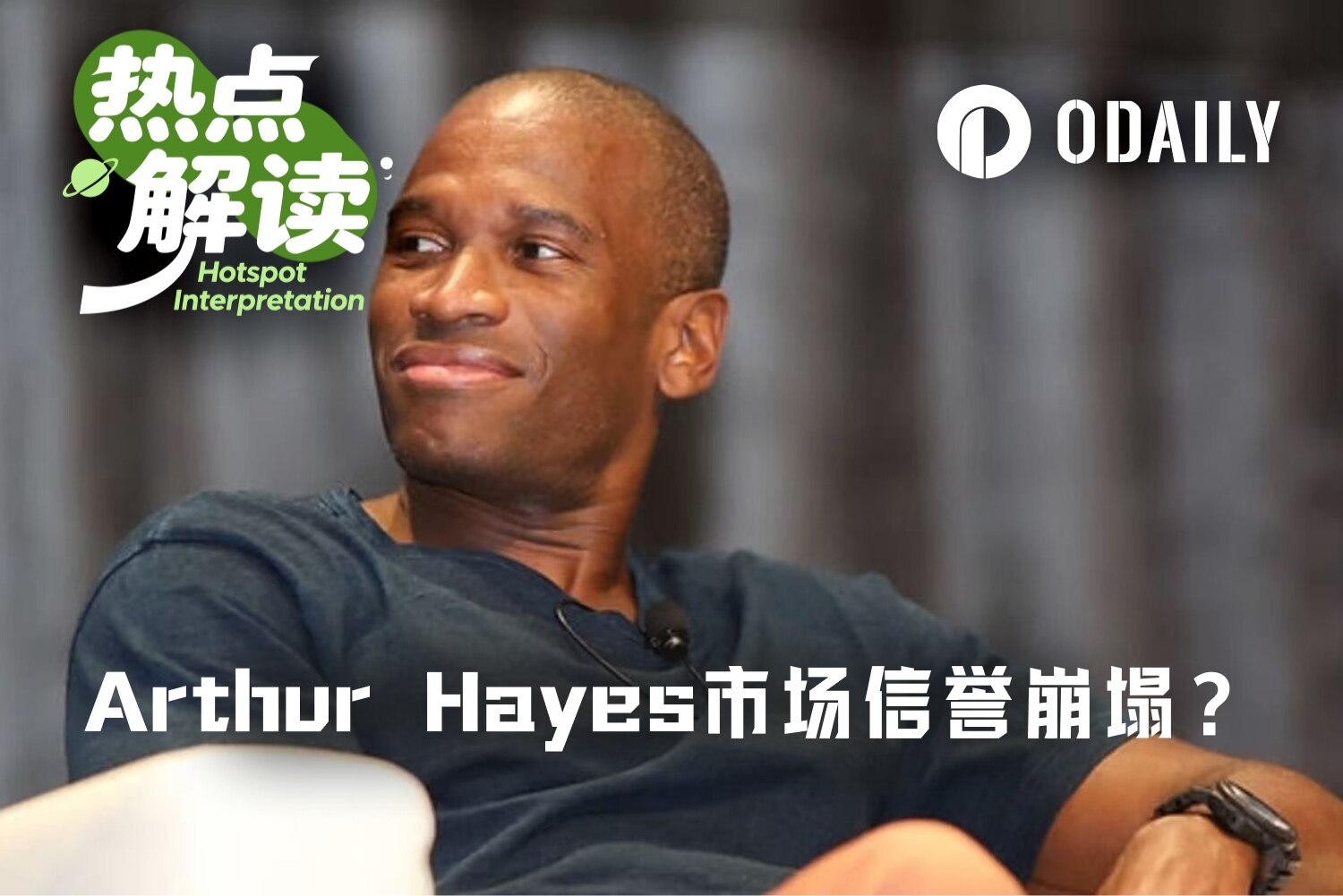
How much market credibility does Arthur Hayes have left? Recently, "the father of crypto perpetual contracts" and BitMEX co-founder Arthur Hayes has faced public criticism. On-chain detective ZachXBT has also publicly questioned how much exit liquidity he has created using his followers.

Liquidating HYPE, NEAR, WLD

Starting last week, Arthur Hayes performed several unexpected sell-offs to exit at the top.

Arthur Hayes had repeatedly stated publicly that HYPE would rise to $150 in this cycle. On June 1, Arthur Hayes passionately clashed with former Multicoin Capital co-founder Kyle Samani, who had disparaged Hyperliquid, and even made a $100,000 bet with him. However, just 3 days later, Arthur Hayes announced he had completely liquidated his HYPE and NEAR holdings. HYPE fell over 13.6% that day. His sell-off indeed allowed him to exit at the peak. HYPE reached a new high of $75.5 on June 4 before starting a continuous decline, currently trading around $62-64.

Besides HYPE and NEAR, Arthur Hayes also liquidated ZEC and WLD. Liquidating ZEC due to the Orchard Pool attack might be somewhat understandable. However, his sell-off of WLD resembles a classic "KOL dumping on retail" operation involving pre-positioning, public shilling, and finally pumping and dumping.

Because from publicly shilling WLD to liquidating it, Arthur Hayes only "pretended" for 3 days. On June 3, the day before selling HYPE, Arthur Hayes publicly shilled WLD with a $10 target, suggesting WLD would become an alternative for investors who couldn't directly participate in SpaceX equity trades. After the news spread, WLD rose over 35% that day. But by June 6, Arthur Hayes changed his tune, stating he had liquidated WLD because SpaceX's pre-IPO price action was "abnormal." This flimsy explanation caused WLD to drop over 20% that day.

The difference between Arthur Hayes and "third-rate KOLs" is that he writes lengthy posts, often justifying his actions from macroeconomic and top-level design perspectives.

On June 9, Arthur Hayes published a long article titled "Reality Test" (requiring about 20 minutes to read fully) explaining his recent moves. He believes three factors will burst the AI bubble: rising energy costs due to restricted traffic in the Strait of Hormuz, the IPOs of three major AI stocks (SpaceX, Anthropic, OpenAI), and Trump turning against AI for the midterm elections.

Therefore, his family office Maelstrom holds significant positions in U.S.-listed energy producers and has sold AI-related stocks and non-core crypto assets, holding only BTC and ETH.

Don't Listen to Arthur Hayes's Words, But Watch His Actions

Arthur Hayes's articles not only skillfully use extensive economic data and charts to argue his points but sometimes also overlay political and historical perspectives, which can be quite impressive. But when you take his words seriously and invest real money following his moves, he might announce a liquidation and turn bearish the very next day, seemingly forgetting what he said the day before, while your portfolio takes a simultaneous hit.

Such operations are not uncommon. As early as 2025, Arthur Hayes repeatedly performed the "bullish one day, liquidate the next" routine. The most classic example remains HYPE. In August 2025, Arthur Hayes promoted HYPE during a speech at Japan WebX, claiming the token still had up to 126x upside potential (Odaily note: the price was $45.9 that day). Yet just one month later, he announced liquidating HYPE, profiting millions, citing the need to avoid token unlock risks.

Arthur Hayes's sell-off then occurred precisely at the peak of HYPE's previous bull run, after which HYPE fluctuated downward. It wasn't until mid-January 2026 that Arthur Hayes again made large-scale purchases of HYPE. Judging from the price chart, his entry point for HYPE was again at the low point of this current cycle.

Similar examples include ETHFI and ENA, where he publicly expressed bullish views, then sold off without warning, achieving precise exits at the top. (Related reading:You Ran First Again! A Record of Arthur Hayes's Top Exits)

Long-term followers of Arthur Hayes have summarized a methodology: don't listen to Arthur Hayes's words, but you must watch his actions; follow his entries cautiously, and decisively liquidate when he sells.

However, if Arthur Hayes continues such performances, especially cases like manipulating WLD price volatility this time, no matter how reasonable the excuses are disguised, his market credibility will be threatened. This is like a crypto version of "The Boy Who Cried Wolf." In the end, Arthur Hayes will surely face backlash.

He said one thing right in his latest article—"I remain an unapologetic gambler," and gamblers usually don't end well.


Criptos en tendencia

Preguntas relacionadas

QWho is Arthur Hayes and why is his market credibility being questioned?

AArthur Hayes is the co-founder of BitMEX, often called the 'father of crypto perpetual contracts.' His market credibility is being questioned due to recent actions where he publicly promoted certain cryptocurrencies like HYPE and WLD, only to sell his holdings shortly after, which critics label as a classic 'pump and dump' strategy, manipulating exit liquidity from his followers.

QWhat specific cryptocurrencies did Arthur Hayes recently sell, and what were the consequences?

AArthur Hayes recently sold his holdings in HYPE, NEAR, ZEC, and WLD. For example, after publicly stating HYPE would reach $150, he sold it three days later, causing its price to drop over 13.6%. He also sold WLD just three days after promoting it, leading to a price drop of over 20%.

QWhat reasons did Arthur Hayes give in his article 'Reality Test' for selling his AI-related crypto assets?

AIn his article 'Reality Test,' Arthur Hayes cited three main reasons for selling AI-related crypto assets: 1) Rising energy costs due to restricted traffic in the Strait of Hormuz, 2) The potential IPO of major AI companies (SpaceX, Anthropic, OpenAI) bursting an AI bubble, and 3) His belief that former President Trump would oppose AI to aid midterm elections. Therefore, his family office shifted to holding energy stocks and core cryptocurrencies like BTC and ETH.

QAccording to the article, what is the suggested strategy for investors regarding Arthur Hayes's actions?

AThe article suggests that investors should not blindly follow Arthur Hayes's public statements but should closely monitor his actual on-chain transactions. The recommended strategy is to be cautious when he buys ('建仓谨慎跟随') and to decisively sell when he sells ('卖出果断清仓').

QWhat historical example does the article provide to show a pattern in Arthur Hayes's behavior?

AThe article provides the example of HYPE from August 2025. Arthur Hayes publicly promoted HYPE at the Japan WebX conference, claiming it had 126x growth potential. Just one month later, he sold all his HYPE holdings near the peak of that price cycle, citing token unlock risks, and re-entered the market at a low point in early 2026.

Lecturas Relacionadas

The Changing Landscape: What Are Crypto VCs Experiencing?

Title: The Shifting Landscape of Crypto Venture Capital The era of dedicated crypto venture capital funds is undergoing a significant transformation. Once essential for navigating the sector's complexity and high risk, these specialized funds are now facing an identity crisis as the market matures. This shift mirrors historical patterns in other specialized investment classes like cleantech and SPACs, where initial information advantages dissipate as technologies become mainstream and integrated into existing industry frameworks. The article argues that crypto is reaching a critical inflection point, transitioning from a "building phase" to an "integration phase." Major players like Stripe, BlackRock, and Visa now engage with crypto not for its novel mechanics but as a foundational financial infrastructure. Their needs—regulatory compliance, banking partnerships, distribution channels—align with traditional fintech, a domain easily understood by large, generalist funds like Sequoia and Founders Fund. This evolution creates a "barbell effect" within the VC landscape. On one end are massive, diversified platforms that can incorporate crypto as one vertical among many. On the other are small, nimble funds focused on niche, experimental projects. The middle ground—medium-sized dedicated crypto funds—is being squeezed out. Their typical fund size makes it impossible to generate sufficient returns solely from early-stage crypto bets, yet they cannot compete with giants for later-stage deals. Consequently, leading crypto-native firms like Paradigm and Framework Ventures are expanding into AI, robotics, and other sectors, driven partly by LP pressure for better returns amid a broader VC DPI crisis. Others, like Dragonfly and a16z, have narrowed their crypto focus predominantly to financial infrastructure like stablecoins, reframing the sector's core narrative. For crypto entrepreneurs, this consolidation presents challenges. While generalist funds offer larger checks and broader resources, crypto projects now compete fiercely with AI for attention and capital within these firms. Furthermore, the long-term, non-commercial foundational work that built the ecosystem—funded by dedicated crypto VCs—is less likely to attract generalist capital focused on direct returns. The conclusion is that "crypto investor" as a standalone category is becoming obsolete, akin to "internet investor." Crypto is becoming a baseline infrastructure layer. The future will see a barbell structure: large-scale growth financing handled by generalist funds, while pioneering, speculative projects are funded by small, specialized vehicles. The dedicated crypto funds of the 2017-2021 boom, which incubated core infrastructure, are giving way to this new, bifurcated reality.

Foresight NewsHace 14 min(s)

The Changing Landscape: What Are Crypto VCs Experiencing?

Foresight NewsHace 14 min(s)

As Consensus Accelerates, What Are Young Investors Betting On?

Title: As Consensus Forms Faster, What Are Young Investors Betting On? In the rapid evolution of tech investment, a new generation of young investors is navigating a landscape where AI, robotics, commercial aerospace, and quantum computing are advancing simultaneously. Traditional investment logic based on financial models is giving way to a need for deep technical understanding and the ability to act before industry consensus forms. An analysis of trends from the "WAIC FUTURE TECH" list of young investment leaders reveals key shifts in focus. The first major trend is the movement of AI from the digital screen into the physical world. Investment is shifting from large language models and chatbots towards embodied AI, robotics, AI hardware, and edge computing. While demonstrations generate excitement, the real challenge lies in achieving scalable, reliable, and cost-effective delivery in complex real-world environments like factories and logistics. Success depends not just on algorithms but on the integration of sensors, actuators, and control systems. Second, the competitive focus for large models is moving beyond raw capability toward building an "intelligence flywheel." The goal is to create self-reinforcing systems where user interaction generates data, improving the model, which in turn enhances the user experience and attracts more engagement. Companies that successfully embed AI into workflows to create these closed-loop systems can build lasting value that isn't easily erased by the next model upgrade. Third, facing a potential bottleneck in high-quality human-generated data, investors are looking at new underlying technologies. Reinforcement learning and self-play, as demonstrated by AlphaGo Zero, offer paths for AI to generate its own experience. Scientific foundation models, which aim to build general AI capabilities for fields like life sciences and materials discovery, represent a non-consensus direction that could unlock new frontiers of knowledge and data. Finally, in deep-tech areas like quantum computing, commercial aerospace, and space-based infrastructure, patient capital is essential. These fields have long, uncertain development and validation cycles involving complex engineering, supply chains, and regulations. Investment here requires a long-term view, focusing on foundational team capabilities and the eventual emergence of market demand, even if commercial returns are distant. Collectively, these trends illustrate how young investors are adapting to a new era. They are learning to make earlier, technically-informed judgments, balance hype with real-world viability, and provide the patient capital needed to build the deep-tech foundations of the future.

marsbitHace 42 min(s)

As Consensus Accelerates, What Are Young Investors Betting On?

marsbitHace 42 min(s)

Can Japan Buy Growth with AI? Will the Bond Market Believe It?

Japan's cabinet has introduced the 2026 Basic Policy on Economic and Fiscal Management and Reform, shifting its primary fiscal target. The new framework moves away from the traditional annual primary balance goal and instead prioritizes a stable reduction of the debt-to-GDP ratio. This change is tied to a strategy of increased "responsible proactive fiscal" spending, aiming to boost long-term growth through investments in strategic sectors like AI, semiconductors, energy, and robotics. The government estimates total public and private investment in 62 key technologies could exceed 370 trillion yen by 2040. The market reaction has been mixed and cautious. While equity markets may respond to policy signals, bond markets are focused on fiscal credibility. Concerns center on whether the weakening of the clear primary balance anchor could lead to looser fiscal discipline. If investors doubt that these strategic investments will generate sufficient productivity gains, tax revenue, and nominal growth to outpace rising interest costs, they may demand higher yields on Japanese Government Bonds (JGBs). Recent volatility in the yen and JGB yields, with the 10-year yield briefly reaching 2.9%, reflects this skepticism. The success of this new framework hinges on two factors: whether Japan can achieve a nominal growth rate consistently higher than its long-term interest rates, and whether future budgets demonstrate disciplined control over bond issuance. The government's narrative is that strategic investment is essential to break Japan's cycle of low growth, aging, and labor shortages. However, the bond market will continuously assess the credibility of this plan, pricing the risk that it may represent fiscal expansion rather than a viable growth strategy.

marsbitHace 1 hora(s)

Can Japan Buy Growth with AI? Will the Bond Market Believe It?

marsbitHace 1 hora(s)

Trading

Spot

Artículos destacados

Cómo comprar HYPE

¡Bienvenido a HTX.com! Hemos hecho que comprar Hyperliquid (HYPE) sea simple y conveniente. Sigue nuestra guía paso a paso para iniciar tu viaje de criptos.Paso 1: crea tu cuenta HTXUtiliza tu correo electrónico o número de teléfono para registrarte y obtener una cuenta gratuita en HTX. Experimenta un proceso de registro sin complicaciones y desbloquea todas las funciones.Obtener mi cuentaPaso 2: ve a Comprar cripto y elige tu método de pagoTarjeta de crédito/débito: usa tu Visa o Mastercard para comprar Hyperliquid (HYPE) al instante.Saldo: utiliza fondos del saldo de tu cuenta HTX para tradear sin problemas.Terceros: hemos agregado métodos de pago populares como Google Pay y Apple Pay para mejorar la comodidad.P2P: tradear directamente con otros usuarios en HTX.Over-the-Counter (OTC): ofrecemos servicios personalizados y tipos de cambio competitivos para los traders.Paso 3: guarda tu Hyperliquid (HYPE)Después de comprar tu Hyperliquid (HYPE), guárdalo en tu cuenta HTX. Alternativamente, puedes enviarlo a otro lugar mediante transferencia blockchain o utilizarlo para tradear otras criptomonedas.Paso 4: tradear Hyperliquid (HYPE)Tradear fácilmente con Hyperliquid (HYPE) en HTX's mercado spot. Simplemente accede a tu cuenta, selecciona tu par de trading, ejecuta tus trades y monitorea en tiempo real. Ofrecemos una experiencia fácil de usar tanto para principiantes como para traders experimentados.

252 Vistas totalesPublicado en 2024.12.11Actualizado en 2026.06.02

Cómo comprar HYPE

Discusiones

Bienvenido a la comunidad de HTX. Aquí puedes mantenerte informado sobre los últimos desarrollos de la plataforma y acceder a análisis profesionales del mercado. A continuación se presentan las opiniones de los usuarios sobre el precio de HYPE (HYPE).

活动图片












