Franklin Templeton Joins Blackrock, Fidelity, and Goldman Sachs in Supporting the CLARITY Act

cryptonews.ruPublicado a 2026-07-28Actualizado a 2026-07-28

Resumen

Financial giant Franklin Templeton has announced its support for the CLARITY Act, joining other major firms like BlackRock, Fidelity, and Goldman Sachs in advocating for clearer cryptocurrency regulations. The company, with $1.79 trillion in assets under management, stated the legislation would establish clearer rules for digital assets, providing regulatory certainty that the industry has long sought. The updated bill, recently released by Republican senators, aims to define the respective oversight roles of the SEC and CFTC over digital securities and commodities. Key supporters argue that a unified national regulatory framework is crucial for fostering responsible innovation, ensuring market transparency, and protecting investors. Wall Street banks have shown growing interest in blockchain-based services, viewing the act as a catalyst for broader institutional and retail adoption of digital assets.

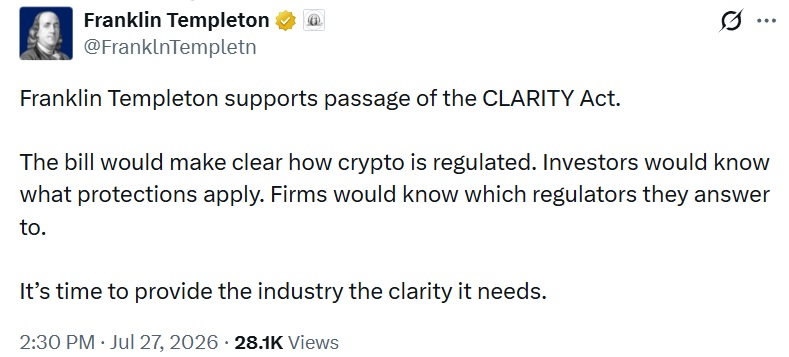
Financial giant Franklin Templeton, a subsidiary of Franklin Resources Inc. (NYSE: BEN), announced its support for the CLARITY Act on July 27 after reporting assets under management of $1.79 trillion as of June 30.

The company stated that the CLARITY Act would establish clearer rules for digital assets, helping investors better understand the protections available to them and providing companies with greater certainty about which federal regulatory bodies oversee their activities. Franklin Templeton added that this law would provide the regulatory clarity the crypto industry has long sought.
On July 6, Franklin Resources announced that preliminary data showed assets under management rose to $1.79 trillion at the end of June, up from $1.78 trillion the previous month, driven by long-term net inflows of $9 billion, partially offset by market fluctuations, income distributions, and other factors.

With this support, Franklin Templeton joins a number of companies such as the world's largest asset manager Blackrock Inc. (NYSE: BLK), investment giant Fidelity Investments, and global investment banking leader Goldman Sachs Group Inc. (NYSE: GS), all of which have publicly voiced their support for the CLARITY Act.

Financial Giants Urge Congress to Adopt Clearer Cryptocurrency Rules

Blackrock Senior Managing Director and Global Head of Market Development Samara Cohen characterized the bill as an important step toward creating a regulatory framework for digital assets that fosters innovation while maintaining transparency, market capital resilience, and investor protection, detailing Blackrock's rationale for supporting the legislation.

Fidelity Investments, which manages approximately $7.1 trillion in assets, also urged senators to approve the bill, arguing that a single national regulatory framework would encourage responsible innovation while providing greater certainty for investors and market participants as part of its call to advance the Senate bill.

Major Wall Street banks are also among the bill's supporters. Goldman Sachs CEO David Solomon endorsed the proposal, highlighting the banking sector's growing interest in tokenization, digital asset custody, trading, and blockchain-based financial services, as per his public statement in support of the proposal.

Charles Schwab Corp. (NYSE: SCHW), one of the nation's largest brokerage firms, also characterized the measure as a catalyst for broader adoption of digital assets by financial institutions and retail investors, while outlining its vision for the future of the industry.

Updated CLARITY Bill Defines Federal Oversight Mechanisms

On July 22, Republican senators unveiled an updated text of the CLARITY Act, reflecting the collaborative work of the Senate Banking Committee and the Senate Committee on Agriculture, as lawmakers sought to secure broader support.

According to the bill's official section-by-section summary, the proposal allocates responsibilities between the U.S. Securities and Exchange Commission (SEC) and the Commodity Futures Trading Commission (CFTC).

This regulatory framework defines how securities and digital commodities will be regulated, establishing registration standards, customer protection measures, disclosure obligations, and preserving anti-fraud authority.

end-content

Preguntas relacionadas

QOn what date did Franklin Templeton announce its support for the CLARITY Act?

AFranklin Templeton announced its support for the CLARITY Act on July 27.

QWhich other major financial companies have publicly supported the CLARITY Act according to the article?

AAccording to the article, Blackrock Inc., Fidelity Investments, Goldman Sachs Group Inc., and Charles Schwab Corp. have also publicly supported the CLARITY Act.

QWhat does the CLARITY Act aim to achieve regarding digital assets?

AThe CLARITY Act aims to establish clearer rules for digital assets, provide investors with better understanding of their protections, give companies greater certainty about which federal regulators oversee them, and provide the regulatory clarity the crypto industry has long sought.

QWhat was the value of assets under management by Franklin Resources as of the end of June?

AFranklin Resources had assets under management of $1.79 trillion as of the end of June.

QWhich two U.S. regulatory bodies does the CLARITY Act propose to assign responsibilities to for overseeing digital assets?

AThe CLARITY Act proposes to assign responsibilities to the U.S. Securities and Exchange Commission (SEC) and the Commodity Futures Trading Commission (CFTC).

Lecturas Relacionadas

In Jinjiang, Fujian, a Storage Super Unicorn Lies Quiet

In Fujian's Jinjiang, a city known for sportswear, lies a quiet semiconductor giant: Fujian Jinhua Integrated Circuit Co. (JHICC). Once a promising domestic DRAM manufacturer alongside Yangtze Memory and ChangXin Memory Technologies (CXMT), its journey was derailed in 2018 when the U.S. placed it on an Entity List and filed criminal charges for alleged trade secret theft. This halted production for years. A turning point came in February 2024 when a U.S. federal court found JHICC not guilty. However, it had lost crucial time. While CXMT soared to become a top-valued A-share company in 2024, JHICC, with an estimated valuation of 80 billion RMB, was just restarting. Its current output is primarily customized DDR4 chips, not the advanced DDR5/HBM demanded for AI, but it still benefits from the broader memory chip upcycle. JHICC's story is tied to Chen Zhengkun, a veteran engineer who left Micron to lead the venture. Founded in 2016 with state-backed funding, JHICC partnered with Taiwan's UMC to develop DRAM technology. Rapid progress was cut short by the U.S. actions, which Micron initiated, partly due to its heavy reliance on the Chinese market. Post-sanctions, Chen's team worked to rebuild the production line with reduced reliance on U.S. technology. According to its records, JHICC achieved small-scale production and revenue growth under immense pressure. It now focuses on the stable "niche" DRAM market (e.g., TVs, routers) with a monthly capacity of ~40,000 wafers, aiming for 60,000 by 2026. It holds over 1,000 patents but remains on the Entity List. For Jinjiang, investing in JHICC was a bold industrial leap. The local government provided unwavering financial and logistical support during the crisis, helping the company survive. JHICC has become the anchor for a growing local semiconductor cluster. Though its scale lags behind domestic peers, JHICC's persistence symbolizes a hard-won foothold in a global market long dominated by Samsung, SK Hynix, and Micron. Having missed one boom, it seeks a place in the new AI-driven memory supercycle.

marsbitHace 54 min(s)

In Jinjiang, Fujian, a Storage Super Unicorn Lies Quiet

marsbitHace 54 min(s)

Trading

Spot
活动图片




