Founder of Baixing.com: I Only Half Believe in the Notion that Large Language Models Devour Everything

链捕手Publicado a 2026-07-07Actualizado a 2026-07-07

Resumen

The founder of Baixing Wang states that while large language models (LLMs) are an extremely important foundational technology—akin to electricity or the internet—he only "half believes" the notion that they will "consume everything." He argues that LLMs provide a base layer of intelligence, but real-world value and transformation come from integrating this intelligence into specific applications and devices designed for particular scenarios—like how electricity powers various appliances from washing machines to TVs. He agrees LLMs will likely consume or replace a significant portion of existing rule-based, workflow-driven software (e.g., many SaaS systems, CRMs), as these are precisely what LLMs excel at handling. However, numerous other elements—such as customer data, execution capabilities (e.g., booking a flight), trust, and physical-world interactions—will not be consumed. Wang emphasizes that after LLMs absorb certain software layers, they will open up a much larger space for innovation: new types of "streaming" software with less rigid interfaces, where fixed rules are managed by AI. This next wave of applications built on top of the stable LLM foundation is where the true mainstream opportunity lies. He cautions against the short-sightedness of declaring any technology as all-consuming, drawing parallels to past premature predictions about internet giants monopolizing the web. The key is to find opportunities within the areas LLMs do transform.

Author: Wang Jianshuo, Founder of Baixing.com

Many people blurt out phrases like 'large models are everything.' I'm not so convinced.

Every time I hear phrases like 'devour everything,' I think it's mostly because our understanding of the future hasn't reached that level, leading us to make such broad statements. Otherwise, how could one thing devour everything? Take the internet for example—it has been touted as devouring everything for so many years, has it truly devoured everything now? So which is it, the internet devouring everything or large models devouring everything? Both are devouring, leaving nothing left?

So, I'd rather put it differently: it is a very important foundational layer. Without this foundation, the entire world cannot develop, just as the internet cannot exist without the underlying backbone network, or using electricity is impossible without power plants. This I acknowledge.

But once the foundation is in place, the real excitement happens on top of it.

Take electricity. Once electricity was generated, what were the first applications people saw? The light bulb. Thomas Edison lit the first one, and then it just kept shining, shining, shining. If the world ended there, with just one light bulb, I could totally say: the power plant is the core of the entire world, the power plant devours everything.

But that's not how it happened. Later came motors to drive machines; then you realize that once you have a fundamental thing like electricity, countless electrical appliances will grow on top of it to use it. Washing machines are for washing clothes, televisions are for watching TV, vacuum cleaners are for vacuuming—they are all applications of electricity. Without electricity, none of these things would exist. But if you say 'electricity devours everything,' I don't believe it.

Large language models are the same. They provide foundational intelligence. But this intelligence must be placed into a specific, scenario-oriented 'machine' or 'appliance' to truly function and change the world.
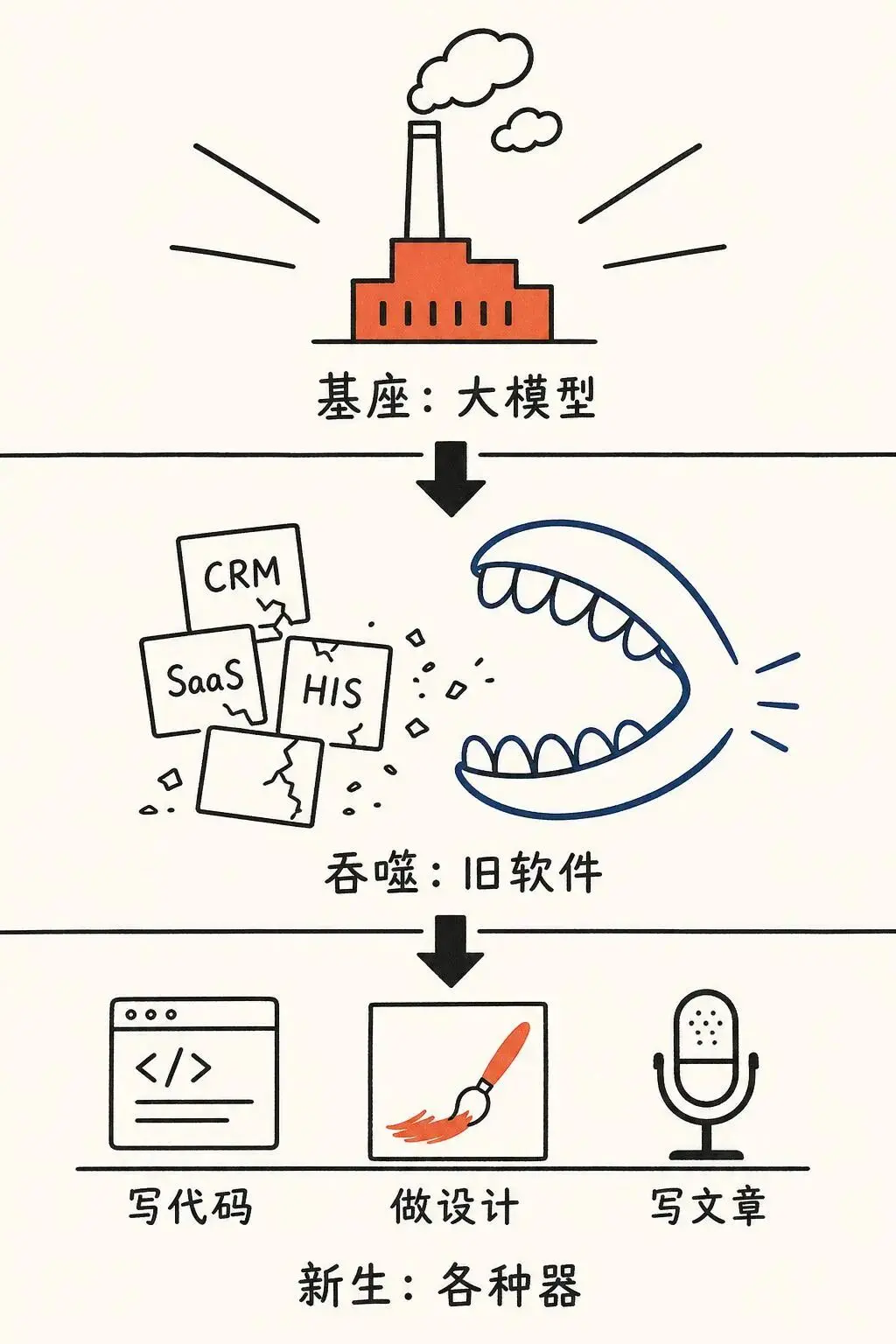
Claude Code is for writing code, Claude Design is for design, VoiceDrop is for writing articles. The same large model, placed into different 'appliances,' solves completely different problems.

Just having electricity, just having water, without a washing machine, clothes still can't be washed. Imagine, the power plant produces a massive amount of electricity, the electricity is incredibly powerful, and then what? Without a washing machine, can this pile of electricity wash clothes by itself?

Intelligence is great, but most things in the world require the combination of multiple elements to work, just as a washing machine needs to combine elements like electricity, water, and even a drum. Large models might replace a lot in the field of software, but there aren't many application scenarios in the world that require only one element.

Let's take a current example. We have large models now, but just having a large model isn't enough. There needs to be a layer on top of it called Harness—this layer has only recently emerged—which interacts with code to finally form something truly usable. A large model by itself cannot write code. Of course, the core of something like Claude Code, honestly, I could write it in fifty-odd lines, add a few more for longer versions, and it could run to write programs. But you must see: with only the large model and without this outer layer, it's still not user-friendly—meaning, the intelligence of the large model, if not combined with the code execution capabilities provided by an operating system, relying on the large model for calculations is uneconomical and sometimes even impossible.

The core value of this interface layer is to help us put that intelligence, akin to electricity and water, into a specific application scenario, turning it into a machine that solves a concrete problem.

Having said that, of course, I don't completely disbelieve the logic behind 'devour everything.'

What it mainly refers to is existing software. Up until now, we have piled up a very large layer of software—things pieced together with many rules, forms, buttons, workflows. A lot of filters, fixed templates, backend operations, many SaaS detection functions. And the various things we used to know as 'M' systems, whether CRM, HIS (hospital information system), all sorts of things called 'systems,' 'software,' or whatever, a whole lot.

This layer, I believe large language models will indeed devour quite a bit of.

Why? Because these software were originally formed by solidifying and repeatedly executing clear, computer-executable instructions—that's what we call software. And this is precisely what large language models are most adept at tackling.

But.

Beyond software, within this layer, there are many other things. Customer information. Execution capabilities—like when you book an airline ticket, the actual capability to move a plane, to transport people from here to there. And trust. Many things in the physical world. These, I don't think will be devoured.

After devouring that layer, it actually opens up an even larger space—on top of it lies the new type of software.

The new software will definitely have a fluid interface; it likely won't solidify as many rules as before. After handing all those rules to AI, think about it, before we could achieve something like Salesforce's CRM, which was already the pinnacle of human effort, requiring immense struggle. If this part becomes relatively easier to solve, then what everyone will work on next is unlocking even more imagination, more possibilities on top of that—and that part is precisely what we haven't seen yet.

This is the mistake we often make. When a new technology arrives, because we can't see the bigger path that follows, we can only focus on the immediate part. We see the leaf but not the forest.

Forget such trend judgments. I still remember in 2004, a group of friends were complaining together, saying that the entire internet could never produce companies larger than Sina, Sohu, and NetEase, that the internet was almost over, that they would monopolize everything. And look how many years have passed since then? The world turned upside down. We would be shocked by our own shortsightedness back then.

So my view is this: Are large models important? Yes, they are a foundational layer, the main focus of recent times. But once they become stable, continuously provided resources, they will require various 'machines' and 'appliances' on top to solve specific problems. That thick layer—where it's used, how it's used—will be the mainstream of the second wave of this trend.

The phrase 'devour everything' is far too imprecise. What thing, what social form, what technology in the world has ever truly devoured everything?

Finding the opportunities within the areas it does devour—that is what truly matters.

Criptos en tendencia

Preguntas relacionadas

QWhy does the founder of Baixing.com believe that 'large models will devour everything' is an imprecise statement?

AHe believes it's imprecise because no single technology has ever truly devoured everything. Large models are a foundational infrastructure, like electricity or the internet, but to be useful, they need to be integrated into specific applications ('machines' or 'devices') that solve real-world problems. They are an essential base, not the entirety of the solution.

QWhat is the author's main analogy for explaining the role of large language models?

AThe author compares large language models to electricity. Just as electricity is a foundational utility that powers various specific appliances (like light bulbs, washing machines, and TVs), large models provide a base of 'intelligence' that must be channeled into specific application tools to solve concrete problems in different fields.

QAccording to the article, what layer of the current software stack is most susceptible to being 'devoured' by large language models, and why?

AThe layer of current software built on fixed rules, forms, workflows, and templates (like many SaaS applications, CRMs, or HIS systems) is most susceptible. This is because such software essentially consists of clear, computer-executable instructions—precisely what large language models are good at processing and generating, making them efficient at handling these structured tasks.

QWhat new layer or space does the author predict will emerge after large models 'devour' parts of the existing software layer?

AThe author predicts the emergence of a larger space for new types of software. Once AI handles the rule-based logic, software can become more 'stream-like' and fluid, without needing to hardcode so many rules. This opens up more imagination and possibilities for applications that are currently unseen, moving beyond the limitations of traditional, rigidly structured software.

QWhat historical example does the author use to caution against short-sightedness when evaluating new technological trends?

AThe author recalls the year 2004, when people complained that the internet was nearing its end, with companies like Sina, Sohu, and NetEase monopolizing everything and no larger companies could emerge. Looking back just a few years later, this view was proven completely wrong and short-sighted, as the internet landscape transformed dramatically.

Lecturas Relacionadas

Treasury Secretary's Move to Suppress Treasury Yields Ignites 'Currency Debasement Trade'! Gold Hits Three-Month High, Bitcoin Surges Over 25% in a Single Week

US Treasury Secretary Besant's efforts to lower long-term Treasury yields by announcing expanded buybacks had only a brief market impact. However, this move fueled a "currency devaluation trade," weakening the US dollar while boosting both gold (to a three-month high) and Bitcoin (up over 25% for the week). Analysts attribute this reaction to deepening market concerns over the massive US fiscal deficit and structural pressures keeping long-term rates elevated, including fierce competition for capital from global government borrowing and massive AI sector financing. Despite the Treasury's actions, fundamental forces like growth, inflation, and capital demand are seen as limiting its ability to sustainably suppress yields. Bitcoin's strong positive correlation with gold has reinforced its narrative as a hedge against devaluation. While equity markets have shown resilience, some strategists warn that Treasury yields nearing 5% increase pressure on the dollar and high-leverage assets. Figures like Ray Dalio have advised reducing bond exposure in favor of gold and some Bitcoin, citing US debt risks. Market opinions are divided on the sustainability of the devaluation trade, with some noting the lack of a near-term catalyst for its next leg higher. The underlying tension between the Treasury's desire for lower borrowing costs and the Federal Reserve's focus on inflation and reducing market intervention remains a key theme. Upcoming events like Nvidia's earnings and the Jackson Hole symposium will test whether AI profits can continue supporting stocks and if the Fed aligns more with Washington's preference for easier financial conditions.

华尔街日报Hace 1 hora(s)

Treasury Secretary's Move to Suppress Treasury Yields Ignites 'Currency Debasement Trade'! Gold Hits Three-Month High, Bitcoin Surges Over 25% in a Single Week

华尔街日报Hace 1 hora(s)

Alexander Shokhin: Business Needs an Interest Rate Below 10% and the Dollar at 90-95 Rubles

Alexander Shokhin, head of the Russian Union of Industrialists and Entrepreneurs (RSPP), has advocated for potentially using "non-market" tools to keep the ruble within a target exchange rate corridor. This, he argues on August 21, would help avoid excessive volatility, though he called the topic a separate discussion. Shokhin had previously raised the idea of a currency corridor in late May, noting the ruble's current exchange rate is not fully market-driven due to a limited currency segment and reduced foreign currency demand. He stated that many business community colleagues propose fixing a corridor, even through non-market methods, to ensure predictability. The business community's key targets, as outlined by Shokhin in late December 2025, are a Central Bank key rate of 12%, inflation of 4–5%, and a US dollar exchange rate of 90–95 rubles by the end of 2026. A turning point for investment, he said, would be lowering the rate to 12% with 6% inflation, though truly comfortable business conditions would require a rate below 10%. He stressed the critical importance of currency predictability for corporate investment decisions. From a data analysis perspective, the idea of a ruble corridor is not new. A similar mechanism was used in Russia from 1995 to 1998, where the central bank held the dollar within fixed boundaries through regular interventions. This regime lasted three years before ending abruptly during the 1998 default, illustrating the fragility of rigid targets under external shocks. The macro-economic link is clear: stricter corridors require more reserves to defend against currency pressure. The key unresolved technical aspect is the specific sources and volume of such interventions given the current market's limited liquidity. Whether this discussion remains theoretical or leads to concrete corridor parameters will be seen in the coming months.

cryptonews.ruHace 3 hora(s)

Alexander Shokhin: Business Needs an Interest Rate Below 10% and the Dollar at 90-95 Rubles

cryptonews.ruHace 3 hora(s)

Trading

Spot

Artículos destacados

Cómo comprar PEOPLE

¡Bienvenido a HTX.com! Hemos hecho que comprar ConstitutionDAO (PEOPLE) sea simple y conveniente. Sigue nuestra guía paso a paso para iniciar tu viaje de criptos.Paso 1: crea tu cuenta HTXUtiliza tu correo electrónico o número de teléfono para registrarte y obtener una cuenta gratuita en HTX. Experimenta un proceso de registro sin complicaciones y desbloquea todas las funciones.Obtener mi cuentaPaso 2: ve a Comprar cripto y elige tu método de pagoTarjeta de crédito/débito: usa tu Visa o Mastercard para comprar ConstitutionDAO (PEOPLE) al instante.Saldo: utiliza fondos del saldo de tu cuenta HTX para tradear sin problemas.Terceros: hemos agregado métodos de pago populares como Google Pay y Apple Pay para mejorar la comodidad.P2P: tradear directamente con otros usuarios en HTX.Over-the-Counter (OTC): ofrecemos servicios personalizados y tipos de cambio competitivos para los traders.Paso 3: guarda tu ConstitutionDAO (PEOPLE)Después de comprar tu ConstitutionDAO (PEOPLE), guárdalo en tu cuenta HTX. Alternativamente, puedes enviarlo a otro lugar mediante transferencia blockchain o utilizarlo para tradear otras criptomonedas.Paso 4: tradear ConstitutionDAO (PEOPLE)Tradear fácilmente con ConstitutionDAO (PEOPLE) en HTX's mercado spot. Simplemente accede a tu cuenta, selecciona tu par de trading, ejecuta tus trades y monitorea en tiempo real. Ofrecemos una experiencia fácil de usar tanto para principiantes como para traders experimentados.

711 Vistas totalesPublicado en 2024.12.12Actualizado en 2026.06.02

Cómo comprar PEOPLE

Discusiones

Bienvenido a la comunidad de HTX. Aquí puedes mantenerte informado sobre los últimos desarrollos de la plataforma y acceder a análisis profesionales del mercado. A continuación se presentan las opiniones de los usuarios sobre el precio de PEOPLE (PEOPLE).

活动图片