Founder: DefiLlama Delayed Mobile App Launch Due to Phishing Apps in App Store

cryptonews.ruPublicado a 2026-08-16Actualizado a 2026-08-16

Resumen

DefiLlama has delayed the launch of its official mobile app, spending months trying to convince Apple to remove phishing apps from the App Store that were impersonating the analytics platform, according to its pseudonymous founder 0xngmi. The team waited to release its own app to prevent users from falling victim to the scams. One malicious app was removed by Apple "within days" only after DefiLlama documented the app withdrawing funds from a test wallet. Fake apps posing as major crypto brands like Rabby Wallet and Curve Finance have previously appeared in the App Store, and a counterfeit Ledger Live app in the Microsoft Store led to the theft of $588,000 in late 2023.

DefiLlama has delayed the launch of its mobile app after spending several months trying to get Apple to remove phishing applications from the App Store that were impersonating the analytics platform, according to the company's pseudonymous founder 0xngmi.

"We waited for all the fake apps to be removed before launching our own so that users wouldn't fall victim to scammers," 0xngmi said in a Saturday post on X.

DefiLlama had been trying for months to get a specific malicious app removed, but Apple only took it down "a few days" after the team downloaded the application and documented it draining funds from a small wallet, 0xngmi added.

Cointelegraph reached out to Apple for comment.

Fake apps impersonating well-known cryptocurrency brands have previously appeared on the App Store, including an app posing as the Rabby wallet and a Curve Finance app in 2024.

In November 2023, a fake Ledger Live app on the Microsoft Store led to the theft of $588,000 across 38 transactions.

Magazine: How a 'wrong number' message turned into a $3.4M crypto scam

end-content

Preguntas relacionadas

QWhy did DefiLlama postpone the launch of its mobile app?

ADefiLlama postponed the launch because it spent months trying to get Apple to remove phishing apps from the App Store that were impersonating its analytics platform. They waited to ensure all fake apps were removed so users wouldn't fall victim to scams.

QWhat action did DefiLlama take to finally get a malicious app removed from the App Store?

ADefiLlama downloaded the malicious app and documented it withdrawing funds from a small wallet. After presenting this evidence to Apple, the app was removed within a few days.

QAccording to the article, what other cryptocurrency brands have had fake apps impersonate them in the App Store?

AAccording to the article, fake apps impersonating the Rabby wallet and Curve Finance have appeared in the App Store. The article also mentions a fake Ledger Live app in the Microsoft Store.

QHow much money was reportedly stolen due to the fake Ledger Live app mentioned in the article?

AThe fake Ledger Live app reportedly led to the theft of $588,000 across 38 transactions.

QWho is the pseudonymous founder of DefiLlama quoted in the article?

AThe pseudonymous founder quoted in the article is known as 0xngmi.

Lecturas Relacionadas

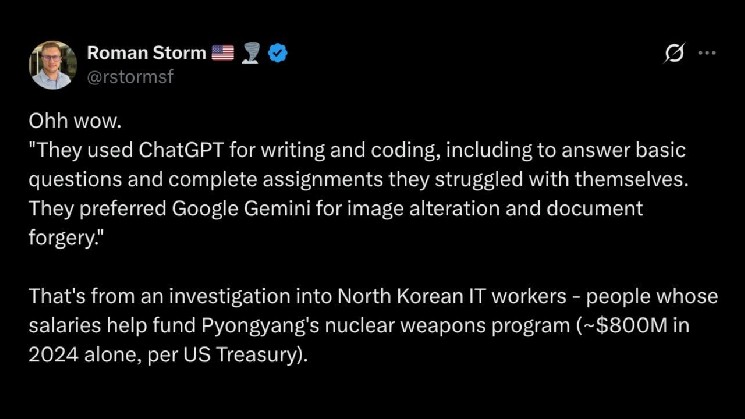
Roman Storm Accuses Google and OpenAI in Connection with U.S. Department of Justice Ruling on Cryptocurrency Case

Roman Storm, founder of the cryptocurrency anonymization protocol Tornado Cash, convicted in August 2025 for conspiracy to operate an unlicensed money-transmitting business, has accused Google and OpenAI of facilitating North Korea's nuclear program. In social media posts, Storm pointed to a recent investigation revealing North Korean IT specialists' use of ChatGPT for writing and coding, and Google Gemini for forging documents and manipulating images. He argued that, under the same legal logic the U.S. Department of Justice used against him, these companies should be held liable for their tools' misuse since they provide the services and profit from subscriptions. Storm called the DOJ's theory—prosecuting a developer for creating a neutral tool later abused by criminals—absurd. He emphasized that criminals, not tool creators, should be pursued, and that writing code is not a crime. The Tornado Cash verdict sets a negative U.S. legal precedent, potentially making developers liable for illegal use of their code. Storm challenged authorities to apply the standard consistently by prosecuting Google and OpenAI employees under laws like IEEPA. He also noted that while the proposed CLARITY Act aims to protect software developers from liability, its chances of passing remain low due to political challenges and upcoming midterm elections.

cryptonews.ruHace 16 min(s)

Roman Storm Accuses Google and OpenAI in Connection with U.S. Department of Justice Ruling on Cryptocurrency Case

cryptonews.ruHace 16 min(s)

Trading

Spot
活动图片