Five Years Later, Vitalik Overturns the Future He Set for Ethereum

marsbitPublicado a 2026-02-04Actualizado a 2026-02-04

Resumen

Five years after championing Layer 2 (L2) scaling as Ethereum's future, Vitalik Buterin has dramatically reversed his position, declaring that L2s have largely failed to fulfill their original vision of "branded sharding." In a pivotal post, he argued that most L2 solutions remain highly centralized, reliant on multi-signature bridges and sequencers, and thus are not truly extending Ethereum's security or decentralization. The initial push for L2s was a survival response to Ethereum's cripplingly high fees and congestion during the 2021 DeFi and NFT boom, when competitors like Solana gained traction. However, despite massive venture funding—with projects like Arbitrum, Optimism, and Starknet raising billions—progress toward full decentralization (Stage 2) has been slow. Many operate more like centralized databases, prioritizing control and regulatory compliance over Ethereum's core values. Meanwhile, Ethereum itself has scaled significantly. Through upgrades like EIP-4844 and increased gas limits, L1 transaction fees have plummeted by over 99%, often costing just cents. This reduces L2's cost advantage and exposes their drawbacks: bridge vulnerabilities, fragmented liquidity, and complex user experiences. Vitalik now urges L2s to pivot from mere scaling to providing unique functional value—like privacy, ultra-fast finality, or application-specific optimizations—that L1 cannot easily offer. He reframes L2s as a spectrum of specialized "plugins" rather than essential scaling...

On February 3, 2026, Vitalik Buterin said something on X.

The shockwaves this statement sent through the Ethereum community were no less than those caused by his vigorous promotion of the "Rollup-centric" roadmap in 2020. In that post, Vitalik admitted: "The initial vision of Layer2 as 'Branded Sharding' to solve Ethereum's scalability is no longer valid."

One sentence, almost declaring the end of Ethereum's mainstream narrative of the past five years. The Layer2 camp, once seen as the lifeline and savior of Ethereum, is facing its biggest legitimacy crisis since its birth. More direct criticism followed. Vitalik wrote mercilessly in the post: "If you create an EVM that handles 10,000 transactions per second, but its connection to L1 is through a multi-signature bridge, then you are not scaling Ethereum."

Why has the former lifeline become the burden to be discarded today? This is not just a shift in technical路线, but a brutal game of power, profit, and ideals. The story begins five years ago.

How Did Layer2 Become Ethereum's Lifeline?

The answer is simple: it wasn't a technical choice, but a survival strategy. Let's go back to 2021. Ethereum was then mired in the quagmire of being a "noble chain".

The data doesn't lie: On May 10, 2021, Ethereum's average transaction fee reached a historical peak of $53.16. During the craziest period of the NFT boom, Gas prices once soared above 500 gwei. What does this mean? A simple ERC-20 token transfer could cost tens of dollars, and a token swap on Uniswap could cost $150 or even more.

The DeFi Summer of 2020 brought unprecedented prosperity to Ethereum, with the Total Value Locked (TVL) skyrocketing from $700 million at the beginning of the year to $15 billion by the end of the year, an increase of over 2100%. But the price of this prosperity was extreme network congestion. By 2021, when the NFT wave hit, the minting and trading of blue-chip projects like Bored Ape Yacht Club made the network worse. The Gas fee for a single NFT transaction often amounted to hundreds of dollars. A collector was once offered over 1000 ETH for a Bored Ape in 2021 but ultimately gave up due to the high Gas fees and complex transaction process.

At the same time, a challenger named Solana emerged. Its data was staggering: tens of thousands of transactions per second throughput, transaction fees as low as $0.00025. The Solana community not only mocked Ethereum's performance but also directly attacked its bloated and inefficient architecture. The rhetoric that "Ethereum is dead" was rampant, and the community was filled with anxiety.

It was against this backdrop that in October 2020, Vitalik formally proposed a concept in "A Rollup-Centric Ethereum Roadmap": positioning Layer2 as Ethereum's "Branded Sharding". The core of this idea was that Layer2 would process massive transactions off-chain, then package and send the compressed results back to the mainnet, theoretically achieving infinite scaling while inheriting the security and censorship resistance of the Ethereum mainnet.

At that point in time, the entire future of the Ethereum ecosystem was almost entirely bet on the success of Layer2. From the Dencun upgrade in March 2024 introducing EIP-4844 (Proto-Danksharding), specifically providing cheaper data availability space for Layer2, to various core developer meetings, everything was paving the way for Layer2. After the Dencun upgrade, Layer2 data publishing costs dropped by at least 90%, and Arbitrum's transaction fees plummeted from about $0.37 to $0.012. Ethereum tried to gradually push L1 into the background, making it a quiet "settlement layer".

But why didn't this bet pay off?

Those "Centralized Databases" with $1.2 Billion Valuations

If Layer2 had truly realized its initial vision, it wouldn't be falling out of favor today. But the problem is, what exactly did they do wrong?

Vitalik pointed out the fatal flaw in his article: the progress towards decentralization is too slow. The vast majority of Layer2s have not yet reached Stage 2—having a fully decentralized fraud or validity proof system and allowing users to withdraw assets permissionlessly in emergencies. They are still controlled by centralized sequencers that manage the packaging and ordering of transactions. In essence, they are closer to centralized databases disguised as blockchains.

The conflict between commercial reality and technological ideals is exposed here. Take Arbitrum as an example. Its development company, Offchain Labs, received a $120 million investment in its Series B round in 2021, valuing the company at $1.2 billion, with investors including top-tier firms like Lightspeed Venture Partners. But until today, this behemoth with over $15 billion in locked funds, holding about 41% of the Layer2 market share, remains at Stage 1.

Optimism's story is equally intriguing. This project, led by Paradigm and Andreessen Horowitz (a16z), completed a $150 million Series B round in March 2022, with total funding reaching $268.5 million. In April 2024, a16z privately purchased $90 million worth of OP tokens. But even with such strong capital support, Optimism also only reached Stage 1.

The rise of Base reveals another dimension of the problem. As a Layer2 launched by Coinbase, Base quickly became a market darling after its mainnet launch in August 2023. By the end of 2025, Base's TVL reached $4.63 billion, capturing 46% of the entire Layer2 market share, surpassing Arbitrum to become the Layer2 with the highest DeFi TVL. But Base is even less decentralized, as it is entirely controlled by Coinbase, making its technical architecture closer to a centralized sidechain.

Starknet's story is even more ironic. This Layer2 using ZK-Rollup technology, developed by Matter Labs, has raised a total of $458 million, including a $200 million Series C round led by Blockchain Capital and Dragonfly in November 2022. But its token STRK price has shrunk by 98% compared to its historical high, with a market cap of about $283 million. According to on-chain data, the protocol revenue it generates daily is not even enough to cover the operating costs of a few servers, and its core nodes remain highly centralized, only reaching Stage 1 by mid-2025.

Some project teams have even privately admitted that they may never fully decentralize. Vitalik cited a case in his post: a certain project argued that they would never further decentralize because "the regulatory needs of their clients require them to have ultimate control." This彻底激怒了Vitalik, and he responded毫不客气地:

"This might be the right thing for your clients. But it's clear that if you do this, then you are not 'scaling Ethereum.'"

This comment almost sentences to death all projects that fly the Ethereum L2 flag but refuse to decentralize. Ethereum wants a分身 that can extend decentralization and security to a broader space, not a group of附庸 that wear the skin of Ethereum but practice centralization.

The deeper problem is that there is an irreconcilable conflict between decentralization and commercial interests. Centralized sequencers mean project parties can control MEV (Maximal Extractable Value) income, respond more flexibly to regulatory requirements, and iterate products faster. Full decentralization means giving up this control and handing power over to the community and the validator network. For those with venture capital funding and growth pressure, this is a difficult choice.

If Layer2 had truly achieved full decentralization, would they still fall out of favor? The answer might still be yes. Because, Ethereum itself has changed.

When the Mainnet is Faster and Cheaper than Sidechains

Why does Ethereum no longer need Layer2 for scaling as much?

As early as February 14, 2025, Vitalik released a key signal. He published an article titled "Even in an L2-heavy Ethereum, there are reasons to have a higher L1 Gas limit," clearly stating that "L1 is scaling." This sounded more like comfort for mainnet fundamentalists at the time, but looking back now, it was actually the charge for the Ethereum mainnet to start competing with Layer2 again.
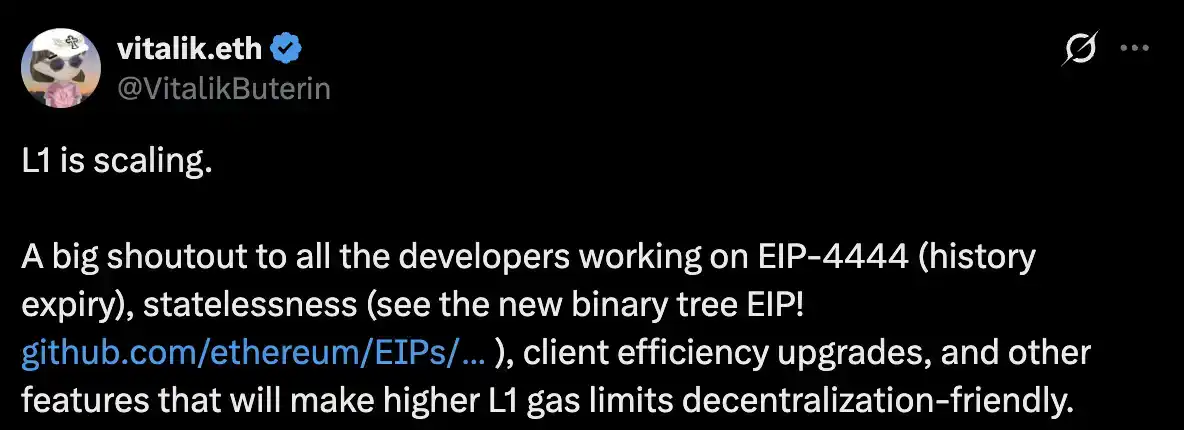
Over the past year, the scaling speed of Ethereum L1 has far exceeded everyone's expectations. Technological breakthroughs came from multiple dimensions: EIP-4444 reduced the storage需求 for historical data, stateless client technology made node operation lighter, and most critically, the continuous increase in the Gas Limit. At the beginning of 2025, Ethereum's Gas Limit was still 30 million; by mid-year, it had increased to 36 million, a 20% growth. This was the first significant increase in Ethereum's Gas Limit since 2021.

But this was just the beginning. According to the plans of Ethereum core developers, there will be two major hard fork upgrades in 2026. The Glamsterdam upgrade will introduce perfect parallel processing capabilities, and the Gas Limit will soar from 60 million to 200 million, an increase of over 3 times. The Heze-Bogota fork will add the FOCIL (Fork-Choice Enforced Inclusion Lists) mechanism, further improving block construction efficiency and censorship resistance.

The Fusaka upgrade completed on December 3, 2025, already allowed the market to witness the power of L1 scaling. After the upgrade, Ethereum's daily transaction volume increased by about 50%, the number of active addresses rose by about 60%, and the 7-day moving average of daily transaction volume reached a historical high of 1.87 million, surpassing the records of the 2021 DeFi peak period.

The results are astounding: Ethereum mainnet transaction fees have dropped to extremely low levels. In January 2026, the average transaction fee on Ethereum dropped to $0.44, a decrease of over 99% compared to the peak of $53.16 in May 2021. During off-peak hours, the cost of a transaction is often below $0.1, sometimes even as low as $0.01, with Gas prices as low as 0.119 gwei. This number is already close to Solana's level, and Layer2's biggest cost advantage is being quickly erased.

Vitalik did a detailed calculation in that February article. He assumed an ETH price of $2500, a Gas price of 15 gwei (long-term average), and a demand elasticity close to 1 (i.e., doubling the Gas Limit would halve the price). Under this assumption:

Censorship resistance demand: Currently, enforcing a transaction censored by L2 through L1 requires about 120,000 gas, costing $4.5. To reduce the cost to below $1, L1 needs to scale 4.5 times.

Cross-L2 asset transfer: Currently, withdrawing from one L2 to L1 requires about 250,000 gas, and depositing into another L2 requires 120,000 gas, totaling $13.87. With an ideal optimized design, it would only require 7,500 gas, costing $0.28. To reach the target of $0.05, it needs to scale 5.5 times.

Mass exit scenario: Taking Sony's Soneium as an example, PlayStation has about 116 million monthly active users. Using an efficient exit protocol (7,500 gas per user), the current Ethereum can just support the emergency exit of 121 million users within a week. But to support multiple applications of this scale, L1 needs to scale about 9 times.

And these scaling goals are being realized step by step in 2026. Technological progress has彻底改变了the rules of the game. When L1 itself can become fast and cheap, why should users still endure the cumbersome cross-chain bridging, complex interaction experience, and potential security risks of Layer2?

The security issues of cross-chain bridges are not unfounded fears. In 2022, cross-chain bridges became a major target for hacker attacks. In February, the Wormhole bridge was hacked for $325 million; in March, the Ronin bridge suffered the largest DeFi attack in history, losing $540 million; and bridge protocols like Meter and Qubit were successively breached. According to Chainalysis statistics, in 2022 alone, the total amount of cryptocurrency stolen from cross-chain bridges reached $2 billion, accounting for the majority of all DeFi attack losses that year.

Liquidity fragmentation is another pain point. With the surge in the number of Layer2s, the liquidity of DeFi protocols is分散到dozens of different chains, leading to increased transaction slippage, reduced capital efficiency, and worsened user experience. A user wanting to move assets between different Layer2s needs to go through a complex bridging process, wait for long confirmation times, and bear additional costs and risks.

This leads to the next, and most brutal, question: what should those Layer2 projects that raised huge funds and issued tokens do now?

Valuation Bubbles and Ghost Towns

Where did all the Layer2 money go?

In the past few years, the Layer2 track has been more like a huge financial game than a technological revolution. Venture capital firms waved checks, pushing the valuations of L2 projects to staggering heights. zkSync raised a total of $458 million, Arbitrum's背后的Offchain Labs was valued at $1.2 billion, Optimism raised $268.5 million, Starknet raised $458 million. Behind these numbers are top VCs like Paradigm, a16z, Lightspeed, Blockchain Capital.

Developers were keen on "套娃" (nesting) across different L2s, building complex DeFi legos to attract more liquidity and airdrop hunters. But real users were worn out by the tedious cross-chain operations and high hidden costs.

A残酷的现实is that the market is highly concentrated towards the top. According to data from crypto research firm 21Shares, the three major L2s—Base, Arbitrum, and Optimism—already control nearly 90% of the transaction volume. Base, leveraging Coinbase's traffic advantage and user base, achieved explosive growth in 2025, its TVL soaring from $1 billion at the beginning of the year to $4.63 billion by the end of the year, with quarterly transaction volume reaching $59 billion, a 37% increase quarter-on-quarter. Arbitrum followed closely with about $19 billion TVL, and Optimism after that.

But outside the top tier, most L2 projects, after losing the drive of airdrop expectations, saw their real user numbers quickly drop to freezing point, becoming名副其实的"ghost towns". Starknet is the most typical example. Although its token price has fallen 98% from its high, its price-to-earnings ratio is still in a very high bubble range relative to its extremely low daily active users and fee income. This means there is a huge gap between the market's expectations for its future and its current ability to create real value.

More ironically, when Layer2 fees dropped significantly due to EIP-4844, the data availability fees they paid to L1 also plummeted, which in turn reduced the fee income of Ethereum L1. In January 2026, an analysis pointed out that the Dencun upgrade caused a large number of transactions to shift from L1 to cheaper L2s, which was one of the main reasons for Ethereum network fees dropping to their lowest level since 2017. While Layer2 was reducing its own costs, it was also "emptying" the economic value of L1.

21Shares predicted in its 2026 Layer2 Outlook report that most Ethereum Layer2s may not survive 2026, the market will experience a残酷的整合, and ultimately only those projects with high performance, true decentralization, and unique value propositions will prevail.

This is the real intention behind Vitalik's recent "challenge". He wants to burst this "infrastructure circle-jerk" bubble and pour a bucket of cold water on this sick market. If a Layer2 cannot provide functions more interesting and valuable than L1, then it will ultimately become just an expensive transitional product in Ethereum's development history.

Ethereum is Taking Back Its Sovereignty

Vitalik's latest suggestion points out a new way out for Layer2: abandon "scaling" as the only selling point, and instead explore functional additional value that L1 cannot or is unwilling to provide in the short term. He specifically listed several directions: privacy protection (achieving on-chain private transactions through zero-knowledge proof technology), application-specific efficiency optimization (such as games, social networks, AI computing), ultra-fast transaction confirmation (millisecond level instead of second level), and exploration of non-financial use cases.

In other words, the role of Layer2 will change from Ethereum's "分身" (avatar) to functional "plugins". They are no longer the only savior for scaling, but a functional extension layer in the Ethereum ecosystem. This is a fundamental shift in positioning and a return of power—Ethereum's core value and sovereignty will be re-anchored on L1.

Vitalik also proposed a new framework: view Layer2 as a spectrum, not a binary classification. Different L2s can have different trade-offs in terms of decentralization degree, security guarantees, and functional characteristics. The key is to clearly explain to users what guarantees they provide, rather than all claiming to be "scaling Ethereum".

This清算has already begun. Those Layer2s that rely on expensive valuations but have no real daily activity are facing their final judgment. Those that can find their unique value positioning and truly achieve decentralization may survive in the new landscape. Base may continue to lead依靠Coinbase's traffic advantage and Web2 user onboarding ability, but it needs to face questions about its lack of decentralization. Arbitrum and Optimism need to accelerate the process towards Stage 2 to prove they are more than just centralized databases. ZK-Rollup projects like zkSync and Starknet need to prove the unique value of their zero-knowledge proof technology while significantly improving user experience and ecological prosperity.

Layer2 has not disappeared, but their era as Ethereum's only hope is彻底结束了. Five years ago, when cornered by competitors like Solana, Ethereum handed the hope of scaling to Layer2 and重构ed the entire technical roadmap for it. Five years later, it found that the best scaling solution is to make itself stronger.

This is not betrayal, but growth. And those Layer2s that cannot adapt to this evolution will become the cost. When the Gas Limit冲向200 million at the end of 2026, when Ethereum L1 transaction fees stabilize at a few cents or even lower, when users find they no longer need to endure the complexity and risks of cross-chain bridges, the market will vote with its feet. Those projects that once had sky-high valuations but did not create real value for users will be forgotten by history in this great浪淘沙.


Preguntas relacionadas

QWhat was the core reason behind Vitalik Buterin's statement that Layer2 solutions are no longer fulfilling their original vision for Ethereum scaling?

AVitalik stated that Layer2 solutions have failed to achieve sufficient decentralization, with most remaining at Stage 1 (lacking fully decentralized fraud or validity proof systems and permissionless user exits), making them more like centralized databases rather than true extensions of Ethereum's security and decentralization.

QHow has Ethereum's Layer1 scalability improved to the point where it competes with Layer2 solutions?

AEthereum L1 scalability improved through technical breakthroughs like EIP-4444 reducing historical data storage, stateless clients, and significant Gas Limit increases (from 30 million to 36 million in 2025, with plans to reach 200 million by end of 2026). This reduced average transaction fees by over 99%, from $53.16 in 2021 to $0.44 in January 2026, making L1 nearly as cheap and fast as many Layer2s.

QWhat are the major criticisms Vitalik raised against current Layer2 projects regarding their business models and decentralization?

AVitalik criticized Layer2 projects for prioritizing commercial interests over decentralization, citing examples like projects refusing further decentralization due to 'client regulatory demands,' controlling MEV revenue through centralized sequencers, and relying on venture capital funding that pressures them to maintain control rather than cede it to the community.

QWhat new role does Vitalik propose for Layer2 solutions in Ethereum's future, instead of mere scaling?

AVitalik proposes that Layer2 should shift from being primarily scaling solutions to providing functional additive value that L1 cannot easily offer, such as privacy features via zero-knowledge proofs, application-specific optimizations (e.g., for gaming or AI), ultra-fast transaction confirmations, and exploration of non-financial use cases, acting as 'plugins' rather than 'scaling layers'.

QAccording to the article, what is the predicted outcome for most Layer2 projects in 2026 due to market consolidation and L1 scalability?

AThe article predicts a brutal market consolidation where most Layer2 projects will not survive in 2026, as they lack real user activity and value proposition beyond speculation. Only high-performance, truly decentralized projects with unique value (e.g., Base with Coinbase's user base, or those achieving Stage 2 decentralization) may endure, while others become 'ghost towns' or are forgotten.

Lecturas Relacionadas

You Bet on the News, the Pros Read the Rules: The True Cognitive Gap in Losing Money on Polymarket

The article explains that the key to profiting on Polymarket, a prediction market platform, lies not just predicting real-world events correctly, but in meticulously understanding the specific rules that govern how each market will be resolved. It illustrates this with examples, such as a market on Venezuela's 2026 leader, where the official rules defining "officially holds" the office overruled the intuitive answer of who was in practical control. Other examples include debates over the definition of a "token" or what constitutes an "agreement." The core argument is that a "reality vs. rules" gap creates pricing discrepancies that savvy traders ("车头" or "whales") exploit. The platform has a formal dispute resolution process managed by UMA token holders to settle ambiguous outcomes. This process involves proposal submission, a challenge window, a discussion period, and a final vote. However, the article highlights a critical flaw in this system compared to a traditional court: the lack of separation between the arbiters (UMA voters) and the interested parties (traders with financial stakes in the outcome). This conflict of interest undermines the discussion phase, leads to herd mentality, and results in opaque final decisions without explanatory rulings. Consequently, the system lacks a body of precedent, making it difficult for users to learn from past disputes. The ultimate takeaway is that success on Polymarket requires a lawyer-like scrutiny of the rules to identify and capitalize on the cognitive gap between how events appear and how they are contractually defined for settlement.

marsbitHace 27 min(s)

You Bet on the News, the Pros Read the Rules: The True Cognitive Gap in Losing Money on Polymarket

marsbitHace 27 min(s)

Will the Fed Still Cut Interest Rates? Tonight's Data Is Crucial

The core debate surrounding the Federal Reserve's potential interest rate cuts is intensifying amid geopolitical conflict and rebounding inflation. The key question is whether high energy prices will cause persistent inflation or weaken consumer demand enough to force the Fed to cut rates. Citigroup presents a bullish case for cuts, arguing that oil supply disruptions from the Strait of Hormuz are temporary and will not lead to lasting inflationary pressure. They point to receding bond yields and oil prices as evidence the market is pricing in a short-lived shock. Citi's data also shows tightening financial conditions, a stabilizing labor market, and healthy tax returns, supporting their view that the path to lower rates remains open. Conversely, Deutsche Bank offers a starkly contrasting, more hawkish outlook. They argue the Fed's current policy is already neutral and expect rates to remain unchanged indefinitely. Their view is based on stalled disinflation progress and a shift toward more hawkish rhetoric from key Fed officials like Waller, who cited risks from prolonged Middle East conflict and tariffs. Other officials, including Williams and Hammack, signaled rates would likely stay on hold for a "considerable time." The market pricing has shifted dramatically, now forecasting zero cuts in 2026. The imminent release of the March retail sales "control group" data is highlighted as a critical test. This metric, which excludes gas station sales, will reveal if high gasoline prices are eroding consumer spending in other areas. A weak reading could support the case for imminent rate cuts, while a strong one would bolster the argument for the Fed to hold steady. This data is pivotal for determining the near-term policy path.

marsbitHace 48 min(s)

Will the Fed Still Cut Interest Rates? Tonight's Data Is Crucial

marsbitHace 48 min(s)

Trading

Spot
Futuros

Artículos destacados

Qué es ETH 2.0

ETH 2.0: Una Nueva Era para Ethereum Introducción ETH 2.0, conocido ampliamente como Ethereum 2.0, marca una actualización monumental para la blockchain de Ethereum. Esta transición no es solo una mejora superficial; busca mejorar fundamentalmente la escalabilidad, seguridad y sostenibilidad de la red. Con un cambio del mecanismo de consenso intensivo en energía Prueba de Trabajo (PoW) a una Prueba de Participación (PoS) más eficiente, ETH 2.0 promete un enfoque transformador para el ecosistema blockchain. ¿Qué es ETH 2.0? ETH 2.0 es un conjunto de actualizaciones interconectadas y distintivas centradas en optimizar las capacidades y el rendimiento de Ethereum. La reestructuración está diseñada para abordar desafíos críticos que el mecanismo actual de Ethereum ha enfrentado, particularmente en lo que respecta a la velocidad de transacción y la congestión de la red. Objetivos de ETH 2.0 Los objetivos principales de ETH 2.0 giran en torno a mejorar tres aspectos clave: Escalabilidad: Con el objetivo de aumentar significativamente el número de transacciones que la red puede manejar por segundo, ETH 2.0 busca superar la limitación actual de aproximadamente 15 transacciones por segundo, potencialmente alcanzando miles. Seguridad: Las medidas de seguridad mejoradas son fundamentales para ETH 2.0, particularmente a través de una mejor resistencia contra ciberataques y la preservación del ethos descentralizado de Ethereum. Sostenibilidad: El nuevo mecanismo PoS está diseñado no solo para mejorar la eficiencia, sino también para reducir drásticamente el consumo de energía, alineando el marco operativo de Ethereum con consideraciones ambientales. ¿Quién es el Creador de ETH 2.0? La creación de ETH 2.0 se puede atribuir a la Fundación Ethereum. Esta organización sin fines de lucro, que desempeña un papel crucial en el apoyo al desarrollo de Ethereum, es liderada por el notable cofundador Vitalik Buterin. Su visión de un Ethereum más escalable y sostenible ha sido la fuerza motriz detrás de esta actualización, involucrando contribuciones de una comunidad global de desarrolladores y entusiastas dedicados a mejorar el protocolo. ¿Quiénes son los Inversores de ETH 2.0? Si bien los detalles sobre los inversores de ETH 2.0 no se han hecho públicos, se sabe que la Fundación Ethereum recibe apoyo de varias organizaciones e individuos en el ámbito de blockchain y tecnología. Estos socios incluyen firmas de capital de riesgo, compañías tecnológicas y organizaciones filantrópicas que comparten un interés mutuo en apoyar el desarrollo de tecnologías descentralizadas e infraestructura blockchain. ¿Cómo Funciona ETH 2.0? ETH 2.0 se distingue por introducir una serie de características clave que lo diferencian de su predecesor. Prueba de Participación (PoS) La transición a un mecanismo de consenso PoS es uno de los cambios más destacados de ETH 2.0. A diferencia de PoW, que se basa en la minería intensiva en energía para la verificación de transacciones, PoS permite a los usuarios validar transacciones y crear nuevos bloques de acuerdo con la cantidad de ETH que apuestan en la red. Esto conduce a una mayor eficiencia energética, reduciendo el consumo en aproximadamente un 99.95%, convirtiendo a Ethereum 2.0 en una alternativa considerablemente más verde. Cadenas Shard Las cadenas shard son otra innovación crítica de ETH 2.0. Estas cadenas más pequeñas operan en paralelo con la cadena principal de Ethereum, lo que permite que múltiples transacciones sean procesadas simultáneamente. Este enfoque mejora la capacidad general de la red, abordando las preocupaciones de escalabilidad que han afectado a Ethereum. Cadena Beacon En el núcleo de ETH 2.0 se encuentra la Cadena Beacon, que coordina la red y gestiona el protocolo PoS. Funciona como un organizador de cierta manera: supervisa a los validadores, asegura que los shards permanezcan conectados a la red y monitorea la salud general del ecosistema blockchain. Cronología de ETH 2.0 El viaje de ETH 2.0 ha estado marcado por varios hitos clave que trazan la evolución de esta importante actualización: Diciembre 2020: El lanzamiento de la Cadena Beacon marcó la introducción de PoS, preparándose para la migración hacia ETH 2.0. Septiembre 2022: La finalización de “La Fusión” representa un momento crucial en el que la red Ethereum se trasladó exitosamente de un marco PoW a uno PoS, anunciando una nueva era para Ethereum. 2023: El lanzamiento esperado de cadenas shard tiene como objetivo mejorar aún más la escalabilidad de la red Ethereum, consolidando a ETH 2.0 como una plataforma robusta para aplicaciones y servicios descentralizados. Características Clave y Beneficios Escalabilidad Mejorada Una de las ventajas más significativas de ETH 2.0 es su escalabilidad mejorada. La combinación de PoS y cadenas shard permite que la red expanda su capacidad, permitiendo acomodar un volumen mucho mayor de transacciones en comparación con el sistema heredado. Eficiencia Energética La implementación de PoS representa un gran paso hacia la eficiencia energética en la tecnología blockchain. Al reducir drásticamente el consumo de energía, ETH 2.0 no solo disminuye los costos operativos, sino que también se alinea más estrechamente con los objetivos de sostenibilidad global. Seguridad Mejorada Los mecanismos actualizados de ETH 2.0 contribuyen a mejorar la seguridad en toda la red. El despliegue de PoS, junto con las medidas de control innovadoras establecidas a través de cadenas shard y la Cadena Beacon, asegura un mayor grado de protección contra posibles amenazas. Costos Más Bajos para los Usuarios A medida que la escalabilidad mejora, los efectos sobre los costos de transacción también serán evidentes. Se espera que una mayor capacidad y una menor congestión se traduzcan en tarifas más bajas para los usuarios, haciendo que Ethereum sea más accesible para transacciones cotidianas. Conclusión ETH 2.0 marca una evolución significativa en el ecosistema blockchain de Ethereum. A medida que aborda problemas fundamentales como la escalabilidad, el consumo de energía, la eficiencia en las transacciones y la seguridad general, la importancia de esta actualización no puede ser subestimada. La transición a la Prueba de Participación, la introducción de cadenas shard y el trabajo fundamental de la Cadena Beacon son indicativos de un futuro donde Ethereum puede satisfacer las crecientes demandas del mercado descentralizado. En una industria impulsada por la innovación y el progreso, ETH 2.0 se erige como un testimonio de las capacidades de la tecnología blockchain para allanar el camino hacia una economía digital más sostenible y eficiente.

166 Vistas totalesPublicado en 2024.04.04Actualizado en 2024.12.03

Qué es ETH 2.0

Qué es ETH 3.0

ETH3.0 y $eth 3.0: Un Examen Profundo del Futuro de Ethereum Introducción En el paisaje en rápida evolución de las criptomonedas y la tecnología blockchain, ETH3.0, a menudo denotado como $eth 3.0, ha surgido como un tema de considerable interés y especulación. El término abarca dos conceptos principales que merecen aclaración: Ethereum 3.0: Esto representa una posible actualización futura destinada a aumentar las capacidades de la blockchain existente de Ethereum, enfocándose particularmente en mejorar la escalabilidad y el rendimiento. ETH3.0 Meme Token: Este proyecto de criptomoneda distinto busca aprovechar la blockchain de Ethereum para crear un ecosistema centrado en memes, promoviendo la participación dentro de la comunidad de criptomonedas. Comprender estos aspectos de ETH3.0 es esencial no solo para los entusiastas de las criptomonedas, sino también para aquellos que observan tendencias tecnológicas más amplias en el espacio digital. ¿Qué es ETH3.0? Ethereum 3.0 Ethereum 3.0 se presenta como una actualización propuesta para la red de Ethereum ya establecida, que ha sido la columna vertebral de muchas aplicaciones descentralizadas (dApps) y contratos inteligentes desde su inicio. Las mejoras previstas se concentran principalmente en la escalabilidad, integrando tecnologías avanzadas como sharding y pruebas de conocimiento cero (zk-proofs). Estas innovaciones tecnológicas tienen como objetivo facilitar un número sin precedentes de transacciones por segundo (TPS), potencialmente alcanzando millones, abordando así una de las limitaciones más significativas que enfrenta la tecnología blockchain actual. La mejora no es meramente técnica, sino también estratégica; está destinada a preparar la red de Ethereum para su adopción generalizada y utilidad en un futuro marcado por una mayor demanda de soluciones descentralizadas. ETH3.0 Meme Token En contraste con Ethereum 3.0, el ETH3.0 Meme Token se aventura en un ámbito más ligero y juguetón al combinar la cultura de memes de internet con la dinámica de las criptomonedas. Este proyecto permite a los usuarios comprar, vender e intercambiar memes en la blockchain de Ethereum, proporcionando una plataforma que fomenta la participación comunitaria a través de la creatividad y los intereses compartidos. El ETH3.0 Meme Token tiene como objetivo demostrar cómo la tecnología blockchain puede intersectarse con la cultura digital, creando casos de uso que son tanto entretenidos como financieramente viables. ¿Quién es el Creador de ETH3.0? Ethereum 3.0 La iniciativa hacia Ethereum 3.0 es impulsada principalmente por un consorcio de desarrolladores e investigadores dentro de la comunidad de Ethereum, incluyendo notablemente a Justin Drake. Conocido por sus ideas y contribuciones a la evolución de Ethereum, Drake ha sido una figura prominente en las discusiones sobre la transición de Ethereum a una nueva capa de consenso, denominada “Beam Chain.” Este enfoque colaborativo para el desarrollo significa que Ethereum 3.0 no es el producto de un creador singular, sino más bien una manifestación de ingenio colectivo centrado en avanzar la tecnología blockchain. ETH3.0 Meme Token Los detalles sobre el creador del ETH3.0 Meme Token son actualmente inidentificables. La naturaleza de los tokens de memes a menudo conduce a una estructura más descentralizada y dirigida por la comunidad, lo que podría explicar la falta de atribución específica. Esto se alinea con la ética de la comunidad cripto más amplia, donde la innovación a menudo surge de esfuerzos colaborativos en lugar de individuales. ¿Quiénes son los Inversores de ETH3.0? Ethereum 3.0 El apoyo a Ethereum 3.0 proviene principalmente de la Fundación Ethereum junto con una entusiasta comunidad de desarrolladores e inversores. Esta asociación fundamental proporciona un grado significativo de legitimidad y mejora la perspectiva de una implementación exitosa, ya que aprovecha la confianza y credibilidad construidas a lo largo de años de operaciones en la red. En el clima cambiando rápidamente de las criptomonedas, el apoyo de la comunidad juega un papel crucial en impulsar el desarrollo y la adopción, posicionando a Ethereum 3.0 como un contendiente serio para futuros avances en blockchain. ETH3.0 Meme Token Si bien las fuentes actualmente disponibles no proporcionan información explícita sobre las fundaciones o organizaciones de inversión que respaldan el ETH3.0 Meme Token, es indicativo del modelo de financiamiento típico para tokens de memes, que a menudo depende del apoyo de base y la participación comunitaria. Los inversores en tales proyectos suelen consistir en individuos motivados por el potencial de innovación impulsada por la comunidad y el espíritu de cooperación que se encuentra dentro de la comunidad cripto. ¿Cómo Funciona ETH3.0? Ethereum 3.0 Las características distintivas de Ethereum 3.0 radican en su implementación propuesta de sharding y tecnología zk-proof. Sharding es un método de particionamiento de la blockchain en piezas más pequeñas y manejables o “shards,” que pueden procesar transacciones de manera concurrente en lugar de secuencial. Esta descentralización del procesamiento ayuda a prevenir la congestión y asegura que la red permanezca receptiva incluso bajo una carga pesada. La tecnología de prueba de conocimiento cero (zk-proof) contribuye con otra capa de sofisticación al permitir la validación de transacciones sin revelar los datos subyacentes involucrados. Este aspecto no solo mejora la privacidad, sino que también aumenta la eficiencia general de la red. También se habla de incorporar una Máquina Virtual de Ethereum de conocimiento cero (zkEVM) en esta actualización, amplificando aún más las capacidades y utilidad de la red. ETH3.0 Meme Token El ETH3.0 Meme Token se distingue al capitalizar la popularidad de la cultura de memes. Establece un mercado para que los usuarios participen en el comercio de memes, no solo por entretenimiento sino también por el posible beneficio económico. Al integrar características como staking, provisión de liquidez y mecanismos de gobernanza, el proyecto fomenta un entorno que incentiva la interacción y participación de la comunidad. Al ofrecer una mezcla única de entretenimiento y oportunidad económica, el ETH3.0 Meme Token tiene como objetivo atraer a una audiencia diversa, que abarca desde entusiastas de las criptomonedas hasta conocedores casuales de memes. Línea de Tiempo de ETH3.0 Ethereum 3.0 11 de noviembre de 2024: Justin Drake insinúa la próxima actualización de ETH 3.0, centrada en mejoras de escalabilidad. Este anuncio significa el comienzo de las discusiones formales sobre la futura arquitectura de Ethereum. 12 de noviembre de 2024: Se espera que la propuesta anticipada para Ethereum 3.0 se desvele en Devcon en Bangkok, preparando el escenario para una mayor retroalimentación de la comunidad y posibles próximos pasos en el desarrollo. ETH3.0 Meme Token 21 de marzo de 2024: El ETH3.0 Meme Token se lista oficialmente en CoinMarketCap, marcando su incursión en el dominio público de las criptomonedas y mejorando la visibilidad de su ecosistema basado en memes. Puntos Clave En conclusión, Ethereum 3.0 representa una evolución significativa dentro de la red de Ethereum, enfocándose en superar las limitaciones en términos de escalabilidad y rendimiento a través de tecnologías avanzadas. Sus actualizaciones propuestas reflejan un enfoque proactivo hacia las demandas y la usabilidad futura. Por otro lado, el ETH3.0 Meme Token encapsula la esencia de la cultura impulsada por la comunidad en el espacio de las criptomonedas, aprovechando la cultura de memes para crear plataformas atractivas que fomentan la creatividad y participación del usuario. Comprender los distintos propósitos y funcionalidades de ETH3.0 y $eth 3.0 es fundamental para cualquiera interesado en los desarrollos en curso dentro del espacio cripto. Con ambas iniciativas abriendo caminos únicos, subrayan colectivamente la naturaleza dinámica y multifacética de la innovación en blockchain.

178 Vistas totalesPublicado en 2024.04.04Actualizado en 2024.12.03

Qué es ETH 3.0

Cómo comprar ETH

¡Bienvenido a HTX.com! Hemos hecho que comprar Ethereum (ETH) sea simple y conveniente. Sigue nuestra guía paso a paso para iniciar tu viaje de criptos.Paso 1: crea tu cuenta HTXUtiliza tu correo electrónico o número de teléfono para registrarte y obtener una cuenta gratuita en HTX. Experimenta un proceso de registro sin complicaciones y desbloquea todas las funciones.Obtener mi cuentaPaso 2: ve a Comprar cripto y elige tu método de pagoTarjeta de crédito/débito: usa tu Visa o Mastercard para comprar Ethereum (ETH) al instante.Saldo: utiliza fondos del saldo de tu cuenta HTX para tradear sin problemas.Terceros: hemos agregado métodos de pago populares como Google Pay y Apple Pay para mejorar la comodidad.P2P: tradear directamente con otros usuarios en HTX.Over-the-Counter (OTC): ofrecemos servicios personalizados y tipos de cambio competitivos para los traders.Paso 3: guarda tu Ethereum (ETH)Después de comprar tu Ethereum (ETH), guárdalo en tu cuenta HTX. Alternativamente, puedes enviarlo a otro lugar mediante transferencia blockchain o utilizarlo para tradear otras criptomonedas.Paso 4: tradear Ethereum (ETH)Tradear fácilmente con Ethereum (ETH) en HTX's mercado spot. Simplemente accede a tu cuenta, selecciona tu par de trading, ejecuta tus trades y monitorea en tiempo real. Ofrecemos una experiencia fácil de usar tanto para principiantes como para traders experimentados.

3.9k Vistas totalesPublicado en 2024.12.10Actualizado en 2025.03.21

Cómo comprar ETH

Discusiones

Bienvenido a la comunidad de HTX. Aquí puedes mantenerte informado sobre los últimos desarrollos de la plataforma y acceder a análisis profesionales del mercado. A continuación se presentan las opiniones de los usuarios sobre el precio de ETH (ETH).

活动图片