Exodus, MoonPay to roll out stablecoin in early 2026, joining gold rush

cointelegraphPublicado a 2025-12-17Actualizado a 2025-12-17

Resumen

Digital asset platform Exodus has partnered with payments infrastructure company MoonPay to launch a U.S. dollar-backed stablecoin, planned for release in early 2026. The yet-unnamed stablecoin will be issued and managed by MoonPay using the M0 infrastructure platform. It aims to simplify digital dollar transactions for everyday consumers by integrating with Exodus Pay, allowing users to spend and send money without needing deep crypto knowledge while maintaining self-custody. This move is part of a broader industry trend, as banks and crypto firms rush to offer stablecoins following the passage of the GENIUS Act in July, which established a clear U.S. regulatory framework for fiat-backed stablecoins. The new entrant will compete in a market currently dominated by Tether (USDT), which holds a 60% market share, and Circle's USDC, which holds 25%. Together, these two stablecoins represent 85% of the total $310 billion market.

Digital asset platform Exodus has partnered with MoonPay to launch a US dollar-backed stablecoin for everyday payments.

The Exodus Movement, which is also behind a popular crypto wallet, announced on Tuesday that its fully reserved dollar stablecoin is planned for launch in early 2026. The stablecoin will be issued and managed by MoonPay and developed using M0.

M0 is a stablecoin infrastructure platform that allows companies to build, issue, and manage their own custom stablecoins, and MoonPay is a leading crypto payments platform and fiat on-ramp.

The new stablecoin, which was not named, aims to make digital dollar transactions simple for consumers without requiring crypto knowledge, as it will integrate into Exodus Pay, allowing users to spend and send money while maintaining self-custody.

“Stablecoins are quickly becoming the simplest way for people to hold and move dollars onchain, but the experience still needs to meet the expectations set by today’s consumer apps,” said JP Richardson, co-founder and CEO of Exodus.

The stablecoin gold rush continues

MoonPay launched its enterprise stablecoin business in November to issue and manage digital dollars across multiple blockchains while integrating with M0’s open infrastructure.

“Enterprises want stablecoins that are programmable, interoperable and tailored to a specific product experience,” said Luca Prosperi, co-founder and CEO of M0.

Related: US banks could soon issue stablecoins under FDIC plan to implement GENIUS Act

Banks and crypto firms have rushed to offer their own stablecoins this year, spurred by the passage of the GENIUS Act in July, which introduced a clear federal regulatory framework for fiat-backed stablecoins in the United States.

The Trump family DeFi platform, World Liberty Financial, launched the USD1 stablecoin in March, global payments platform Stripe introduced stablecoin-based accounts to clients in over 100 countries in May, and Tether announced a regulatory-compliant stablecoin called USAT in September.

Two stablecoin players dominate the sector

The new Exodus and MoonPay stablecoin is entering a crowded market still dominated by two primary players.

Tether (USDT) remains the biggest stablecoin issuer with a market share of around 60% and a circulating supply of $186 billion, while Circle’s USDC is second with a 25% share and $78 billion market cap.

These two alone comprise 85% of the total stablecoin market capitalization, which is over $310 billion, according to CoinGecko.
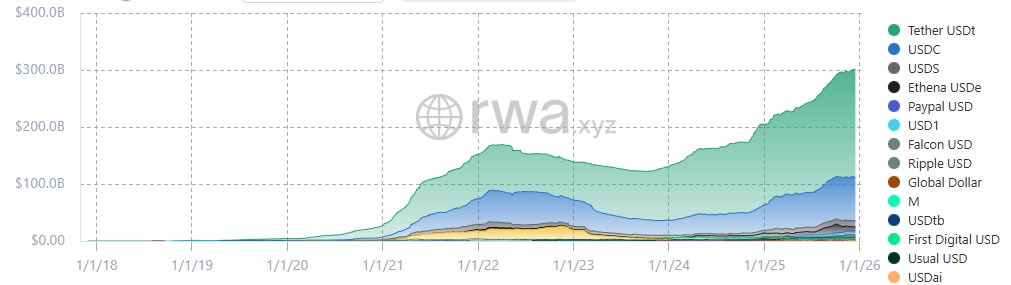
USDT and USDC still dominate stablecoin markets. Source: RWA.xyz

Magazine: Do Kwon sentenced to 15 years, Bitcoin’s ‘choppy dance’: Hodler’s Digest

Lecturas Relacionadas

The AI Agent Era Accelerates Its Arrival: Questflow Defines a New Paradigm of Financial Intelligence with On-Chain AI Brokerage

The AI Agent era is accelerating, with the CB Insights AI 100 list highlighting global investment confidence. The focus has shifted from whether AI works to its speed of deployment and ability to manage complex workflows, with autonomous AI Agents driving this transformation. At the forefront is Questflow, a Singapore-based startup redefining financial intelligence through its on-chain AI brokerage. Unlike tools that merely provide data dashboards, Questflow deploys AI Agents that proactively scan markets, form judgments, and execute trades via a conversational interface—operating 24/7 without requiring manual confirmation for each decision. This embodies the new AI paradigm of agents capable of executing multi-step workflows autonomously. Questflow's mission is to democratize institutional-grade trading intelligence. Historically reserved for the ultra-wealthy, this capability is now accessible starting from just $1 through Questflow's "AI Clone + Copy Trade" model. The platform charges only a 1% execution fee, aligning its incentives directly with users and eliminating traditional management or performance fees. The timing is opportune, aligning with key trends identified by CB Insights: the scalable deployment of AI Agents, accelerated AI adoption in financial services, and the maturation of on-chain infrastructure. With robust liquidity on platforms like Hyperliquid and Polymarket, alongside advancements in AI reasoning and non-custodial wallet security, Questflow is positioned to merge the roles of broker, fund, and exchange into a single, accessible platform for millions.

链捕手Hace 44 min(s)

The AI Agent Era Accelerates Its Arrival: Questflow Defines a New Paradigm of Financial Intelligence with On-Chain AI Brokerage

链捕手Hace 44 min(s)

Why Pricing Social Interactions is Doomed to Fail?

Titled "Why Putting a Price on Social Interaction Is Doomed to Fail," this article critiques attempts to monetize social networks directly through SocialFi models, arguing their inevitable failure stems from a fundamental misunderstanding of media dynamics. Using Marshall McLuhan's theory of "hot" and "cold" media, the author posits that social networks are inherently "cold" media. Their value isn't contained in individual posts but is co-created through user participation, interpretation, and fragmented, ongoing interaction (e.g., replies, shares). This ambiguity and need for user involvement are core to their function. The article asserts that SocialFi projects like Friend.tech failed because introducing real-time, tradable financial pricing (a definitive "hot" signal) into this "cold" environment doesn't add a layer—it replaces the medium's essence. The unambiguous price signal overshadows and nullifies the nuanced, participatory social signal. Users become traders, not participants, and when speculative profits vanish, the underlying social ecosystem—never genuinely cultivated—collapses entirely. This principle extends beyond crypto. The author argues platforms like Twitter have gradually "heated up" through metrics (likes, retweets counts, algorithmically defined value), shifting users from participants to performers and eroding organic engagement. The solution isn't to abandon capital but to manage its entry point. Successful models like Substack, Patreon, or Bandcamp allow capital to "condense" at specific, isolated nodes (e.g., subscriptions, one-time payments) without permeating and "heating" every social interaction. They preserve the core "cold," participatory medium while enabling monetization at designated boundaries. The NFT boom and bust serves as a stark parallel: the ancient "cold" medium of collecting (valued for story, community, gradual accumulation) was rapidly destroyed by platforms that introduced real-time floor prices, rarity scores, and trading dashboards, transforming collectors into speculators and vaporizing cultural value when prices fell. The core lesson: "Liquidity equals heat." Injecting high liquidity and definitive pricing into a "cold" participatory medium doesn't optimize it; it fundamentally alters and destroys its value-creating mechanism. The future lies not in pricing every social gesture but in finding precise, non-invasive points for capital to condense without overheating the entire ecosystem.

marsbitHace 52 min(s)

Why Pricing Social Interactions is Doomed to Fail?

marsbitHace 52 min(s)

Trading

Spot
Futuros
活动图片




