EU Proposes Ban On Russian Crypto Transactions To Crack Down Sanctions Evasion – Report

bitcoinistPublicado a 2026-02-11Actualizado a 2026-02-11

Resumen

The European Union is considering a comprehensive ban on all cryptocurrency transactions with Russia to prevent the country from using digital assets to evade sanctions. According to a report, the European Commission has proposed prohibiting engagement with any crypto asset service provider established in Russia, arguing that targeting individual entities would lead to the creation of new ones to circumvent restrictions. The proposal specifically aims to prevent the growth of platforms like the sanctioned exchange Garantex and targets the payments platform A7 and its ruble-pegged stablecoin. Additionally, the Commission suggested adding 20 Russian banks to the sanctions list, banning digital ruble transactions, and restricting certain exports to Kyrgyzstan. The measures require unanimous support from EU member states, though some countries have expressed doubts. This potential crackdown coincides with Russia's ongoing development of its digital assets regulatory system.

As Russia moves to regulate the crypto sector later this year, the European Union (EU) is considering implementing strict sanctions on all digital asset transactions linked to the country to curb sanctions evasion.

EU Seeks Sanctions On Russian Crypto Transactions

On Tuesday, the Financial Times (FT) reported that the European Commission (EC) is evaluating measures to prohibit all crypto transactions with Russia, stepping up its efforts to crack down on the country’s use of digital assets to evade sanctions.

According to documents reviewed by the FT, the Commission has seemingly proposed a broader prohibition “instead of attempting to ban copycat Russian crypto entities spun out of already sanctioned platforms.”

“In order to ensure that sanctions achieve their intended effect [the EU] prohibits to engage with any crypto asset service provider, or to make use of any platform allowing the transfer and exchange of crypto assets that is established in Russia,” explained the internal document outlining the proposed sanctions.

The Commission argued that “any further listing of individual crypto asset service providers ... is therefore likely to result in the set-up of new ones to circumvent those listings.”

Notably, the proposal reportedly focuses on preventing the growth of successors to the Russia-linked crypto exchange Garantex. In 2022, the US sanctioned the platform for “operating as the exchange of choice for cybercriminals”.

Moreover, the document is aimed at the payments platform A7, a company reportedly conceived as a mechanism to facilitate cross-border trades due to sanctions imposed after Russia invaded Ukraine, and its connected ruble-pegged stablecoin A7A5, previously used by Garantex to transfer funds to Kyrgyz exchange Grinex.

As reported by Bitcoinist, the EU, UK, and US have adopted restrictive measures against the payment platform. Despite this, recent reports revealed the stablecoin has an aggregate transaction volume of $100 billion.

In addition, the EC suggested adding 20 banks to the list of sanctioned entities and a ban on any digital ruble-related transactions. The Commission also proposed a ban on the export of certain dual-use goods to Kyrgyzstan, claiming that local companies have sold prohibited goods to Russia.

Nonetheless, imposing the measures would require the unanimous support of member states, and three of the bloc’s countries have reportedly expressed doubts, three diplomats briefed on discussions told the FT.

Russia’s Digital Assets Landscape

The potential crackdown comes as Russia continues to develop its upcoming digital assets framework. The CBR recently unveiled its comprehensive regulatory proposals to enable retail and qualified investors to buy digital assets through licensed platforms in the country.

Last month, the Committee on State Building and Legislation at the State Duma also advanced a bill to regulate the seizure of crypto assets in criminal proceedings and reduce the risks associated with the use of digital assets in criminal activities, including money laundering, corruption, and terrorist financing.

Meanwhile, Russia’s largest bank by assets, Sberbank, recently announced that it is preparing to offer crypto-backed loans to corporate clients following strong corporate interest.

The bank affirmed its readiness to work with the Central Bank of Russia (CBR) to develop regulations, and it is finalizing the necessary infrastructure and procedures for potential scaling of crypto-backed lending.
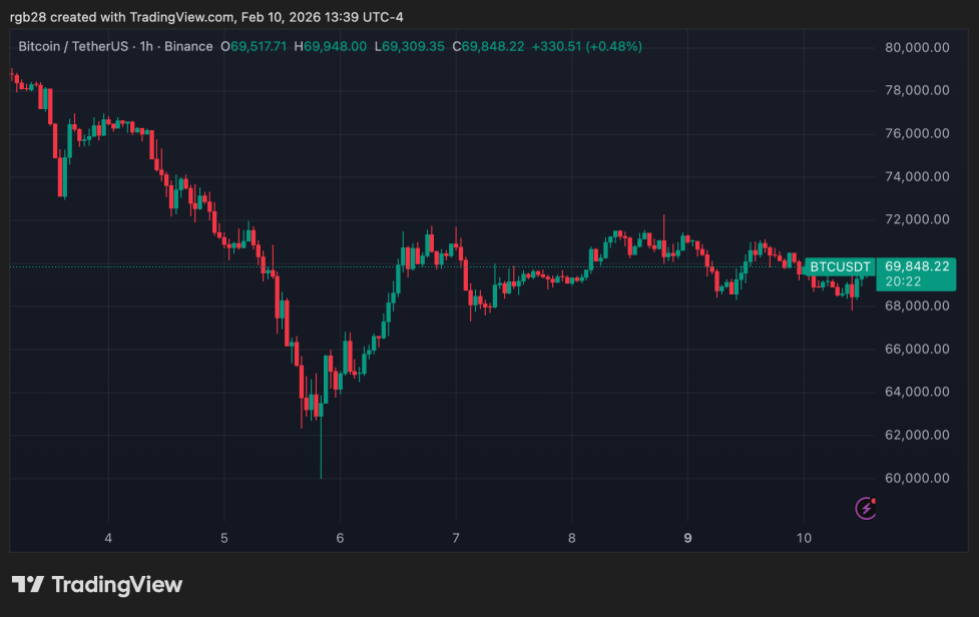
Bitcoin (BTC) trades at $69,848 in the one-week chart. Source: BTCUSDT on TradingView


Criptos en tendencia

Lecturas Relacionadas

Platform Token Soars 15x in Half a Month, Pons Tops Robinhood Chain Charts for Both Token Launches and Trading

In just half a month, the Pons platform token (PONS) surged over 15x in value as Pons solidified its position as the leading token launch and trading platform on Robinhood Chain, capturing both the highest daily token creation volume and transaction volume. Following the exit of previous leader NOXA, competition initially favored Flap before Pons emerged dominant around mid-July. By July 26th, Pons accounted for 77.1% of total trading volume across all Robinhood Chain launchpads. Pons's success is attributed to its streamlined, one-transaction process for deploying a token contract and its corresponding Uniswap V3 liquidity pool simultaneously, eliminating the need for bonding curves or complex migrations. This simplicity, combined with low creation costs and immediate tradability, attracted significant creation activity and speculative trading. The meteoric rise of its native token, PONS, further fueled platform growth. A tokenomics model directing 80% of protocol fees to buy back and burn PONS created a reinforcing cycle: platform usage boosted PONS value, which in turn attracted more users. Looking ahead, Pons V2 aims to expand beyond meme tokens by integrating support for paying fees in stablecoins (USDG) and RWA assets, aligning with Robinhood Chain's broader focus on on-chain finance and stock tokens.

Odaily星球日报Hace 39 min(s)

Platform Token Soars 15x in Half a Month, Pons Tops Robinhood Chain Charts for Both Token Launches and Trading

Odaily星球日报Hace 39 min(s)

Qualcomm Chip Price Hike Deals a Blow to Android Phones

Qualcomm has officially announced a new round of price increases for its entire chip portfolio, effective September 1. The hikes, reaching up to 18% for the flagship Snapdragon 8 Elite Gen 6 Pro, follow similar moves by MediaTek, intensifying cost pressures on the already strained smartphone industry. CEO Cristiano Amon confirmed the plan, citing the need to offset rising industry-wide costs and restore declining profit margins. Qualcomm's Q3 FY2026 results showed a 25% drop in net profit, with mobile revenue plunging 20% year-over-year, hitting its lowest level since 2021. The surge in AI computing demand has led memory manufacturers to prioritize HBM production, creating a shortage in general-purpose DRAM and NAND Flash chips. Their prices soared by 93%-98% and 55%-60% respectively in Q1 2026, causing the memory cost share in smartphones to jump from 10%-15% to over 30%. Coupled with the soaring cost of advanced nodes like TSMC's 2nm and packaging, overall chip costs have reached historic highs. These upstream pressures are forcing downstream smartphone brands like Xiaomi, OPPO, and vivo to cut orders for mid-to-low-end models by up to 20% and use cost-saving measures like older chipsets. Reportedly, the Snapdragon 8E5 will be repurposed as a "long-lasting" chip for sub-brand phones in H2 2026. Amid this cost crisis, the Android market remains sluggish. Q2 2026 smartphone shipments in China fell 4.3% year-over-year, marking five consecutive quarters of decline. Major Android brands saw market share drop, while Huawei and Apple, with their in-house chip advantages, gained share. Qualcomm is diversifying into automotive and IoT sectors to reduce reliance on smartphones, but these new segments cannot yet fill the mobile revenue gap. Industry observers warn that the full impact of component cost hikes will hit in the second half of 2026, likely leading to higher-than-expected price increases for Android flagships and a further contraction in the Chinese smartphone market.

marsbitHace 50 min(s)

Qualcomm Chip Price Hike Deals a Blow to Android Phones

marsbitHace 50 min(s)

Breaking: GPT-5.6 Prices Slashed Effective Today

OpenAI has announced significant price cuts for its GPT-5.6 model API, effective immediately. The entry-level **GPT-5.6 Luna** sees the most drastic reduction, with input prices dropping 80% to $0.20 per million tokens and output prices falling to $1.20 per million tokens. The mid-tier **GPT-5.6 Terra** is reduced by 20%, now costing $2.00 (input) and $12.00 (output) per million tokens. The flagship **GPT-5.6 Sol** maintains its original price but introduces a new **Fast mode**, offering speeds up to 2.5 times faster for double the cost. The company attributes these price reductions to efficiency gains achieved through **GPT-5.6 Sol's own involvement in optimizing its production systems**. The model assisted in rewriting GPU kernels and improving speculative decoding, leading to a 20% reduction in end-to-end service costs and over 15% improvement in token generation efficiency. OpenAI emphasizes this process remained human-led. A key focus of the降价 is to lower the barrier for running **AI agent workflows**. By making the capable, tool-calling Luna model significantly cheaper, OpenAI aims to enable more frequent use in cost-sensitive, high-volume tasks like code review and monitoring. This creates a potential feedback loop: model-assisted efficiency gains lead to lower costs, which enables broader agent deployment, which in turn drives further optimization. The new pricing and features will also apply to Codex and ChatGPT Work subscriptions. The changes intensify competition in the large language model market, with OpenAI directly challenging rivals like Anthropic to respond.

marsbitHace 1 hora(s)

Breaking: GPT-5.6 Prices Slashed Effective Today

marsbitHace 1 hora(s)

Trading

Spot

Artículos destacados

Cómo comprar BAN

¡Bienvenido a HTX.com! Hemos hecho que comprar Comedian (BAN) sea simple y conveniente. Sigue nuestra guía paso a paso para iniciar tu viaje de criptos.Paso 1: crea tu cuenta HTXUtiliza tu correo electrónico o número de teléfono para registrarte y obtener una cuenta gratuita en HTX. Experimenta un proceso de registro sin complicaciones y desbloquea todas las funciones.Obtener mi cuentaPaso 2: ve a Comprar cripto y elige tu método de pagoTarjeta de crédito/débito: usa tu Visa o Mastercard para comprar Comedian (BAN) al instante.Saldo: utiliza fondos del saldo de tu cuenta HTX para tradear sin problemas.Terceros: hemos agregado métodos de pago populares como Google Pay y Apple Pay para mejorar la comodidad.P2P: tradear directamente con otros usuarios en HTX.Over-the-Counter (OTC): ofrecemos servicios personalizados y tipos de cambio competitivos para los traders.Paso 3: guarda tu Comedian (BAN)Después de comprar tu Comedian (BAN), guárdalo en tu cuenta HTX. Alternativamente, puedes enviarlo a otro lugar mediante transferencia blockchain o utilizarlo para tradear otras criptomonedas.Paso 4: tradear Comedian (BAN)Tradear fácilmente con Comedian (BAN) en HTX's mercado spot. Simplemente accede a tu cuenta, selecciona tu par de trading, ejecuta tus trades y monitorea en tiempo real. Ofrecemos una experiencia fácil de usar tanto para principiantes como para traders experimentados.

616 Vistas totalesPublicado en 2024.12.11Actualizado en 2026.06.02

Cómo comprar BAN

Discusiones

Bienvenido a la comunidad de HTX. Aquí puedes mantenerte informado sobre los últimos desarrollos de la plataforma y acceder a análisis profesionales del mercado. A continuación se presentan las opiniones de los usuarios sobre el precio de BAN (BAN).

活动图片