Qualcomm Chip Price Hike Deals a Blow to Android Phones

marsbitPublicado a 2026-07-31Actualizado a 2026-07-31

Resumen

Qualcomm has officially announced a new round of price increases for its entire chip portfolio, effective September 1. The hikes, reaching up to 18% for the flagship Snapdragon 8 Elite Gen 6 Pro, follow similar moves by MediaTek, intensifying cost pressures on the already strained smartphone industry. CEO Cristiano Amon confirmed the plan, citing the need to offset rising industry-wide costs and restore declining profit margins. Qualcomm's Q3 FY2026 results showed a 25% drop in net profit, with mobile revenue plunging 20% year-over-year, hitting its lowest level since 2021. The surge in AI computing demand has led memory manufacturers to prioritize HBM production, creating a shortage in general-purpose DRAM and NAND Flash chips. Their prices soared by 93%-98% and 55%-60% respectively in Q1 2026, causing the memory cost share in smartphones to jump from 10%-15% to over 30%. Coupled with the soaring cost of advanced nodes like TSMC's 2nm and packaging, overall chip costs have reached historic highs. These upstream pressures are forcing downstream smartphone brands like Xiaomi, OPPO, and vivo to cut orders for mid-to-low-end models by up to 20% and use cost-saving measures like older chipsets. Reportedly, the Snapdragon 8E5 will be repurposed as a "long-lasting" chip for sub-brand phones in H2 2026. Amid this cost crisis, the Android market remains sluggish. Q2 2026 smartphone shipments in China fell 4.3% year-over-year, marking five consecutive quarters of decline. Major An...

Recently, global chip giant Qualcomm officially announced a new round of price adjustments for its product line. Effective September 1st, the entire series of chip products will see double-digit percentage price increases, with the new flagship Snapdragon 8 Elite Gen 6 Pro seeing the highest increase of up to 18%.

Following MediaTek's announcement of price hikes for its Dimensity series chips in late June, Qualcomm has now followed suit. This brings a new wave of cost pressure to the already strained mobile terminal industry.

It is reported that Qualcomm issued price increase notifications to global customers on July 24th local time. The new prices will uniformly apply to all chip products shipped after September 1st, covering multiple product lines including smartphones, tablets, wearables, and automotive chips. Qualcomm CEO Cristiano Amon confirmed the adjustment plan during the earnings call, stating that the core reason for the price increase is to hedge against rising costs across the entire industry chain, repair the company's declining gross margin, and drive profitability back to historical normal levels.
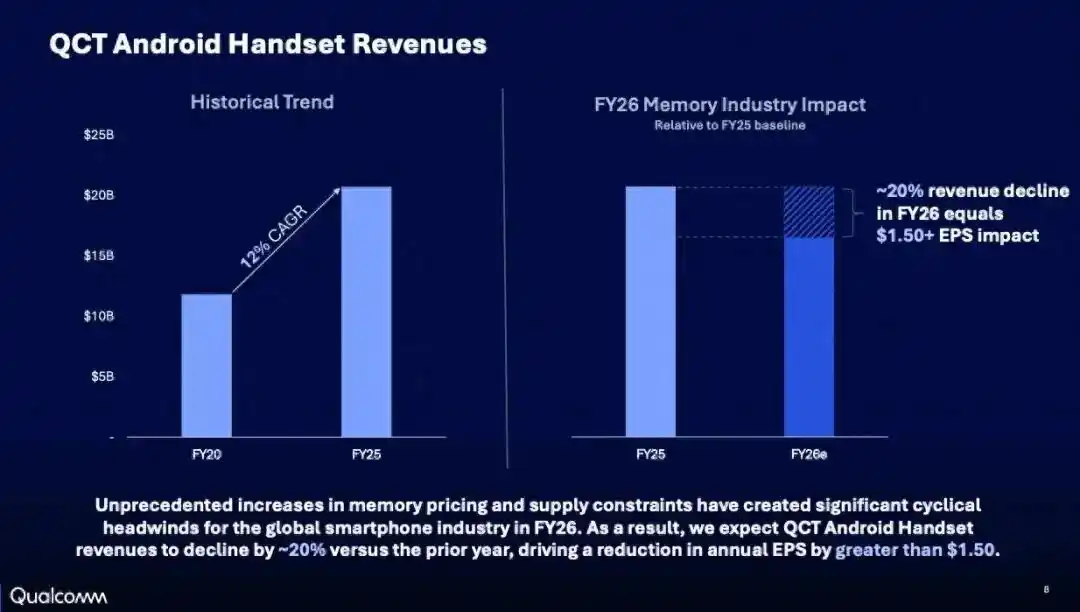
Data shows that Qualcomm's Q3 FY2026 revenue was $9.947 billion, a year-over-year increase of 4%, but net profit plummeted by 25% YoY. Revenue from the mobile handset business plunged by 20% YoY, hitting the lowest record since 2021. The main reason cited is industry-wide price increases triggered by the AI boom.

As demand for AI computing power surges, memory manufacturers like Samsung and SK Hynix have significantly increased production capacity for HBM memory, leading to an imbalance in the supply and demand for general-purpose memory chips.

According to data from TrendForce, general-purpose DRAM contract prices increased by 93%-98% quarter-over-quarter in Q1 2026, while NAND Flash contract prices rose by 55%-60% QoQ. The share of memory costs in mobile phone material costs has skyrocketed from 10%-15% to over 30%. At the same time, the wafer cost for TSMC's 2nm advanced process has exceeded $30,000, coupled with a price increase of over 20% for advanced packaging, pushing chip costs to a historical high.

The cost pressures on chip giants have ultimately been passed down to downstream smartphone manufacturers, trapping the industry in a vicious cycle.

Previously, continuous price increases for memory chips had already squeezed the profit margins of terminal manufacturers. To control costs, brands like Xiaomi, OPPO, and vivo have significantly reduced orders for mid-range and low-end models in 2026, with cuts up to 20%. Some manufacturers are also compressing costs by simplifying hardware configurations and even resorting to using older-generation chips.

Reportedly, the Snapdragon 8 Gen 5 Ultimate Edition (SD 8E5) released last September has "been forced" to become a long-lasting workhorse chip. Qualcomm is set to release a downclocked version specifically for sub-brand iterative new models in the second half of this year, offering performance not inferior to the standard SD 8E5 but at a price significantly lower than the concurrently released SD 8E6.

Under heavy cost pressure, the Android smartphone market continues to be sluggish. IDC data shows that domestic smartphone shipments in Q2 2026 fell by 4.3% year-over-year, marking five consecutive quarters of decline. The market shares of major Android brands like OPPO, vivo, Xiaomi, and Honor have all dropped significantly. In contrast, Huawei and Apple, which do not rely on external high-end SoC chips, have seen noticeable growth in market share, leveraging their advantages in self-developed chips and stable pricing.

Compared to smartphone manufacturers, Qualcomm could potentially pass on cost pressures even without raising prices.

Currently, Qualcomm is accelerating its business diversification transformation, focusing on new sectors like automotive, IoT, and data centers. Its automotive business has achieved 23 consecutive quarters of double-digit year-over-year growth, and it recently secured a ten-year chip supply agreement with BMW. However, the scale of these new businesses is still limited and cannot fully offset the gap left by the handset business.

Industry insiders predict that as the rising costs of chips and memory are fully reflected in the second half of the year, price increases for new Android flagship models may exceed market expectations. The decline in domestic smartphone market shipments in 2026 could further widen.

This article is sourced from the WeChat public account "镁客网", author: 镁客网

Criptos en tendencia

Preguntas relacionadas

QAccording to the article, what is the main reason for Qualcomm's decision to increase the prices of its chips across the board?

AThe main reason for Qualcomm's price increase is to hedge against rising costs across the entire industry supply chain, repair the company's declining gross margin, and restore profitability to historically normal levels.

QWhich specific Qualcomm chip model is mentioned as seeing the highest price increase, and what is the percentage?

AThe new flagship chip, the Snapdragon 8 Elite Gen 6 Pro, is mentioned as having the highest price increase, reaching up to 18%.

QHow did the surge in AI computing power indirectly affect smartphone material costs, specifically regarding memory?

AThe surge in AI computing power led memory manufacturers like Samsung and SK Hynix to significantly increase production of HBM memory. This created an imbalance in supply and demand for general-purpose memory chips, causing DRAM and NAND Flash contract prices to soar. As a result, the proportion of memory costs in smartphone material costs surged from 10-15% to over 30%.

QWhat contrasting trend in market share is highlighted between brands like OPPO, vivo, and Xiaomi compared to Huawei and Apple?

AThe article highlights that mainstream Android brands like OPPO, vivo, Xiaomi, and Honor have all seen significant declines in market share. In contrast, Huawei and Apple, which do not rely on external high-end SoC chips and benefit from their in-house chip advantages and stable pricing, have shown noticeable growth in market share.

QWhat strategy did Qualcomm adopt regarding the Snapdragon 8E5 chip to help smartphone manufacturers cope with cost pressures?

ATo help smartphone manufacturers cope with cost pressures, Qualcomm is planning to release a down-clocked version of the Snapdragon 8E5 chip in the second half of the year. This version will offer performance comparable to the standard Snapdragon 8E5 but at a significantly lower price than the concurrently released Snapdragon 8E6, making it suitable for sub-brand iterative new models.

Lecturas Relacionadas

Why Bitcoin Holds Above $64,000 After Fed's Hard Pause

**Bitcoin Stabilizes Near $64,000 Following Hawkish Fed Pause** The cryptocurrency market, led by Bitcoin, remained stable around $64,000 despite a volatile reaction to the latest U.S. Federal Reserve meeting. The Fed paused interest rates but signaled a hawkish stance, with three committee members voting for an increase—the highest dissent since 2016. This limits risk appetite but hasn't triggered panic selling. Key market highlights include Bitcoin ETFs seeing a net inflow of $32.1 million, breaking a streak of outflows, while Ethereum ETFs experienced outflows of $18.65 million. Liquidations affected about 90,000 traders. Technically, Bitcoin finds support around $63,000-$63,500, with major resistance near $66,000. While its price is about 49% below its all-time high, institutional demand via ETFs and the absence of mass capitulation support a potential recovery scenario in the second half of the year. Major altcoins showed mixed movements, with Solana attracting capital while Ethereum faced selling pressure despite strong on-chain metrics like a growing staking queue. Regulatory news took a pause as the U.S. Senate delayed the CLARITY Act vote until at least autumn. For the final trading day of July, U.S. inflation and consumer spending data will be crucial. Bitcoin's key levels to watch are $63,000 support and $66,000 resistance. Sustained ETF inflows and Bitcoin holding above $63,000 are seen as positive signs for a potential market recovery later in the year.

cryptonews.ruHace 1 hora(s)

Why Bitcoin Holds Above $64,000 After Fed's Hard Pause

cryptonews.ruHace 1 hora(s)

Participants in XRP Fraud Scheme That Stole $9 Million from 71 Investors Arrested

South Korean police have arrested three individuals accused of operating a fraudulent investment platform that stole approximately 3.4 million XRP (worth about $9 million) from 71 investors between October 16 and 23. The suspects promoted the site Fxrpntwork.com through blogs, online articles, and YouTube videos, promising guaranteed principal and monthly returns of 1.5% to 1.8%. Investors were instructed to transfer XRP from Korean exchanges to overseas platforms and then to wallets controlled by the group before the site was shut down. The scammers copied the branding of legitimate projects Flare Network and FXRP to appear credible. Authorities warn that such impersonation frauds, which use familiar branding and urgent promises of guaranteed profits, are a common red flag. Legitimate companies do not solicit cryptocurrency transfers through unsolicited promotions. Seoul police have issued an Interpol Red Notice for a fourth suspect abroad and are investigating others involved in creating and promoting the fraudulent website. While investigators froze 17.3 billion won in assets, approximately 10 billion won was moved during the probe, with wallet analysis revealing transfers totaling 27.3 billion won, suggesting there may be additional unidentified victims and accomplices. The case underscores the organized, cross-border nature of crypto investment fraud.

cryptonews.ruHace 1 hora(s)

Participants in XRP Fraud Scheme That Stole $9 Million from 71 Investors Arrested

cryptonews.ruHace 1 hora(s)

Trading

Spot

Artículos destacados

Cómo comprar CHIP

¡Bienvenido a HTX.com! Hemos hecho que comprar USD.AI (CHIP) sea simple y conveniente. Sigue nuestra guía paso a paso para iniciar tu viaje de criptos.Paso 1: crea tu cuenta HTXUtiliza tu correo electrónico o número de teléfono para registrarte y obtener una cuenta gratuita en HTX. Experimenta un proceso de registro sin complicaciones y desbloquea todas las funciones.Obtener mi cuentaPaso 2: ve a Comprar cripto y elige tu método de pagoTarjeta de crédito/débito: usa tu Visa o Mastercard para comprar USD.AI (CHIP) al instante.Saldo: utiliza fondos del saldo de tu cuenta HTX para tradear sin problemas.Terceros: hemos agregado métodos de pago populares como Google Pay y Apple Pay para mejorar la comodidad.P2P: tradear directamente con otros usuarios en HTX.Over-the-Counter (OTC): ofrecemos servicios personalizados y tipos de cambio competitivos para los traders.Paso 3: guarda tu USD.AI (CHIP)Después de comprar tu USD.AI (CHIP), guárdalo en tu cuenta HTX. Alternativamente, puedes enviarlo a otro lugar mediante transferencia blockchain o utilizarlo para tradear otras criptomonedas.Paso 4: tradear USD.AI (CHIP)Tradear fácilmente con USD.AI (CHIP) en HTX's mercado spot. Simplemente accede a tu cuenta, selecciona tu par de trading, ejecuta tus trades y monitorea en tiempo real. Ofrecemos una experiencia fácil de usar tanto para principiantes como para traders experimentados.

499 Vistas totalesPublicado en 2026.04.21Actualizado en 2026.06.02

Cómo comprar CHIP

Discusiones

Bienvenido a la comunidad de HTX. Aquí puedes mantenerte informado sobre los últimos desarrollos de la plataforma y acceder a análisis profesionales del mercado. A continuación se presentan las opiniones de los usuarios sobre el precio de CHIP (CHIP).

活动图片













