Ethereum's Year of Interoperability: A Deep Dive into EIL, a Grand Experiment in Entrusting 'Trust' to Game Theory?

marsbitPublicado a 2026-01-12Actualizado a 2026-01-12

Resumen

Ethereum is entering a major phase of mass adoption in 2026, driven by the development of the Ethereum Interoperability Layer (EIL). EIL is not a new blockchain but a set of standards and protocols designed to connect Ethereum’s Layer 2 (L2) networks seamlessly. It aims to standardize state proofs and message passing between L2s, enabling native interoperability without altering their core security models. Currently, L2s operate as isolated environments with separate signatures, assets, and user experiences. EIL, combined with Account Abstraction (ERC-4337) and a trust-minimized messaging layer (XLP), allows users to perform cross-chain transactions with a single signature, abstracting away complexities like gas fees and repeated authorizations. Unlike traditional bridges or intent-based solutions, EIL avoids introducing new trust assumptions like solvers. Instead, it relies on XLP providers to facilitate instant transactions, with Ethereum L1 serving as a fallback enforcement layer via slashing mechanisms in case of malfeasance. However, EIL faces challenges in balancing efficiency and security. Its model shifts trust from technical verification to economic incentives and penalties, raising questions about sustainability under market volatility, scalability in multi-chain environments, and the economic feasibility of liquidity provision. Despite these open questions, EIL represents a significant experiment in expanding Ethereum’s interoperability while preserving its core...

2026 is destined to be a pivotal year for Ethereum's Mass Adoption.

With the finalization of multiple underlying upgrades in 2025 and the establishment and advancement of the Interop roadmap, the Ethereum ecosystem is gradually entering the "Great Era of Interoperability." Against this backdrop, EIL (Ethereum Interoperability Layer) is stepping into the spotlight from behind the scenes (Further reading: "Ethereum's Interop Roadmap: Unlocking the 'Last Mile' of Mass Adoption").

If early technical discussions were still at the "proof-of-concept" stage, EIL has undoubtedly now entered the deep waters of standard implementation and engineering. This has sparked a series of major community debates. For instance, when pursuing a Web2-smooth cross-chain experience, are we quietly altering the long-held trust boundaries of Ethereum?

Objectively speaking, when any technological vision moves towards engineering implementation, trade-offs between efficiency and security are inevitable. This article also attempts to move beyond technical slogans and, by examining the specific design details of EIL, deconstruct its real trade-offs between efficiency, standards, and security assumptions.

I. What Exactly is EIL 'Sewing' Together?

First, we need to clarify the essence of EIL once again—it is not a new chain, nor a new consensus layer, but rather a set of interoperability communication frameworks and standard protocol collections.

In short, the core logic of EIL lies in standardizing the "state proofs" and "message passing" of different L2s without rewriting Ethereum's underlying security model, enabling different L2s to possess composability and interaction capabilities akin to a single chain without changing their own security assumptions (Further reading: "The End of Ethereum Islands: How EIL Reconstructs Fragmented L2s into a 'Supercomputer'?").

As is well known, in the current Ethereum ecosystem, each L2 is an isolated island. For example, your account (EOA) on Optimism and your account on Arbitrum, while having the same address, have completely isolated states:

  • Signature Isolation: Your signature on Chain A cannot be directly verified by Chain B;
  • Asset Isolation: Your assets on Chain A are also invisible to Chain B;
  • Interaction Barriers: Cross-chain operations require repeated authorizations, gas swaps, waiting for settlement, etc.;

EIL, combining the capabilities of "Account Abstraction (ERC-4337)" and a "trust-minimized message layer," constructs a unified execution environment at the account layer + message layer, attempting to eliminate these artificial divisions:

The author previously gave an intuitive example: cross-chain interactions used to be like traveling abroad—you needed to exchange currency (cross-chain assets), obtain a visa (re-authorize), and follow local traffic rules (purchase target chain Gas). Entering the EIL era, cross-chain interactions are more like using a Visa card globally:

No matter which country you are in, just swipe your card once (sign), and the underlying banking network (EIL) automatically handles exchange rates, settlement, and verification—you don't perceive the existence of national borders.

Compared to traditional cross-chain bridges, Relayers, and Intent/Solver models, the advantages of this design are also intuitive—the Native route is the safest, most transparent, but slow and experience-fragmented; the Intent route offers the best experience but introduces Solver trust and game theory; EIL attempts to push the experience closer to Intent without introducing a Solver, but requires deep integration with wallets and protocol layers.
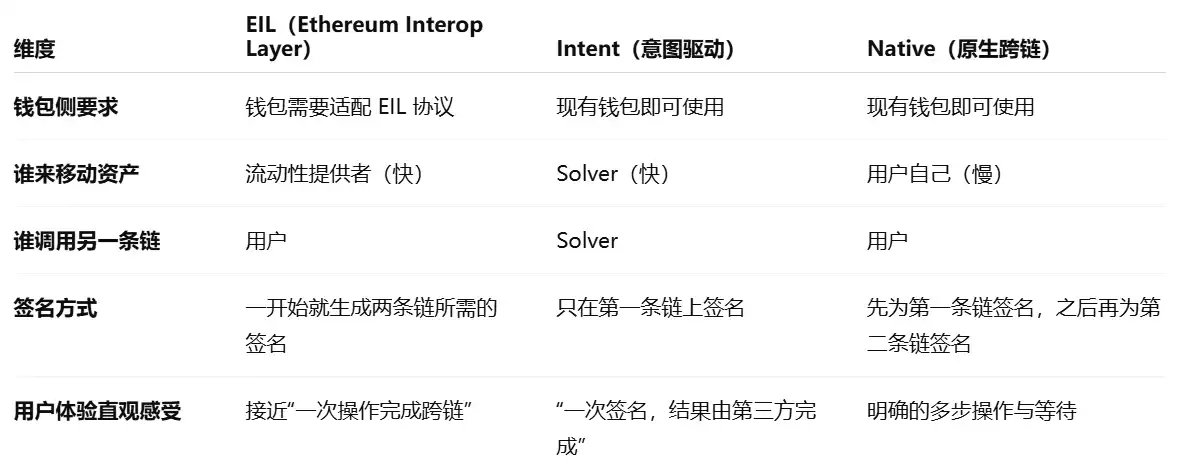
Source: Based on @MarcinM02, self-generated image

The EIL proposal put forward by the Ethereum Foundation's Account Abstraction team paints such a future: users only need to sign once to complete a cross-chain transaction, without relying on centralized relays or adding new trust assumptions, and can initiate transactions directly from their wallet for seamless settlement across different L2s.

II. EIL's Engineering Path: Account Abstraction + Trust-Minimized Message Layer

Of course, this also raises a more practical question: whether the implementation details and ecosystem adaptation of EIL can achieve "theory equals practice" remains an open proposition.

We can break down EIL's engineering implementation path. As mentioned above, it does not attempt to introduce a new inter-chain consensus but is built upon two existing building blocks: ERC-4337 Account Abstraction (AA) + a trust-minimized cross-chain message and liquidity mechanism.

First is Account Abstraction based on ERC-4337. It decouples the account and the private key, allowing a user account to become a smart contract account with customizable validation logic and cross-chain execution logic, no longer limited to the traditional EOA key-pair model.

The significance of this for EIL is that cross-chain operations do not need to rely on external executors (Solvers) to act on your behalf. Instead, they can be expressed at the account layer as a standardized User Operation object (UserOp), constructed and managed uniformly by the wallet.

These functions were previously impossible with EOA itself and required complex external contract wrappers. Account Abstraction based on ERC-4337 allows user accounts to evolve from a rigid "key pair" into programmable code. More bluntly, users only need one signature (UserOp) to express cross-chain intent (Further reading: "From EOA to Account Abstraction: Will Web3's Next Leap Happen in the 'Account System'?"):

Account contracts can embed more complex validation/execution rules; one signature can trigger a series of cross-chain instructions. Combined with mechanisms like Paymaster, it can even achieve Gas abstraction—for example, paying for target chain fees using source chain assets, eliminating the awkwardness of having to buy a few dollars of native Gas tokens before crossing chains.

This is why the EIL narrative is often tied to wallet experience, as what it truly aims to change is the entry point through which users interact with the multi-chain world.

The second is the trust-minimized message passing mechanism—XLP (Cross-chain Liquidity Provider), which solves the efficiency problem of cross-chain message passing.

Because traditional cross-chain interactions rely on relays or centralized bridges, EIL introduces XLP. On this basis, an ideal path that is theoretically efficient and sacrifices as little security as possible can be built:

  • The user submits a cross-chain transaction on the source chain;
  • XLP observes this intent in the mempool and advances funds/Gas on the target chain, providing a "Payment Voucher";
  • The user utilizes the voucher to complete self-execution on the target chain;

The actual user experience is near-instantaneous settlement, without waiting for the slow settlement of the official bridge.

However, you might spot a problem: what if the XLP takes the money but doesn't deliver? The ingenious design of EIL lies in the fact that if an XLP defaults, the user can submit proof on Ethereum L1 to trigger permissionless slashing of its staked assets.

The official bridge is only used for settlement and recourse in case of bad debt. This means the system runs extremely fast under normal conditions; in extreme cases, security is still backed by Ethereum L1.
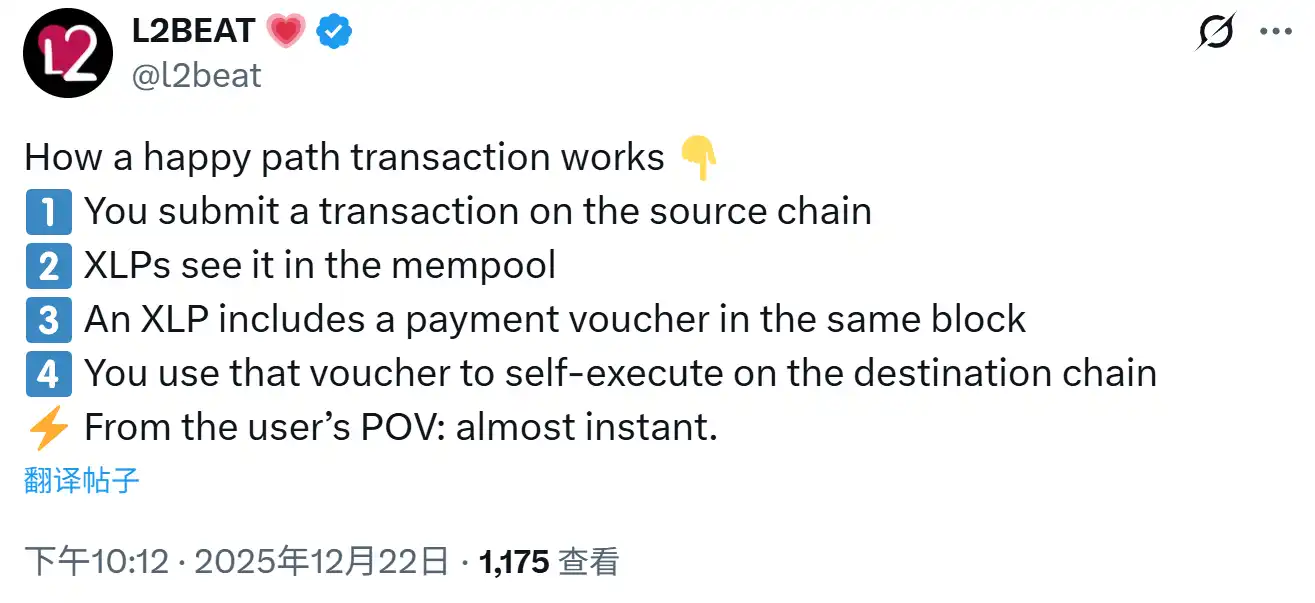
This structure means moving the slow and expensive security mechanism out of the default path, instead concentrating the trust pressure on failure handling.

Of course, this is also one of the sources of controversy: when security relies more on the "executability of the failure path" and the "effectiveness of economic penalties," is EIL truly adding no new trust assumptions? Or is it merely shifting trust from explicit relays to a more hidden, more engineered set of conditions?

This leads to the more critical discussion below—while it looks elegant in theory, what potential centralization and economic frictions might it face in the real-world ecosystem, and why does the community remain cautious about it?

III. Between Vision and Engineering: Is EIL Truly 'Minimizing Trust'?

By now, EIL's ambition is clear. Its design strives to avoid explicit relay trust and attempts to converge cross-chain interactions into one signature and one user operation at the wallet layer.

The problem is—trust doesn't just disappear; it merely migrates.

This is why platforms like L2BEAT, which have long focused on L2 risk boundaries, remain particularly cautious about the engineering implementation of EIL. After all, once an interoperability layer becomes the universal default path, any hidden assumptions, incentive failures, or governance single points of failure could amplify into systemic risks.

Specifically, EIL's efficiency comes from two points: first, AA packages actions into one signature; second, XLP's advance payment allows users to bypass waiting. The former is more straightforward, an efficiency gain from embedded AA. But the latter's advance payment means that some security no longer comes from immediately verifiable finality, but from "economic guarantees that can be pursued and penalized."

This undoubtedly pushes the risk exposure towards several more engineering-oriented questions:

  • Under real market fluctuations, how are the XLP's default probability, capital cost, and risk hedging priced?
  • Is "slashing" timely and executable enough to cover losses in extreme scenarios?
  • When amounts become larger and paths more complex (multi-hop/multi-chain), do failure scenarios become exponentially more difficult?

Ultimately, the trust foundation here is no longer mathematical proof but the validator's staked collateral. If the cost of attack is lower than the potential profit, the system still faces rollback risks.

Furthermore, objectively speaking, EIL attempts to solve liquidity fragmentation through technical means, but liquidity itself is market behavior. If significant cost and trust disparities still exist between chains, a mere communication standard (EIL) cannot make liquidity truly flow. After all, a pure communication protocol standard cannot solve the economic essence of "liquidity unwillingness to flow."

Extending this thought further, without accompanying economic incentive design, EIL might face the dilemma of having standardized pipelines but lacking executors because it's unprofitable.

However, overall, EIL is one of the most important infrastructure concepts proposed by the Ethereum community to address fragmented L2 experiences. It attempts to simplify UX while maintaining Ethereum's core values (self-custody, censorship resistance, disintermediation), which is commendable in itself (Further reading: "Seeing Through the Noise of Ethereum 'Degeneration': Why is 'Ethereum Values' the Widest Moat?").

For ordinary users, there's no need to hastily praise or否定 EIL, but rather to understand its trade-offs and boundary assumptions in protocol design.

After all, for the current Ethereum, EIL is not a simple upgrade to existing cross-chain pain points, but a technical and value attempt that deeply integrates experience, economy, and security trust boundaries. It has the potential to push Ethereum towards truly seamless interoperability, but it might also expose new boundary effects and necessary compromises during implementation.

In Conclusion

In 2026, EIL is not a plug-and-play ultimate answer, but more like a systematic test of trust boundaries, engineering feasibility, and the limits of user experience.

If it succeeds, Ethereum's L2 world will truly look like one chain; if it is less successful, it will undoubtedly leave clear lessons for the next generation of interoperability design.

Before 2026, everything is still an experiment.

And this, perhaps, is Ethereum's most real and most respectable aspect.

Preguntas relacionadas

QWhat is the core purpose of the Ethereum Interoperability Layer (EIL)?

AThe core purpose of the Ethereum Interoperability Layer (EIL) is to serve as a set of interoperability communication frameworks and standard protocol collections. It aims to standardize 'state proofs' and 'message passing' for different Layer 2 solutions (L2s) without altering Ethereum's underlying security model, enabling seamless composability and interaction between L2s as if they were a single chain.

QHow does EIL combine Account Abstraction (ERC-4337) and trust-minimized messaging to improve cross-chain experiences?

AEIL combines Account Abstraction (ERC-4337), which decouples accounts from private keys and allows user accounts to become programmable smart contract accounts, with a trust-minimized cross-chain messaging and liquidity mechanism (XLP). This enables users to express cross-chain intent with a single signature (UserOp), while XLP providers prepay funds/Gas on the target chain for near-instant transactions, backed by economic penalties for malfeasance enforceable via Ethereum L1.

QWhat are the potential risks or trust assumptions introduced by EIL's engineering design?

AEIL's design shifts some security from immediate verifiable finality to economic guarantees reliant on penalties. Risks include the pricing of XLP违约 probability and capital costs, the timeliness and executability of slashing mechanisms in extreme cases, and potential systemic risks if incentives fail or governance becomes centralized. Trust is not eliminated but transferred to more engineered economic and failure-handling processes.

QHow does EIL differ from traditional cross-chain bridges or Intent/Solver models in terms of security and user experience?

ATraditional cross-chain bridges (native routes) are secure and transparent but slow with fragmented user experiences. Intent/Solver models offer the best user experience but introduce solver trust and博弈. EIL attempts to approach Intent-like usability without solvers by deeply integrating wallet and protocol standards, relying on Account Abstraction and trust-minimized messaging, though it requires significant ecosystem adaptation and introduces new economic trust assumptions.

QWhy is the Ethereum community cautious about EIL's implementation despite its promising vision?

AThe Ethereum community remains cautious because EIL's efficiency gains depend on economic incentives and penalty mechanisms that are untested at scale. Concerns include the feasibility of timely slashing, market-driven risks for XLP providers, liquidity fragmentation economic issues not solved by mere communication standards, and the potential for new centralization points or failure scenarios in complex multi-chain transactions, which could amplify systemic risks if not properly engineered.

Lecturas Relacionadas

Bitwise: Bullish on Bitcoin's Performance in the Second Half of the Year, AI and Regulation Will Spark a New Altcoin Season

Bitwise CIO Matt Hougan and Research Lead Ryan Rasmussen express strong bullish sentiment on Bitcoin's long-term prospects, suggesting that its $1 million price target may be too conservative. They argue Bitcoin serves a dual role: as digital gold and a potential global settlement asset, especially amid declining trust in traditional monetary systems. Despite a weak Q1 2026 where nearly all crypto assets and prices saw double-digit declines, the analysts remain optimistic due to strong forward-looking catalysts, including institutional adoption via Bitcoin ETFs from major firms like Morgan Stanley and Goldman Sachs. Geopolitical instability, such as Iran’s mention of using Bitcoin for international payments, increases the value of Bitcoin’s “out-of-the-money call option” as a non-political, global settlement currency. This enhances its appeal beyond a mere store of value. . Additionally, Hougan highlights that a clearer regulatory token framework under current SEC leadership, combined with AI efficiency gains and high-performance blockchains, could fuel a new “altseason” by late 2026. This may lead to a wave of legitimate, value-capturing token projects, unlike the earlier ICO boom. . Bitwise also announced an Avalanche ETF, citing its unique architecture and rapid growth in real-world asset (RWA) tokenization, which has surged 10x to nearly $30 billion in two years. The firm believes Layer 1 blockchains are still early in their growth cycle, with significant potential ahead.

marsbitHace 19 min(s)

Bitwise: Bullish on Bitcoin's Performance in the Second Half of the Year, AI and Regulation Will Spark a New Altcoin Season

marsbitHace 19 min(s)

Trading

Spot
Futuros

Artículos destacados

Qué es ETH 2.0

ETH 2.0: Una Nueva Era para Ethereum Introducción ETH 2.0, conocido ampliamente como Ethereum 2.0, marca una actualización monumental para la blockchain de Ethereum. Esta transición no es solo una mejora superficial; busca mejorar fundamentalmente la escalabilidad, seguridad y sostenibilidad de la red. Con un cambio del mecanismo de consenso intensivo en energía Prueba de Trabajo (PoW) a una Prueba de Participación (PoS) más eficiente, ETH 2.0 promete un enfoque transformador para el ecosistema blockchain. ¿Qué es ETH 2.0? ETH 2.0 es un conjunto de actualizaciones interconectadas y distintivas centradas en optimizar las capacidades y el rendimiento de Ethereum. La reestructuración está diseñada para abordar desafíos críticos que el mecanismo actual de Ethereum ha enfrentado, particularmente en lo que respecta a la velocidad de transacción y la congestión de la red. Objetivos de ETH 2.0 Los objetivos principales de ETH 2.0 giran en torno a mejorar tres aspectos clave: Escalabilidad: Con el objetivo de aumentar significativamente el número de transacciones que la red puede manejar por segundo, ETH 2.0 busca superar la limitación actual de aproximadamente 15 transacciones por segundo, potencialmente alcanzando miles. Seguridad: Las medidas de seguridad mejoradas son fundamentales para ETH 2.0, particularmente a través de una mejor resistencia contra ciberataques y la preservación del ethos descentralizado de Ethereum. Sostenibilidad: El nuevo mecanismo PoS está diseñado no solo para mejorar la eficiencia, sino también para reducir drásticamente el consumo de energía, alineando el marco operativo de Ethereum con consideraciones ambientales. ¿Quién es el Creador de ETH 2.0? La creación de ETH 2.0 se puede atribuir a la Fundación Ethereum. Esta organización sin fines de lucro, que desempeña un papel crucial en el apoyo al desarrollo de Ethereum, es liderada por el notable cofundador Vitalik Buterin. Su visión de un Ethereum más escalable y sostenible ha sido la fuerza motriz detrás de esta actualización, involucrando contribuciones de una comunidad global de desarrolladores y entusiastas dedicados a mejorar el protocolo. ¿Quiénes son los Inversores de ETH 2.0? Si bien los detalles sobre los inversores de ETH 2.0 no se han hecho públicos, se sabe que la Fundación Ethereum recibe apoyo de varias organizaciones e individuos en el ámbito de blockchain y tecnología. Estos socios incluyen firmas de capital de riesgo, compañías tecnológicas y organizaciones filantrópicas que comparten un interés mutuo en apoyar el desarrollo de tecnologías descentralizadas e infraestructura blockchain. ¿Cómo Funciona ETH 2.0? ETH 2.0 se distingue por introducir una serie de características clave que lo diferencian de su predecesor. Prueba de Participación (PoS) La transición a un mecanismo de consenso PoS es uno de los cambios más destacados de ETH 2.0. A diferencia de PoW, que se basa en la minería intensiva en energía para la verificación de transacciones, PoS permite a los usuarios validar transacciones y crear nuevos bloques de acuerdo con la cantidad de ETH que apuestan en la red. Esto conduce a una mayor eficiencia energética, reduciendo el consumo en aproximadamente un 99.95%, convirtiendo a Ethereum 2.0 en una alternativa considerablemente más verde. Cadenas Shard Las cadenas shard son otra innovación crítica de ETH 2.0. Estas cadenas más pequeñas operan en paralelo con la cadena principal de Ethereum, lo que permite que múltiples transacciones sean procesadas simultáneamente. Este enfoque mejora la capacidad general de la red, abordando las preocupaciones de escalabilidad que han afectado a Ethereum. Cadena Beacon En el núcleo de ETH 2.0 se encuentra la Cadena Beacon, que coordina la red y gestiona el protocolo PoS. Funciona como un organizador de cierta manera: supervisa a los validadores, asegura que los shards permanezcan conectados a la red y monitorea la salud general del ecosistema blockchain. Cronología de ETH 2.0 El viaje de ETH 2.0 ha estado marcado por varios hitos clave que trazan la evolución de esta importante actualización: Diciembre 2020: El lanzamiento de la Cadena Beacon marcó la introducción de PoS, preparándose para la migración hacia ETH 2.0. Septiembre 2022: La finalización de “La Fusión” representa un momento crucial en el que la red Ethereum se trasladó exitosamente de un marco PoW a uno PoS, anunciando una nueva era para Ethereum. 2023: El lanzamiento esperado de cadenas shard tiene como objetivo mejorar aún más la escalabilidad de la red Ethereum, consolidando a ETH 2.0 como una plataforma robusta para aplicaciones y servicios descentralizados. Características Clave y Beneficios Escalabilidad Mejorada Una de las ventajas más significativas de ETH 2.0 es su escalabilidad mejorada. La combinación de PoS y cadenas shard permite que la red expanda su capacidad, permitiendo acomodar un volumen mucho mayor de transacciones en comparación con el sistema heredado. Eficiencia Energética La implementación de PoS representa un gran paso hacia la eficiencia energética en la tecnología blockchain. Al reducir drásticamente el consumo de energía, ETH 2.0 no solo disminuye los costos operativos, sino que también se alinea más estrechamente con los objetivos de sostenibilidad global. Seguridad Mejorada Los mecanismos actualizados de ETH 2.0 contribuyen a mejorar la seguridad en toda la red. El despliegue de PoS, junto con las medidas de control innovadoras establecidas a través de cadenas shard y la Cadena Beacon, asegura un mayor grado de protección contra posibles amenazas. Costos Más Bajos para los Usuarios A medida que la escalabilidad mejora, los efectos sobre los costos de transacción también serán evidentes. Se espera que una mayor capacidad y una menor congestión se traduzcan en tarifas más bajas para los usuarios, haciendo que Ethereum sea más accesible para transacciones cotidianas. Conclusión ETH 2.0 marca una evolución significativa en el ecosistema blockchain de Ethereum. A medida que aborda problemas fundamentales como la escalabilidad, el consumo de energía, la eficiencia en las transacciones y la seguridad general, la importancia de esta actualización no puede ser subestimada. La transición a la Prueba de Participación, la introducción de cadenas shard y el trabajo fundamental de la Cadena Beacon son indicativos de un futuro donde Ethereum puede satisfacer las crecientes demandas del mercado descentralizado. En una industria impulsada por la innovación y el progreso, ETH 2.0 se erige como un testimonio de las capacidades de la tecnología blockchain para allanar el camino hacia una economía digital más sostenible y eficiente.

166 Vistas totalesPublicado en 2024.04.04Actualizado en 2024.12.03

Qué es ETH 2.0

Qué es ETH 3.0

ETH3.0 y $eth 3.0: Un Examen Profundo del Futuro de Ethereum Introducción En el paisaje en rápida evolución de las criptomonedas y la tecnología blockchain, ETH3.0, a menudo denotado como $eth 3.0, ha surgido como un tema de considerable interés y especulación. El término abarca dos conceptos principales que merecen aclaración: Ethereum 3.0: Esto representa una posible actualización futura destinada a aumentar las capacidades de la blockchain existente de Ethereum, enfocándose particularmente en mejorar la escalabilidad y el rendimiento. ETH3.0 Meme Token: Este proyecto de criptomoneda distinto busca aprovechar la blockchain de Ethereum para crear un ecosistema centrado en memes, promoviendo la participación dentro de la comunidad de criptomonedas. Comprender estos aspectos de ETH3.0 es esencial no solo para los entusiastas de las criptomonedas, sino también para aquellos que observan tendencias tecnológicas más amplias en el espacio digital. ¿Qué es ETH3.0? Ethereum 3.0 Ethereum 3.0 se presenta como una actualización propuesta para la red de Ethereum ya establecida, que ha sido la columna vertebral de muchas aplicaciones descentralizadas (dApps) y contratos inteligentes desde su inicio. Las mejoras previstas se concentran principalmente en la escalabilidad, integrando tecnologías avanzadas como sharding y pruebas de conocimiento cero (zk-proofs). Estas innovaciones tecnológicas tienen como objetivo facilitar un número sin precedentes de transacciones por segundo (TPS), potencialmente alcanzando millones, abordando así una de las limitaciones más significativas que enfrenta la tecnología blockchain actual. La mejora no es meramente técnica, sino también estratégica; está destinada a preparar la red de Ethereum para su adopción generalizada y utilidad en un futuro marcado por una mayor demanda de soluciones descentralizadas. ETH3.0 Meme Token En contraste con Ethereum 3.0, el ETH3.0 Meme Token se aventura en un ámbito más ligero y juguetón al combinar la cultura de memes de internet con la dinámica de las criptomonedas. Este proyecto permite a los usuarios comprar, vender e intercambiar memes en la blockchain de Ethereum, proporcionando una plataforma que fomenta la participación comunitaria a través de la creatividad y los intereses compartidos. El ETH3.0 Meme Token tiene como objetivo demostrar cómo la tecnología blockchain puede intersectarse con la cultura digital, creando casos de uso que son tanto entretenidos como financieramente viables. ¿Quién es el Creador de ETH3.0? Ethereum 3.0 La iniciativa hacia Ethereum 3.0 es impulsada principalmente por un consorcio de desarrolladores e investigadores dentro de la comunidad de Ethereum, incluyendo notablemente a Justin Drake. Conocido por sus ideas y contribuciones a la evolución de Ethereum, Drake ha sido una figura prominente en las discusiones sobre la transición de Ethereum a una nueva capa de consenso, denominada “Beam Chain.” Este enfoque colaborativo para el desarrollo significa que Ethereum 3.0 no es el producto de un creador singular, sino más bien una manifestación de ingenio colectivo centrado en avanzar la tecnología blockchain. ETH3.0 Meme Token Los detalles sobre el creador del ETH3.0 Meme Token son actualmente inidentificables. La naturaleza de los tokens de memes a menudo conduce a una estructura más descentralizada y dirigida por la comunidad, lo que podría explicar la falta de atribución específica. Esto se alinea con la ética de la comunidad cripto más amplia, donde la innovación a menudo surge de esfuerzos colaborativos en lugar de individuales. ¿Quiénes son los Inversores de ETH3.0? Ethereum 3.0 El apoyo a Ethereum 3.0 proviene principalmente de la Fundación Ethereum junto con una entusiasta comunidad de desarrolladores e inversores. Esta asociación fundamental proporciona un grado significativo de legitimidad y mejora la perspectiva de una implementación exitosa, ya que aprovecha la confianza y credibilidad construidas a lo largo de años de operaciones en la red. En el clima cambiando rápidamente de las criptomonedas, el apoyo de la comunidad juega un papel crucial en impulsar el desarrollo y la adopción, posicionando a Ethereum 3.0 como un contendiente serio para futuros avances en blockchain. ETH3.0 Meme Token Si bien las fuentes actualmente disponibles no proporcionan información explícita sobre las fundaciones o organizaciones de inversión que respaldan el ETH3.0 Meme Token, es indicativo del modelo de financiamiento típico para tokens de memes, que a menudo depende del apoyo de base y la participación comunitaria. Los inversores en tales proyectos suelen consistir en individuos motivados por el potencial de innovación impulsada por la comunidad y el espíritu de cooperación que se encuentra dentro de la comunidad cripto. ¿Cómo Funciona ETH3.0? Ethereum 3.0 Las características distintivas de Ethereum 3.0 radican en su implementación propuesta de sharding y tecnología zk-proof. Sharding es un método de particionamiento de la blockchain en piezas más pequeñas y manejables o “shards,” que pueden procesar transacciones de manera concurrente en lugar de secuencial. Esta descentralización del procesamiento ayuda a prevenir la congestión y asegura que la red permanezca receptiva incluso bajo una carga pesada. La tecnología de prueba de conocimiento cero (zk-proof) contribuye con otra capa de sofisticación al permitir la validación de transacciones sin revelar los datos subyacentes involucrados. Este aspecto no solo mejora la privacidad, sino que también aumenta la eficiencia general de la red. También se habla de incorporar una Máquina Virtual de Ethereum de conocimiento cero (zkEVM) en esta actualización, amplificando aún más las capacidades y utilidad de la red. ETH3.0 Meme Token El ETH3.0 Meme Token se distingue al capitalizar la popularidad de la cultura de memes. Establece un mercado para que los usuarios participen en el comercio de memes, no solo por entretenimiento sino también por el posible beneficio económico. Al integrar características como staking, provisión de liquidez y mecanismos de gobernanza, el proyecto fomenta un entorno que incentiva la interacción y participación de la comunidad. Al ofrecer una mezcla única de entretenimiento y oportunidad económica, el ETH3.0 Meme Token tiene como objetivo atraer a una audiencia diversa, que abarca desde entusiastas de las criptomonedas hasta conocedores casuales de memes. Línea de Tiempo de ETH3.0 Ethereum 3.0 11 de noviembre de 2024: Justin Drake insinúa la próxima actualización de ETH 3.0, centrada en mejoras de escalabilidad. Este anuncio significa el comienzo de las discusiones formales sobre la futura arquitectura de Ethereum. 12 de noviembre de 2024: Se espera que la propuesta anticipada para Ethereum 3.0 se desvele en Devcon en Bangkok, preparando el escenario para una mayor retroalimentación de la comunidad y posibles próximos pasos en el desarrollo. ETH3.0 Meme Token 21 de marzo de 2024: El ETH3.0 Meme Token se lista oficialmente en CoinMarketCap, marcando su incursión en el dominio público de las criptomonedas y mejorando la visibilidad de su ecosistema basado en memes. Puntos Clave En conclusión, Ethereum 3.0 representa una evolución significativa dentro de la red de Ethereum, enfocándose en superar las limitaciones en términos de escalabilidad y rendimiento a través de tecnologías avanzadas. Sus actualizaciones propuestas reflejan un enfoque proactivo hacia las demandas y la usabilidad futura. Por otro lado, el ETH3.0 Meme Token encapsula la esencia de la cultura impulsada por la comunidad en el espacio de las criptomonedas, aprovechando la cultura de memes para crear plataformas atractivas que fomentan la creatividad y participación del usuario. Comprender los distintos propósitos y funcionalidades de ETH3.0 y $eth 3.0 es fundamental para cualquiera interesado en los desarrollos en curso dentro del espacio cripto. Con ambas iniciativas abriendo caminos únicos, subrayan colectivamente la naturaleza dinámica y multifacética de la innovación en blockchain.

178 Vistas totalesPublicado en 2024.04.04Actualizado en 2024.12.03

Qué es ETH 3.0

Cómo comprar ETH

¡Bienvenido a HTX.com! Hemos hecho que comprar Ethereum (ETH) sea simple y conveniente. Sigue nuestra guía paso a paso para iniciar tu viaje de criptos.Paso 1: crea tu cuenta HTXUtiliza tu correo electrónico o número de teléfono para registrarte y obtener una cuenta gratuita en HTX. Experimenta un proceso de registro sin complicaciones y desbloquea todas las funciones.Obtener mi cuentaPaso 2: ve a Comprar cripto y elige tu método de pagoTarjeta de crédito/débito: usa tu Visa o Mastercard para comprar Ethereum (ETH) al instante.Saldo: utiliza fondos del saldo de tu cuenta HTX para tradear sin problemas.Terceros: hemos agregado métodos de pago populares como Google Pay y Apple Pay para mejorar la comodidad.P2P: tradear directamente con otros usuarios en HTX.Over-the-Counter (OTC): ofrecemos servicios personalizados y tipos de cambio competitivos para los traders.Paso 3: guarda tu Ethereum (ETH)Después de comprar tu Ethereum (ETH), guárdalo en tu cuenta HTX. Alternativamente, puedes enviarlo a otro lugar mediante transferencia blockchain o utilizarlo para tradear otras criptomonedas.Paso 4: tradear Ethereum (ETH)Tradear fácilmente con Ethereum (ETH) en HTX's mercado spot. Simplemente accede a tu cuenta, selecciona tu par de trading, ejecuta tus trades y monitorea en tiempo real. Ofrecemos una experiencia fácil de usar tanto para principiantes como para traders experimentados.

3.9k Vistas totalesPublicado en 2024.12.10Actualizado en 2025.03.21

Cómo comprar ETH

Discusiones

Bienvenido a la comunidad de HTX. Aquí puedes mantenerte informado sobre los últimos desarrollos de la plataforma y acceder a análisis profesionales del mercado. A continuación se presentan las opiniones de los usuarios sobre el precio de ETH (ETH).

活动图片















