Ethereum's Quantum Security and Privacy: Why Developers Are Reassessing Priorities

cryptonews.ruPublicado a 2026-08-30Actualizado a 2026-08-30

Resumen

The article discusses a major shift in Ethereum's development priorities, focusing on quantum resistance, privacy, and scalability. The new roadmap, updated to 2029, elevates post-quantum cryptography as a critical near-term goal, aiming to prepare the network for future quantum computing threats before they become practical. Privacy is also being integrated at the base protocol level (Private L1), moving beyond an add-on feature, using mechanisms like keyed nonces and zero-knowledge proofs to obscure user activity. Scalability efforts will leverage technologies like STARK proofs and zkVM, while the protocol architecture is being simplified under the "Lean Ethereum" concept. This strategic pivot coincides with significant personnel changes within the Ethereum Foundation and is influenced by external tech trends like AI and the growing market demand for privacy-focused cryptocurrencies. The article concludes that while these updates present long-term technical promise, market volatility and implementation complexities remain considerations for investors.

Ethereum's quantum security has become one of the main focuses of the new roadmap: the team behind the second-largest cryptocurrency by market cap is strengthening its focus on post-quantum cryptography, privacy, and scaling, while some previous technical priorities are taking a backseat. This is not about a one-time upgrade but a shift in priorities: developers are choosing schemes designed to prepare the network for future risks, although a practical quantum threat to $ETH is currently seen as a task for the coming years, not a current widespread hack.

Ethereum is needed as an open blockchain infrastructure for digital finance and applications: the network can verify transactions, run programmable rules, and build services on top of the base layer. Its strengths compared to more rigid networks are update flexibility, a developed ecosystem, support for scaling solutions, and a quick transition towards privacy and new cryptographic schemes.

How Vitalik Buterin Described the New Vision for Ethereum

On August 10, Vitalik Buterin explained that he compared Ethereum's previous development plans with the current Strawmap, calculated until 2029. As a result, the priorities have changed noticeably: quantum attack resistance, base-layer privacy, and a simpler protocol architecture are now at the center of attention. According to his logic, quantum computing can no longer be left out of basic planning: if signatures and keys ever become a weak point, protection will need to be rebuilt in advance, not during a crisis.

The main roadmap, prepared in 2023, was synchronized with the new Strawmap. Buterin compares the modernization approach to the Ship of Theseus: if every part of a ship is gradually replaced, does it remain the same ship? The logic for Ethereum is similar. Developers want to update key system elements without a sharp break from the current network—essentially rebuilding the blockchain while it's in motion.

Such changes are planned to be carried out through a series of hard forks within the Lean Ethereum concept. Its meaning is to simplify the infrastructure, leave fewer complex components, and rely on a limited set of reliable cryptographic primitives. For a network where every transaction must be verifiable and secure, such compactness becomes not just a matter of convenience but a security factor.

What Changed in the Strawmap

Fresh edits to the Strawmap appeared in August. The map still contains upcoming upgrades, including Ethereum Improvement Proposals, as well as the Glamsterdam upgrade in 2026 and the Hegota upgrade in 2027. A separate block is dedicated to long-term priorities—security, scaling, and privacy.

Compared to the 2023 roadmap, the new version changes the balance of forces. Buterin highlights several key shifts.

  • Quantum resistance has risen higher on the priority list.
  • Some EVM improvements have become less important.
  • Some previous technical solutions are being replaced by more modern designs.
  • Ideas not present in the early plan have been added to the Strawmap, primarily due to rapid progress in artificial intelligence and post-quantum cryptography.

These changes show that the team is responding not only to the network's internal problems. External technological trends also influence the plans: the development of AI, growing interest in zero-knowledge proofs, and the anticipation of an era where quantum computers become a practical threat to old protection schemes.

Privacy Moves to the Base Protocol Level

One of the most noticeable shifts is related to privacy. It is now considered not as an additional feature on top of the network but as a requirement for the base level—Private L1. The idea is to make it harder to link network actions to a specific user and allow data verification without revealing unnecessary information.

To this end, keyed nonces and recent roots are being discussed. These mechanisms should help hide connections between operations and participants. Part of the task of protecting sensitive information may also be addressed by FOCIL—a mechanism that fights censorship and forcibly includes transactions in the ledger.

Additionally, developers are considering lean privacy pools and wormholes. The latter idea is related to zero-knowledge proofs and proposal EIP-7503. In such a model, a user can prove the correctness of an action without revealing all details. For a blockchain, this is an important balance: the network remains verifiable, but publicity no longer means complete transparency of every step.

Post-Quantum Cryptography Becomes an Urgent Task

2029 is increasingly mentioned as a possible deadline by which significant digital infrastructure must transition to quantum-resistant solutions.

Specialists from Microsoft, Google, and Cloudflare consider 2029 an important milestone for preparing significant digital infrastructure for quantum risks.

US authorities, in turn, plan to transition federal service cryptography to new standards by 2030.

Simply put, post-quantum cryptography is a set of protection methods designed to withstand attacks not only from ordinary computers but also from future quantum computers. For Ethereum, this means gradually replacing vulnerable elements: primarily signature schemes, proof aggregation methods, and account protection mechanisms.

Ethereum is moving in the same direction. Among the options are replacing some current mechanisms with hash-based signatures like leanXMSS, implementing leanSPHINCS, and aggregation via zkzk-frames. Nicolas Kocinie from the Ethereum Foundation believes that individual solutions for account protection can be implemented without a hard fork.

The problem is particularly important because modern electronic signatures in many systems are built on algorithms that could be weakened by a quantum computer in the future. For cryptocurrencies, this is not an abstract threat: if a vulnerability in computer security affects signatures or keys, user funds will be at risk.

Currently, the main risk does not appear as an instant opportunity to steal $ETH, but as a future scenario: a sufficiently powerful quantum computer could attempt to recover private keys from public data or weaken the signatures that underpin the right to control funds. Therefore, addresses, keys, and wallets that can be transferred to new schemes before such a threat becomes practical are important.

In this context, ECDSA, hash functions, and new signature schemes are discussed. Ethereum's cryptography must be ready for a world where quantum mechanics stops being just a laboratory topic and becomes a practical basis for computation. If an ordinary computer takes too long to solve such tasks, a specialized quantum machine could potentially change the rules of the game.

How Users Can Reduce Future Quantum Risks

For an ordinary $ETH holder, the main task now is not to panic but to monitor network and wallet updates. While developers are preparing quantum-resistant schemes, a reasonable set of actions looks like this.

  • Store seed phrases and private keys offline and do not enter them into third-party services.
  • Use wallets that quickly support Ethereum updates and new account protection standards.
  • After the appearance of recommended quantum-resistant schemes, transfer funds to new addresses or accounts if such a step is suggested by wallet or protocol developers.
  • Do not keep large amounts in old wallets that have not been updated for a long time and may not support new signature mechanisms.

Scaling Through STARK and More Rigid Constructions

Scaling is associated with new state types and recursive STARK proofs. Buterin calls STARK proofs and AI-accelerated formal verification methods full-fledged building blocks upon which Ethereum's future can be designed.

STARK proofs and formal verification, enhanced by artificial intelligence, are becoming some of the reliable components for Ethereum's technical development.

Instead of trying to scale all network activity equally, developers want to use more specialized mechanisms with clear limitations. This approach should help better withstand periods of high load and allocate resources more accurately. For a data transmission protocol in a distributed network, this is fundamental: the clearer the rules, the easier the verification and the lower the risk of unexpected failures.

Blobs, Native Rollups, and the Role of Artificial Intelligence

The new Strawmap includes elements that in 2023 either did not yet exist in their current form or were not seriously considered. Among them are blobs, gas futures, native rollups, and more noticeable integration of artificial intelligence.

Some previous ideas, on the contrary, have become outdated. For example, Verkle trees no longer look like the main direction, and developers plan to gradually transition from them to polynomial binary trees. This is another example of how the roadmap changes along with the technological environment.

Buterin separately talks about zkVM. This concept suggests that the protocol will give users access to a system of commands different from the EVM. Among the main candidates are leanISA and RISC-V. According to Buterin's estimate, such systems are simpler, more modern, and more efficient than the EVM.

Why the Reassessment of Plans Coincided with Personnel Changes

The new priority setting emerged after a series of departures from the Ethereum Foundation. Since 2025, developers and managers have left the organization. Among them:

  • Peter Szilagyi.
  • Tomasz Stanczak.
  • Raul Kripalani.
  • Josh Stark.
  • Tim Beiko.
  • Barnabe Monnot.
  • Julian Ma.
  • Carl Beekhuizen.

Other specialists have also left.

Not all commented on their decisions. Peter Szilagyi, for example, hinted at Vitalik Buterin's too strong influence on the direction of the ecosystem. Buterin himself previously stated that the role of the Ethereum Foundation has been reassessed: it is now more of a "Special Node" with a specific purpose, not the central command hub of the entire network.

Therefore, the roadmap update can be seen not only as a technical process. It is happening against the backdrop of personnel changes, a reassessment of the balance of influence, and a search for a new coordination model within the ecosystem.

Privacy Became a Market Signal

The interest in privacy is not growing in a vacuum. Over the past year, attention to anonymous coins has sharply increased in the cryptocurrency market.

The price picture for this period looks like this:

  • Zcash: around $40 in summer 2025 and $796 now, a roughly 20x increase.
  • Monero: $150 in summer 2025, $443 now, and a rise above $570 in January 2026.
  • Ethereum: over $4,700 in August 2025 and around $2,460 now.

Against this backdrop, the focus on privacy can be explained not only by technical reasons but also by market expectations. Users increasingly want cryptocurrencies to combine blockchain transparency with personal data protection.

At the same time, technologies based on zero-knowledge proofs are useful not only for privacy. They help scale the network and simplify the verification of complex operations. According to Buterin, SNARKs in 2023 were not yet mature enough to be included in the roadmap. By 2026, the situation had changed, so the new paradigm began to look more realistic.

Should You Buy $ETH Now?

The situation around $ETH is ambiguous: the technical roadmap has become clearer regarding privacy, scaling, and quantum resistance, but the price after August 2025 is noticeably lower than previous levels, and there have been personnel changes within the Ethereum Foundation.

  • Arguments in favor of buying could include long-term updates, work with zero-knowledge proofs, a course towards Private L1, and preparation for post-quantum cryptography.
  • Arguments against buying or for caution include volatility, the complexity of hard forks, dependence on development timelines, and the risk that the market has already priced in some of the expectations.
  • A neutral approach is to buy $ETH only with a clear horizon in mind, limit its share in the portfolio, and not use money whose loss would be critical.

Quantum Threat to Bitcoin and the Marketing Effect

Quantum computing could become a problem not only for Ethereum. Bitcoin is also often discussed in this context. Deloitte believes that over 4 million $BTC on early addresses, including about 1 million $BTC from the Patoshi mining period, could be at risk. These coins are potentially associated with Satoshi Nakamoto.

Ledger's CTO, Charles Guillemet, admits that Bitcoin might go through a series of hard forks in the future. The reason is simple: it will be difficult for users to agree on a single modernization method. Ethereum compared to it looks more flexible, although this flexibility is achieved at the cost of constantly refining goals and the noticeable role of key figures like Vitalik Buterin.

There is also a more pragmatic explanation for what is happening. The updated roadmap can work as a signal for investors. After personnel changes and a prolonged price decline, the asset needs to show clear future directions: privacy, scaling, quantum resistance, and more modern cryptography.

What This Means for Ethereum's Future

Ethereum's current course cannot be called entirely new. Many ideas have been discussed for a long time, but now they have received a different order and a clearer place in the development plan. The main shift is that quantum security, privacy, and provable scalability are becoming not peripheral improvements but part of the core of the future architecture.

Developers are adjusting the roadmap to the technological reality: AI is developing faster, zero-knowledge proofs are becoming more practical, and post-quantum cryptography is ceasing to be a distant future topic. For a network that aims to be the basic infrastructure for digital finance, such a reassessment looks not like a sharp turn but an attempt to prepare in advance for the next stage of the industry's development.

end-content
Criptos en tendencia

Preguntas relacionadas

QAccording to the article, what are the three main new priorities for Ethereum's development roadmap as highlighted by Vitalik Buterin?

AThe three main new priorities are quantum resistance (post-quantum cryptography), base-layer privacy (Private L1), and a simpler protocol architecture.

QWhy has post-quantum cryptography become an urgent task for Ethereum, according to the text?

APost-quantum cryptography has become urgent because significant digital infrastructure is targeting 2029 as a deadline to prepare for quantum risks, with U.S. authorities aiming to transition federal cryptography by 2030. The threat is future-focused: a sufficiently powerful quantum computer could potentially recover private keys from public data or weaken the digital signatures that secure funds.

QWhat is the concept of 'Private L1' mentioned in the article, and how does it differ from previous approaches to privacy on Ethereum?

A'Private L1' refers to treating privacy as a requirement for the base-layer protocol itself, rather than as an additional feature built on top of the network. The goal is to make it harder to link network actions to specific users and to enable data verification without revealing unnecessary information, moving privacy from a peripheral add-on to a core architectural principle.

QThe article mentions that the updated roadmap coincides with personnel changes at the Ethereum Foundation. What reason did one departing developer, Peter Szilágyi, hint at for his departure?

APeter Szilágyi hinted that his departure was due to what he perceived as Vitalik Buterin's excessive influence on the direction of the ecosystem.

QWhat are two specific technical mechanisms or concepts mentioned for improving Ethereum's scalability in the new Strawmap?

ATwo specific concepts for improving scalability mentioned are the use of recursive STARK proofs and the exploration of 'native rollups.'

Lecturas Relacionadas

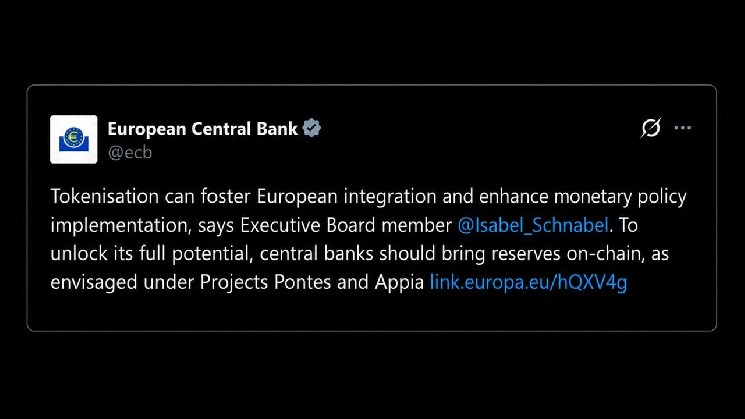
ECB's Schnabel says central bank money 'should move to blockchain'

ECB Executive Board member Isabel Schnabel stated that central bank money "must move onto the blockchain." She argued that stablecoins lack the independent ability to scale liquidity during financial stress—a gap only a central bank can fill. Her proposed solution involves tokenization, which she says can make transactions faster, safer, and more programmable, but only if the safest asset (central bank money) is on the same "rails" as other tokenized assets. This marks a notable shift for the Eurosystem, which had previously viewed Distributed Ledger Technology (DLT) mainly as a tool for regulating stablecoins and crypto, not as infrastructure to adopt directly. The first step is Project Pontes, launching in September. It will initially synchronize the ECB’s existing TARGET services with private DLT platforms. Eventually, it aims to enable settlement finality on a Eurosystem-managed DLT platform with smart contract functionality and 24/7 operation. The long-term strategy is Project Appia, tasked with developing the architecture, standards, and legal framework for a genuine European tokenized asset market by 2028. Trials have already processed around €1.6 billion, and since March 2026, the ECB accepts DLT-based assets as collateral. While not directly impacting Bitcoin's price, these developments signal that a major G7 central bank is preparing to settle transactions on-chain, lending legitimacy to the underlying infrastructure of crypto markets. The ECB's move to avoid "disintermediation" by private tokenization shows that debates in central bank boardrooms are now aligning with discussions long followed in the crypto space.

cryptonews.ruHace 42 min(s)

ECB's Schnabel says central bank money 'should move to blockchain'

cryptonews.ruHace 42 min(s)

Ripple Labs Warns of a New Challenge for Blockchains

Ripple Labs is preparing the XRP Ledger for quantum threats but now emphasizes a broader challenge: ensuring financial infrastructure can adapt simultaneously to quantum computing and artificial intelligence. Senior Director of Engineering Ayo Akinyele states the goal is not merely anticipating a "Q-Day" but building infrastructure capable of preemptively adopting new security mechanisms without network disruption. The shift to post-quantum cryptography involves more than swapping algorithms; it requires flexible infrastructure, improved key management, and clear upgrade paths. Financial systems were not designed with quantum computers in mind, necessitating a rethink of transaction, identity, asset, and data protection. This is underscored by significant investments, such as the $2 billion U.S.-IBM quantum factory initiative and a 2030 U.S. government mandate for post-quantum cryptography adoption. AI introduces distinct risks by driving automation and autonomous economic activity, increasing demand for an always-on, internet-oriented payment infrastructure. AI agents could soon conduct transactions independently, creating new security requirements. Ripple Labs advocates for proactive, orderly preparation rather than a crisis-driven transition, having outlined a four-phase strategy aiming for a full XRP Ledger transition by 2028, now expanded to address both quantum and AI-driven challenges.

cryptonews.ruHace 42 min(s)

Ripple Labs Warns of a New Challenge for Blockchains

cryptonews.ruHace 42 min(s)

Trading

Spot

Artículos destacados

Qué es ETH 2.0

ETH 2.0: Una Nueva Era para Ethereum Introducción ETH 2.0, conocido ampliamente como Ethereum 2.0, marca una actualización monumental para la blockchain de Ethereum. Esta transición no es solo una mejora superficial; busca mejorar fundamentalmente la escalabilidad, seguridad y sostenibilidad de la red. Con un cambio del mecanismo de consenso intensivo en energía Prueba de Trabajo (PoW) a una Prueba de Participación (PoS) más eficiente, ETH 2.0 promete un enfoque transformador para el ecosistema blockchain. ¿Qué es ETH 2.0? ETH 2.0 es un conjunto de actualizaciones interconectadas y distintivas centradas en optimizar las capacidades y el rendimiento de Ethereum. La reestructuración está diseñada para abordar desafíos críticos que el mecanismo actual de Ethereum ha enfrentado, particularmente en lo que respecta a la velocidad de transacción y la congestión de la red. Objetivos de ETH 2.0 Los objetivos principales de ETH 2.0 giran en torno a mejorar tres aspectos clave: Escalabilidad: Con el objetivo de aumentar significativamente el número de transacciones que la red puede manejar por segundo, ETH 2.0 busca superar la limitación actual de aproximadamente 15 transacciones por segundo, potencialmente alcanzando miles. Seguridad: Las medidas de seguridad mejoradas son fundamentales para ETH 2.0, particularmente a través de una mejor resistencia contra ciberataques y la preservación del ethos descentralizado de Ethereum. Sostenibilidad: El nuevo mecanismo PoS está diseñado no solo para mejorar la eficiencia, sino también para reducir drásticamente el consumo de energía, alineando el marco operativo de Ethereum con consideraciones ambientales. ¿Quién es el Creador de ETH 2.0? La creación de ETH 2.0 se puede atribuir a la Fundación Ethereum. Esta organización sin fines de lucro, que desempeña un papel crucial en el apoyo al desarrollo de Ethereum, es liderada por el notable cofundador Vitalik Buterin. Su visión de un Ethereum más escalable y sostenible ha sido la fuerza motriz detrás de esta actualización, involucrando contribuciones de una comunidad global de desarrolladores y entusiastas dedicados a mejorar el protocolo. ¿Quiénes son los Inversores de ETH 2.0? Si bien los detalles sobre los inversores de ETH 2.0 no se han hecho públicos, se sabe que la Fundación Ethereum recibe apoyo de varias organizaciones e individuos en el ámbito de blockchain y tecnología. Estos socios incluyen firmas de capital de riesgo, compañías tecnológicas y organizaciones filantrópicas que comparten un interés mutuo en apoyar el desarrollo de tecnologías descentralizadas e infraestructura blockchain. ¿Cómo Funciona ETH 2.0? ETH 2.0 se distingue por introducir una serie de características clave que lo diferencian de su predecesor. Prueba de Participación (PoS) La transición a un mecanismo de consenso PoS es uno de los cambios más destacados de ETH 2.0. A diferencia de PoW, que se basa en la minería intensiva en energía para la verificación de transacciones, PoS permite a los usuarios validar transacciones y crear nuevos bloques de acuerdo con la cantidad de ETH que apuestan en la red. Esto conduce a una mayor eficiencia energética, reduciendo el consumo en aproximadamente un 99.95%, convirtiendo a Ethereum 2.0 en una alternativa considerablemente más verde. Cadenas Shard Las cadenas shard son otra innovación crítica de ETH 2.0. Estas cadenas más pequeñas operan en paralelo con la cadena principal de Ethereum, lo que permite que múltiples transacciones sean procesadas simultáneamente. Este enfoque mejora la capacidad general de la red, abordando las preocupaciones de escalabilidad que han afectado a Ethereum. Cadena Beacon En el núcleo de ETH 2.0 se encuentra la Cadena Beacon, que coordina la red y gestiona el protocolo PoS. Funciona como un organizador de cierta manera: supervisa a los validadores, asegura que los shards permanezcan conectados a la red y monitorea la salud general del ecosistema blockchain. Cronología de ETH 2.0 El viaje de ETH 2.0 ha estado marcado por varios hitos clave que trazan la evolución de esta importante actualización: Diciembre 2020: El lanzamiento de la Cadena Beacon marcó la introducción de PoS, preparándose para la migración hacia ETH 2.0. Septiembre 2022: La finalización de “La Fusión” representa un momento crucial en el que la red Ethereum se trasladó exitosamente de un marco PoW a uno PoS, anunciando una nueva era para Ethereum. 2023: El lanzamiento esperado de cadenas shard tiene como objetivo mejorar aún más la escalabilidad de la red Ethereum, consolidando a ETH 2.0 como una plataforma robusta para aplicaciones y servicios descentralizados. Características Clave y Beneficios Escalabilidad Mejorada Una de las ventajas más significativas de ETH 2.0 es su escalabilidad mejorada. La combinación de PoS y cadenas shard permite que la red expanda su capacidad, permitiendo acomodar un volumen mucho mayor de transacciones en comparación con el sistema heredado. Eficiencia Energética La implementación de PoS representa un gran paso hacia la eficiencia energética en la tecnología blockchain. Al reducir drásticamente el consumo de energía, ETH 2.0 no solo disminuye los costos operativos, sino que también se alinea más estrechamente con los objetivos de sostenibilidad global. Seguridad Mejorada Los mecanismos actualizados de ETH 2.0 contribuyen a mejorar la seguridad en toda la red. El despliegue de PoS, junto con las medidas de control innovadoras establecidas a través de cadenas shard y la Cadena Beacon, asegura un mayor grado de protección contra posibles amenazas. Costos Más Bajos para los Usuarios A medida que la escalabilidad mejora, los efectos sobre los costos de transacción también serán evidentes. Se espera que una mayor capacidad y una menor congestión se traduzcan en tarifas más bajas para los usuarios, haciendo que Ethereum sea más accesible para transacciones cotidianas. Conclusión ETH 2.0 marca una evolución significativa en el ecosistema blockchain de Ethereum. A medida que aborda problemas fundamentales como la escalabilidad, el consumo de energía, la eficiencia en las transacciones y la seguridad general, la importancia de esta actualización no puede ser subestimada. La transición a la Prueba de Participación, la introducción de cadenas shard y el trabajo fundamental de la Cadena Beacon son indicativos de un futuro donde Ethereum puede satisfacer las crecientes demandas del mercado descentralizado. En una industria impulsada por la innovación y el progreso, ETH 2.0 se erige como un testimonio de las capacidades de la tecnología blockchain para allanar el camino hacia una economía digital más sostenible y eficiente.

375 Vistas totalesPublicado en 2024.04.04Actualizado en 2024.12.03

Qué es ETH 2.0

Qué es ETH 3.0

ETH3.0 y $eth 3.0: Un Examen Profundo del Futuro de Ethereum Introducción En el paisaje en rápida evolución de las criptomonedas y la tecnología blockchain, ETH3.0, a menudo denotado como $eth 3.0, ha surgido como un tema de considerable interés y especulación. El término abarca dos conceptos principales que merecen aclaración: Ethereum 3.0: Esto representa una posible actualización futura destinada a aumentar las capacidades de la blockchain existente de Ethereum, enfocándose particularmente en mejorar la escalabilidad y el rendimiento. ETH3.0 Meme Token: Este proyecto de criptomoneda distinto busca aprovechar la blockchain de Ethereum para crear un ecosistema centrado en memes, promoviendo la participación dentro de la comunidad de criptomonedas. Comprender estos aspectos de ETH3.0 es esencial no solo para los entusiastas de las criptomonedas, sino también para aquellos que observan tendencias tecnológicas más amplias en el espacio digital. ¿Qué es ETH3.0? Ethereum 3.0 Ethereum 3.0 se presenta como una actualización propuesta para la red de Ethereum ya establecida, que ha sido la columna vertebral de muchas aplicaciones descentralizadas (dApps) y contratos inteligentes desde su inicio. Las mejoras previstas se concentran principalmente en la escalabilidad, integrando tecnologías avanzadas como sharding y pruebas de conocimiento cero (zk-proofs). Estas innovaciones tecnológicas tienen como objetivo facilitar un número sin precedentes de transacciones por segundo (TPS), potencialmente alcanzando millones, abordando así una de las limitaciones más significativas que enfrenta la tecnología blockchain actual. La mejora no es meramente técnica, sino también estratégica; está destinada a preparar la red de Ethereum para su adopción generalizada y utilidad en un futuro marcado por una mayor demanda de soluciones descentralizadas. ETH3.0 Meme Token En contraste con Ethereum 3.0, el ETH3.0 Meme Token se aventura en un ámbito más ligero y juguetón al combinar la cultura de memes de internet con la dinámica de las criptomonedas. Este proyecto permite a los usuarios comprar, vender e intercambiar memes en la blockchain de Ethereum, proporcionando una plataforma que fomenta la participación comunitaria a través de la creatividad y los intereses compartidos. El ETH3.0 Meme Token tiene como objetivo demostrar cómo la tecnología blockchain puede intersectarse con la cultura digital, creando casos de uso que son tanto entretenidos como financieramente viables. ¿Quién es el Creador de ETH3.0? Ethereum 3.0 La iniciativa hacia Ethereum 3.0 es impulsada principalmente por un consorcio de desarrolladores e investigadores dentro de la comunidad de Ethereum, incluyendo notablemente a Justin Drake. Conocido por sus ideas y contribuciones a la evolución de Ethereum, Drake ha sido una figura prominente en las discusiones sobre la transición de Ethereum a una nueva capa de consenso, denominada “Beam Chain.” Este enfoque colaborativo para el desarrollo significa que Ethereum 3.0 no es el producto de un creador singular, sino más bien una manifestación de ingenio colectivo centrado en avanzar la tecnología blockchain. ETH3.0 Meme Token Los detalles sobre el creador del ETH3.0 Meme Token son actualmente inidentificables. La naturaleza de los tokens de memes a menudo conduce a una estructura más descentralizada y dirigida por la comunidad, lo que podría explicar la falta de atribución específica. Esto se alinea con la ética de la comunidad cripto más amplia, donde la innovación a menudo surge de esfuerzos colaborativos en lugar de individuales. ¿Quiénes son los Inversores de ETH3.0? Ethereum 3.0 El apoyo a Ethereum 3.0 proviene principalmente de la Fundación Ethereum junto con una entusiasta comunidad de desarrolladores e inversores. Esta asociación fundamental proporciona un grado significativo de legitimidad y mejora la perspectiva de una implementación exitosa, ya que aprovecha la confianza y credibilidad construidas a lo largo de años de operaciones en la red. En el clima cambiando rápidamente de las criptomonedas, el apoyo de la comunidad juega un papel crucial en impulsar el desarrollo y la adopción, posicionando a Ethereum 3.0 como un contendiente serio para futuros avances en blockchain. ETH3.0 Meme Token Si bien las fuentes actualmente disponibles no proporcionan información explícita sobre las fundaciones o organizaciones de inversión que respaldan el ETH3.0 Meme Token, es indicativo del modelo de financiamiento típico para tokens de memes, que a menudo depende del apoyo de base y la participación comunitaria. Los inversores en tales proyectos suelen consistir en individuos motivados por el potencial de innovación impulsada por la comunidad y el espíritu de cooperación que se encuentra dentro de la comunidad cripto. ¿Cómo Funciona ETH3.0? Ethereum 3.0 Las características distintivas de Ethereum 3.0 radican en su implementación propuesta de sharding y tecnología zk-proof. Sharding es un método de particionamiento de la blockchain en piezas más pequeñas y manejables o “shards,” que pueden procesar transacciones de manera concurrente en lugar de secuencial. Esta descentralización del procesamiento ayuda a prevenir la congestión y asegura que la red permanezca receptiva incluso bajo una carga pesada. La tecnología de prueba de conocimiento cero (zk-proof) contribuye con otra capa de sofisticación al permitir la validación de transacciones sin revelar los datos subyacentes involucrados. Este aspecto no solo mejora la privacidad, sino que también aumenta la eficiencia general de la red. También se habla de incorporar una Máquina Virtual de Ethereum de conocimiento cero (zkEVM) en esta actualización, amplificando aún más las capacidades y utilidad de la red. ETH3.0 Meme Token El ETH3.0 Meme Token se distingue al capitalizar la popularidad de la cultura de memes. Establece un mercado para que los usuarios participen en el comercio de memes, no solo por entretenimiento sino también por el posible beneficio económico. Al integrar características como staking, provisión de liquidez y mecanismos de gobernanza, el proyecto fomenta un entorno que incentiva la interacción y participación de la comunidad. Al ofrecer una mezcla única de entretenimiento y oportunidad económica, el ETH3.0 Meme Token tiene como objetivo atraer a una audiencia diversa, que abarca desde entusiastas de las criptomonedas hasta conocedores casuales de memes. Línea de Tiempo de ETH3.0 Ethereum 3.0 11 de noviembre de 2024: Justin Drake insinúa la próxima actualización de ETH 3.0, centrada en mejoras de escalabilidad. Este anuncio significa el comienzo de las discusiones formales sobre la futura arquitectura de Ethereum. 12 de noviembre de 2024: Se espera que la propuesta anticipada para Ethereum 3.0 se desvele en Devcon en Bangkok, preparando el escenario para una mayor retroalimentación de la comunidad y posibles próximos pasos en el desarrollo. ETH3.0 Meme Token 21 de marzo de 2024: El ETH3.0 Meme Token se lista oficialmente en CoinMarketCap, marcando su incursión en el dominio público de las criptomonedas y mejorando la visibilidad de su ecosistema basado en memes. Puntos Clave En conclusión, Ethereum 3.0 representa una evolución significativa dentro de la red de Ethereum, enfocándose en superar las limitaciones en términos de escalabilidad y rendimiento a través de tecnologías avanzadas. Sus actualizaciones propuestas reflejan un enfoque proactivo hacia las demandas y la usabilidad futura. Por otro lado, el ETH3.0 Meme Token encapsula la esencia de la cultura impulsada por la comunidad en el espacio de las criptomonedas, aprovechando la cultura de memes para crear plataformas atractivas que fomentan la creatividad y participación del usuario. Comprender los distintos propósitos y funcionalidades de ETH3.0 y $eth 3.0 es fundamental para cualquiera interesado en los desarrollos en curso dentro del espacio cripto. Con ambas iniciativas abriendo caminos únicos, subrayan colectivamente la naturaleza dinámica y multifacética de la innovación en blockchain.

389 Vistas totalesPublicado en 2024.04.04Actualizado en 2024.12.03

Qué es ETH 3.0

Cómo comprar ETH

¡Bienvenido a HTX.com! Hemos hecho que comprar Ethereum (ETH) sea simple y conveniente. Sigue nuestra guía paso a paso para iniciar tu viaje de criptos.Paso 1: crea tu cuenta HTXUtiliza tu correo electrónico o número de teléfono para registrarte y obtener una cuenta gratuita en HTX. Experimenta un proceso de registro sin complicaciones y desbloquea todas las funciones.Obtener mi cuentaPaso 2: ve a Comprar cripto y elige tu método de pagoTarjeta de crédito/débito: usa tu Visa o Mastercard para comprar Ethereum (ETH) al instante.Saldo: utiliza fondos del saldo de tu cuenta HTX para tradear sin problemas.Terceros: hemos agregado métodos de pago populares como Google Pay y Apple Pay para mejorar la comodidad.P2P: tradear directamente con otros usuarios en HTX.Over-the-Counter (OTC): ofrecemos servicios personalizados y tipos de cambio competitivos para los traders.Paso 3: guarda tu Ethereum (ETH)Después de comprar tu Ethereum (ETH), guárdalo en tu cuenta HTX. Alternativamente, puedes enviarlo a otro lugar mediante transferencia blockchain o utilizarlo para tradear otras criptomonedas.Paso 4: tradear Ethereum (ETH)Tradear fácilmente con Ethereum (ETH) en HTX's mercado spot. Simplemente accede a tu cuenta, selecciona tu par de trading, ejecuta tus trades y monitorea en tiempo real. Ofrecemos una experiencia fácil de usar tanto para principiantes como para traders experimentados.

4.8k Vistas totalesPublicado en 2024.12.10Actualizado en 2026.06.02

Cómo comprar ETH

Discusiones

Bienvenido a la comunidad de HTX. Aquí puedes mantenerte informado sobre los últimos desarrollos de la plataforma y acceder a análisis profesionales del mercado. A continuación se presentan las opiniones de los usuarios sobre el precio de ETH (ETH).

活动图片