Ethereum Founder Buterin Slams Elon Musk As Anti-Europe Attacks Ignite

bitcoinistPublicado a 2025-12-10Actualizado a 2025-12-10

Resumen

Ethereum founder Vitalik Buterin has publicly criticized Elon Musk, accusing his platform X of enabling aggressive, coordinated attacks against Europe rather than fostering free speech. Buterin acknowledged EU flaws like excessive bureaucracy and criticized policies like Chat Control, but argued the rhetoric on X has become unhinged and resembles a delegitimization campaign. He directly warned Musk that using X for "coordinated hate sessions" harms free speech and could provoke major backlashes. Buterin hinted at possible Russian involvement in the anti-EU discourse and reaffirmed his support for the EU as a valuable, though imperfect, institutional experiment. His comments follow Musk's outburst against the EU, which included calls to abolish the bloc after it fined X €120 million for DSA breaches.

Ethereum founder Vitalik Buterin has issued a sharp public warning to Elon Musk over how X is being used to direct increasingly aggressive rhetoric at Europe, arguing that the platform is drifting from a free-speech ideal toward orchestrated hostility.

Ethereum Founder Calls Out Elon Musk

In a series of posts on X, Buterin said that “the attacks on Europe I’ve seen here the last couple of days, including from people I’ve generally considered interesting and sophisticated, have been getting unhinged.”

He acknowledged that the European Union has serious shortcomings, listing “GDPR clickthroughs are dumb, Chat Control is awful, they need to be less bureaucratic and supportive toward entrepreneurs,” and criticizing what he called Europe’s selective moral stance, noting that its “kindness toward Ukraine often doesn’t extend well to Gaza or Sudan or other places.” He also described “people saying mean things about criminals getting longer sentences than the criminals” as “just crazy.”

Despite that, the Ethereum founder argued that the way some users on X are talking about Europe has moved well beyond legitimate criticism. He described “the apocalyptic attitude about the issues, evoking imagery of barbarians pillaging Rome etc,” as “really over the top” and said it “feels more like a coordinated attempt to delegitimize than constructive criticism.”

He rejected the idea that the real target is only Brussels-based institutions, writing: “I don’t believe the line that ‘the target is not Europe, it’s the EU’: I’ve seen many instances of London specifically being targeted in the hate session, so no, much of it is an attack on Europe.” This, he argued, does not match his experience from “spending an average of two months every year there for the last decade.”

The central confrontation came in a direct reply to Musk. Addressing the X owner’s self-positioning as a defender of free speech, the Ethereum founder wrote: “I think you should consider that making X a global totem pole for Free Speech, and then turning it into a death star laser for coordinated hate sessions, is actually harmful for the cause of free speech. I’m seriously worried that huge backlashes against values I hold dear are coming in a few years’ time.”

Buterin Hints At Russian Involvement

The thread sparked pushback from some users who argued that his framing underplays European complicity in current conflicts. One critic responded that “’not extending kindness’ is an incredible way to frame funding, arming and politically backing a genocide,” and claimed that it is “hilarious to think the US doesn’t suffer from many of the same things or worse that Americans say about the EU.”

The Ethereum founder replied that Europe is “a genuinely mixed bag,” emphasizing that “different countries in Europe have very different policies,” and pointing out that the continent “also hosts ICC, which is under a lot of pressure (see: judges being financially deplatformed).”

Other replies widened the lens to geopolitics. Commenting on a suggestion that the current discourse looks like “a coordinated campaign due to the Kremlin liking the new US ‘going back to Monroe’ global security policy,” Buterin answered “yeah basically” and added that “a lot of powerful people really like the vision that the world should just be 5–20 adults who have their spheres and sometimes get together in a room to hash out any differences, and everyone else can be shut out because they are annoying and inconvenient.”

At the same time, Buterin restated his support for the European project as an institutional experiment. “I have a lot of respect for the idea of EU, as an experiment in trying to get the benefits of a superstate, without the homogenization, becoming an aggressive ‘great power’, and other downsides,” he wrote, while stressing that “the experiment does need to be adjusted in a lot of ways; eg. we see not enough unity in its external policy and too much unity on top-down bureaucracy and surveillance at the same time.” If improved, he argued, “it’s a model that could set a really good example for the world.”

On the technical side, the Ethereum founder used the debate over “gdpr clickthroughs” to propose a different approach to online control, calling for “more sophisticated user-side software (browsers, local LLMs...) that helps the user navigate the internet and make intelligent decisions about what requires confirmations from the user.” In contrast to the centralized dynamics he criticizes on X, he is effectively pointing back to user-empowering, decentralized tools as the way to reconcile regulation, usability and free expression.

Musk Vs. The European Union

Notably, Musk’s anti-EU outburst comes after the Commission has issued a fine of €120 million to X for breaching its transparency obligations under the Digital Services Act (DSA). Musk wrote via X that “The ‘EU’ imposed this crazy fine not just on @X, but also on me personally, which is even more insane!” and says it would be “appropriate to apply our response not just to the EU, but also to the individuals who took this action against me.”

In subsequent posts he escalated further, declaring that “The EU should be abolished and sovereignty returned to individual countries,” calling to “Dissolve the EU and return power to the people,” and even asserting that “The EU commissars are responsible for the murder of Europe.”

At press time, Ethereum traded at $3,316.
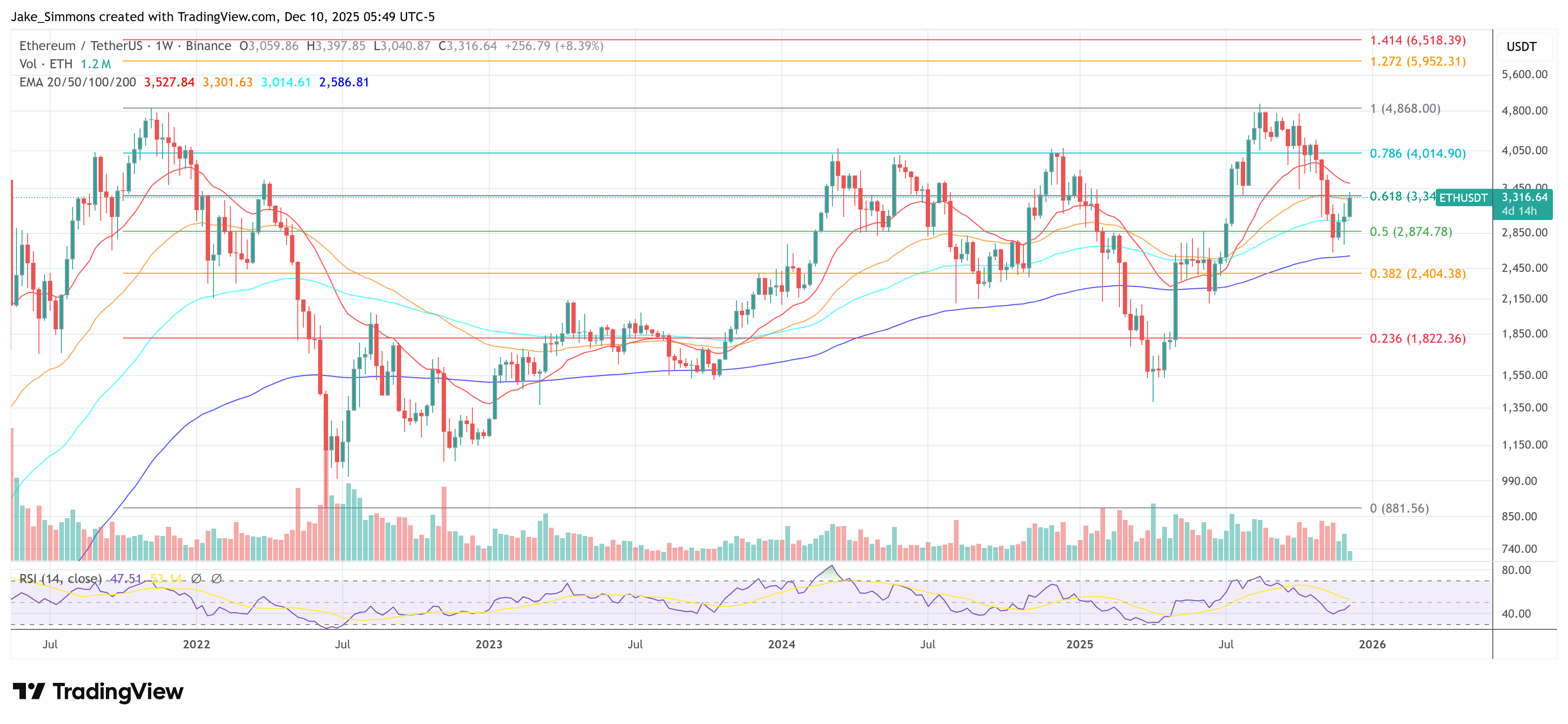
Ethereum hovers below the 0.618 Fib, 1-week chart | Source: TOTAL on TradingView.com

Lecturas Relacionadas

This Week's Key Events Preview | U.S. to Release April CPI Data; U.S. Senate Banking Committee to Review "Digital Asset Market Structure Act of 2025"

Weekly News Preview: Key events for May 12-16 include major economic and crypto industry developments. On Tuesday, May 12, the U.S. will release its April CPI data. Additionally, the gaming blockchain Ronin will begin a 10-hour migration to an Ethereum Layer 2, built on OP Stack with EigenDA for data availability. This aims to leverage Ethereum's security and settle RON's annual inflation below 1%. Base's first independent network upgrade, "Base Azul," is scheduled for mainnet activation on Wednesday, May 13, focusing on security, performance, and developer experience enhancements. Thursday, May 14, sees the U.S. Senate Banking Committee voting on the "Digital Asset Market Structure Act of 2025." In other news, Solana DeFi protocol Carrot will shut down, setting a final withdrawal deadline due to impacts from the Drift exploit. The Moscow Exchange will launch futures trading for Solana, Ripple, and Tron indices (RUB-settled) for qualified investors. Multiple service closures are scheduled for Friday, May 15. Dmail Network will begin winding down due to unsustainable infrastructure costs and failed commercialization. Users must export data before this date. Separately, the Cosmos-based lending blockchain UX Chain will fully shut down. Finally, on Saturday, May 16, gaming infrastructure provider Lattice will wind down operations, with its Redstone Layer 2 network ceasing. Users are urged to withdraw assets, especially from contracts like Uniswap pools, before the shutdown.

链捕手Hace 5 min(s)

This Week's Key Events Preview | U.S. to Release April CPI Data; U.S. Senate Banking Committee to Review "Digital Asset Market Structure Act of 2025"

链捕手Hace 5 min(s)

Morning Post | Trump Media Group Releases Q1 Financial Report; Top Three DeFi Applications Return Nearly $100 Million in Revenue to Token Holders in 30 Days; Michael Saylor Shares Bitcoin Tracker Info Again

**Title: Daily Briefing | Trump Media Group Releases Q1 Report; Top 3 DeFi Apps Return Nearly $100M to Token Holders; Michael Saylor Signals Potential Bitcoin Buy** **Summary:** Key developments in the past 24 hours include: * **Economic Outlook:** Goldman Sachs has pushed back its forecast for the next two Federal Reserve interest rate cuts to December 2026 and March 2027, citing persistent inflationary pressures from energy costs. This delayed timeline is expected to tighten liquidity flow into risk assets, including cryptocurrencies. * **DeFi & Revenue:** Data from DefiLlama shows that three leading DeFi applications—Hyperliquid, Pump.fun, and EdgeX—collectively distributed $96.3 million in revenue to their token holders over the last 30 days. This trend highlights a shift in the crypto community's focus towards real protocol earnings and sustainable economic models. * **Corporate Bitcoin Moves:** Michael Saylor, founder of MicroStrategy (note: referred to as 'Strategy' in the text, likely a typographical error), has signaled potential upcoming Bitcoin purchases by posting a "Bitcoin Tracker" update, following a pattern that typically precedes the company's official disclosure of new acquisitions. * **Market Integrity:** Prediction market platform Polymarket announced updates to address platform issues, including identifying and banning clusters of accounts involved in "ghost-fill" activities and implementing measures to prevent bulk account creation. * **Regulation:** The Bank of England Governor warned that stablecoin regulation could lead to tensions between US and international regulators. In South Korea, the National Tax Service has launched a pilot program to entrust seized virtual assets to private custody firms for management. * **Meme Token Trends:** GMGN data lists the top trending meme tokens on Ethereum (e.g., HEX, SHIB), Solana (e.g., FWOG, TROLL), and Base (e.g., SKITTEN, PEPE) over the past day. **Financial Note:** Trump Media & Technology Group reported a Q1 loss of approximately $4 billion, primarily attributed to unrealized losses on its Bitcoin and other digital asset holdings.

链捕手Hace 36 min(s)

Morning Post | Trump Media Group Releases Q1 Financial Report; Top Three DeFi Applications Return Nearly $100 Million in Revenue to Token Holders in 30 Days; Michael Saylor Shares Bitcoin Tracker Info Again

链捕手Hace 36 min(s)

Telegram Takes Direct Control of TON, Social Traffic Rewrites the Public Chain Narrative

Telegram founder Pavel Durov announced that Telegram will replace the TON Foundation as the core driver and largest validator of The Open Network (TON). Key initiatives include a sixfold reduction in transaction fees, performance upgrades, and improved developer tools within the next few weeks. This marks a strategic shift from Telegram merely providing user access to deeply integrating TON into its platform's core infrastructure. The goal is to transform Telegram's massive social traffic into sustainable on-chain activity. While viral mini-apps like Notcoin have demonstrated Telegram's ability to drive user adoption, TON aims to support frequent, low-value transactions inherent to social platforms—such as tipping, in-app payments, and game rewards. Ultra-low fees and sub-second finality (0.6 seconds) are crucial to making blockchain interactions seamless and nearly invisible within the Telegram user experience. However, Telegram's increased central role raises questions about network decentralization. Durov argues that Telegram's participation will attract more large validators, thereby enhancing decentralization. TON also offers high annual staking rewards (18.8%), aiming to retain capital within its ecosystem. The fundamental challenge for TON is no longer leveraging Telegram's user base, but becoming an indispensable, seamless infrastructure layer for Telegram's everyday applications—moving from an adjacent chain to an embedded utility.

marsbitHace 37 min(s)

Telegram Takes Direct Control of TON, Social Traffic Rewrites the Public Chain Narrative

marsbitHace 37 min(s)

Telegram Takes Direct Control of TON, Social Traffic Reshapes Public Chain Narrative

Telegram's founder, Pavel Durov, has announced a major shift in the development of The Open Network (TON). Telegram will now become the core driver of TON, replacing the TON Foundation and becoming its largest validator. The focus will be on technical upgrades over the next few weeks, including slashing network fees by six times to near-zero and improving finality time to 0.6 seconds. This move signifies a deeper integration between Telegram and TON, moving beyond just providing a user base. The goal is to transform Telegram's vast social traffic and built-in features—like Mini Apps, payments, and bots—into sustainable, on-chain usage scenarios. The reduced fees and faster speeds are crucial for enabling the small, frequent transactions typical of social interactions. While this promises stronger execution and product alignment, it raises questions about centralization. Durov argues Telegram's involvement will attract more validators, enhancing decentralization, but the outcome remains to be seen. Additionally, TON's high annual staking reward of 18.8% aims to retain capital within the ecosystem. The key challenge for TON is no longer just leveraging Telegram's entry point, but becoming an invisible, seamless infrastructure layer within Telegram's daily use. Its success hinges on converting viral attention into lasting, embedded utility.

Odaily星球日报Hace 47 min(s)

Telegram Takes Direct Control of TON, Social Traffic Reshapes Public Chain Narrative

Odaily星球日报Hace 47 min(s)

Trading

Spot
Futuros

Artículos destacados

Cómo comprar ELON

¡Bienvenido a HTX.com! Hemos hecho que comprar Dogelon Mars (ELON) sea simple y conveniente. Sigue nuestra guía paso a paso para iniciar tu viaje de criptos.Paso 1: crea tu cuenta HTXUtiliza tu correo electrónico o número de teléfono para registrarte y obtener una cuenta gratuita en HTX. Experimenta un proceso de registro sin complicaciones y desbloquea todas las funciones.Obtener mi cuentaPaso 2: ve a Comprar cripto y elige tu método de pagoTarjeta de crédito/débito: usa tu Visa o Mastercard para comprar Dogelon Mars (ELON) al instante.Saldo: utiliza fondos del saldo de tu cuenta HTX para tradear sin problemas.Terceros: hemos agregado métodos de pago populares como Google Pay y Apple Pay para mejorar la comodidad.P2P: tradear directamente con otros usuarios en HTX.Over-the-Counter (OTC): ofrecemos servicios personalizados y tipos de cambio competitivos para los traders.Paso 3: guarda tu Dogelon Mars (ELON)Después de comprar tu Dogelon Mars (ELON), guárdalo en tu cuenta HTX. Alternativamente, puedes enviarlo a otro lugar mediante transferencia blockchain o utilizarlo para tradear otras criptomonedas.Paso 4: tradear Dogelon Mars (ELON)Tradear fácilmente con Dogelon Mars (ELON) en HTX's mercado spot. Simplemente accede a tu cuenta, selecciona tu par de trading, ejecuta tus trades y monitorea en tiempo real. Ofrecemos una experiencia fácil de usar tanto para principiantes como para traders experimentados.

159 Vistas totalesPublicado en 2024.12.12Actualizado en 2025.03.21

Cómo comprar ELON

Discusiones

Bienvenido a la comunidad de HTX. Aquí puedes mantenerte informado sobre los últimos desarrollos de la plataforma y acceder a análisis profesionales del mercado. A continuación se presentan las opiniones de los usuarios sobre el precio de ELON (ELON).

活动图片













