Ethena rallies 14.5% in a day, but THIS will limit further gains

ambcryptoPublicado a 2026-04-09Actualizado a 2026-04-09

Resumen

Ethena (ENA) rallied 14.6% in 24 hours, extending gains from earlier in the week, partly driven by a broader crypto market boost following former President Trump's ceasefire announcement. The project's plan to diversify its USDe stablecoin reserves into non-crypto assets has also contributed to positive momentum, aiming to address declining yields and supply since the October 2025 market downturn. Despite the recent surge, ENA's overall trend remains bearish. Technical analysis on the 1-day chart shows lower highs, with the RSI below 50 and declining OBV, indicating sustained selling pressure. The price has struggled to break the key $0.095-$0.10 resistance zone, where a cluster of short liquidations is located. The 4-hour chart structure is also bearish, and a break above $0.095 is needed to shift momentum bullishly. Traders are advised to consider taking profits near current levels, as the relief rally may be over, and a downward move could follow. The resistance band remains a significant barrier to further gains.

Ethena [ENA] has rallied 14.6% over the past 24 hours, extending the gains it made on Monday, the 6th of April. The crypto market saw a bullish boost from the short liquidations that followed President Trump’s ceasefire announcement.

Ethena plans to diversify its USDe reserve assets into non-crypto assets, which is why ENA has been rallying even before the announcement. The crypto rout since October 2025 saw declining USDe supply and yield.

The protocol’s founder, Gary Young, had said that Ethena was poorly positioned since that crash. Including non-crypto reserve assets will boost its falling yield and aid market performance.

ENA’s trend remains bearishly poised
Source: ENA/USDT on TradingView

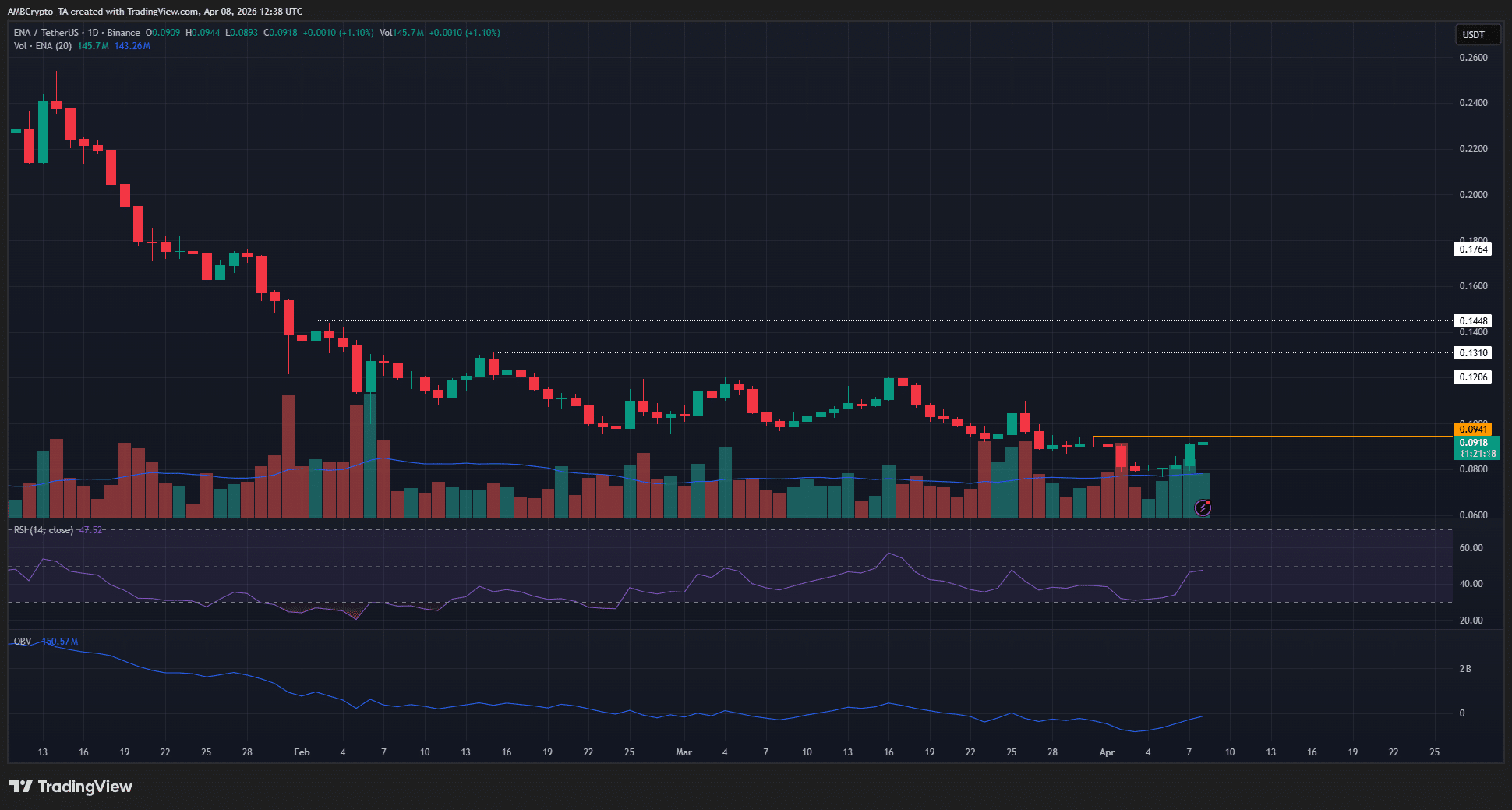
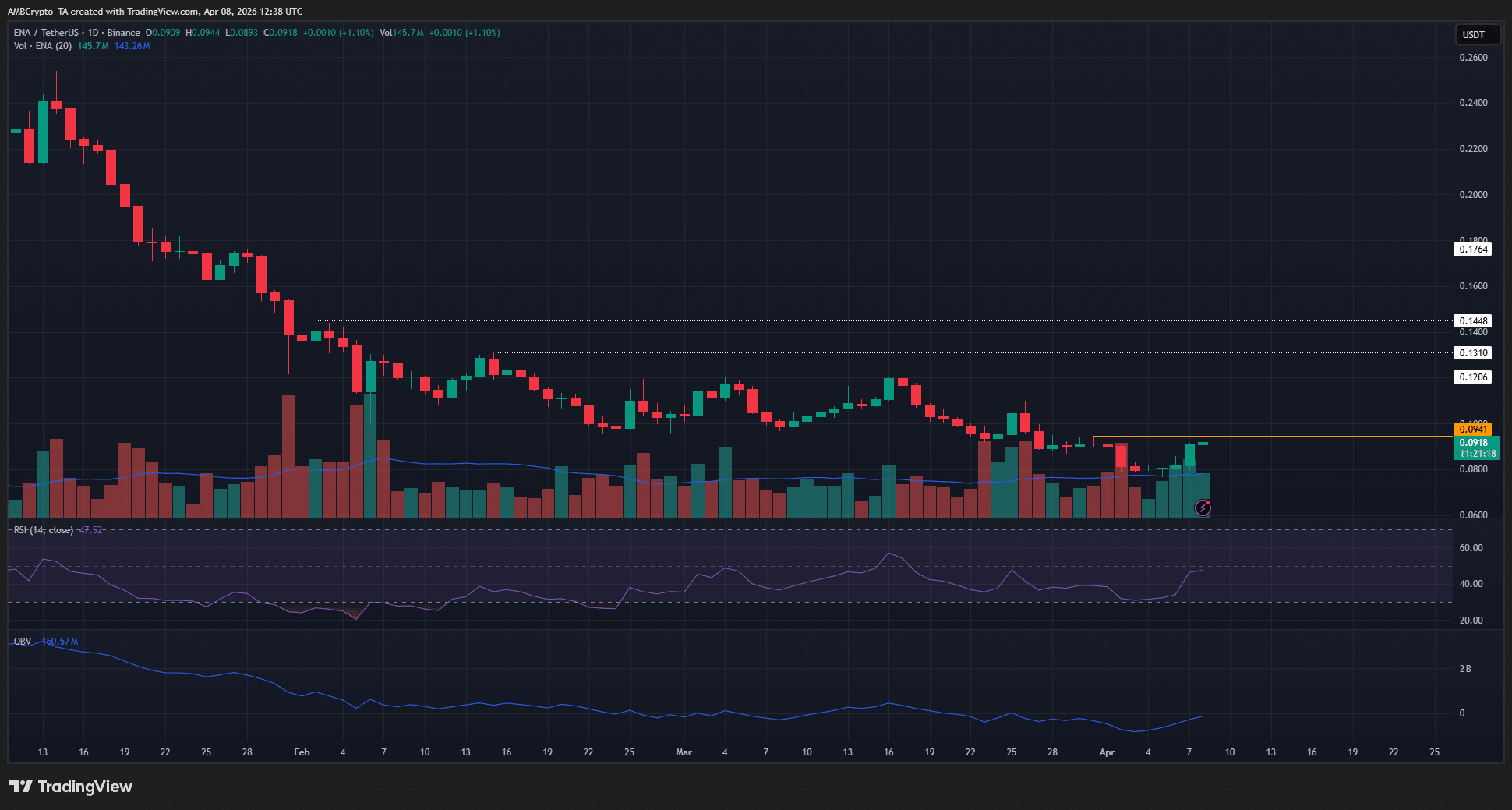
The lower highs on the 1-day timeframe, highlighted in white, showed that Ethena continued to labor under a bearish trend. The RSI was below neutral 50, and the OBV was in a slump, too.

This showed that the trend, selling pressure, and market structure were all in favor of the sellers. Even the rally in recent days, though it was high-volume, was unable to convincingly smash past the $0.094 local highs.

This was a complication for ENA bulls. Or, in a way, some pessimistic participants would say it makes the picture clearer. The sweep of the $0.095-$0.10 local highs means that the Ethena relief rally is over.

A new leg downward can commence from these liquidity pockets.

Traders’ call to action – Sell
Source: CoinGlass

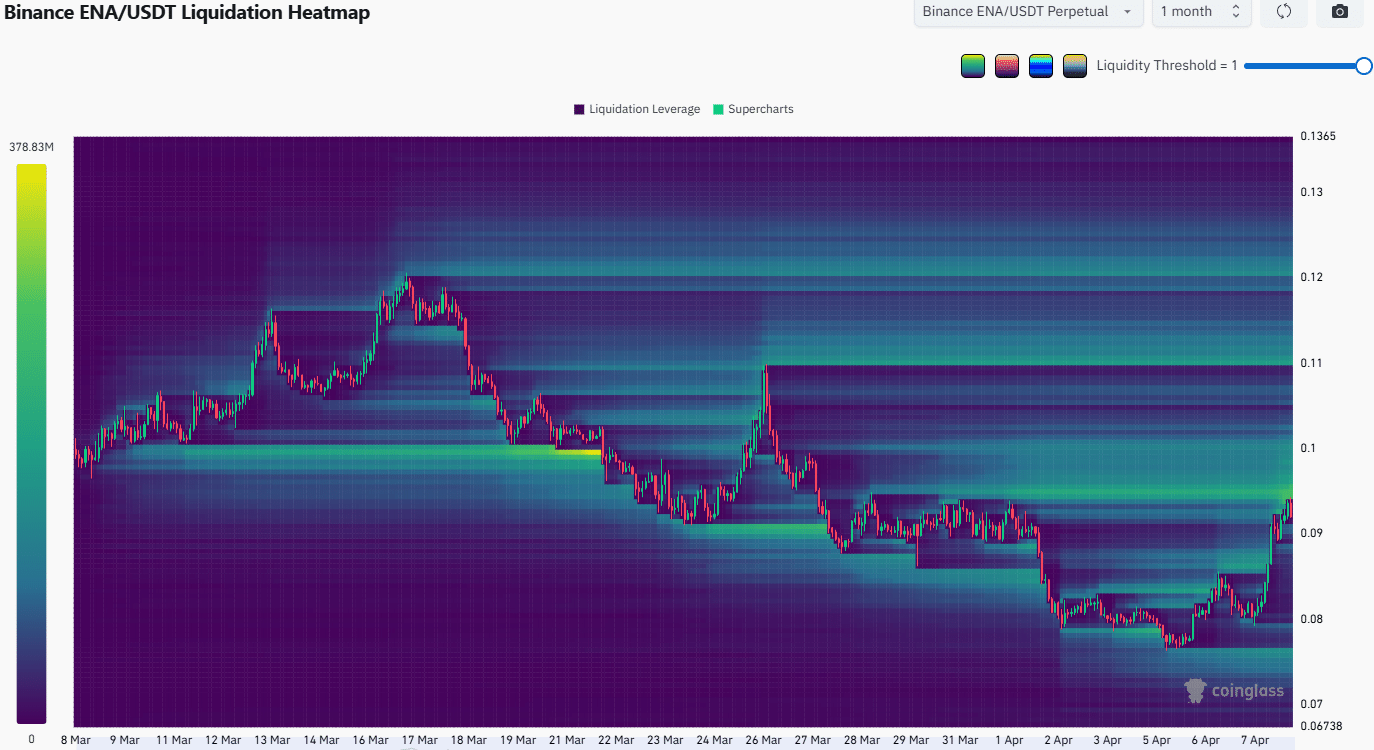
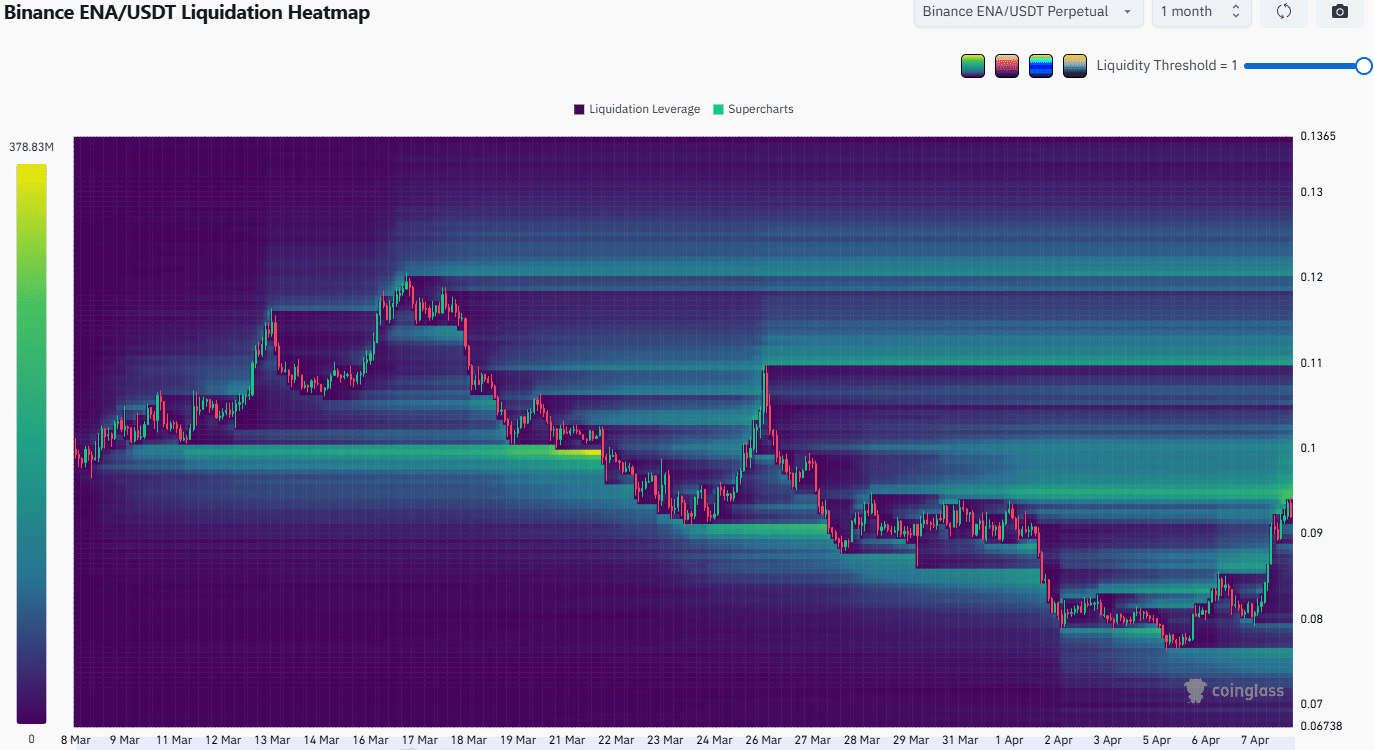
The past month’s liquidation heatmap showed a cluster of short liquidations from $0.094 to $0.10. This was the same band of resistance that the price has struggled to clear in the past 12 hours of trading.
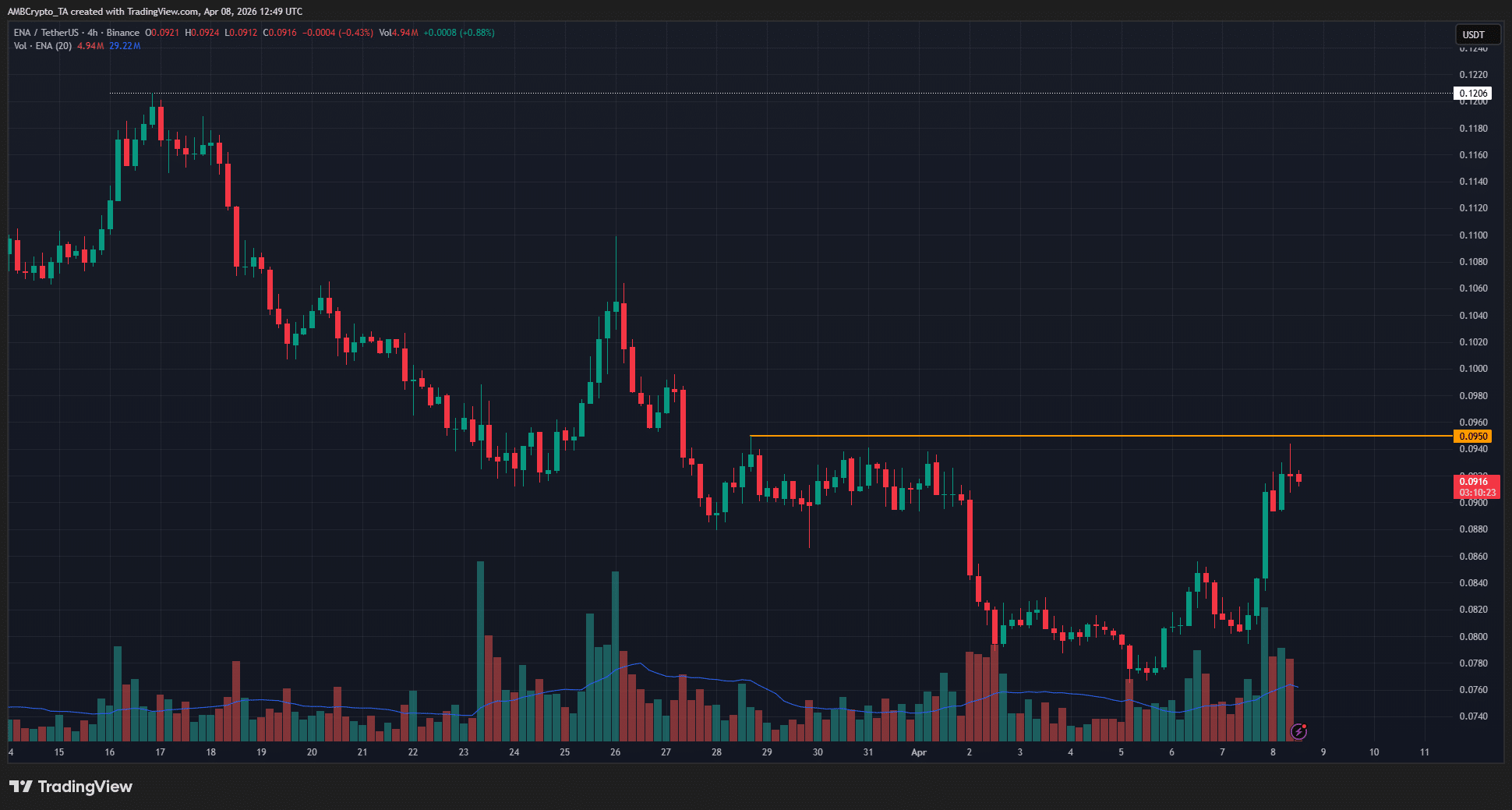
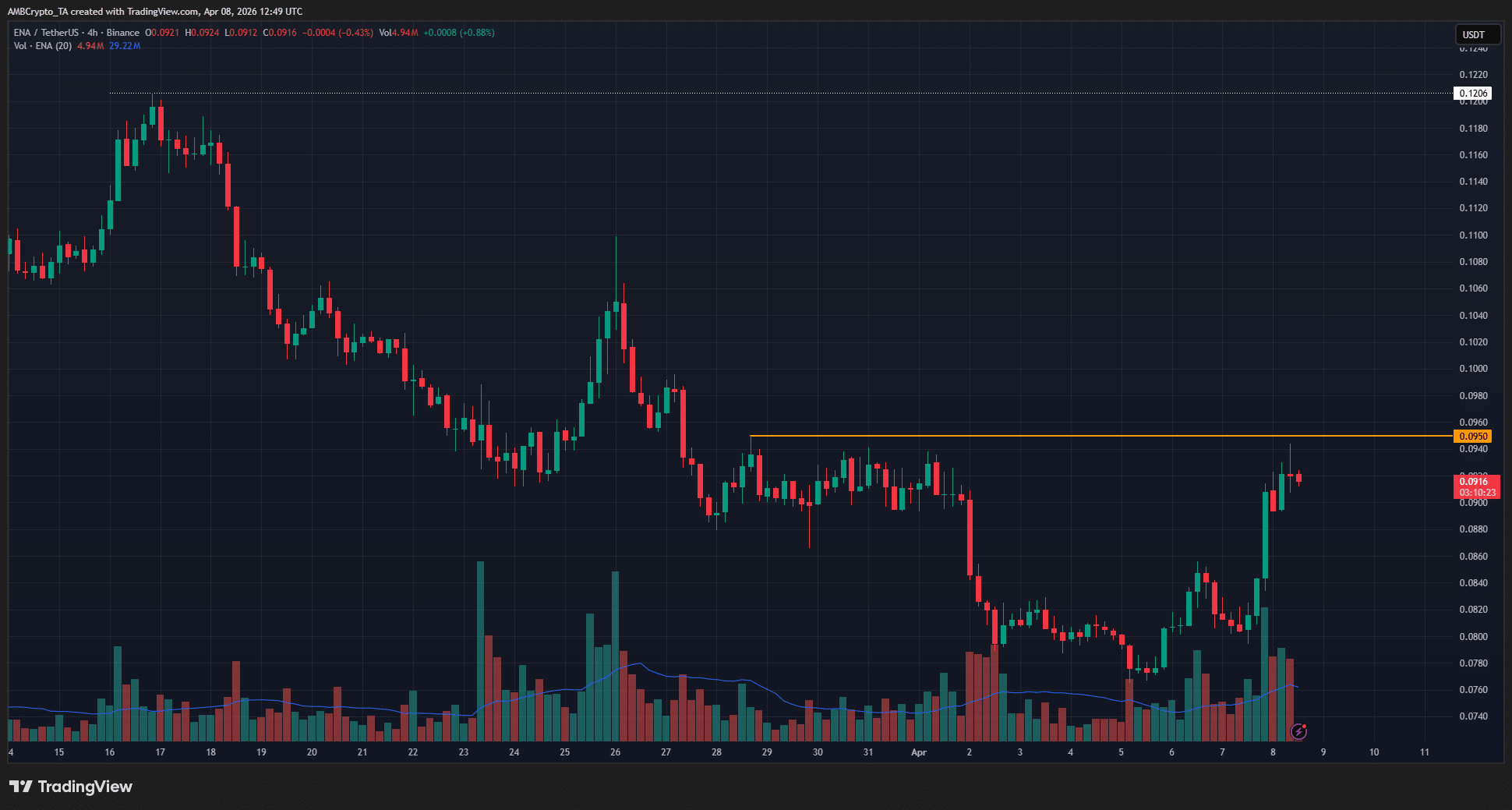
Source: ENA/USDT on TradingView

The 4-hour timeframe’s structure remained bearish. The $0.095 level must be beaten for the swing structure to shift bullishly. A breakout and retest as support can inform bulls that the momentum might continue.

Until then, traders can maintain a bearish bias and look to take profits from the bounce.


Final Summary

  • Ethena has racked up sizeable gains since the start of the week and was aided by the ceasefire announcement and crypto market bounce.
  • The $0.095-$0.10 resistance level remained in place, and traders should be prepared to take profits in this area as the swing structure remained bearish.


Preguntas relacionadas

QWhat was the main reason behind Ethena's 14.6% price rally in the past 24 hours?

AThe rally was primarily driven by a bullish boost from short liquidations following President Trump's ceasefire announcement, as well as Ethena's plan to diversify its USDe reserve assets into non-crypto assets.

QWhy is Ethena planning to diversify its USDe reserve assets into non-crypto assets?

AThe diversification aims to boost Ethena's falling yield and improve market performance, as the crypto rout since October 2025 led to declining USDe supply and yield, leaving the protocol poorly positioned.

QWhat key resistance level is ENA struggling to break, according to the technical analysis?

AENA is struggling to break the $0.095-$0.10 resistance level, which has been a significant barrier despite recent high-volume rallies.

QWhat do the RSI and OBV indicators suggest about ENA's market trend?

AThe RSI is below the neutral 50 level, and the OBV is in a slump, indicating that the trend, selling pressure, and market structure are all in favor of sellers.

QWhat trading bias does the article recommend for ENA based on its current market structure?

AThe article recommends maintaining a bearish bias and taking profits from the bounce, as the swing structure remains bearish unless ENA convincingly breaks and holds above $0.095.

Lecturas Relacionadas

The Verdict in Choi Tae-won's Divorce Case: Revealing the Inheritance Undercurrent Behind SK Hynix's Trillion-Won Empire

SK Group Chairman Chey Tae-won's high-profile divorce case, involving a record 1.38 trillion won settlement, has drawn attention to the succession plans for Korea's second-largest conglomerate, especially its crown jewel, SK hynix. Unlike traditional chaebol scripts centered on the eldest son, Chey's three children from his marriage to former President Roh Tae-woo's daughter, Roh Soh-yeong, are carving distinct, non-traditional paths. Eldest daughter Chey Yun-jung (b. 1989) is seen as the most evident successor. With a scientific and consulting background, she holds executive roles at SK bioscience and SK Inc.'s growth support department, focusing on future strategy and biopharma. Her marriage is to an AI infrastructure entrepreneur, not a traditional business alliance. Second daughter Chey Min-jung (b. 1991) took a unique route, voluntarily serving as a South Korean naval officer, including an anti-piracy deployment. She later worked on policy and strategy for SK hynix in Washington D.C. before co-founding an AI-driven healthcare startup. She married a former U.S. Marine Corps officer, connecting her to U.S. defense and policy circles—networks crucial for a global semiconductor giant. The only son, Chey In-geun (b. 1995), who studied physics like his father, worked briefly at SK E&S before joining McKinsey. Despite fitting the traditional "heir" profile as the eldest son, he remains silent and holds no public position or shares in SK, suggesting the old succession playbook is obsolete. As SK hynix's valuation soars, becoming a geopolitical asset in the AI era, the heirs' legitimacy is no longer automatic. They must prove themselves in fields like AI biotech, global policy, and strategic consulting. Their marriages also reflect new elite networks in tech and defense, not old political alliances. Their inheritance is the complex challenge of navigating a globalized, tech-driven world, not just a corporate throne.

marsbitHace 11 hora(s)

The Verdict in Choi Tae-won's Divorce Case: Revealing the Inheritance Undercurrent Behind SK Hynix's Trillion-Won Empire

marsbitHace 11 hora(s)

From OpenSea to OpenRouter: Is Alex Atallah Repeating His 'Exit at the Peak' Playbook?

From OpenSea to OpenRouter: Is Alex Atallah Repeating His "Exit at the Peak" Playbook? According to the Wall Street Journal, payments giant Stripe is in talks to acquire the AI model aggregation platform OpenRouter in a potential deal valuing the company near $100 billion. This would mark founder Alex Atallah's second creation of a company reaching a $100 billion valuation, following his co-founding of NFT marketplace OpenSea. OpenRouter, founded just over three years ago, has grown rapidly by acting as a unified gateway for developers to access over 400 AI models. It currently has about 10 million users and processes over 200 trillion tokens monthly. While the platform's annualized revenue is around $50 million, its valuation has skyrocketed from $1.3 billion in March 2026. The potential acquisition by Stripe, a company OpenRouter's founder once likened it to, represents a major expansion into AI infrastructure for the payments leader. This move echoes Atallah's previous timing with OpenSea, where he departed before the NFT market's significant downturn. For OpenRouter, selling now may be strategic. Despite its scale, its business model—charging a 5-5.5% fee on AI inference calls—faces pressure from competition, open-source models, and potential price wars among model providers, limiting its profitability narrative for an IPO. A key asset for potential acquirers like Stripe is OpenRouter's vast repository of real-world AI usage data, which offers unique insights into model performance and developer preferences that are difficult to replicate. Whether this potential deal signifies a new valuation benchmark for AI infrastructure or another market peak signal remains to be seen.

链捕手Hace 11 hora(s)

From OpenSea to OpenRouter: Is Alex Atallah Repeating His 'Exit at the Peak' Playbook?

链捕手Hace 11 hora(s)

Trading

Spot
活动图片