End Of An Era: Trend Research’s Ethereum Unwinding Finally Complete After Extended Market Pressure

bitcoinistPublicado a 2026-02-09Actualizado a 2026-02-09

Resumen

A major Ethereum sell-off by Trend Research, an Edmonton-based firm, has concluded after extended market pressure. The company offloaded its entire position of 651,757 ETH (worth approximately $1.34 billion) onto Binance at an average price of $2,055. This move finalizes a leveraged long position that began unwinding in February 2026 when ETH's price dropped sharply, resulting in an estimated loss of around $747 million. The sell-pressure from this event has now lifted, though market impact depends on broader sentiment. Despite the sell-off, on-chain data indicates that large holders are accumulating ETH, suggesting a shift from retail panic selling to whale accumulation.

A recent major Ethereum sell-off is sharply taking over the spotlight in the broader cryptocurrency community. Given the prolonged volatile state of the market over the past few months, Trend Research has officially concluded its massive ETH unwinding, offloading thousands of the leading altcoin.

Massive Trend Research’s Ethereum Unwind Concludes

Ethereum’s price is facing heightened bearish pressure, and several big institutions appear to be dumping their ETH holdings, which is likely to extend the ongoing volatility. The most recent and popular sell-off swelling across the community is that of Trend Research, an Edmonton-based marketing research data collection firm.

Trend Research is marking a significant turning point for Ethereum, with the announcement that the protracted tale of strong selling and position unwinding has finally ended. MartyParty, a crypto commentator and the host of The Office Space, shared this update on the X platform, attracting community attention.

Looking at the on-chain tracking, the company has deposited/liquidated the entire 651,757 ETH into Binance, the largest cryptocurrency exchange in the world. At the time of the transaction, the portion of ETH was valued at a whopping $1.34 billion, with a reported average exit price of $2,055.

According to MartyParty, this caps off a brutal leveraged long position that began unraveling hard when the price of Ethereum experienced a sharp decline. Specifically, the forced selling began at levels of $1,750 earlier in February 2026. After the sell-off, the estimated realized loss clocks in at roughly $747 million, while other trackers estimate it at roughly $745 million, marking one of the biggest public sales from a major player in recent memory.
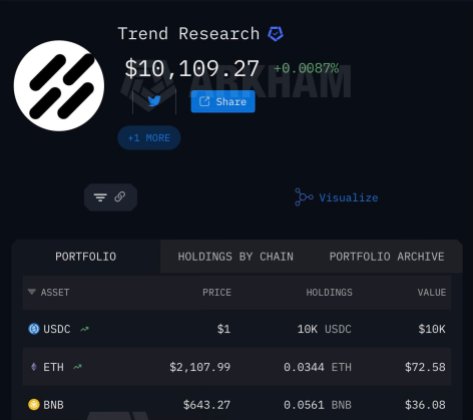
Trend Research complete offload ETH holdings | Source: Chart from MartyParty on X

MartyParty has outlined a breakdown of the action. The commentator highlighted that Trend Research originally built a huge ETH long. This was carried out by borrowing stables on Aave against ETH collateral, then buying more ETH exposure that reportedly peaked near +$2 billion at points.

As the price of Ethereum tanked, the company started moving ETH into Binance in the past days/weeks to repay debt and prevent complete liquidation. Prior batches ranged from 10,000 to 90,000 ETH, and they are increasing. Meanwhile, the final batch removed the rest, basically leaving their wallets empty. However, a few trackers point to tiny remnants like 0.165 ETH left in their wallet.

By making this move, a significant source of sell pressure that had been looming over cryptocurrency for the last week or so is eliminated. However, whether it triggers a relief bounce or if the market simply ignores it hinges on the broader crypto sentiment, including macro, other whales, and ETF flows, among others.

ETH Whales Reviving Buying Pressure

Even with the ongoing pullback, investors’ sentiment has not entirely turned bearish toward the altcoin. CW, a market expert, disclosed that inflows to accumulating wallet addresses seem to have increased despite ETH experiencing a notable drop.

Data shows that large holders or whales have been increasing their holdings, while retail investors continue to offload due to the panic. This divergence represents a shift in ownership, where supply moves from weaker hands to stronger conviction-driven investors.

ETH trading at $2,065 on the 1D chart | Source: ETHUSDT on Tradingview.com

Preguntas relacionadas

QWhat is the significance of Trend Research's recent Ethereum sell-off, and how much ETH was involved?

ATrend Research's sell-off marks a major turning point, concluding a massive position unwind. They deposited 651,757 ETH (valued at $1.34 billion at the time) into Binance.

QWhat was the reported average exit price and the estimated realized loss for Trend Research?

AThe average exit price was reported to be $2,055 per ETH, resulting in an estimated realized loss of roughly $747 million.

QHow did MartyParty describe the initial strategy that led to Trend Research's forced selling?

AMartyParty outlined that Trend Research built a huge leveraged long position by borrowing stablecoins on Aave against ETH collateral and then buying more ETH, with exposure reportedly peaking near $2 billion.

QDespite the sell pressure from entities like Trend Research, what contrasting activity are ETH whales exhibiting according to the article?

AAccording to the article, large holders or whales have been increasing their ETH holdings, representing a shift in supply from weaker-handed retail investors to stronger, conviction-driven investors.

QWhat event triggered the forced selling of Trend Research's leveraged long position?

AThe forced selling began when the price of Ethereum experienced a sharp decline, starting at levels around $1,750 earlier in February 2026.

Lecturas Relacionadas

The Value Distribution of Stablecoins

**Summary: The Value Distribution of Stablecoins** The article argues that stablecoins are evolving from mere trading tools into broader channels for dollar access. It divides the stablecoin ecosystem into four layers to analyze how value is distributed: 1. **Issuance Layer:** Mints stablecoins, holds reserve assets, and captures the spread between reserve yield and user costs (e.g., Tether, Circle). This layer currently earns the largest profit margin. 2. **Infrastructure Layer:** Connects stablecoins to the traditional financial system, handling fiat on/off-ramps, banking integration, compliance (KYC/AML), and asset management (e.g., Bridge, BVNK). This is the "unglamorous" but critical work, building the essential bridges between crypto and real-world finance. 3. **Acquiring/Distribution Layer:** Integrates stablecoins into merchant systems, manages payment flows, and provides enterprise financial software (e.g., Stripe, Coinbase). They act as the access point for businesses. 4. **Application Layer:** The end-users and businesses that ultimately use stablecoins for payments, settlements, or as a store of value. They benefit from convenience but have little pricing power. The core thesis is that while the issuance layer currently dominates profits, the often-overlooked **infrastructure layer holds significant long-term potential**. The real challenge and barrier to mass adoption is not the on-chain transfer of stablecoins (which is simple), but the complex "last mile" integration into existing business workflows, banking systems, and regulatory frameworks across different countries. Companies in this layer are currently in a "land grab" phase, investing heavily to build networks, secure bank partnerships, and establish compliance pathways. While their position is currently pressured by the profitable issuers above and distribution platforms below, the article suggests that if stablecoins become a default financial rail for businesses, the infrastructure providers who have done the hard work of integration will ultimately gain strong pricing power and become entrenched, essential players.

marsbitHace 4 hora(s)

The Value Distribution of Stablecoins

marsbitHace 4 hora(s)

The Value Distribution of Stablecoins

The Value Distribution of Stablecoins The article argues that stablecoins are evolving from a mere trading tool into a broad "dollar channel." It analyzes the industry's value chain through four layers: 1. **Issuance Layer (e.g., Tether, Circle):** The top layer that mints stablecoins, holds reserve assets, and captures the thickest interest rate spread. 2. **Infrastructure Layer (e.g., Bridge, BVNK):** Connects stablecoins to the traditional financial system, handling critical but complex "dirty work" like fiat on/off-ramps, banking integration, compliance (KYC/AML), and cross-border settlement. 3. **Acquiring/Distribution Layer (e.g., Stripe, Coinbase):** Embeds stablecoins into merchant systems, manages payment flows, and integrates with enterprise software. 4. **Application Layer:** End-users and businesses that ultimately use stablecoins for payments, settlement, or storing value. The author posits that while the issuance layer currently captures the most profit, the most overlooked and potentially critical layer is infrastructure. The core challenge for stablecoin adoption isn't the on-chain transfer (which is simple), but bridging the gap between blockchain and the real-world financial system. This involves solving practical problems for businesses: fiat conversion, reconciliation, tax handling, and user onboarding. Infrastructure companies are currently in a difficult "land-grab" phase—building networks, securing banking relationships, and achieving compliance country-by-country. They face pressure from both the profitable issuance layer above and distribution platforms below. However, the author suggests this layer is building a crucial moat. Once stablecoins become a default business rail, the infrastructure players who have done the hard work of integration may gain significant, durable value and pricing power.

链捕手Hace 4 hora(s)

The Value Distribution of Stablecoins

链捕手Hace 4 hora(s)

How to Do Research Well: Deliberately Practice the Real Skills That Matter

No one truly teaches you how to do research. You're often given a desk, a pre-selected problem, and vague instructions to "create something new." Consequently, many people reverse-engineer the job based on visible outputs—papers, posts, announcements—learning only how to *appear* like a researcher rather than how to *become* one. True research capability is built from stacking small, trainable skills, nearly all of which can be developed through deliberate practice. **Pick Your Own Problem:** Most researchers absorb problems from advisors or trends, lacking the underlying reasoning. Choosing a problem you genuinely care about, as John Schulman advises, leads to original work. Develop "taste" like a muscle: predict experiment outcomes, guess paper results from methods, and track which findings remain important over time. **Upgrade Your Inputs:** Relying on shared reading lists (arXiv hot lists, filtered group chats) leads to unoriginal conclusions. Undervalued old literature often holds crucial insights (e.g., MoE, LSTM, backpropagation). Richard Sutton's "The Bitter Lesson" or Claude Shannon's 1952 talk on creative thinking are more predictive than lengthy modern surveys. Breadth matters as much as depth: draw from neuroscience, mechanism design, hardware knowledge, and honest statistics. Read papers directly, especially appendices and limitations sections. **Write Everything Down:** As Paul Graham noted, writing exposes flaws in seemingly mature ideas. Writing is the cheapest defense against self-deception. Following Feynman's principle, Darwin programmatically wrote down facts contradicting his theory to combat memory bias. Maintain a detailed log of hypotheses, setups, predictions, results, and updated understandings. Reviewing past logs fosters essential humility.

marsbitHace 6 hora(s)

How to Do Research Well: Deliberately Practice the Real Skills That Matter

marsbitHace 6 hora(s)

Trading

Spot
Futuros

Artículos destacados

Cómo comprar ERA

¡Bienvenido a HTX.com! Hemos hecho que comprar Caldera (ERA) sea simple y conveniente. Sigue nuestra guía paso a paso para iniciar tu viaje de criptos.Paso 1: crea tu cuenta HTXUtiliza tu correo electrónico o número de teléfono para registrarte y obtener una cuenta gratuita en HTX. Experimenta un proceso de registro sin complicaciones y desbloquea todas las funciones.Obtener mi cuentaPaso 2: ve a Comprar cripto y elige tu método de pagoTarjeta de crédito/débito: usa tu Visa o Mastercard para comprar Caldera (ERA) al instante.Saldo: utiliza fondos del saldo de tu cuenta HTX para tradear sin problemas.Terceros: hemos agregado métodos de pago populares como Google Pay y Apple Pay para mejorar la comodidad.P2P: tradear directamente con otros usuarios en HTX.Over-the-Counter (OTC): ofrecemos servicios personalizados y tipos de cambio competitivos para los traders.Paso 3: guarda tu Caldera (ERA)Después de comprar tu Caldera (ERA), guárdalo en tu cuenta HTX. Alternativamente, puedes enviarlo a otro lugar mediante transferencia blockchain o utilizarlo para tradear otras criptomonedas.Paso 4: tradear Caldera (ERA)Tradear fácilmente con Caldera (ERA) en HTX's mercado spot. Simplemente accede a tu cuenta, selecciona tu par de trading, ejecuta tus trades y monitorea en tiempo real. Ofrecemos una experiencia fácil de usar tanto para principiantes como para traders experimentados.

385 Vistas totalesPublicado en 2025.07.17Actualizado en 2026.06.02

Cómo comprar ERA

Discusiones

Bienvenido a la comunidad de HTX. Aquí puedes mantenerte informado sobre los últimos desarrollos de la plataforma y acceder a análisis profesionales del mercado. A continuación se presentan las opiniones de los usuarios sobre el precio de ERA (ERA).

活动图片