Eight Consecutive Bullish Days Signal Strong Return: ETH Surges Past $2,300 as Whales Continue to Accumulate

Odaily星球日报Publicado a 2026-03-16Actualizado a 2026-03-16

Resumen

Ethereum (ETH) has surged past $2,300, marking an eight-day consecutive rally, while Bitcoin (BTC) broke above $74,000. The broader crypto market showed strength, with over 80% of the top 200 tokens by market cap closing the week in positive territory. Market sentiment improved, with the Crypto Fear and Greed Index rising to 39, nearing neutral levels. Key factors driving the rebound include macro developments, such as potential easing in the Middle East—particularly efforts to reopen the Hormuz Strait—which could lower oil prices and reduce inflationary pressure, increasing the likelihood of future Fed rate cuts. The market widely expects the Fed to hold rates steady in its upcoming meeting. On-chain and ETF flow data also support bullish momentum. Bitcoin and Ethereum spot ETFs recorded three consecutive weeks of net inflows, totaling approximately $2.12 billion and $265 million, respectively. Large investors and institutions have been accumulating ETH, with several "whale" addresses making significant purchases. Analysts suggest that Bitcoin may have bottomed, citing low network selling pressure and historical accumulation signals. Some models even point to a potential mid-to-long-term rally, with targets as high as $100,000, assuming key resistance levels are broken. However, risks remain if Bitcoin fails to hold above critical support or break through resistance near $78,000.

Original | Odaily Planet Daily (@OdailyChina)

Author | Golem (@web3_golem)

While the market focuses on OpenClaw's "Crawfish," BTC and the entire crypto market have quietly risen for a week.

According to OKX market data, BTC has recorded eight consecutive bullish days from March 9 to March 16, successfully breaking through $74,000 and reaching a high of $74,451. The altcoin market has steadily climbed alongside the major trend, with ETH rising over 12.5% in the past 7 days, breaking $2,300; SOL up over 13% in the past 7 days; and BNB gaining over 10% in the past week. Data from Quantify Crypto shows that among the top 200 cryptocurrencies by market cap in the past week, only 31 tokens closed the week in the red, while the remaining 169 closed in the green.
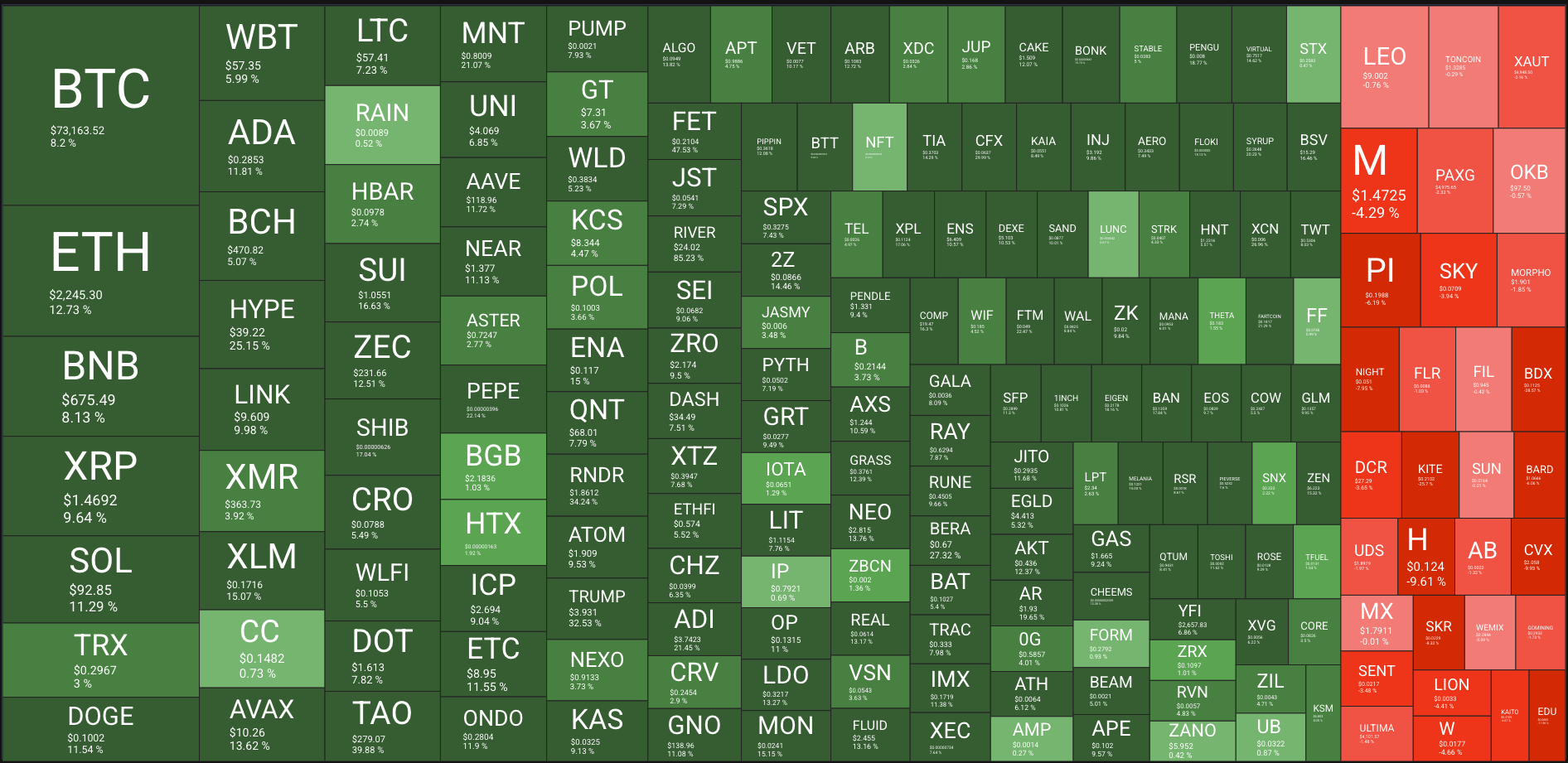
The Crypto Fear and Greed Index shows that last week, the crypto panic index moved out of the extreme fear zone, currently standing at 39, nearly entering the neutral sentiment range. What factors have contributed to the improved market sentiment? What changes have occurred in crypto market liquidity? Is this rally a temporary rebound or a potential bottom confirmation? Odaily Planet Daily will provide a brief analysis in this article.

Strait of Hormuz May Reopen, Fed Expected to Hold Rates Steady This Week

On the macro level, the primary reason for the crypto market rebound was Trump's announcement on March 10 that the war with Iran was largely over, along with several measures to stabilize oil prices, such as considering exemptions for some energy sanctions to offset the Middle East shortfall and initiating a large-scale strategic petroleum reserve release plan with other countries.

As shown in the chart below, international oil prices even fell below $90/barrel on March 10. There is a negative correlation between international oil prices and Bitcoin prices, with the basic logic being that when oil prices fall, the threat of global inflation decreases, and the market anticipates that global central banks, particularly the Fed, are more likely to cut rates, injecting more liquidity into the market. Thus, Bitcoin rebounds in anticipation of this scenario.
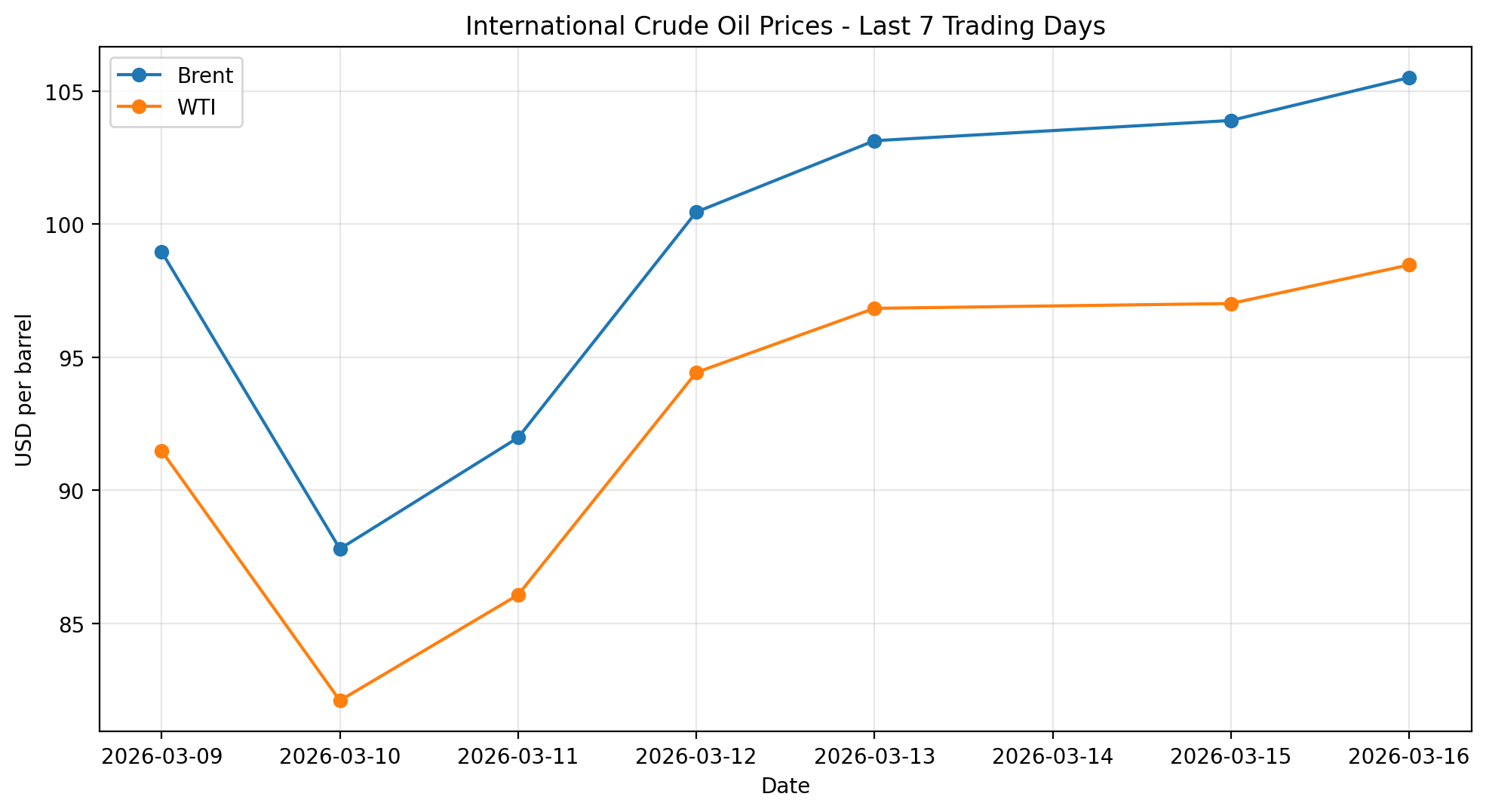
Brent Crude and WTI Crude Price Trends Over the Past Week

However, since March 10, oil prices have started to rise again, mainly due to Trump's反复无常 attitude toward the conflict, sometimes saying it might end "soon," other times vowing to strike Iran hard, even admitting he wasn't sure if he wanted a deal with Iran. Meanwhile, Iran's new Supreme Leader, Mojtaba Khamenei, vowed to close the Strait of Hormuz to enemy countries and their allies' tankers and vessels.

Fortunately, Trump is still working to prevent the closure of the Strait of Hormuz. According to an Axios report on March 16, Trump is seeking to form a multinational coalition to reopen the Strait of Hormuz and plans to announce it later this week. Four sources revealed that if the obstruction of oil tanker traffic in the Persian Gulf persists, Trump is also considering seizing Iran's key oil transit hub, Kharg Island. Located about 15 miles off the coast of Iran, Kharg Island handles about 90% of Iran's crude exports. Last Friday, Trump ordered strikes on military facilities on the island but did not target oil facilities.

However, last week's rebound in oil prices did not cause Bitcoin to fall; instead, Bitcoin continued to rise, as the market already expected the Fed to likely keep rates unchanged at this week's meeting. According to Polymarket data, the probability of the Fed maintaining rates on March 19 is nearly 100%. CME's "FedWatch Tool" similarly shows traders believe the probability of the Fed holding rates steady is as high as 99.1%.
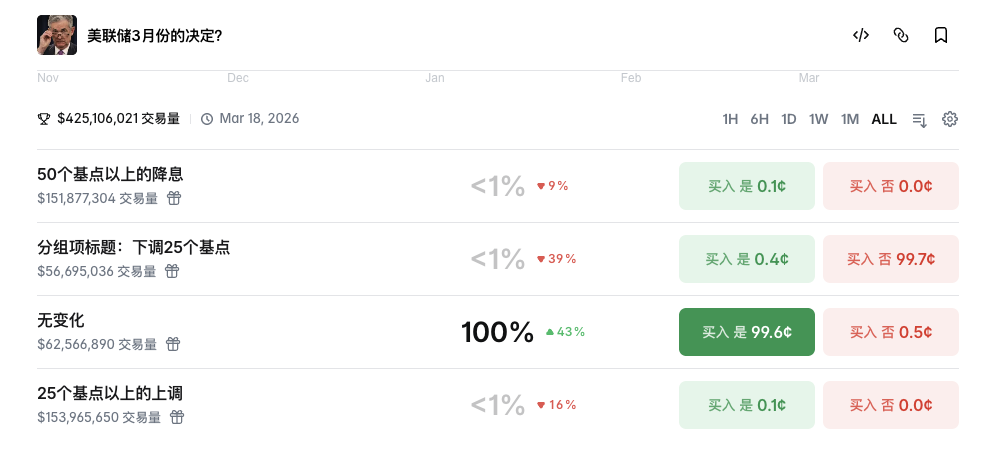
Although the Iran conflict and rising oil prices pose a new inflation threat to the Fed, they need time to carefully assess how much the surge in energy prices has impacted consumer prices and economic growth, and whether the impact is temporary or persistent. Therefore, amid the fog of war, "standing pat" is the best strategy.

Morgan Stanley economists stick to their forecast that the Fed will cut rates by 25 basis points each in June and September. They believe rate cuts might be delayed, meaning the Fed may have to act more aggressively later.

But investors shouldn't be blindly optimistic about rate cuts this year, as the Fed can set rates, but they can't reopen the Strait of Hormuz. The key policy decision depends on how long this conflict lasts and Trump's next move.

James Eaglehoff, Chief US Economist at BNP Paribas Securities, said he will watch whether Fed officials change their wording during this week's meeting to indicate plans to cut or raise rates in the coming months.

However, some analysts believe that the parabolic rise in Bitcoin prices amid falling oil prices is more of a short-term technical adjustment and "should not be overinterpreted."

Crypto ETFs See Three Consecutive Weeks of Net Inflows, Whales/Institutions Continue Buying

Besides macro easing, Bitcoin and other major cryptocurrencies have also seen structural buying on the capital front. On March 15, BlackRock's Head of Digital Assets stated in a live stream that although BlackRock's Bitcoin ETF was the only one among the top 20 global ETF inflows with negative returns, 90% of investors were buying the dip, indicating that Bitcoin is in a phase of intense turnover and long-term accumulation.

Data supports this claim. According to SoSoValue data, both Bitcoin spot ETFs and Ethereum spot ETFs have seen three consecutive weeks of net inflows. Bitcoin spot ETFs saw a combined net inflow of approximately $2.119 billion, while Ethereum spot ETFs saw a combined net inflow of approximately $265 million.

Moreover, Bitcoin spot ETFs recorded their first five-day streak of inflows in 2026 during last week's trading days (March 9 to March 13 ET), with total inflows of $767 million. The last similar streak was in late November 2025, when spot Bitcoin ETFs saw five consecutive days of net inflows from November 25 to December 2, totaling $284.61 million.
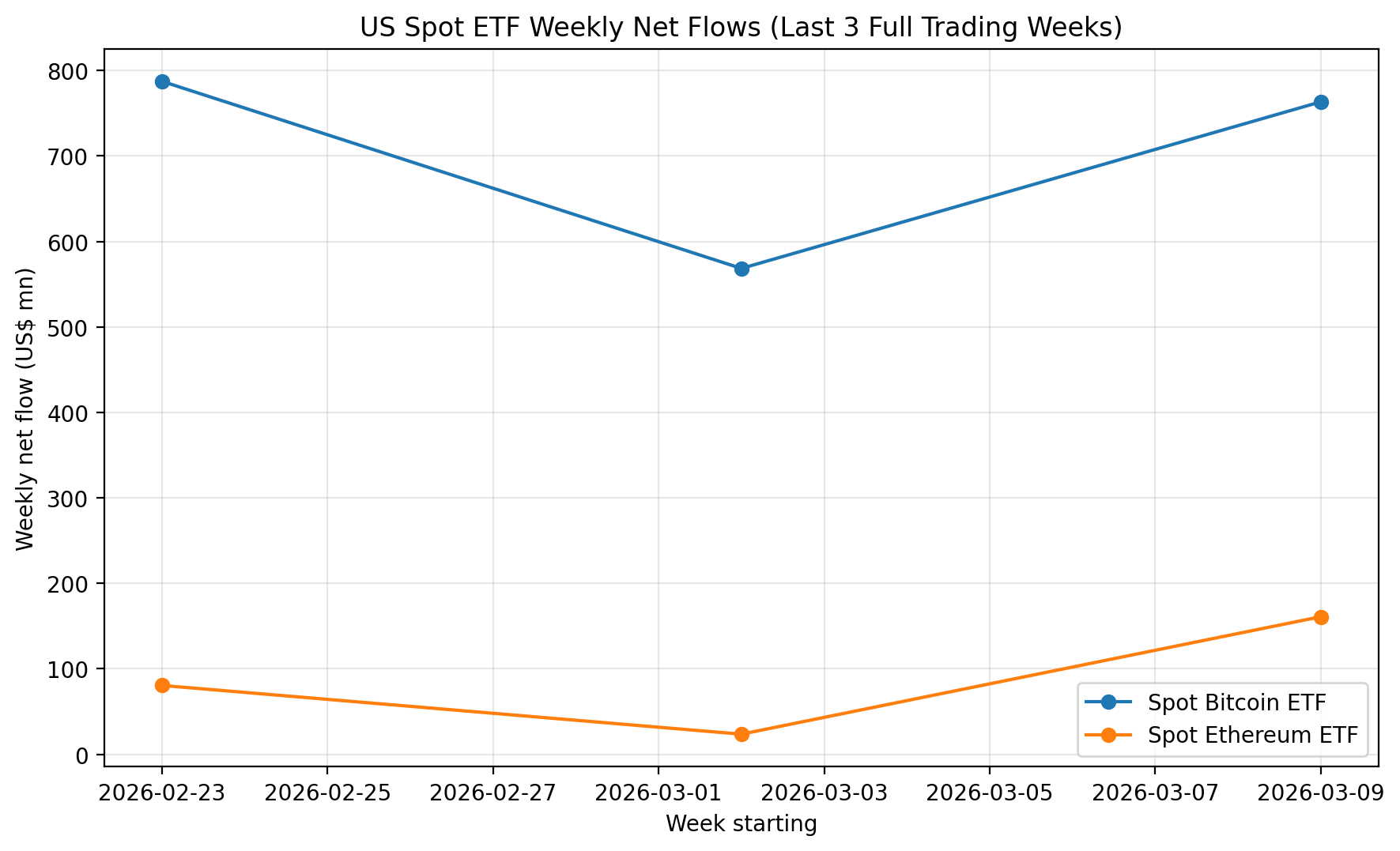
Bitcoin Spot ETFs and Ethereum Spot ETFs See Three Consecutive Weeks of Net Inflows

On-chain whales and institutions also started buying the dip last week, and besides Bitcoin, whales still prefer buying ETH.

According to Arkham monitoring, a whale accumulated $131.3 million worth of ETH last week and distributed it across two wallets; a whale address starting with 0x743d also spent $24.79 million to buy 11,985 ETH at an average price of $2,068; another dormant whale address (0x2d85) that had been inactive for six months bought 5,003 ETH at $2,179, worth $10.9 million. Notably, this address sold ETH at around $4,300 about six months ago near the peak.

Whales are still buying ETH today. Whale billΞ.eth (@0xbilly) bought 7,769 ETH at an average price of $2,248, totaling $17.46 million.

Bitcoin Bottom Confirmed, Uptrend Channel Opened?

Facing this rebound, many analysts believe Bitcoin's bottom has been confirmed.

Matrixport analysts believe that although current crypto market sentiment is weak, with many traders shifting attention to assets like gold and crude oil, Bitcoin has fallen for five consecutive months, which is rare historically, and similar moves often precede阶段性 rebounds. Meanwhile, the total market cap of altcoins has fallen back to levels from which multiple rebounds started historically. As stablecoin funds flow back into the market, liquidity conditions continue to improve. Taken together, these signals indicate that the possibility of a crypto market rebound is gradually increasing.

On-chain analysis models also show that Bitcoin's current network selling pressure has dropped to cycle lows, and the market is in a clear accumulation phase. The Sell-side Risk Ratio measures the活跃度 of profit-taking by market participants relative to the network's cost basis. When the indicator exceeds the adaptive upper threshold, it triggers a distribution signal, indicating seller dominance; when it falls below the lower threshold, it triggers an accumulation signal, meaning extremely low selling pressure.

Data shows that current selling pressure has dropped to about one-sixth of the cycle average. Meanwhile, the 180-day rolling average Sell-side Risk Ratio has dropped from 3,210 to 1,913 over the past 60 days, a decrease of 1,297 points, and continues to fall at about 20 points per day. Historically, the 1,500 to 2,000 range usually corresponds to selling pressure levels during the 2019 bear market (BTC around $3,000–$6,000) and the mid-2022–2023 bear market (BTC around $16,000–$20,000). However, the current BTC price is still in the $67,000 to $72,000 range, showing a clear structural divergence.

This means that early low-cost accumulators have completed large-scale profit-taking in the $64,000 to $107,000 range, and those who did not sell in that range are choosing to hold. Only when Bitcoin price stabilizes above $100,000 to $110,000 accompanied by large-scale profit-taking may a new distribution signal be triggered.

Therefore, many view this rally not as a short-term rebound but as a signal of a new uptrend.

A macro model combining the US 10-year Treasury yield and China's 10-year Treasury yield (US10Y×CN10Y) recently showed an "extremely precise" bullish crossover signal. Historical data shows that this indicator issued similar signals before the 2013, 2017, 2020–2021, and 2023 bull markets, corresponding to Bitcoin gains of approximately 8,700%, 1,900%, 600%, and over 350%, respectively. Analysts believe that if Bitcoin stabilizes and rebounds near the 200-week moving average, the price could test $100,000 around August. However, if it fails to break the key resistance at $78,000, there is still a risk of forming a "bull trap."

Even now, some choose to ignore short-term fluctuations and focus on Bitcoin's long-term value, like Bitwise Asset Management CIO Matt Hougan. He stated that if Bitcoin can capture a larger share of the global store of value market currently dominated by gold and government bonds, Bitcoin could eventually reach $1 million per coin.

But the $1 million target is less a precise prediction and more a shorthand for Bitcoin maturing into a global monetary asset, the outcome depending on long-term institutional adoption and the expansion of the store of value market.


Preguntas relacionadas

QWhat is the main reason for the recent rebound in the cryptocurrency market according to the article?

AThe main reason is the announcement by Trump that the war with Iran is largely over, along with measures to stabilize oil prices, which led to a drop in international oil prices. Lower oil prices reduce global inflation threats, increasing market expectations that central banks, especially the Federal Reserve, may cut interest rates, thereby injecting more liquidity into the market and driving Bitcoin's rebound.

QHow did Bitcoin and Ethereum spot ETFs perform in terms of net inflows over the past three weeks?

ABitcoin spot ETFs achieved a net inflow of approximately $2.119 billion, and Ethereum spot ETFs achieved a net inflow of approximately $265 million over the past three weeks, both marking three consecutive weeks of net inflows.

QWhat on-chain analysis indicator suggests that Bitcoin's selling pressure has decreased to a cycle low?

AThe Sell-side Risk Ratio indicator shows that Bitcoin's current network selling pressure has dropped to about one-sixth of the cycle average, indicating extremely low selling pressure and that the market is in a clear accumulation phase.

QWhat key event related to the Federal Reserve is expected to occur this week, and what is the market's anticipation for it?

AThe Federal Reserve's interest rate decision is expected this week, and the market anticipates that the Fed will keep interest rates unchanged, with a probability close to 100% according to Polymarket data and CME 'FedWatch'.

QWhat price target does Bitwise Asset Management's CIO suggest Bitcoin could eventually reach, and what is the basis for this prediction?

ABitwise Asset Management's CIO, Matt Hougan, suggests that Bitcoin could eventually reach $1 million per coin if it captures a larger share of the global store-of-value market currently dominated by gold and government bonds, depending on long-term institutional adoption and expansion of the value storage market.

Lecturas Relacionadas

Three Frameworks for Ordinary People to Achieve AI Capability Leap: Say Goodbye to the Dilemma of 'Repeating Inputs Every Day'

Summary: This article outlines three frameworks for maximizing AI efficiency, moving beyond basic prompt usage. 1. **Three-Layer Evolution**: Users progress from (1) **Prompt** (one-off instructions, reset each session), to (2) **Project** (context-aware within a specific project), to (3) **Skill** (permanent, auto-applied knowledge). Most users stagnate at the first layer, repeating the same instructions daily with no cumulative improvement. Skills transform the AI from a chat tool into a personalized work system. 2. **Transaction vs. Compound Interest Mindset**: Using prompts is a linear transaction—effort and output are 1:1, and stopping resets progress. Investing time in building Skills is compound interest; a small initial time investment pays continuous dividends, as each Skill permanently elevates the AI's baseline performance. 3. **Thin Harness, Fat Skills**: The system architecture should prioritize thick, well-defined Skills (90% of the value—containing processes, standards, and domain knowledge) and a thin "harness" (the minimal technical environment). Avoid over-engineering the toolchain while neglecting the AI's actual knowledge. Skills are permanent assets that automatically improve with model updates. The key takeaway: Identify tasks you repeat, encode them into Skills (using tools like Claude's Skill Creator), and shift focus from daily prompting to building a compounding, self-improving AI system.

marsbitHace 21 min(s)

Three Frameworks for Ordinary People to Achieve AI Capability Leap: Say Goodbye to the Dilemma of 'Repeating Inputs Every Day'

marsbitHace 21 min(s)

Trading

Spot
Futuros

Artículos destacados

Qué es ETH 2.0

ETH 2.0: Una Nueva Era para Ethereum Introducción ETH 2.0, conocido ampliamente como Ethereum 2.0, marca una actualización monumental para la blockchain de Ethereum. Esta transición no es solo una mejora superficial; busca mejorar fundamentalmente la escalabilidad, seguridad y sostenibilidad de la red. Con un cambio del mecanismo de consenso intensivo en energía Prueba de Trabajo (PoW) a una Prueba de Participación (PoS) más eficiente, ETH 2.0 promete un enfoque transformador para el ecosistema blockchain. ¿Qué es ETH 2.0? ETH 2.0 es un conjunto de actualizaciones interconectadas y distintivas centradas en optimizar las capacidades y el rendimiento de Ethereum. La reestructuración está diseñada para abordar desafíos críticos que el mecanismo actual de Ethereum ha enfrentado, particularmente en lo que respecta a la velocidad de transacción y la congestión de la red. Objetivos de ETH 2.0 Los objetivos principales de ETH 2.0 giran en torno a mejorar tres aspectos clave: Escalabilidad: Con el objetivo de aumentar significativamente el número de transacciones que la red puede manejar por segundo, ETH 2.0 busca superar la limitación actual de aproximadamente 15 transacciones por segundo, potencialmente alcanzando miles. Seguridad: Las medidas de seguridad mejoradas son fundamentales para ETH 2.0, particularmente a través de una mejor resistencia contra ciberataques y la preservación del ethos descentralizado de Ethereum. Sostenibilidad: El nuevo mecanismo PoS está diseñado no solo para mejorar la eficiencia, sino también para reducir drásticamente el consumo de energía, alineando el marco operativo de Ethereum con consideraciones ambientales. ¿Quién es el Creador de ETH 2.0? La creación de ETH 2.0 se puede atribuir a la Fundación Ethereum. Esta organización sin fines de lucro, que desempeña un papel crucial en el apoyo al desarrollo de Ethereum, es liderada por el notable cofundador Vitalik Buterin. Su visión de un Ethereum más escalable y sostenible ha sido la fuerza motriz detrás de esta actualización, involucrando contribuciones de una comunidad global de desarrolladores y entusiastas dedicados a mejorar el protocolo. ¿Quiénes son los Inversores de ETH 2.0? Si bien los detalles sobre los inversores de ETH 2.0 no se han hecho públicos, se sabe que la Fundación Ethereum recibe apoyo de varias organizaciones e individuos en el ámbito de blockchain y tecnología. Estos socios incluyen firmas de capital de riesgo, compañías tecnológicas y organizaciones filantrópicas que comparten un interés mutuo en apoyar el desarrollo de tecnologías descentralizadas e infraestructura blockchain. ¿Cómo Funciona ETH 2.0? ETH 2.0 se distingue por introducir una serie de características clave que lo diferencian de su predecesor. Prueba de Participación (PoS) La transición a un mecanismo de consenso PoS es uno de los cambios más destacados de ETH 2.0. A diferencia de PoW, que se basa en la minería intensiva en energía para la verificación de transacciones, PoS permite a los usuarios validar transacciones y crear nuevos bloques de acuerdo con la cantidad de ETH que apuestan en la red. Esto conduce a una mayor eficiencia energética, reduciendo el consumo en aproximadamente un 99.95%, convirtiendo a Ethereum 2.0 en una alternativa considerablemente más verde. Cadenas Shard Las cadenas shard son otra innovación crítica de ETH 2.0. Estas cadenas más pequeñas operan en paralelo con la cadena principal de Ethereum, lo que permite que múltiples transacciones sean procesadas simultáneamente. Este enfoque mejora la capacidad general de la red, abordando las preocupaciones de escalabilidad que han afectado a Ethereum. Cadena Beacon En el núcleo de ETH 2.0 se encuentra la Cadena Beacon, que coordina la red y gestiona el protocolo PoS. Funciona como un organizador de cierta manera: supervisa a los validadores, asegura que los shards permanezcan conectados a la red y monitorea la salud general del ecosistema blockchain. Cronología de ETH 2.0 El viaje de ETH 2.0 ha estado marcado por varios hitos clave que trazan la evolución de esta importante actualización: Diciembre 2020: El lanzamiento de la Cadena Beacon marcó la introducción de PoS, preparándose para la migración hacia ETH 2.0. Septiembre 2022: La finalización de “La Fusión” representa un momento crucial en el que la red Ethereum se trasladó exitosamente de un marco PoW a uno PoS, anunciando una nueva era para Ethereum. 2023: El lanzamiento esperado de cadenas shard tiene como objetivo mejorar aún más la escalabilidad de la red Ethereum, consolidando a ETH 2.0 como una plataforma robusta para aplicaciones y servicios descentralizados. Características Clave y Beneficios Escalabilidad Mejorada Una de las ventajas más significativas de ETH 2.0 es su escalabilidad mejorada. La combinación de PoS y cadenas shard permite que la red expanda su capacidad, permitiendo acomodar un volumen mucho mayor de transacciones en comparación con el sistema heredado. Eficiencia Energética La implementación de PoS representa un gran paso hacia la eficiencia energética en la tecnología blockchain. Al reducir drásticamente el consumo de energía, ETH 2.0 no solo disminuye los costos operativos, sino que también se alinea más estrechamente con los objetivos de sostenibilidad global. Seguridad Mejorada Los mecanismos actualizados de ETH 2.0 contribuyen a mejorar la seguridad en toda la red. El despliegue de PoS, junto con las medidas de control innovadoras establecidas a través de cadenas shard y la Cadena Beacon, asegura un mayor grado de protección contra posibles amenazas. Costos Más Bajos para los Usuarios A medida que la escalabilidad mejora, los efectos sobre los costos de transacción también serán evidentes. Se espera que una mayor capacidad y una menor congestión se traduzcan en tarifas más bajas para los usuarios, haciendo que Ethereum sea más accesible para transacciones cotidianas. Conclusión ETH 2.0 marca una evolución significativa en el ecosistema blockchain de Ethereum. A medida que aborda problemas fundamentales como la escalabilidad, el consumo de energía, la eficiencia en las transacciones y la seguridad general, la importancia de esta actualización no puede ser subestimada. La transición a la Prueba de Participación, la introducción de cadenas shard y el trabajo fundamental de la Cadena Beacon son indicativos de un futuro donde Ethereum puede satisfacer las crecientes demandas del mercado descentralizado. En una industria impulsada por la innovación y el progreso, ETH 2.0 se erige como un testimonio de las capacidades de la tecnología blockchain para allanar el camino hacia una economía digital más sostenible y eficiente.

166 Vistas totalesPublicado en 2024.04.04Actualizado en 2024.12.03

Qué es ETH 2.0

Qué es ETH 3.0

ETH3.0 y $eth 3.0: Un Examen Profundo del Futuro de Ethereum Introducción En el paisaje en rápida evolución de las criptomonedas y la tecnología blockchain, ETH3.0, a menudo denotado como $eth 3.0, ha surgido como un tema de considerable interés y especulación. El término abarca dos conceptos principales que merecen aclaración: Ethereum 3.0: Esto representa una posible actualización futura destinada a aumentar las capacidades de la blockchain existente de Ethereum, enfocándose particularmente en mejorar la escalabilidad y el rendimiento. ETH3.0 Meme Token: Este proyecto de criptomoneda distinto busca aprovechar la blockchain de Ethereum para crear un ecosistema centrado en memes, promoviendo la participación dentro de la comunidad de criptomonedas. Comprender estos aspectos de ETH3.0 es esencial no solo para los entusiastas de las criptomonedas, sino también para aquellos que observan tendencias tecnológicas más amplias en el espacio digital. ¿Qué es ETH3.0? Ethereum 3.0 Ethereum 3.0 se presenta como una actualización propuesta para la red de Ethereum ya establecida, que ha sido la columna vertebral de muchas aplicaciones descentralizadas (dApps) y contratos inteligentes desde su inicio. Las mejoras previstas se concentran principalmente en la escalabilidad, integrando tecnologías avanzadas como sharding y pruebas de conocimiento cero (zk-proofs). Estas innovaciones tecnológicas tienen como objetivo facilitar un número sin precedentes de transacciones por segundo (TPS), potencialmente alcanzando millones, abordando así una de las limitaciones más significativas que enfrenta la tecnología blockchain actual. La mejora no es meramente técnica, sino también estratégica; está destinada a preparar la red de Ethereum para su adopción generalizada y utilidad en un futuro marcado por una mayor demanda de soluciones descentralizadas. ETH3.0 Meme Token En contraste con Ethereum 3.0, el ETH3.0 Meme Token se aventura en un ámbito más ligero y juguetón al combinar la cultura de memes de internet con la dinámica de las criptomonedas. Este proyecto permite a los usuarios comprar, vender e intercambiar memes en la blockchain de Ethereum, proporcionando una plataforma que fomenta la participación comunitaria a través de la creatividad y los intereses compartidos. El ETH3.0 Meme Token tiene como objetivo demostrar cómo la tecnología blockchain puede intersectarse con la cultura digital, creando casos de uso que son tanto entretenidos como financieramente viables. ¿Quién es el Creador de ETH3.0? Ethereum 3.0 La iniciativa hacia Ethereum 3.0 es impulsada principalmente por un consorcio de desarrolladores e investigadores dentro de la comunidad de Ethereum, incluyendo notablemente a Justin Drake. Conocido por sus ideas y contribuciones a la evolución de Ethereum, Drake ha sido una figura prominente en las discusiones sobre la transición de Ethereum a una nueva capa de consenso, denominada “Beam Chain.” Este enfoque colaborativo para el desarrollo significa que Ethereum 3.0 no es el producto de un creador singular, sino más bien una manifestación de ingenio colectivo centrado en avanzar la tecnología blockchain. ETH3.0 Meme Token Los detalles sobre el creador del ETH3.0 Meme Token son actualmente inidentificables. La naturaleza de los tokens de memes a menudo conduce a una estructura más descentralizada y dirigida por la comunidad, lo que podría explicar la falta de atribución específica. Esto se alinea con la ética de la comunidad cripto más amplia, donde la innovación a menudo surge de esfuerzos colaborativos en lugar de individuales. ¿Quiénes son los Inversores de ETH3.0? Ethereum 3.0 El apoyo a Ethereum 3.0 proviene principalmente de la Fundación Ethereum junto con una entusiasta comunidad de desarrolladores e inversores. Esta asociación fundamental proporciona un grado significativo de legitimidad y mejora la perspectiva de una implementación exitosa, ya que aprovecha la confianza y credibilidad construidas a lo largo de años de operaciones en la red. En el clima cambiando rápidamente de las criptomonedas, el apoyo de la comunidad juega un papel crucial en impulsar el desarrollo y la adopción, posicionando a Ethereum 3.0 como un contendiente serio para futuros avances en blockchain. ETH3.0 Meme Token Si bien las fuentes actualmente disponibles no proporcionan información explícita sobre las fundaciones o organizaciones de inversión que respaldan el ETH3.0 Meme Token, es indicativo del modelo de financiamiento típico para tokens de memes, que a menudo depende del apoyo de base y la participación comunitaria. Los inversores en tales proyectos suelen consistir en individuos motivados por el potencial de innovación impulsada por la comunidad y el espíritu de cooperación que se encuentra dentro de la comunidad cripto. ¿Cómo Funciona ETH3.0? Ethereum 3.0 Las características distintivas de Ethereum 3.0 radican en su implementación propuesta de sharding y tecnología zk-proof. Sharding es un método de particionamiento de la blockchain en piezas más pequeñas y manejables o “shards,” que pueden procesar transacciones de manera concurrente en lugar de secuencial. Esta descentralización del procesamiento ayuda a prevenir la congestión y asegura que la red permanezca receptiva incluso bajo una carga pesada. La tecnología de prueba de conocimiento cero (zk-proof) contribuye con otra capa de sofisticación al permitir la validación de transacciones sin revelar los datos subyacentes involucrados. Este aspecto no solo mejora la privacidad, sino que también aumenta la eficiencia general de la red. También se habla de incorporar una Máquina Virtual de Ethereum de conocimiento cero (zkEVM) en esta actualización, amplificando aún más las capacidades y utilidad de la red. ETH3.0 Meme Token El ETH3.0 Meme Token se distingue al capitalizar la popularidad de la cultura de memes. Establece un mercado para que los usuarios participen en el comercio de memes, no solo por entretenimiento sino también por el posible beneficio económico. Al integrar características como staking, provisión de liquidez y mecanismos de gobernanza, el proyecto fomenta un entorno que incentiva la interacción y participación de la comunidad. Al ofrecer una mezcla única de entretenimiento y oportunidad económica, el ETH3.0 Meme Token tiene como objetivo atraer a una audiencia diversa, que abarca desde entusiastas de las criptomonedas hasta conocedores casuales de memes. Línea de Tiempo de ETH3.0 Ethereum 3.0 11 de noviembre de 2024: Justin Drake insinúa la próxima actualización de ETH 3.0, centrada en mejoras de escalabilidad. Este anuncio significa el comienzo de las discusiones formales sobre la futura arquitectura de Ethereum. 12 de noviembre de 2024: Se espera que la propuesta anticipada para Ethereum 3.0 se desvele en Devcon en Bangkok, preparando el escenario para una mayor retroalimentación de la comunidad y posibles próximos pasos en el desarrollo. ETH3.0 Meme Token 21 de marzo de 2024: El ETH3.0 Meme Token se lista oficialmente en CoinMarketCap, marcando su incursión en el dominio público de las criptomonedas y mejorando la visibilidad de su ecosistema basado en memes. Puntos Clave En conclusión, Ethereum 3.0 representa una evolución significativa dentro de la red de Ethereum, enfocándose en superar las limitaciones en términos de escalabilidad y rendimiento a través de tecnologías avanzadas. Sus actualizaciones propuestas reflejan un enfoque proactivo hacia las demandas y la usabilidad futura. Por otro lado, el ETH3.0 Meme Token encapsula la esencia de la cultura impulsada por la comunidad en el espacio de las criptomonedas, aprovechando la cultura de memes para crear plataformas atractivas que fomentan la creatividad y participación del usuario. Comprender los distintos propósitos y funcionalidades de ETH3.0 y $eth 3.0 es fundamental para cualquiera interesado en los desarrollos en curso dentro del espacio cripto. Con ambas iniciativas abriendo caminos únicos, subrayan colectivamente la naturaleza dinámica y multifacética de la innovación en blockchain.

178 Vistas totalesPublicado en 2024.04.04Actualizado en 2024.12.03

Qué es ETH 3.0

Cómo comprar ETH

¡Bienvenido a HTX.com! Hemos hecho que comprar Ethereum (ETH) sea simple y conveniente. Sigue nuestra guía paso a paso para iniciar tu viaje de criptos.Paso 1: crea tu cuenta HTXUtiliza tu correo electrónico o número de teléfono para registrarte y obtener una cuenta gratuita en HTX. Experimenta un proceso de registro sin complicaciones y desbloquea todas las funciones.Obtener mi cuentaPaso 2: ve a Comprar cripto y elige tu método de pagoTarjeta de crédito/débito: usa tu Visa o Mastercard para comprar Ethereum (ETH) al instante.Saldo: utiliza fondos del saldo de tu cuenta HTX para tradear sin problemas.Terceros: hemos agregado métodos de pago populares como Google Pay y Apple Pay para mejorar la comodidad.P2P: tradear directamente con otros usuarios en HTX.Over-the-Counter (OTC): ofrecemos servicios personalizados y tipos de cambio competitivos para los traders.Paso 3: guarda tu Ethereum (ETH)Después de comprar tu Ethereum (ETH), guárdalo en tu cuenta HTX. Alternativamente, puedes enviarlo a otro lugar mediante transferencia blockchain o utilizarlo para tradear otras criptomonedas.Paso 4: tradear Ethereum (ETH)Tradear fácilmente con Ethereum (ETH) en HTX's mercado spot. Simplemente accede a tu cuenta, selecciona tu par de trading, ejecuta tus trades y monitorea en tiempo real. Ofrecemos una experiencia fácil de usar tanto para principiantes como para traders experimentados.

3.9k Vistas totalesPublicado en 2024.12.10Actualizado en 2025.03.21

Cómo comprar ETH

Discusiones

Bienvenido a la comunidad de HTX. Aquí puedes mantenerte informado sobre los últimos desarrollos de la plataforma y acceder a análisis profesionales del mercado. A continuación se presentan las opiniones de los usuarios sobre el precio de ETH (ETH).

活动图片