China's Chips, the Hidden Intersection of DeepSeek and Kimi

marsbitPublicado a 2026-04-22Actualizado a 2026-04-22

Resumen

China's AI startup Kimi has released its latest open-source model, K2.6, featuring significant improvements in coding and agent capabilities. This version enhances long-context processing, supports up to 4,000 lines of code generation, and improves API accuracy and multi-agent collaboration, allowing up to 300 sub-agents to work in parallel. Kimi also introduced architectural innovations like MuonClip, Kimi Linear, and Attention Residuals to optimize scaling and efficiency. A key development is the "Prefill-as-a-Service" (PrfaaS) approach, which decouples prefill and decode tasks across data centers using heterogeneous hardware, significantly reducing latency and cost per token. This strategy not only improves performance but also creates opportunities for integration with domestic AI chips, as reliance on Chinese hardware grows due to export restrictions. Both Kimi and DeepSeek are increasingly aligning with local semiconductor advancements, shaping a new ecosystem for AI development in China.

"K2.6 is our strongest code model to date," Kimi wrote on its official account.

On the evening of April 20th, Kimi officially launched the open-source model K2.6, which demonstrates stronger programming and Agent capabilities, about a quarter after the release of version K2.5.

There was also a minor episode: rumors suggested that DeepSeek V4 would be released this week. If everything proceeds as expected by the outside world, this would be the Nth time Kimi and DeepSeek have coincided. But at a more fundamental infrastructure level, there is an underlying thread: Kimi and DeepSeek, these two large model startups, are ultimately destined to step into the same river—advancing together with domestic chip startups.

Rewind to March 2026, when Yang Zhilin took the stage at NVIDIA's GTC conference to discuss Kimi's technical roadmap. He said, "Many of the commonly used technical standards today are essentially products from eight or nine years ago, gradually becoming a bottleneck for Scaling."

To address such issues, Kimi has contributed to the open-source community the first large-scale application of the second-order optimizer MuonClip, the Kimi Linear architecture that makes large models more efficient at processing long contexts, and Attention Residuals, which optimizes the connections between deep neural network layers.
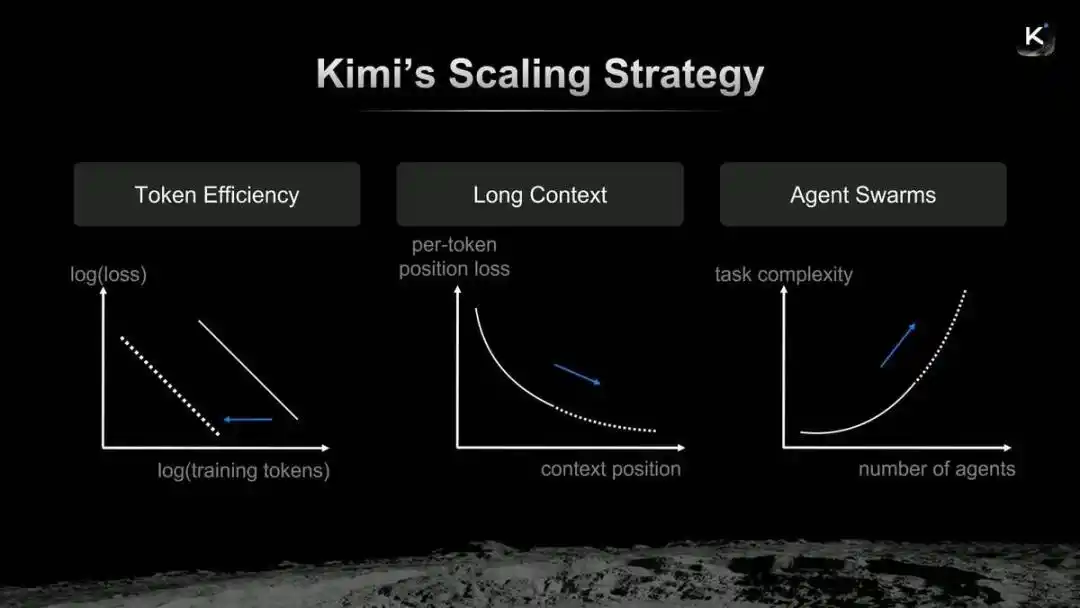
Kimi's Scaling Strategy

Yang Zhilin believes that Kimi's evolution logic can be summarized as the "merger" of Token efficiency, long context, and Agent clusters. The newly launched Kimi K2.6 can be understood as a new assignment submitted by Yang Zhilin along this Scaling path.
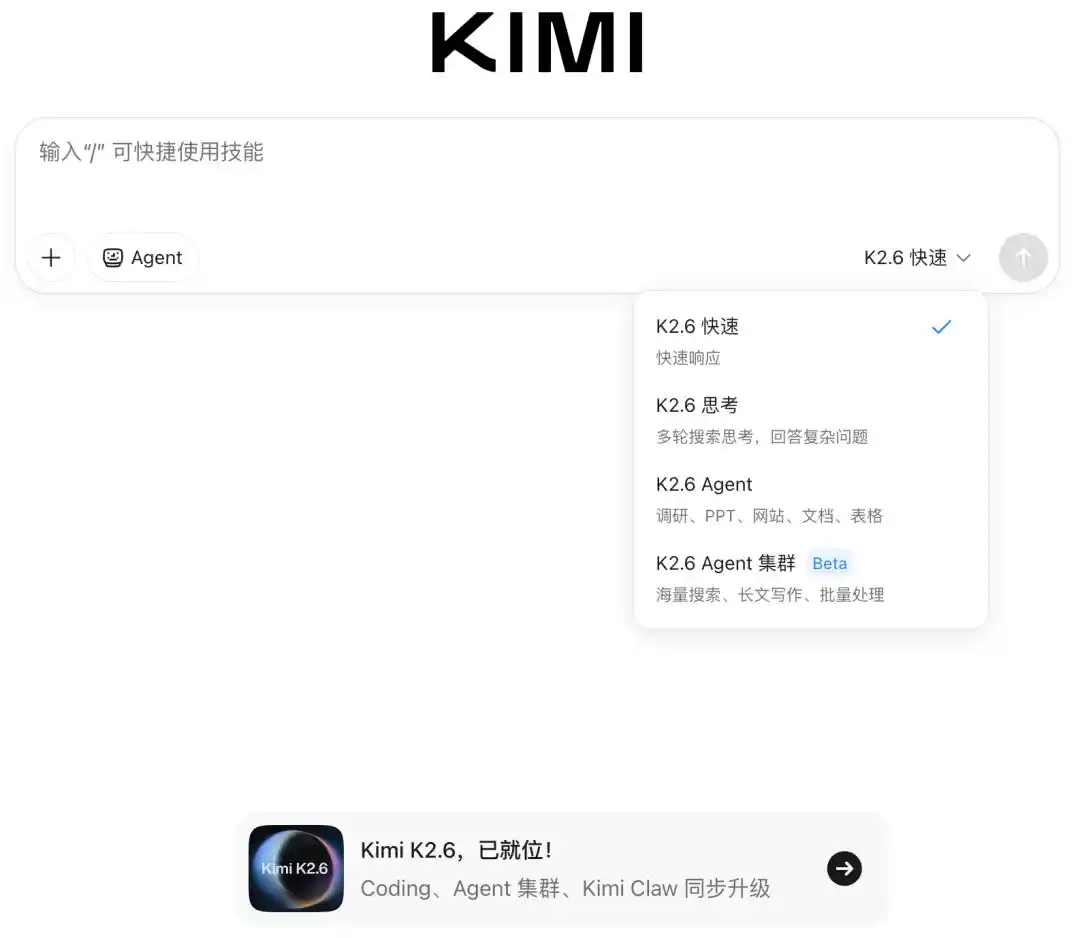
Kimi's official website has integrated K2.6

Code, Agent, and What Else?

As one of the most easily standardized capabilities, code is a must-win area for cutting-edge models.

From K2 to K2.5 to K2.6, Kimi has maintained an iteration rhythm of about one quarter on several open-source models. However, since this is a minor version number, it hints that Yang Zhilin may have more cards up his sleeve.

"K2.6 has significantly improved long-range coding capabilities, able to code uninterrupted for 13 hours in tests, writing or modifying over 4,000 lines of code," Kimi wrote in a promotional material. "On the Kimi Code Bench, Kimi's internal strict code evaluation benchmark covering various complex end-to-end tasks, K2.6's score improved by about 20% compared to K2.5."

It's worth noting that K2.5 was already a very "capable model," topping the OpenRouter charts in February. A source close to Kimi posted a screenshot of co-founder Zhang Yutao's朋友圈 at the time, saying, "He seemed very satisfied with this version."
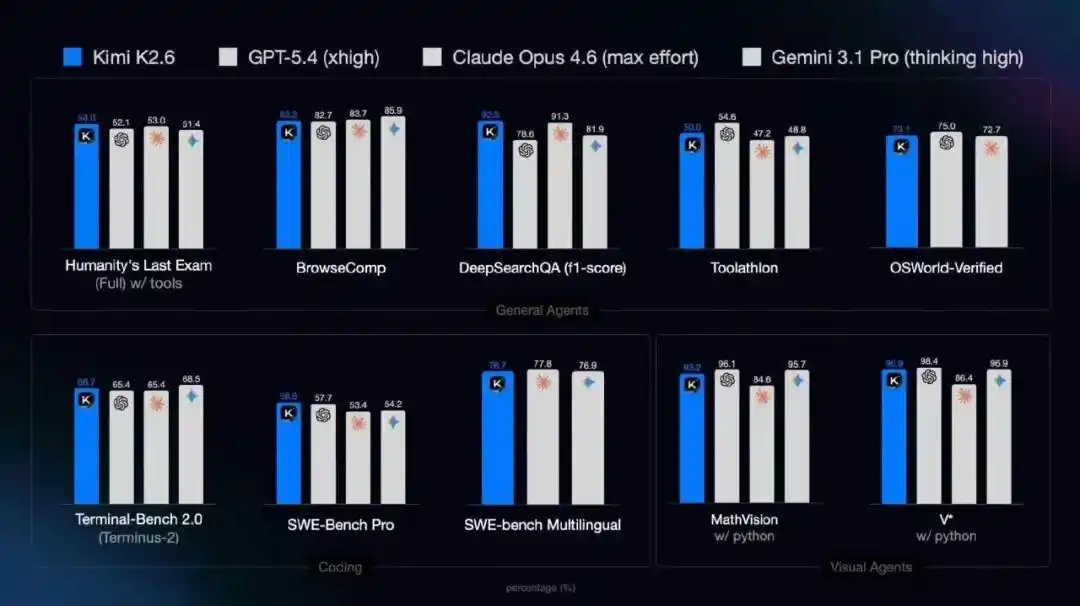
K2.6's performance on general Agent, programming, and visual Agent benchmarks

For Agent frameworks like OpenClaw and Hermes, K2.6's core improvements focus on the accuracy of API calls and the stability of long-running operations—one enhances the cost of task execution, while the other optimizes the efficiency of task execution.

In the K2.5 version launched in January, Kimi introduced the concept of "Agent clusters," breaking down a task into multiple sub-tasks and automatically assigning them to different specialized Agents for processing, thereby reducing task processing time and avoiding the risk of entire project failure under serial task flows.
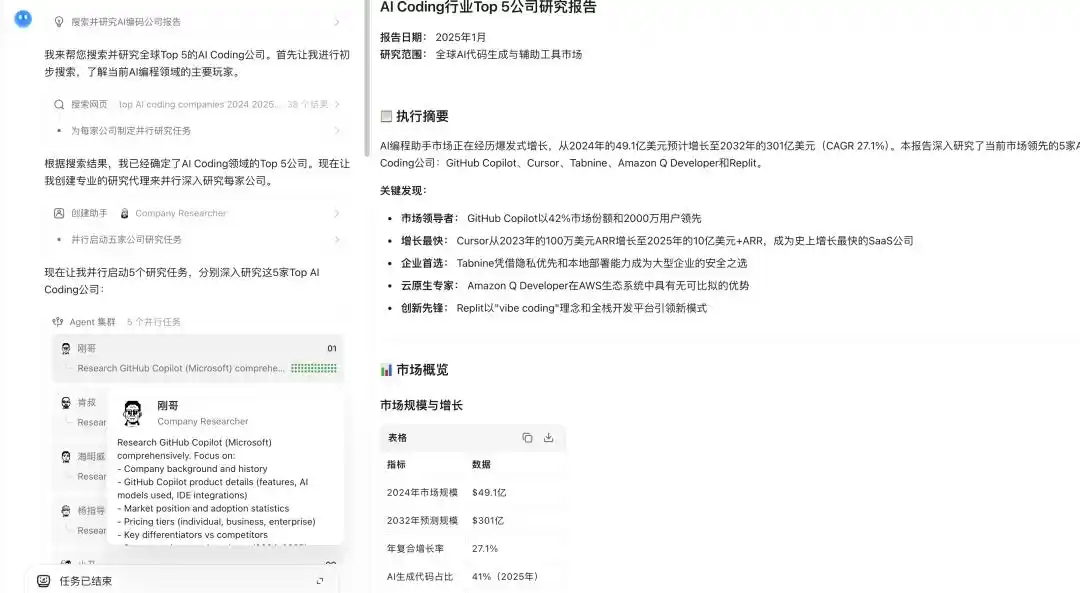
Demonstration of Kimi K2.6's Agent cluster capability

In the new K2.6 version, this capability is further amplified, integrating and parallelizing breadth search with in-depth research, large-scale document analysis and long-form writing, and multi-format content generation, supporting up to 300 sub-Agents completing 4,000 collaborative steps in parallel.

To summarize the highlights of Kimi K2.6 in one sentence, they大致包括: evolution in code and long-range task capabilities, evolution of Agent cluster capabilities, and optimization for mainstream Agent frameworks.

If I had to pick a personal preference from the above features, I believe the Agent cluster is the most valuable capability—it directly embodies the explosive power of parallel computing. Whether it's code or the stability of long-range tasks, these are things that model iteration must address. More importantly, based on these capability improvements, they drive innovation in Agent working methods, efficiency, and even interaction modes.

After all, as a user, what I want is not for it to tell me what it can do, but for it to drive Agents to solve my real problems and form effective productivity.

When K2.5 was launched, an academic researcher began using this model for scientific research projects. His evaluation at the time was that it had no weaknesses and could serve as a research assistant.

"The multi-Agent provided by the official is indeed effective; many domestic Agents last year were still toys."

If Kimi K2.5 received positive evaluations both internally and externally, how effective will K2.6, which goes a step further, be?
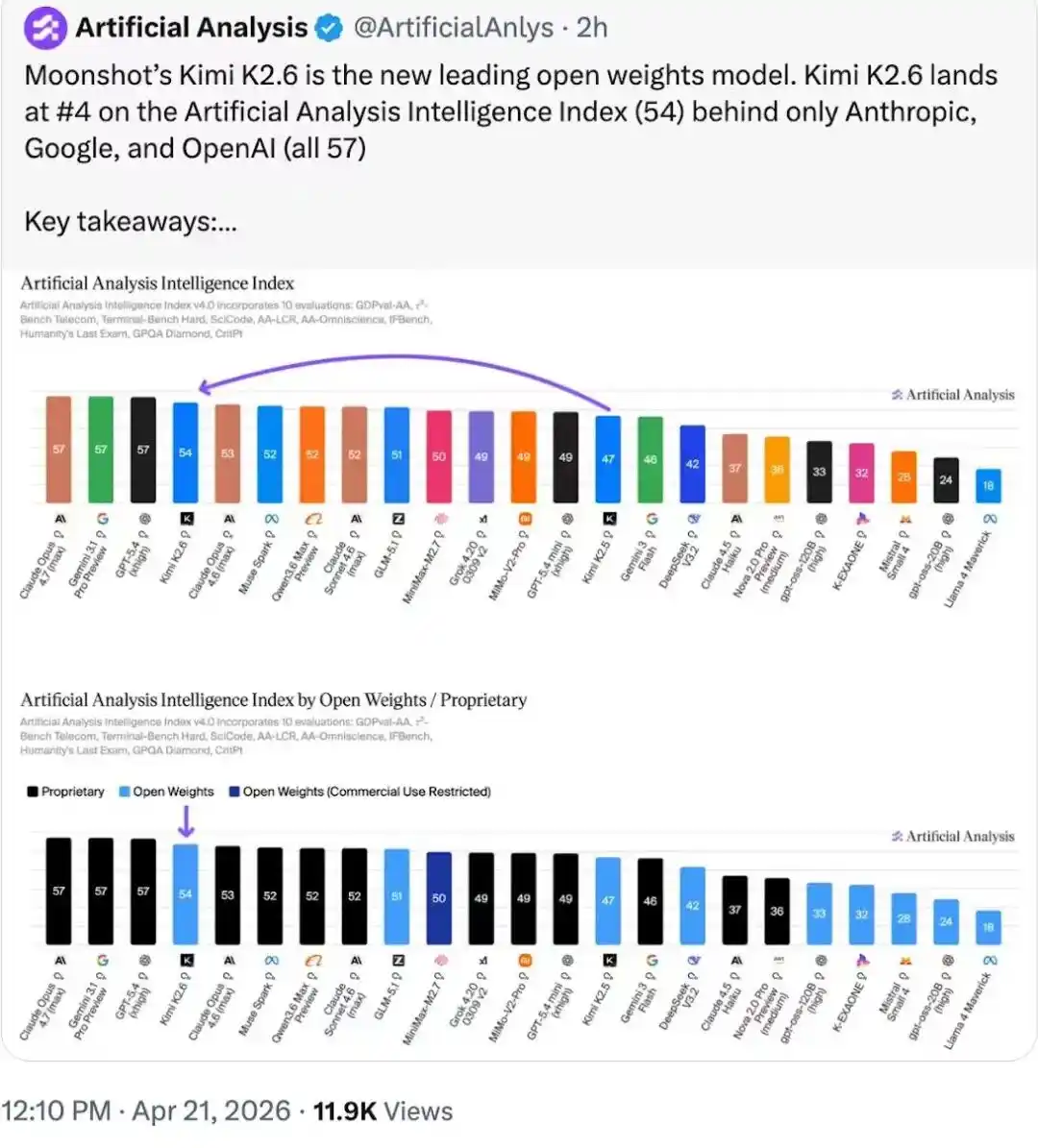
On the Artifacial Analysis intelligence leaderboard, Kimi K2.6 ranks仅次于 three closed-source models and leads the open-source model weight leaderboard

The "New Story" in the Roadmap

Kimi always occasionally brings something new to the industry, including the MuonClip, Kimi Linear, and Attention Residuals mentioned in Yang Zhilin's roadmap speech. Some explorations have also received positive recognition from industry top players.

In mid-March, Kimi published a paper on Attention Residuals, proposing the use of attention mechanisms to改造残差连接. Musk directly tweeted that this was "an impressive breakthrough by Kimi."
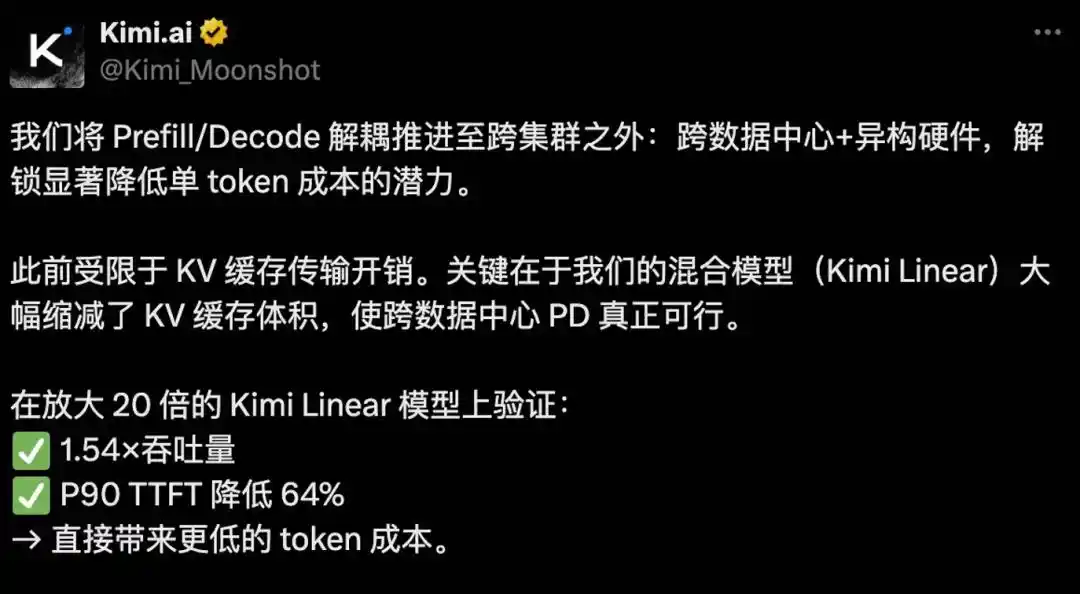
Last weekend, Kimi published a new paper titled "Prefill-as-a-Service: KVCache of Next-Generation Models Could Go Cross-Datacenter" (PrfaaS, Prefill-as-a-Service), mentioning Kimi's new exploration in architecture,核心讨论的仍然是 PD separation (Prefill and Decode).

PD separation is not a new topic—the Prefill stage of model inference is a computationally intensive task, while the Decode stage relies on memory bandwidth, with memory repeatedly reading and writing KV Cache. This architecture aims to decouple compute-intensive tasks from bandwidth-intensive tasks, improving compute utilization and throughput, thereby reducing costs and increasing efficiency.

Although PD separation is good, there is a sticking point: it must be based on RDMA high-speed networks within the same data center.

The core point of Kimi's PrfaaS paper is: based on a hybrid model (Kimi Linear), it significantly reduces the KV cache size, and then completely decouples Prefill and Decode into different heterogeneous clusters.

The experimental example mentioned in the paper shows that the PrfaaS dedicated prefill cluster uses 32 H200 GPUs focused on high compute power; the local PD decoding cluster uses 64 H20 GPUs interconnected via RDMA internal network; the two clusters are connected via VPC dedicated line, with a total cross-cluster bandwidth of about 100Gbps. The test model is a 1T parameter Kimi Linear hybrid attention model.

Actual test results show that the PrfaaS-PD cross-data center solution, compared to the 96-card H20 same PD cluster solution, improves throughput by 54%, reduces P90 TTFT (the waiting time for 90% of users from sending a request to seeing the first character returned) from 9.73s to 3.51s, a reduction of 64%, and the cross-data center KV cache transmission bandwidth only占用 13% of the total 100Gbps bandwidth.
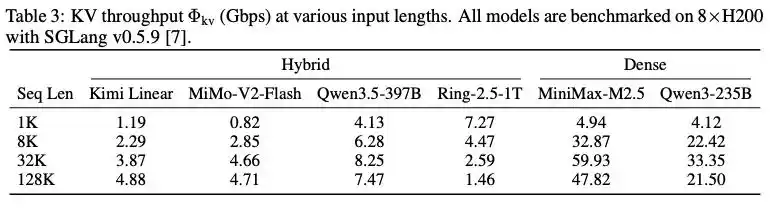
Comparison of KV throughput between hybrid architecture models and dense models under different context lengths

To demonstrate the advantages of the hybrid model architecture, the paper mentions a set of experiments: under an 8-card H200 and SGLang v0.5.9 inference framework, benchmark tests were conducted on several mainstream models. At a context length of 32K, the KV throughput of the MiMo-V2-Flash model using hybrid attention was only 4.66Gbps, while the similarly scaled dense attention model MiniMax-M2.5 reached 59.93Gbps, directly proving that the hybrid attention architecture can reduce KV cache transmission requirements to within the range manageable by ordinary Ethernet.

"Cross-data center + heterogeneous hardware unlocks the potential to significantly reduce per-token cost," Kimi said on its official account.

Regarding token cost reduction, I mentioned in the article "The People Miss DeepSeek" that there is room for optimization at both the model and hardware levels. Professor Hu Yanping from Shanghai University of Finance and Economics specifically posted a朋友圈, emphasizing that cost reduction cannot rely on DeepSeek alone. "The solution depends on the cost efficiency of compute power supply,跨代提升 of model quality, continuous advancement of intelligence paradigms, and the放大效应 of workflow and scenario integration."

From this perspective, Kimi has told the industry a new story about token cost reduction.

Chinese Models Summon Chinese Chips

In the Prefill-as-a-Service paper, more people only noticed the cross-data center narrative, while overlooking the point about heterogeneous hardware.

It is important to note that H200 and H20 are still based on the Hopper architecture in terms of chip design. The heterogeneity mentioned in the paper refers to heterogeneity in bandwidth and compute power. Its启示 is: we can use一部分 compute-powerful domestic cards for Prefill, or bandwidth-strong domestic cards for Decode, and of course, they can also be mixed with overseas cards to achieve cost reduction and efficiency improvement.

It can be said that this is a door opened by Kimi for Chinese chips in large model inference.

In the view of a domestic compute power insider, to catch this wave of traffic benefits brought by the Prefill-as-a-Service solution, they still have to face the old problem of ecosystem.

Over the past few years, Chinese large models have been stuck outside domestic compute power due to ecosystem challenges, but there is another unnoticed detail: products like the H20 have been断供 for a year. In other words, in the short term, there is only one option for inference chips: domestic.

As inference demand surges, compared to supply, ecosystem challenges will switch to secondary issues—the dependence of Chinese large models on domestic compute power has changed from optional to不得不使用. Because of this, many predictions are discussing that DeepSeek V4 is adapting to domestic compute power.

In my article with Professor Hu Yanping, "The Last Urging Letter to DeepSeek," we said that adapting to domestic compute power is a very difficult road for domestic models, but in the longer term, it has to be done. Something that must be done always needs a starting point, and perhaps DeepSeek V4 is that starting point.

Now, DeepSeek V4 has not yet arrived, but Kimi has already used its own practice to explore a feasible path for the combination of Chinese models + Chinese chips.

Kimi has taken the lead as a model representative in extending an olive branch; the problem now lies with domestic chip startups.

Does everyone remember Huang Renxun's reaction when asked about the chip export ban to China in the latest episode of "the Dwarkesh Podcast"? He said that chips are not uranium enrichment, and禁售 cannot stop the progress of Chinese chips; they can still develop models by暴力堆叠 domestic chips.

Why did Huang Renxun say this? The next step for DeepSeek and Kimi is the standard answer.

This article is from the WeChat public account "Tencent Technology," author: Su Yang, editor: Xu Qingyang

Preguntas relacionadas

QWhat are the key improvements in Kimi's K2.6 model compared to K2.5?

AKimi's K2.6 model shows significant improvements in long-range coding capabilities, allowing uninterrupted coding for up to 13 hours and handling over 4000 lines of code. It also enhances API call accuracy and long-running stability for Agent frameworks, and expands Agent cluster capabilities to support up to 300 sub-agents performing 4000 collaborative steps in parallel. Overall, it achieves a 20% performance boost on Kimi's internal code benchmark compared to K2.5.

QHow does Kimi's Prefill-as-a-Service (PrfaaS) architecture improve efficiency?

AKimi's PrfaaS architecture decouples the Prefill (compute-intensive) and Decode (memory bandwidth-intensive) stages of model inference across different heterogeneous clusters, even across data centers. By using a hybrid attention model (Kimi Linear) to reduce KV cache size, it allows the use of high-compute chips (e.g., H200) for Prefill and high-bandwidth chips (e.g., H20) for Decode, connected via VPC dedicated lines. This approach increases throughput by 54%, reduces latency (P90 TTFT) by 64%, and significantly lowers token costs.

QWhat role do Chinese chips play in the future of AI companies like Kimi and DeepSeek?

AChinese chips are becoming a critical infrastructure for AI companies like Kimi and DeepSeek due to export restrictions on high-end GPUs like NVIDIA's H20. Kimi's PrfaaS architecture demonstrates how heterogeneous hardware—including domestic chips—can be used for Prefill and Decode tasks, offering a viable path for cost-efficient inference. As推理 demand grows, reliance on domestic chips shifts from optional to necessary, pushing Chinese AI firms to adapt and collaborate with local chip startups.

QWhat did Elon Musk say about Kimi's research contribution?

AElon Musk tweeted that Kimi's work on Attention Residuals—a technique using attention mechanisms to modify residual connections—was 'an impressive breakthrough by Kimi.'

QHow does Kimi's Agent cluster capability enhance productivity?

AKimi's Agent cluster capability breaks down complex tasks into sub-tasks distributed among specialized agents, enabling parallel processing. This reduces task failure rates and improves efficiency by avoiding serial bottlenecks. In K2.6, it integrates breadth-depth search, large-scale document analysis, long-form writing, and multi-format content generation, supporting up to 300 sub-agents and 4000 collaborative steps, making it a concrete productivity tool for users.

Lecturas Relacionadas

PA Graphics Explanation | One Chart to Understand the Major Web3 Events in August 2026

**PANews Crypto Calendar: Key Web3 Events in August 2026** PANews introduces its revamped crypto calendar, featuring comprehensive coverage, flexible filtering, and easy export options. The market in August will be shaped by multiple key events across macroeconomics, regulation, tokenomics, and project developments: * **Macro & Policy:** Key US economic data releases (July Non-Farm Payrolls, CPI), the Federal Reserve meeting minutes, and the Jackson Hole Economic Symposium will be in focus. On the regulatory front, the US Senate plans to release a new draft of the *CLARITY Act*, while the EU's expanded crypto ban against Belarus comes into effect. * **Token Unlocks:** Significant token unlocks are scheduled for assets including ENA, AVAX, CONX, ZRO, and KAITO, which may influence market volatility. * **Project Updates & Shutdowns:** Several services, including Exchange Art, Ctrl Wallet, Zapper, NFTfi, and Summer.fi, are set to cease operations or undergo major adjustments. Users are advised to manage their assets accordingly. * **Corporate Activity:** Q2 earnings reports from companies like SpaceX, Circle, and Nvidia are due. Unitree Robotics will initiate its IPO subscription on the STAR Market, and Moonshot AI plans to begin a Pre-IPO financing round. * **Industry Events:** Major conferences such as Bitcoin Asia 2026 and the 2026 Digital Expo will take place. The overarching market narrative for August will revolve around macroeconomic expectations, regulatory developments, token unlock schedules, and ongoing industry consolidation.

marsbitHace 4 min(s)

PA Graphics Explanation | One Chart to Understand the Major Web3 Events in August 2026

marsbitHace 4 min(s)

Wall Street's Most Famous 'Cassandra' Now Has His Sights Set on Nvidia

Michael Burry, the famed "Big Short" investor, has once again captured Wall Street's attention with a series of short positions against major tech and semiconductor stocks, most notably Nvidia. In late June and July, through his "Cassandra Unchained" newsletter, Burry disclosed short bets against Nvidia, Tesla, Applied Materials, Caterpillar, the SOXX semiconductor ETF, and later, Micron Technology. His core thesis revolves around potential distortions in the AI infrastructure boom, specifically questioning whether extended depreciation schedules (e.g., 6 years vs. a realistic 2-3 years for AI chips) by cloud giants like Microsoft and Google artificially inflate profits. He also raises concerns about possible "off-balance-sheet circular financing," where chip demand might be propped up by vendor-backed funding to clients. Nvidia's stock experienced volatility following these disclosures, briefly dipping but largely holding near Burry's reported entry points, leaving his positions roughly flat or slightly underwater as of late July. This move is part of a pattern for Burry, whose track record since his legendary 2008 bet is mixed. He has faced notable losses, such as on Tesla in 2021, while scoring on broader market turns like the 2020 pandemic crash. His methodology focuses intensely on free cash flow and scrutinizing original financial documents to spot overvaluation and structural risks, but it often struggles with timing the market. The article contrasts Burry's stance with other prominent investors. Steve Eisman, another "Big Short" figure, is not shorting Nvidia, citing strong fundamentals but expressing nervousness about sustainability. Jim Chanos agrees with the broad "accounting mismatch" concern—comparing it to the dot-com bubble—but targets financial leverage in private equity firms rather than the chip stocks themselves. While Nvidia's short interest remains relatively low at 1.3-1.4% of float, the massive stock size means absolute short losses have been significant, exceeding $5 billion earlier this year. The piece concludes that for ordinary investors, the key takeaway is not replicating specific short bets but learning from the critical frameworks these investors use: questioning rosy accounting, identifying structural vulnerabilities, and maintaining skepticism during market euphoria, even if pinpointing the exact catalyst for a downturn remains elusive.

marsbitHace 29 min(s)

Wall Street's Most Famous 'Cassandra' Now Has His Sights Set on Nvidia

marsbitHace 29 min(s)

Weekly Selection丨Epic Stock Market Volatility, Changxin Tech's IPO Reshapes Storage Landscape, Saylor Aims to Re-Anchor STRC Around September 8th

PANews Weekly Digest: Market Turmoil, Tech Breakthroughs, and Crypto Developments. The week saw significant volatility across global markets. South Korea's KOSPI index experienced extreme turbulence, including multiple trading halts, largely driven by sharp declines in AI hardware stocks like SK Hynix. In contrast, China's Changxin Xinqiao (CXC) achieved a landmark IPO with a market cap surpassing 4 trillion yuan, marking a major success for the domestic DRAM industry after a decade of losses. In the crypto and Web3 space, several key narratives emerged. AI is driving demand for new infrastructure, with projects like AI agent wallets and programmable payments gaining traction, attracting interest from firms like Coinbase. The Bitcoin mining sector is pivoting, with companies like MARA focusing on energy management as electricity becomes a core AI-era asset. Meanwhile, the RWA (Real World Assets) sector faces a "utilization puzzle," with hundreds of billions in on-chain assets remaining dormant. Notable market movements included a historic single-day surge of over 17% for the KOSPI index and a significant migration of $16.5 billion in staked ETH within the Lido ecosystem. Michael Saylor announced a target to re-peg the STRC stablecoin around September 8th. Other highlights include discussions on Ethereum's ambitious 2030 roadmap for scaling and privacy, analysis showing high protocol revenues not always translating to token price gains, and warnings from Citi about potential extreme commodity price shocks by late 2026.

marsbitHace 34 min(s)

Weekly Selection丨Epic Stock Market Volatility, Changxin Tech's IPO Reshapes Storage Landscape, Saylor Aims to Re-Anchor STRC Around September 8th

marsbitHace 34 min(s)

When the Market Begins to Question AI Capex: A Full Analysis of Q2 Earnings Reports from Five Tech Giants

In late July 2026, five major US tech giants—Alphabet, Intel, Microsoft, Meta, and Apple—released their Q2 earnings reports. While all companies exceeded revenue and profit expectations, driven by strong AI-related business growth, investor reactions diverged sharply due to concerns over escalating AI capital expenditures (capex) and their impact on free cash flow. Alphabet reported strong revenue growth and a surging cloud business, but its stock fell after announcing a doubled year-on-year capex and negative quarterly free cash flow for the first time. Intel posted its strongest revenue growth in over 15 years, but its stock experienced volatile trading after significantly raising its full-year capex guidance. Microsoft saw its stock surge after beating estimates and, crucially, lowering its capex forecast while projecting positive free cash flow. Meta faced the most severe sell-off as its profits declined despite revenue beats, with free cash flow plunging over 90% and its capex guidance raised. Apple reported record June-quarter results, but its stock plummeted after providing Q4 revenue guidance that fell short of expectations, citing supply chain constraints and forex headwinds. The overall takeaway is that the market's focus has shifted from validating AI demand to scrutinizing the timeline for returns on massive AI investments. Companies demonstrating a clearer path to managing capex and preserving free cash flow, like Microsoft, were rewarded, while those signaling continued aggressive spending faced investor skepticism.

Odaily星球日报Hace 43 min(s)

When the Market Begins to Question AI Capex: A Full Analysis of Q2 Earnings Reports from Five Tech Giants

Odaily星球日报Hace 43 min(s)

a16z: From Companies to DAOs, DUNA May Become the Next Generation Organizational Form

This article, "From Companies to DAOs: How DUNA Could Become the Next Organizational Form," traces the 500-year evolution of business collaboration. It begins with medieval structures like the *commenda* and Florentine *compagnia*, which exposed partners to personal risk. The modern corporation, exemplified by the Dutch East India Company (VOC), was a revolutionary leap, enabling large-scale, capital-intensive ventures by offering limited liability and reducing coordination costs. However, corporations introduced new challenges like principal-agent problems and bureaucratic overhead. The piece argues that software and internet-native protocols are now reducing these traditional overheads. Decentralized Autonomous Organizations (DAOs) emerged as a new model for coordination without centralized management. Yet, DAOs face a significant legal vacuum: they lack legal recognition, leaving members exposed to unlimited personal liability, and their tokens are vulnerable to being classified as securities under unclear regulations (e.g., the Howey Test). This has forced projects into suboptimal workarounds like offshore foundations. The article identifies the Decentralized Unincorporated Nonprofit Association (DUNA) as a potential solution. Recently legalized in states like Wyoming, the DUNA provides a legal wrapper for decentralized networks. It grants key protections—legal personality, limited liability, and perpetual existence—to a group without imposing a traditional hierarchical management structure. This allows token-holder communities to govern, hold assets, and contract as a single legal entity, aligning with their decentralized nature. While DUNA doesn't solve all governance challenges or magically resolve securities law questions, it represents a crucial step. It fills the legal recognition gap, offering a native legal form for internet-scale, decentralized collaboration and extending the separation of personal risk from organizational venture into a new domain.

marsbitHace 1 hora(s)

a16z: From Companies to DAOs, DUNA May Become the Next Generation Organizational Form

marsbitHace 1 hora(s)

Trading

Spot
活动图片