Earning $80,000 in One Day: How Top Players Turn Polymarket into Their Personal ATM?

比推Publicado a 2026-02-13Actualizado a 2026-02-13

Resumen

In just under a day, a top trader on Polymarket, using the handle Bidou28old, netted $80,000 by exploiting the platform’s newly launched ultra-short-term prediction markets (5-minute and 15-minute intervals). The user is believed to be a quantitative trader or arbitrageur leveraging low-latency data feeds to capitalize on pricing delays. With only 48 total predictions, the trader maintained a remarkably high risk-reward ratio, often buying outcomes with only a 3-8% probability (e.g., betting on a Bitcoin rebound within minutes during a sharp decline). Even with 7 losses exceeding $10,000, the strategy remained profitable due to high payoff multiples—sometimes as high as 33x. The trader employed strict position management, placing large bets ($7,000–$19,000) on high-probability opportunities and securing returns between $4,800–$6,400 per successful trade. In one notable 30-minute span, the user executed three consecutive winning trades, earning over $18,000, demonstrating a high-frequency, data-driven approach. Activity was concentrated during U.S. evening hours (7:30–11:00 PM ET), suggesting either a North American night trader or a professional Asian quant operating during daytime hours. The trader focused predominantly on Bitcoin and Ethereum due to their high liquidity and volatility. This case highlights how sophisticated players use quantitative strategies and real-time market data to systematically profit from short-term market movements on prediction platfo...

Author: Ma He, Foresight News

Original Title: Earning $80,000 in One Day, This Top Player Treats Polymarket as an ATM


The crypto market is unpredictable, even top traders sometimes step back due to its hellish difficulty.

Predicting weekly or monthly trends might not be too hard, but what if the timeframe shrinks to minutes? The difficulty skyrockets.

However, smart people always find their own ways to make money.

A player nicknamed Bidou28old (0x4460bf2c0aa59db412a6493c2c08970797b62970) on Polymarket, who just joined in February this year, netted $80,000 in less than a day.
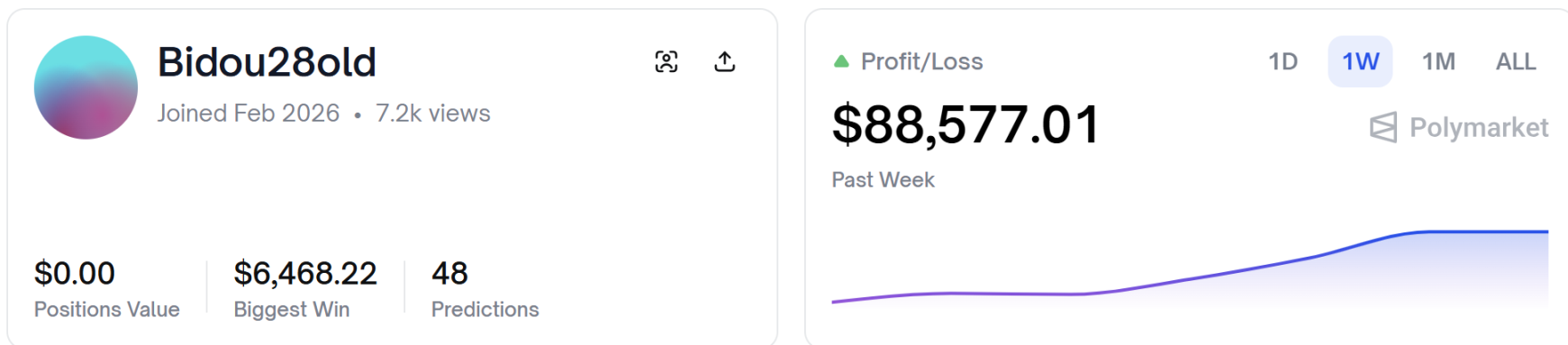
This player is no ordinary speculator; they were among the first top players on Polymarket's newly launched "5-minute / 15-minute ultra-short-term prediction markets" in February 2026.

They made only 48 predictions in all, but the win rate and profit-loss ratio are astonishing. They aren't "predicting" the future; they are "hunting" volatility. They are most likely a quantitative trader or an arbitrageur with extremely low-latency market data, specifically targeting Polymarket's pricing delays for a dimensional strike.

If you scroll down on this trader's Polymarket address homepage, you will be stunned by their "losses" – just these 7 losses amount to over $10,000.
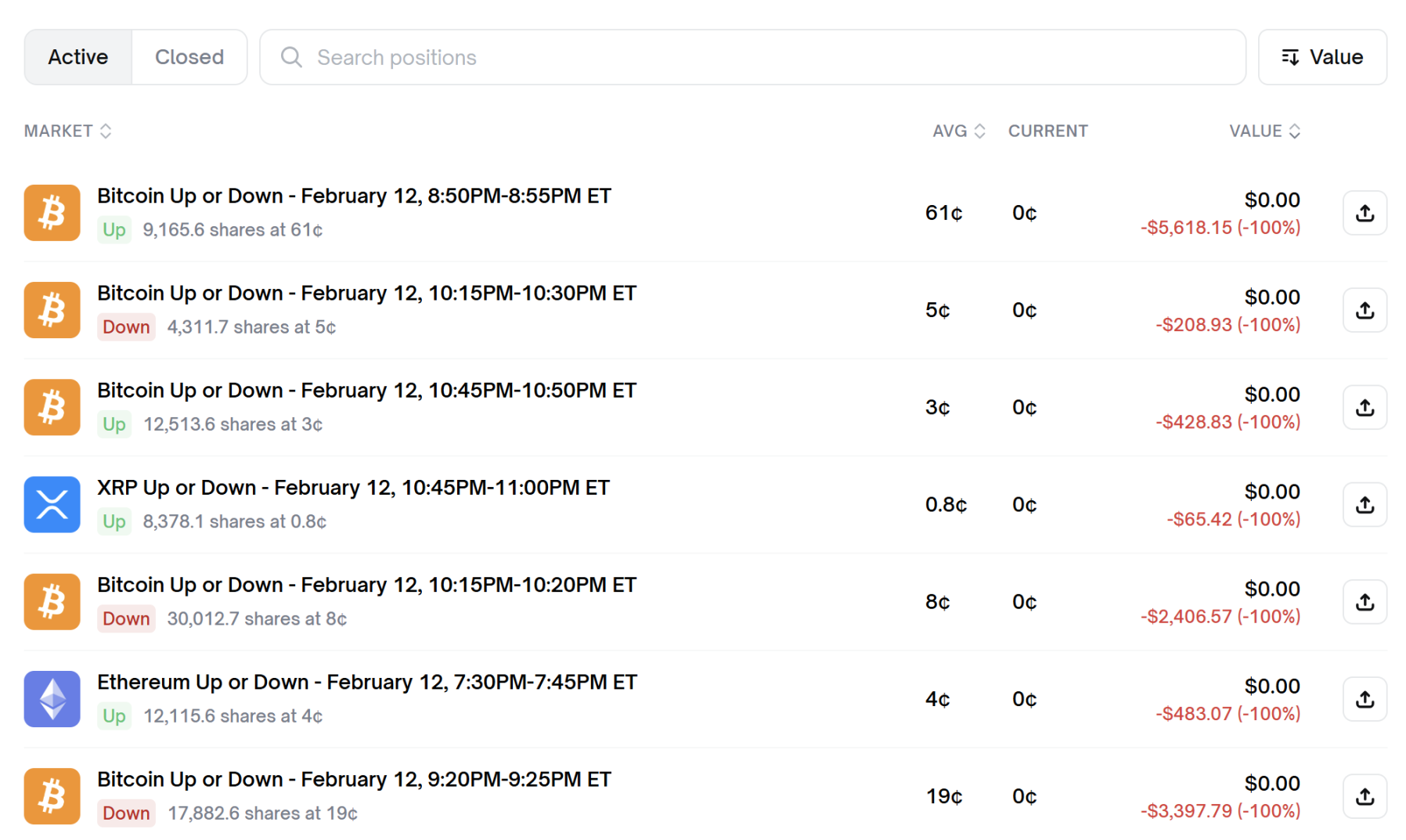
Ordinary people see failure, but this player sees mathematical logic. Observe some of their entry prices: 3¢, 5¢, 8¢, 0.8¢. On Polymarket, they specifically buy events the market believes have only a 3%-8% chance of happening (e.g., buying "rebound within 5 minutes" when BTC plummets). If they buy at 3¢ and guess correctly, the return is 33x. This means even if they fail 30 times, succeeding just once covers the cost; succeeding twice is pure profit.

If these failed cases are about betting small to win big, losing more but winning occasionally, then the big wins shown below truly reveal the other side of their top-tier trading skills.
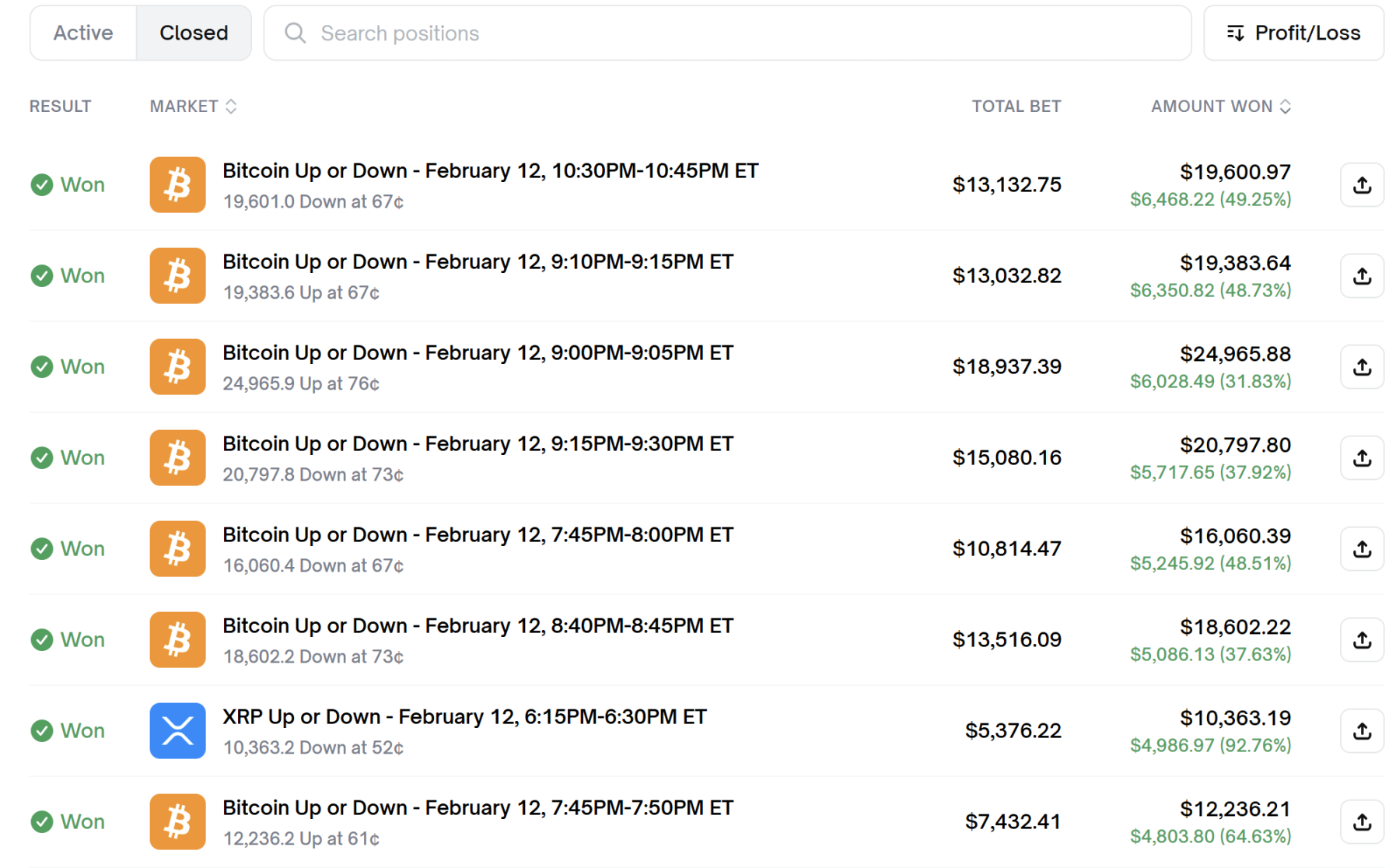
Looking at this screenshot of massive wins, you'll notice a startling pattern: extremely high single-trade investments. Their winning bets generally range from $7,000 to $19,000. Furthermore, their profit amounts are very stable, almost every single one falling between $4,800 and $6,400.

This indicates they have a strict position management model. They aren't gambling for a "double-up"; they are betting on "certainty." Whenever the market shows a signal they recognize, the moment the trend becomes clear, they push in tens of thousands of dollars, capturing 30%-50% of the move before retreating.

If you think those so-called techniques are child's play, then look at these three bets placed within 15-minute timeframes.
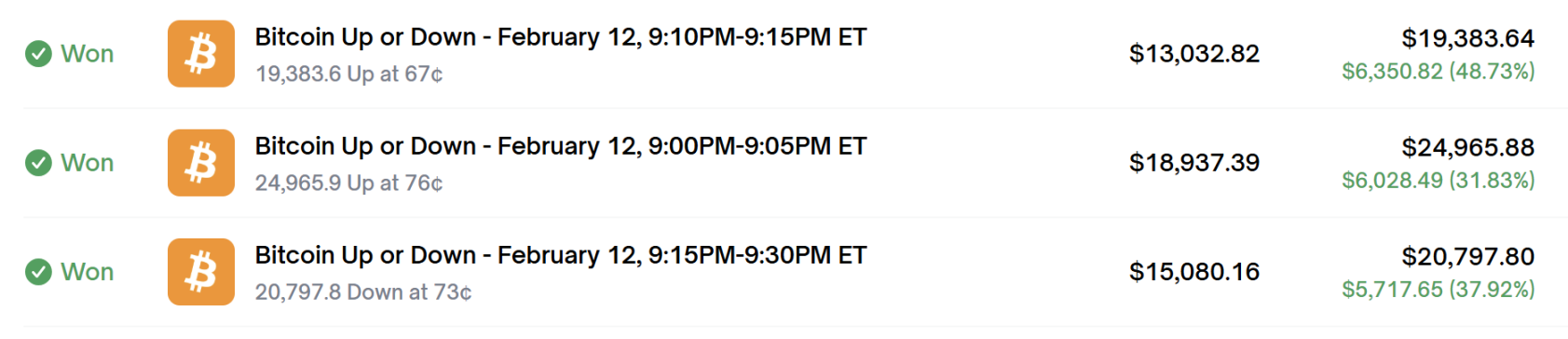
9:00 PM – 9:05 PM: Made $6,028;

9:10 PM – 9:15 PM: Made $6,350;

9:15 PM – 9:30 PM: Made $5,717;

This can be called a textbook example of high-frequency position switching.

Within 30 minutes, they executed three consecutive operations on price predictions for different short timeframes, accumulating over $18,000 in profit. This frequency means they are definitely not making decisions based on news; they are watching second-level candlestick charts or order flow.

Looking carefully at their historical transaction records, most of their trading time is concentrated between 7:30 PM and 11:00 PM EST, which is 8:30 AM to 12:00 PM Beijing Time the next day.

Based on their trading frequency and time, this trader is either a night hunter in North America, perhaps using their evening rest time after the US stock market closes and dinner to specifically harvest volatility in cryptocurrencies during the US post-market session. Or, they could be a "daytime professional trader" in the Asia-Pacific region, as the extremely calm, high-frequency style with single bets in the tens of thousands of dollars matches a professional quantitative trader based in Asia treating this as a full-time job.

In terms of asset selection, they heavily favor BTC, followed by ETH and other major cryptocurrencies, because their high volatility makes them less susceptible to manipulation by single forces, suitable for such large short-term bets.

They allow themselves small losses but dare to place heavy bets on high-probability opportunities (60¢+).

Perhaps, this is the self-cultivation of a Polymarket top player.


Twitter:https://twitter.com/BitpushNewsCN

Bitpush TG Discussion Group:https://t.me/BitPushCommunity

Bitpush TG Subscription: https://t.me/bitpush

Original link:https://www.bitpush.news/articles/7611832

Criptos en tendencia

Preguntas relacionadas

QWho is the top player mentioned in the article that earned $80,000 in less than a day on Polymarket?

AThe top player is known by the nickname Bidou28old, with the address 0x4460bf2c0aa59db412a6493c2c08970797b62970.

QWhat is the key strategy that the player Bidou28old uses to profit on Polymarket?

AThe player is not predicting the future but 'hunting' volatility, likely as a quantitative trader or an arbitrageur exploiting Polymarket's pricing delays by buying low-probability events for high returns.

QHow does the player manage risk despite having significant losses in some trades?

AThe player uses a strict position management model, allowing small losses on low-probability bets but placing large bets (e.g., $7,000 to $19,000) on high-probability opportunities (60¢+), ensuring that even with many small losses, a few wins cover costs and generate profit.

QWhat trading pattern did Bidou28old demonstrate in one 30-minute period, as highlighted in the article?

AIn a 30-minute period, the player executed three consecutive trades in different short-term prediction markets (5-minute and 15-minute intervals), earning over $18,000, showcasing high-frequency position switching based on real-time data like second-level K-line charts or order flow.

QDuring which time periods does Bidou28old primarily trade, and what does this suggest about their location or strategy?

AThe player trades mostly between 7:30 PM and 11:00 PM EST, which is 8:30 AM to 12:00 PM Beijing time, suggesting they could be a night trader in North America or a professional daytime quant in Asia, capitalizing on cryptocurrency volatility during post-US market hours or Asian trading sessions.

Lecturas Relacionadas

From South Korea to the United States: Blue-Collar Jobs Are Becoming Increasingly Popular, Thanks to AI

AI is reshaping the labor market's value proposition. The traditional four-year college degree is losing its appeal as a guaranteed career path, while skilled blue-collar trades like electricians, welders, and plumbers are experiencing historic demand and wage premiums. This shift is driven by dual pressures: AI's displacement of certain white-collar roles and a booming need for physical infrastructure and data center construction. Data confirms the trend. In the U.S., vocational school revenue surged, and a significant portion of recent layoffs are AI-related. Surveys show a majority of Gen Z adults plan to pursue blue-collar work, citing better job security against AI automation. Vocational education interest has exploded recently. Experts cite a psychological shift as younger generations seek tangible, AI-resistant careers and avoid high student debt. In many cases, salaries for skilled trades now match or exceed those requiring a bachelor's degree. In South Korea, semiconductor vocational high schools boast near-total employment, with graduates securing high-paying roles at companies like Samsung. The shortage is structural, exacerbated by a retiring baby boomer workforce and massive infrastructure projects. Companies like JPMorgan Chase, Meta, and Lowe's are investing heavily in training programs. However, overcoming historical stigma and a "perception gap" around trade careers remains a key challenge to closing the talent gap.

marsbitHace 1 hora(s)

From South Korea to the United States: Blue-Collar Jobs Are Becoming Increasingly Popular, Thanks to AI

marsbitHace 1 hora(s)

Qualcomm: AI Hype Subsides, When Will Smartphones Emerge from the Gloom?

Qualcomm reported its Q3 FY2026 results (ending June 2026), with revenue of $9.95B, down 4% YoY but above expectations. Gross margin declined to 53.1%, pressured by rising costs across manufacturing and memory. Key business segments showed mixed performance: Handset revenue fell 19.6% YoY to $5.09B, dragged by an 11% decline in non-Apple Android shipments and weaker high-end mix. Conversely, Automotive revenue surged 61% to $1.59B, and IoT grew 9% to $1.83B. Core operating profit dropped 41% YoY due to margin compression and higher expenses. Management's Q4 FY2026 guidance projects revenue of $9.7B-$10.5B, in line with consensus, but Non-GAAP EPS guidance of $2.05-$2.25 fell short of expectations. Amidst persistent weakness in its core handset market, Qualcomm is pursuing growth in AI, focusing on Edge AI (smartphones, PCs, automotive) and Data Center AI. Its data center strategy includes four pillars: AI accelerators (e.g., AI200), commercial CPUs (Dragonfly C1000), custom silicon, and connectivity solutions. While these initiatives initially boosted its stock, concerns over AI capital expenditure sustainability have since erased those gains. The company targets $5B in data center revenue for FY2027 and $15B for FY2029. The report concludes that with the traditional handset business still under pressure, the data center opportunity is currently viewed as a longer-term option, and a more conservative valuation based on core operations may be warranted until AI contributions materialize.

marsbitHace 1 hora(s)

Qualcomm: AI Hype Subsides, When Will Smartphones Emerge from the Gloom?

marsbitHace 1 hora(s)

From TPU to Self-Evolving Agents: How Jeff Dean Predicts the Next Step in AI

At the 2026 YC Startup School, Jeff Dean outlined his vision for AI's next phase, shifting focus from simply scaling models to building intelligent, autonomous systems. He believes AI's progress is no longer just about creating smarter models, but about integrating them into systems capable of long-term, iterative work, automated experimentation, and continuous learning. This evolution moves the competition from "who has the bigger model" to "who can best organize intelligence." Dean suggests AI capabilities are now comparable to a junior engineer, enabling the automation of complex workflows. However, the true challenge and opportunity lie in managing these AI "workers" at scale. He emphasizes the importance of **context engineering**—structuring tools, memory, and feedback loops—over raw model power. For startups, this means building deep expertise in niche domains where general models currently fail (near 0-1% success rates), leveraging proprietary data, specialized tools, and domain-specific evaluators. A recurring theme is re-examining fundamental constraints. Dean's past work, like moving Google's search index to memory or creating the TPU, stemmed from questioning outdated assumptions about hardware and cost. He sees similar inflection points today, particularly in **specialized inference hardware** to drastically reduce latency and energy consumption for real-time Agent operation. Notably, he points out that in modern AI systems, the dominant cost is often not computation but **data movement**. Reliable, long-running Agents require robust system design, borrowing concepts from distributed computing like checkpointing, state management, and parallel exploration to handle failures and maintain progress over days or weeks. As AI automates execution, the scarcest human skills will shift to **defining clear specifications**, **judging what problems are worth solving** (taste), and designing effective feedback loops. Ultimately, Dean's framework prioritizes understanding the problem deeply, identifying the true bottlenecks, and systematically building closed-loop systems where AI can not only perform tasks but also improve AI itself.

marsbitHace 1 hora(s)

From TPU to Self-Evolving Agents: How Jeff Dean Predicts the Next Step in AI

marsbitHace 1 hora(s)

Trading

Spot

Artículos destacados

Cómo comprar ATM

¡Bienvenido a HTX.com! Hemos hecho que comprar Atletico De Madrid Fan Token (ATM) sea simple y conveniente. Sigue nuestra guía paso a paso para iniciar tu viaje de criptos.Paso 1: crea tu cuenta HTXUtiliza tu correo electrónico o número de teléfono para registrarte y obtener una cuenta gratuita en HTX. Experimenta un proceso de registro sin complicaciones y desbloquea todas las funciones.Obtener mi cuentaPaso 2: ve a Comprar cripto y elige tu método de pagoTarjeta de crédito/débito: usa tu Visa o Mastercard para comprar Atletico De Madrid Fan Token (ATM) al instante.Saldo: utiliza fondos del saldo de tu cuenta HTX para tradear sin problemas.Terceros: hemos agregado métodos de pago populares como Google Pay y Apple Pay para mejorar la comodidad.P2P: tradear directamente con otros usuarios en HTX.Over-the-Counter (OTC): ofrecemos servicios personalizados y tipos de cambio competitivos para los traders.Paso 3: guarda tu Atletico De Madrid Fan Token (ATM)Después de comprar tu Atletico De Madrid Fan Token (ATM), guárdalo en tu cuenta HTX. Alternativamente, puedes enviarlo a otro lugar mediante transferencia blockchain o utilizarlo para tradear otras criptomonedas.Paso 4: tradear Atletico De Madrid Fan Token (ATM)Tradear fácilmente con Atletico De Madrid Fan Token (ATM) en HTX's mercado spot. Simplemente accede a tu cuenta, selecciona tu par de trading, ejecuta tus trades y monitorea en tiempo real. Ofrecemos una experiencia fácil de usar tanto para principiantes como para traders experimentados.

148 Vistas totalesPublicado en 2024.12.11Actualizado en 2025.03.21

Cómo comprar ATM

Discusiones

Bienvenido a la comunidad de HTX. Aquí puedes mantenerte informado sobre los últimos desarrollos de la plataforma y acceder a análisis profesionales del mercado. A continuación se presentan las opiniones de los usuarios sobre el precio de ATM (ATM).

活动图片













