Earning $100,000 in 10 Days: An Interview with OpenClaw's Practical Experience in Prediction Markets

Odaily星球日报Publicado a 2026-03-16Actualizado a 2026-03-16

Resumen

In an interview with Odaily Planet Daily, Kevin, a former ERP architect and Web3 investor, shares how he used OpenClaw to generate a profit of approximately $100,000 in just 10 days, turning a $30,000 investment into over $130,000 at its peak (currently around $112,000). Kevin began his crypto journey during the "inscription summer" of 2023, earning his first significant returns from ORDI. He later transitioned to prediction markets, specifically Polymarket, in mid-2025, attracted by its improved liquidity and user experience. Initially, he used self-developed algorithmic strategies for arbitrage, primarily in sports betting markets, doubling a $100,000 investment over several months. Since integrating OpenClaw in late February, Kevin adopted a hybrid approach: 60% of his strategy remains automated arbitrage, while 40% uses OpenClaw for predictive betting. OpenClaw helps gather and analyze factors like smart money movements, public sentiment, team lineups, and player conditions—even identifying new influencing variables. It also automates backtesting, strategy discovery, and execution, making it effective in Polymarket due to its AI-friendly API. While currently focused on sports markets with limited automated capital ($1,000 per test account), Kevin plans to expand into other domains and may later offer paid OpenClaw "Skills" based on his methodology.

Original | Odaily Planet Daily (@OdailyChina)

Author | Golem (@web 3_golem)
Currently, "raising lobsters" is no longer difficult, but how to master OpenClaw and actually use it to make money still puzzles many lobster farmers.

Last week, I spoke with some deep users of OpenClaw in the crypto space. Some mentioned that OpenClaw's heartbeat mechanism and scheduled tasks can improve the efficiency of news trading, but more interviewees believed that using OpenClaw to trade cryptocurrencies for profit is still challenging.(Related reading:Odaily Editorial Tea Party)

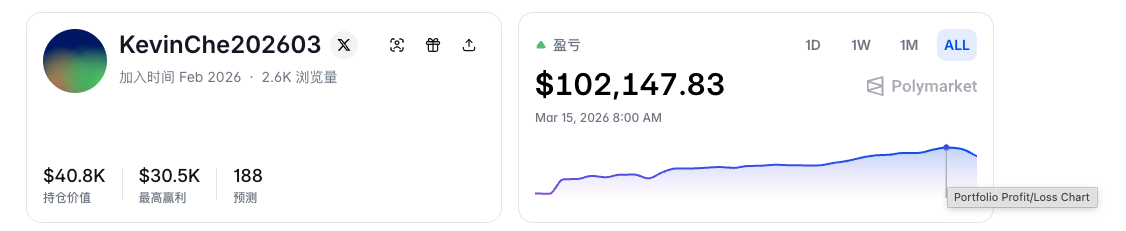
However, where there's a will, there's a way. A trader named Kevin , with the assistance of OpenClaw, turned a $30,000 principal into 4 times its value in 10 days, achieving a net profit of $100,000 (currently slightly retraced to $82,000). Kevin himself stated that this was initially just an experiment, but he didn't expect to actually make money.
So how did Kevin transform OpenClaw from a toy that only burns tokens into a money-making machine? Odaily Planet Daily spoke with Kevin, who shared his personal crypto journey and how he leveraged OpenClaw in prediction markets, hoping readers can gain some inspiration.

Transition from "Scientist" to "Prophet"

Kevin's early career primarily involved designing ERP architectures for enterprises. He later joined a Top 3 domestic internet giant to build a sports event betting software system from scratch. This professional background laid the foundation for Kevin's current achievements in prediction markets. After 2018, Kevin entered the Web3 investment sector, mainly incubating and accelerating startups.

However, Kevin's first real windfall came five years after entering the crypto space. In 2023, ordi emerged, ushering in the "Inscription Summer" for the crypto market. With a background in computers and code, Kevin became one of the highly sought-after "scientists" at that time(Odaily Note: Scientists refer to those who could write programs and code to quickly participate in new asset deployments during the inscription craze).

"The period when ordi was listed on Binance was when my account assets reached their peak. I ultimately pocketed about over 2 million RMB," Kevin said, noting that he was also among the first batch of people to participate in the ordi launch, with a cost of less than 1 RMB per token, subsequently enjoying a thousand-fold increase.

After inscriptions completely cooled down, Kevin began searching for other opportunities and finally started seriously researching and participating in the prediction market Polymarket in the summer of 2025. "I had played Polymarket before, but the liquidity was poor, so I ignored it," Kevin said. For someone who had worked in traditional sports betting, the early Polymarket's trading depth was completely insufficient.

However, after Polymarket successfully predicted Trump becoming the 47th President of the United States in 2025, Kevin's attention returned to Polymarket. "After 2025, Polymarket's reputation grew, its liquidity could handle large orders, and more importantly, deposits and withdrawals became very convenient," so Kevin began experimenting with algorithms on Polymarket, becoming a "prophet".

Kevin's journey in prediction markets is divided into two stages: before using OpenClaw assistance and after using OpenClaw assistance. For clarity, Odaily Planet Daily has condensed Kevin's sharing as follows, enjoy~

How to Play Prediction Markets Before Using OpenClaw

Odaily Planet Daily: When you started playing Polymarket in the summer of 2025, how much money did you invest, and what was the final profit?

Kevin: I invested a total of about $100,000 at that time, and the total profit by this year is approximately double the principal.

Odaily Planet Daily: What strategy did you mainly use?

Kevin: I don't bet directly; instead, I wrote programs for automated arbitrage to make money. My previous experience building sports event betting systems in a Web3 internet company, which also involved order book design, was very helpful in understanding Polymarket's order book. Therefore, I used programs to capture spreads between order books, especially in sports events, where a lot of emotional arbitrage can be done.

Odaily Planet Daily: Do you have a dedicated team, and is anyone providing you with funds?

Kevin: I'm doing this alone; AI assistance is enough. Initially, I was afraid Polymarket might hinder withdrawals, so I ran dozens of accounts. But later, I found the deposit and withdrawal process very smooth, so I reduced the number of accounts. I mainly use my own money to run strategies, but indeed, some people provide funds for me to run strategies for them, but this is just one way to make money.

How to Play Prediction Markets After Using OpenClaw

Odaily Planet Daily: So when did you start using OpenClaw to play prediction markets?

Kevin: At the end of February. This was itself an experiment to see how much money OpenClaw could make at the trading level, but I didn't expect it to actually make money. For example, the account KevinChe202603, I used $30,000 in capital and made up to $100,000 at its peak, all within just 10 days.

Odaily Planet Daily: So what is your specific strategy?

Kevin: Frankly, this account's strategy is mixed. Currently, 60% is still running the previous automated arbitrage algorithm, and 40% is using the "Lobster" (OpenClaw) for subjective betting. Compared to market making arbitrage, betting is a complex decision, requiring consideration of the prediction market's smart money, sentiment, lineups, player form, etc. OpenClaw's role here is to actively collect various factors that determine the outcome of a match and turn them into an indicator. After several training sessions, it can also find other influencing factors that I might overlook, saving me a lot of time and mental effort.

Odaily Planet Daily: But isn't this just AI predicting matches? Conversational AI can do that too, and some developers have even specifically created AI prediction tools for matches. What's special about OpenClaw?

Kevin: Having an information advantage is just one of OpenClaw's strengths. It can also mine new strategies by itself, conduct its own backtesting, and perform automated betting in matches. If the strategy is good, we just need to give the money to OpenClaw; everything else is automated, which AI prediction tools cannot do. For example, it can actively discover some smart money addresses and fool addresses, either following the smart money's bets or using the fool addresses as a counter-indicator.

Additionally, this is why Polymarket, among all prediction markets, integrates particularly well with OpenClaw—because Polymarket's API is the most AI-friendly, making data access very convenient for AI.

Odaily Planet Daily: In which areas is OpenClaw primarily betting now? Is it fully automated already?

Kevin: Based on my areas of expertise, OpenClaw is currently also experimenting mainly in the sports competition领域. But once mature, I will consider expanding OpenClaw to other areas. Right now, I give OpenClaw small amounts of capital for automated betting, around $1000. I still don't dare to put too much money in a fully automated account.

Odaily Planet Daily: Is your strategy replicable? Or will you write a Skill for the market in the future?

Kevin: Also trying. Because there is indeed user demand for this, to see if my methodology can be combined to allow everyone to build a money-making Lobster. Later, I also plan to package some Skills for the market to use, which will certainly be paid.


Preguntas relacionadas

QWhat was Kevin's initial investment and profit using OpenClaw in the prediction market?

AKevin started with a $30,000 investment and achieved a peak profit of $100,000 within 10 days, though it later retraced to $82,000.

QWhat was Kevin's professional background before using OpenClaw in prediction markets?

AKevin initially designed ERP systems for enterprises, then worked at a top-three internet company in China to build sports betting systems from scratch, and later moved to Web3 investment to incubate startups.

QHow did Kevin use OpenClaw to assist in his prediction market strategy?

AKevin used OpenClaw to collect various factors influencing game outcomes, transform them into indicators, and automate betting. It also helped identify smart money addresses and automate strategies, with 40% of his account using OpenClaw for subjective betting.

QWhat was Kevin's strategy in prediction markets before using OpenClaw?

ABefore OpenClaw, Kevin used automated arbitrage programs to profit from spreads between different market makers, particularly in sports events, leveraging emotional arbitrage without personally gambling.

QWhy does Kevin believe Polymarket is well-suited for integration with OpenClaw?

AKevin believes Polymarket is ideal for OpenClaw integration because it has user-friendly APIs that make data access easy for AI, good liquidity for large orders, and smooth deposit and withdrawal processes.

Lecturas Relacionadas

Coinbase Vice President: The Wars Over Cryptocurrency Regulation Are Over

Coinbase's new Vice President, Ryan VanGrak, declared that regulatory wars in the cryptocurrency sector are over. Since taking office on July 9, 2026, he has shifted the company's approach from litigation and sanctions to focusing on growth and innovation. The industry can now concentrate on development rather than fighting for its right to exist. He highlighted that the Digital Asset Market Clarity Act (CLARITY Act), which aims to establish a clear federal regulatory framework dividing oversight between the SEC and CFTC, has gained significant momentum. This framework is intended to provide proper supervision, investor protection, and maintain U.S. leadership in digital assets. VanGrak's appointment marks a strategic shift from a "wartime" to a "peacetime" advisor, replacing former Chief Legal Officer Paul Grewal, who oversaw major litigation, including a dismissed 2023 SEC lawsuit. With his background at Citadel Securities and the SEC, VanGrak brings deep regulatory and institutional finance expertise as Coinbase expands beyond a simple exchange into a broader financial services provider, offering stocks, futures, prediction markets, and AI tools. For investors, bipartisan support for crypto legislation like the CLARITY Act represents a major shift from the enforcement-focused environment of 2023-2024. Lawmakers are now focused on *how* to regulate crypto, not *if* it should exist. However, risks remain, as the bill's passage is not yet guaranteed.

cryptonews.ruHace 37 min(s)

Coinbase Vice President: The Wars Over Cryptocurrency Regulation Are Over

cryptonews.ruHace 37 min(s)

Deep Dive into FWA: An Intriguing Experiment Turning NFTs into "On-Chain Gachapon"

A Deep Dive into FWA: The “On-Chain Gacha” Experiment for NFTs Fake World Assets (FWA), created by TokenWorks, introduces an innovative “NFT gacha machine” fully operating on-chain. Users can deposit eligible NFTs paired with ETH (called Backing) to create a Position, acting as a prize pool. Others can then pay a uniform Acquisition Price for a chance to win a random NFT from the pool. The core mechanism features a reverse probability system: Positions with lower Backing have a higher chance of being selected, serving as common prizes, while high-Backing Positions are rare “jackpots.” The acquisition price is calculated based on the harmonic mean of all Backings, keeping entry costs low. When a Position is won, the purchaser must choose: keep the NFT or accept the Standing Bid (85% of the Backing, claimable in ETH or $FWA tokens), returning the NFT to the original depositor. The protocol involves two main roles. Depositors provide liquidity (NFT + ETH), earning a share of fees from each draw, distributed equally per active Position, plus potential $FWA rewards. Purchasers pay to spin the gacha, receiving $FWA rewards for participation. A special “Crown” reward goes to the Position with the highest Backing. The $FWA token has a fixed supply and is initially obtainable only through protocol participation (depositing or purchasing), with external buying disabled early on to reduce sell pressure. Its value is supported by a built-in buy pressure: when purchasers opt for the $FWA settlement on a Standing Bid, the protocol uses the backing ETH to buy $FWA from the market. Revenue for the protocol comes from a 1% fee on each draw, a 1% settlement fee when an NFT is kept, and the 15% discount from Standing Bid settlements (currently allocated to the protocol). The design cleverly blends Uniswap-style liquidity provision, gacha mechanics, and tokenomics to create a novel, self-regulating marketplace for NFT liquidity and engagement.

marsbitHace 52 min(s)

Deep Dive into FWA: An Intriguing Experiment Turning NFTs into "On-Chain Gachapon"

marsbitHace 52 min(s)

10,000 Scientists Get 1 Year of Free Access: OpenAI Brings the Scientific Research Pipeline into ChatGPT

OpenAI has launched the "ChatGPT for Academic Researchers" program, offering free one-year access to its flagship models for 100,000 university researchers globally, with 10,000 spots available this summer. Selected institutions include prestigious centers like ENS Paris and the IAS at Princeton. The initiative provides an integrated research workspace within ChatGPT, bundling tools like ChatGPT, ChatGPT Work, and Codex, along with expanded Deep Research capabilities, higher usage limits, and specialized tools for life sciences. The suite connects to platforms like Zotero and GitHub, aiming to streamline the entire research workflow from literature review and coding to data analysis and manuscript drafting. OpenAI notes that about 1.3 million people already use ChatGPT weekly for advanced science and math. The program targets building long-term user dependency by embedding these tools into daily research habits. However, access comes with limitations: it does not include API credits or model weights, and eligibility is restricted to verified academic researchers from supported countries. This approach contrasts with Anthropic's "AI for Science" program, which offers API credits but not an integrated workspace. Both companies emphasize preventing misuse by withholding model weights, a point of contention for AI researchers seeking transparency. The core strategy remains clear: provide a powerful, integrated environment to foster user reliance ahead of the post-free period.

marsbitHace 57 min(s)

10,000 Scientists Get 1 Year of Free Access: OpenAI Brings the Scientific Research Pipeline into ChatGPT

marsbitHace 57 min(s)

What's Going On with Gigadevice? Major Shareholder Cashes Out 44 Billion, Then Announces 20 Billion Buyback

Gigadevice Innovation, a leading Chinese memory chip company, has executed a controversial financial maneuver. The company's controlling shareholder and chairman, Zhu Yiming, sold approximately 44 billion RMB worth of his shares between early May and mid-June 2026, capitalizing on a soaring stock price that peaked at 846.66 RMB on June 29th. Following a subsequent stock crash—plummeting to around 350 RMB in 22 trading days and erasing over 330 billion RMB in market value—Zhu announced a combined "market rescue" plan on July 29th. This plan includes his personal commitment to buy back at least 1 billion RMB in shares and a company proposal to repurchase 1 to 2 billion RMB worth of stock. This sequence of high-selling followed by a low-buying plan has confused and unsettled many of the company's 240,000 retail investors. The stock's dramatic decline was attributed to several factors: the successful IPO of its sister company, Changxin Technologies, which ended Gigadevice's status as a primary investment proxy for the domestic memory sector; a Morgan Stanley report warning of a potential peak in the memory chip cycle; and a severe loss of market confidence triggered by the chairman's massive sell-off. While the sell-off was procedurally compliant, its timing has been criticized. The company's fundamentals appear strong, with preliminary H1 2026 results showing revenue up 177% year-on-year to 11.5 billion RMB and net profit skyrocketing 1099% to 6.9 billion RMB, driven by a boom in memory chips and MCU demand. However, a significant portion (2.05 billion RMB) of this profit came from non-recurring gains like securities investment, and the memory industry is notoriously cyclical. Analysts highlight the company's role in the domestic substitution of niche DRAM and NOR Flash memory, with some maintaining bullish price targets. Yet, the recent events underscore key risks: its fabless model creates dependency on foundries like Changxin, and the chairman's actions have raised serious questions about management's alignment with minority shareholders. The promised buybacks cannot commence until December 13th due to a mandatory six-month cooling-off period following an insider sale, leaving the stock vulnerable in the interim.

marsbitHace 57 min(s)

What's Going On with Gigadevice? Major Shareholder Cashes Out 44 Billion, Then Announces 20 Billion Buyback

marsbitHace 57 min(s)

Trading

Spot
活动图片