Double Zero slides 12% as momentum fades – Is the worst over for 2Z?

ambcryptoPublicado a 2026-01-26Actualizado a 2026-01-26

Resumen

Double Zero (2Z) has declined over 12% amid a broader market downturn and significant long liquidations exceeding $719,000. Technical indicators remain bearish, with the MACD showing a death cross and the RSI trending downward around 46, suggesting potential further losses. A key demand zone lies between $0.114 and $0.118, which could serve as support. A rebound from this level toward $0.15 would represent a 28% gain, but current spot buying of around $874,400 appears insufficient to drive a strong recovery. Despite the bearish signals, derivatives traders maintain a slight long bias, with a Long-to-Short Ratio of 1.043 and a positive funding rate, indicating lingering bullish sentiment.

Double Zero has moved decisively lower following a major liquidity shift that triggered broad capitulation.

At press time, the altcoin was down over 12%, with rebound prospects appearing muted as momentum remains notably weak. While market participants continue to anticipate a reversal, the technical confluence needed to support such a move has yet to materialize.

Downtrend deepens as 2Z loses momentum

Double Zero’s [2Z] decline does not appear to be slowing at the time of publication. From a technical perspective, the chart showed an absence of immediate support levels—zones that typically act as buffers for price stabilization or rebounds.

However, the chart does reveal a lower ascending support that could serve as a potential pivot for price action.

This structure aligns with a demand zone between $0.114 and $0.118, an area that may provide the necessary footing for the price to stabilize or attempt a recovery.

A rebound from this zone toward the $0.15 level would represent a potential 28% upside, with additional gains possible if momentum improves.

That said, trader confidence remains fragile. Over the past 24 hours, long-positioned traders have incurred losses exceeding $719,700, compared to just $2,400 in losses recorded by short sellers.

Technical indicators tilt firmly bearish

Technical indicators continue to argue against aggressive accumulation at current levels. The Moving Average Convergence Divergence (MACD) remained firmly bearish after printing a classic “death cross.”

This pattern forms when the MACD line crosses below the signal line and is often associated with prolonged downside pressure. Historically, such setups have preceded sharper declines as selling momentum accelerates.

The Relative Strength Index (RSI) reinforces this bearish setup. At the time of publication, the RSI had slipped into the bearish zone between 30 and 50 and printed a reading of 46, with momentum still trending lower.

A sustained decline in the RSI typically reflects weakening market strength and raises the likelihood of continued downside price action.

If both indicators remain under pressure—particularly with the MACD firmly in negative territory—2Z could face deeper losses in the near term.

Spot demand lags as derivatives traders hold long bias

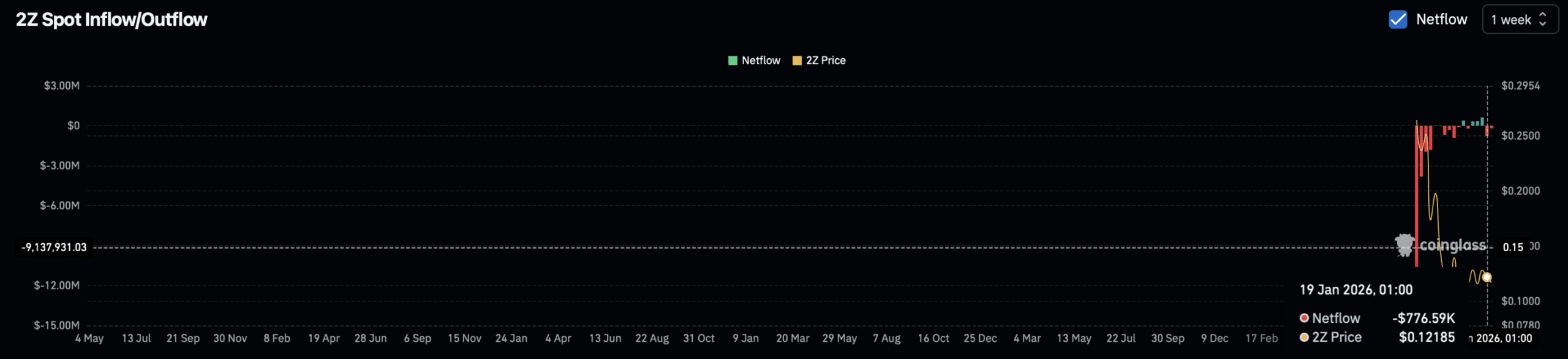
Spot market activity showed signs of accumulation, with buyers adding to positions over the past two weeks. However, the scale of these purchases remains modest.

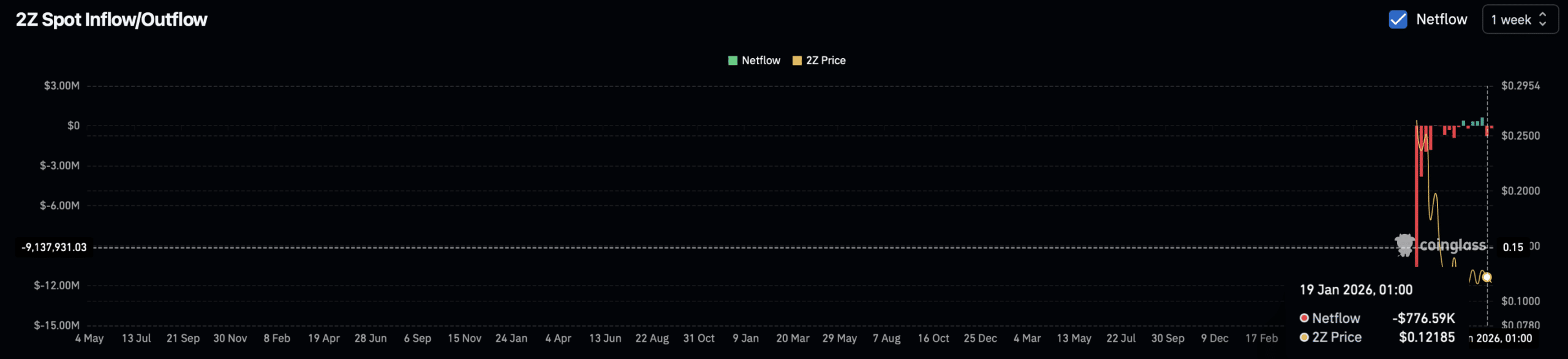
According to CoinGlass Spot Netflow data, total spot purchases over this period amounted to approximately $874,400. While this inflow may help slow the pace of the decline, it remains insufficient to provide meaningful price support.

Meanwhile, sentiment in the 2Z perpetual market continued to hint at a potential rebound near the previously identified support zone.

The Long-to-Short Ratio, which tracks directional positioning—above 1 indicating long dominance and below 1 signaling short control—supports this view.
At press time, the ratio stood at 1.043. In addition, the Open Interest–Weighted Funding Rate printed a positive 0.0019%, suggesting that capital positioning remained tilted in favor of bullish traders.

This indicates that despite recent liquidation losses, trader conviction on the long side remains intact. Whether this positioning holds may prove pivotal in shaping 2Z’s next directional move.


Final Thoughts

  • 2Z may extend its decline until it finds a support level capable of cushioning further losses, even as a potential 28% rebound remains in view.
  • Indicators point to a short-term pullback, although spot traders and perpetual 2Z traders continue to maintain a bullish bias.


Preguntas relacionadas

QWhat was the percentage decline in Double Zero (2Z) at the time of publication?

ADouble Zero was down over 12% at the time of publication.

QWhat is the potential upside percentage if 2Z rebounds from the demand zone to the $0.15 level?

AA rebound from the demand zone to the $0.15 level would represent a potential 28% upside.

QWhat key bearish technical pattern did the MACD indicator show?

AThe MACD indicator showed a classic 'death cross', which occurs when the MACD line crosses below the signal line.

QWhat does a Long-to-Short Ratio above 1 indicate for the 2Z perpetual market?

AA Long-to-Short Ratio above 1 indicates that long positions are dominant in the market.

QWhat was the total value of spot purchases over the two weeks leading up to the article?

ATotal spot purchases over the past two weeks amounted to approximately $874,400.

Lecturas Relacionadas

In Jinjiang, Fujian, a Storage Super Unicorn Lies Quiet

In Fujian's Jinjiang, a city known for sportswear, lies a quiet semiconductor giant: Fujian Jinhua Integrated Circuit Co. (JHICC). Once a promising domestic DRAM manufacturer alongside Yangtze Memory and ChangXin Memory Technologies (CXMT), its journey was derailed in 2018 when the U.S. placed it on an Entity List and filed criminal charges for alleged trade secret theft. This halted production for years. A turning point came in February 2024 when a U.S. federal court found JHICC not guilty. However, it had lost crucial time. While CXMT soared to become a top-valued A-share company in 2024, JHICC, with an estimated valuation of 80 billion RMB, was just restarting. Its current output is primarily customized DDR4 chips, not the advanced DDR5/HBM demanded for AI, but it still benefits from the broader memory chip upcycle. JHICC's story is tied to Chen Zhengkun, a veteran engineer who left Micron to lead the venture. Founded in 2016 with state-backed funding, JHICC partnered with Taiwan's UMC to develop DRAM technology. Rapid progress was cut short by the U.S. actions, which Micron initiated, partly due to its heavy reliance on the Chinese market. Post-sanctions, Chen's team worked to rebuild the production line with reduced reliance on U.S. technology. According to its records, JHICC achieved small-scale production and revenue growth under immense pressure. It now focuses on the stable "niche" DRAM market (e.g., TVs, routers) with a monthly capacity of ~40,000 wafers, aiming for 60,000 by 2026. It holds over 1,000 patents but remains on the Entity List. For Jinjiang, investing in JHICC was a bold industrial leap. The local government provided unwavering financial and logistical support during the crisis, helping the company survive. JHICC has become the anchor for a growing local semiconductor cluster. Though its scale lags behind domestic peers, JHICC's persistence symbolizes a hard-won foothold in a global market long dominated by Samsung, SK Hynix, and Micron. Having missed one boom, it seeks a place in the new AI-driven memory supercycle.

marsbitHace 1 hora(s)

In Jinjiang, Fujian, a Storage Super Unicorn Lies Quiet

marsbitHace 1 hora(s)

Trading

Spot
活动图片




