Dogecoin Tries to Hold $0.09370 – Is 2026 the Doge Year or Will $MAXI Take Over?

bitcoinistPublicado a 2026-02-10Actualizado a 2026-02-10

Resumen

Dogecoin is currently testing a critical support level at $0.09370, which is seen as a key determinant of its near-term price direction. If this level holds, analysts project a potential rally toward $0.20 by 2026, supported by oversold technical indicators and historical accumulation patterns. However, a breakdown below $0.088 could trigger a decline toward $0.060. Meanwhile, liquidity is shifting toward newer, high-risk meme tokens like Maxi Doge ($MAXI), which has raised $4.58M in its presale. $MAXI targets a high-leverage trading culture with features like holder-exclusive competitions and a dedicated treasury fund. Whale activity indicates growing interest, though the token remains a speculative play. The broader meme coin market remains sensitive to macroeconomic liquidity conditions, with Dogecoin’s performance tied to Bitcoin’s movements and central bank policies. The article highlights both the technical outlook for DOGE and the emerging appeal of narrative-driven altcoins like $MAXI for risk-seeking investors.

Trusted Editorial content, reviewed by leading industry experts and seasoned editors. Ad Disclosure

Quick Facts:

  • ➡️ Dogecoin must hold the $0.09370 support level to maintain its bullish structure and target $0.20 by 2026.
  • ➡️ A breakdown below $0.088 would invalidate the current reversal thesis, risking a drop to $0.060.
  • ➡️ Market liquidity is rotating toward thematic projects like Maxi Doge, which integrates trading competitions and leverage culture for high-risk ROI hunters.
  • ➡️ Macroeconomic shifts in global liquidity remain the primary catalyst for the next leg of the meme coin supercycle.

Dogecoin is fighting a critical battle at $0.09370.

That price point, once just a blip on the technical chart, has hardened into a psychological line in the sand for the entire meme sector. With Bitcoin stuck in consolidation, high-beta assets like DOGE are being forced to test their liquidity floors. The real question for traders isn’t just about surviving the current dip. It’s about whether this retest can trigger a parabolic run deep into 2026.

Why does this specific level matter? It aligns perfectly with historical accumulation zones where retail panic usually meets institutional buying. While volume indicators suggest ‘weak hands’ are folding, on-chain metrics reveal a quiet divergence in wallet growth.

Someone is accumulating. The market is currently trying to price in macro uncertainty alongside the hope for a ‘meme supercycle.’ If support holds, the structure points toward a reversal that could challenge year-to-date highs.

But the liquidity landscape is shifting. Legacy giants like Dogecoin are battling the law of large numbers, it takes massive capital just to move the needle 5%. Consequently, speculative cash is beginning to fragment. Traders chasing asymmetric returns are increasingly hedging major positions with newer, narrative-driven projects.

This rotation explains why assets like Maxi Doge ($MAXI) are gaining traction. They offer a totally different risk-reward profile for anyone betting on the next wave of retail euphoria.

Learn more about Maxi Doge.

Analysts Eye $0.20 Reversal if Key Support Holds

The technical case for Dogecoin hinges entirely on holding the $0.09000–$0.09370 zone. A breakdown here would be ugly—, likely triggering a cascade of long liquidations down to the $0.075 region. But a successful defense?

That confirms a ‘higher low’ macro structure (a classic reversal signal). Plus, the daily RSI is hovering in oversold territory. Historically, that’s exactly where impulsive bounces in the meme sector start.

Fundamentally, DOGE remains tied to payment narratives. Yet, what most analysts miss is the link between global liquidity cycles and meme performance. As central banks signal rate adjustments, risk-on assets react first. Liquidity usually flows into Bitcoin, then rotates into heavyweights like DOGE.

If the $0.09370 support holds through this volatility, charts point to immediate resistance at $0.12, with a medium-term target of $0.20 by early 2026.

Scenario Analysis:

  • Bull Case: DOGE reclaims the 50-day EMA, confirming $0.09370 as a cycle bottom. Buying pressure targets $0.14 initially, with a breakout to $0.22 imminent if volume holds up.
  • Base Case: The asset chops sideways between $0.090 and $0.105 for 3-5 weeks, shaking out leverage before making a decisive move.
  • Bear Case (Invalidation): A daily candle close below $0.088 invalidates the bullish thesis, exposing the asset to a retest of 2023 lows around $0.060.

$MAXI is available here.

Smart Money Rotates: $MAXI Targets High-Leverage Culture

While Dogecoin relies on broad sentiment, Maxi Doge ($MAXI) is carving out a niche by targeting the aggressive trading culture defining this cycle.

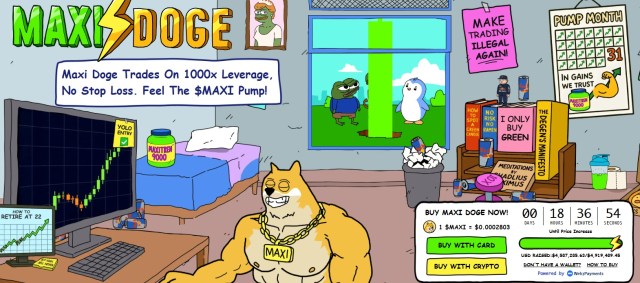
Early adopters call it the ‘Left-Curve’ play. It positions itself not just as a currency, but as the embodiment of the 1000x leverage mentality. That distinction is key. While DOGE wants mass adoption, Maxi Doge targets the high-frequency trader and the ‘gym-bro’ aesthetic dominating crypto Twitter.

The project stands out with a ‘Leverage King’ ecosystem, featuring holder-only trading competitions and a ‘Maxi Fund’ treasury. The numbers seem to back the hype.

According to the presale page, Maxi Doge has raised exactly $4.58M, with tokens currently priced at $0.0002803. This influx suggests retail investors are hunting for volatility and outsized returns, gains that mature assets like $DOGE struggle to deliver these days due to their massive caps.
Smart money is watching this rotation. On-chain data from Etherscan reveals that 2 whale wallets scooped up $628K ($314K, $314K) in recent transactions.

That signals high-net-worth players are positioning themselves before the project moves to open markets. View whale activity on Etherscan.

Still, caution is required. As an ERC-20 token focused on high-octane culture, Maxi Doge carries early-stage volatility risks. The ‘never skip leg-day’ branding and competitive staking APY are attractive, sure, but this remains a high-risk allocation. It’s for those looking to diversify into speculative narratives, not safe havens.

Watch the liquidity rotation, Maxi Doge ($MAXI) presale is live here. It represents the aggressive edge of the current meme market.

Buy your $MAXI here.

The information provided in this article is for educational purposes only and does not constitute financial advice. Crypto assets, including Dogecoin and presale tokens like Maxi Doge, are highly volatile and unregulated. Always conduct your own independent research and consult a professional advisor before making investment decisions.

Editorial Process for bitcoinist is centered on delivering thoroughly researched, accurate, and unbiased content. We uphold strict sourcing standards, and each page undergoes diligent review by our team of top technology experts and seasoned editors. This process ensures the integrity, relevance, and value of our content for our readers.

patrubogdan

Follow

Full Profile

Related Posts

Government Shutdown Fears Trigger 2% Crypto Dip, But Bitcoin Hyper Remains Unshaken

US Debt Spiral Eyes $39T: Why Bitcoin Hyper ($HYPER) Is The Hedge to Watch

Crypto Exchange Backpack Targets Token Launch Soon, as BMIC Fires Up Quantum Defense

Ethereum Foundation Backs SEAL Initiative as LiquidChain L3 Protocol Gains Traction

Vitalik Buterin Outlines Ethereum’s AI Future, While SUBBD Token Targets the Creator Economy

Binance Dominates Trump’s USD1 Supply as Bitcoin Hyper Breaks Records

Preguntas relacionadas

QWhat is the critical support level for Dogecoin mentioned in the article, and why is it important?

AThe critical support level for Dogecoin is $0.09370. It is important because it aligns with historical accumulation zones where retail panic often coincides with institutional buying. Holding this level is crucial for maintaining its bullish structure and targeting a price of $0.20 by 2026.

QWhat are the potential price targets for Dogecoin if the $0.09370 support holds?

AIf the $0.09370 support holds, the immediate resistance target is $0.12, with a medium-term target of $0.20 by early 2026.

QWhat is Maxi Doge ($MAXI), and how does it differentiate itself from Dogecoin?

AMaxi Doge ($MAXI) is a newer, narrative-driven project that targets high-leverage trading culture. It differentiates itself by integrating trading competitions and a 'Maxi Fund' treasury, focusing on high-risk ROI hunters and the aggressive trading mentality, unlike Dogecoin, which aims for broader mass adoption.

QWhat on-chain activity suggests smart money is interested in Maxi Doge?

AOn-chain data from Etherscan reveals that two whale wallets purchased $628K (split as $314K each) in $MAXI tokens, indicating high-net-worth players are positioning themselves before the project moves to open markets.

QWhat is the bear case scenario for Dogecoin if it fails to hold the key support level?

AThe bear case scenario involves a daily candle close below $0.088, which would invalidate the bullish thesis and expose Dogecoin to a retest of its 2023 lows around $0.060.

Lecturas Relacionadas

If the AI Bubble Is Already Bursting, Who Will Truly Survive?

If the AI Bubble is Bursting, Who Will Remain? The debate over an AI bubble is intensifying, with figures like Ray Dalio warning of high levels and Jensen Huang seeing immense, early-stage opportunity. Both views hold truth: a speculative bubble in capital markets likely exists, mirroring the dot-com era, but the underlying technological shift is real and transformative. History shows that while bubbles burst—wiping out overvalued companies and speculative capital—they often leave behind critical physical and digital infrastructure. The dot-com bust, for instance, eliminated many firms but left the global fiber optic networks and data centers that enabled the rise of Amazon, Netflix, and cloud computing. Today's massive AI infrastructure investments (projected at trillions by 2030) in data centers, power, cooling, and GPUs may follow a similar path, creating the foundation for future applications. A key divergence from past bubbles is the "Jevons Paradox" effect in AI. As the cost of AI inference has plummeted by over 99.7% since 2023, enterprise spending on AI has skyrocketed. Cheap "tokens" have unlocked vast, previously uneconomical use cases, moving AI from simple chatbots into core business workflows—code generation, legal document review, scientific simulation, and financial analysis. The market is now in a phase of self-correction, weeding out superficial "API-wrapper" startups, but this cleansing process strengthens the ecosystem. The long-term trajectory is clear. The value is gradually shifting from capital expenditure (CapEx) on hardware to operational expenditure (OpEx) on transformative applications. As AI becomes a utility, the winners will be firms that deeply integrate it to solve vertical industry problems in law, healthcare, finance, and manufacturing. The泡沫 will recede, but the foundational shift towards an AI-powered era across all sectors is irreversible. The underlying productive force of AI contains no bubble.

marsbitHace 33 min(s)

If the AI Bubble Is Already Bursting, Who Will Truly Survive?

marsbitHace 33 min(s)

If the AI Bubble Is Already Bursting, Who Will Truly Remain?

**Summary: If the AI Bubble is Bursting, What Will Remain?** The debate around an AI bubble is intensifying, with figures like Ray Dalio warning of high valuations while Jensen Huang sees immense opportunity. This echoes the dot-com bubble, which saw massive wealth destruction but ultimately left behind critical infrastructure like undersea cables and broadband, enabling future giants like Amazon and Netflix. Similarly, today's AI boom involves trillions invested in data centers, power, cooling, and GPUs, while application-layer revenue remains comparatively modest. This investment-disparity signals a bubble. However, the core technological progress is real and accelerating. AI inference costs have plummeted by over 99.7% since 2023, making intelligence increasingly cheap and accessible. This cost collapse is unlocking vast new demand. Instead of reducing spending, enterprises are tripling their AI cloud expenditure. Cheap "tokens" enable AI to move beyond simple chatbots into complex workflows—automating code writing, legal document review, financial analysis, and scientific research. This follows "Jevons's paradox": improved efficiency leads to greater total consumption. The market is now undergoing a necessary purification, weeding out "API-wrapper" startups with no real moat. The deeper evolution involves a shift from capital expenditure (CapEx) on infrastructure to operational expenditure (OpEx) on value-creation in applications. While hardware vendors currently profit most, long-term value will migrate to AI-native firms solving vertical industry problems. Ultimately, a market correction will cleanse speculative excess but will not reverse the AI+ trend. The massive physical and algorithmic infrastructure being built will endure, becoming a cheap, utility-like foundation. Just as the internet became indispensable to all industries post-2000, AI is poised to empower and redefine every sector, moving society irreversibly toward an intelligence-augmented era. The bubble may burst, but the underlying productive momentum is solid.

链捕手Hace 40 min(s)

If the AI Bubble Is Already Bursting, Who Will Truly Remain?

链捕手Hace 40 min(s)

Microsoft CEO: In the AI Era, How Do You Define a Company's Moat?

Microsoft CEO Satya Nadella argues that in the AI era, a company's true competitive edge, or "moat," is not determined by choosing the single most powerful model, but by its ability to build a continuous "learning loop." This system integrates and evolves by connecting human workflows, domain expertise, organizational judgment, and employee experience. He posits that future companies will accumulate two types of capital: Human Capital (employee knowledge, judgment, creativity) and "Token Capital" (a firm's own built and owned AI capabilities). Importantly, AI amplifies rather than devalues human capital. Human direction is essential to guide progress, as computational power alone is aimless. The core opportunity lies in creating a closed-loop system where human and token capital reinforce each other in a compound, self-improving cycle. A company must be able to preserve its unique institutional knowledge—its "company veteran" expertise—even if it switches underlying general-purpose AI models. This requires private evaluation benchmarks, reinforcement learning environments based on internal data, and queryable knowledge bases. Nadella warns against a future where economic value is concentrated by a few dominant models that commoditize entire industries' knowledge. Instead, the priority should be building a broad "frontier ecosystem" where every company, industry, and nation can own its learning loop. This allows organizations to retain control of their intellectual property, amplify employee capabilities, and ensure the economic value created by AI is captured within their own businesses and communities. True corporate sovereignty in the AI age comes from turning organizational knowledge into a compounding system that creates enduring, defensible value.

marsbitHace 1 hora(s)

Microsoft CEO: In the AI Era, How Do You Define a Company's Moat?

marsbitHace 1 hora(s)

ETFs Are Just the Ticket: The True Institutionalization of Bitcoin Is Happening Where You Can't See It

Beyond the Bitcoin ETF spotlight, a deeper institutionalization is underway, leveraging Bitcoin as a foundational financial primitive. Institutions are using Bitcoin for purposes long reserved for assets like U.S. Treasuries and gold: as collateral for loans, insurance reserves, and the backbone of rated bonds. Examples include a Barbados-based insurer capitalizing with $40M in Bitcoin reserves and Ledn's $188M securitization of Bitcoin-backed loans, which received the first-ever investment-grade rating (BBB-) from S&P for a digital asset-backed security. This structure was stress-tested during a 27% price drop in early 2026, triggering automatic liquidations that functioned as designed but revealed the systemic risk of synchronized selling across leveraged positions. Infrastructure is evolving to support this, with platforms like Anchorage Digital's Atlas network enabling secure, institutional-grade settlement and collateral management. Strategies like basis trades and corporate treasuries (exemplified by companies like MicroStrategy issuing billions in equity and debt to fund Bitcoin acquisitions) further integrate Bitcoin into financial mechanics. While ETFs solved "how to own" Bitcoin, these developments answer "what to do with it," embedding the asset into the working machinery of finance—as collateral upon which loans, derivatives, and structured products are built. The real, enduring institutional shift is happening in these largely invisible plumbing and financing systems.

marsbitHace 1 hora(s)

ETFs Are Just the Ticket: The True Institutionalization of Bitcoin Is Happening Where You Can't See It

marsbitHace 1 hora(s)

ZEC Co-Founder Responds to Orchard Vulnerability: No Signs of Theft, Orchard Pool to Be Sealed

ZEC Co-Founder Addresses Orchard Vulnerability: No Signs of Theft, Plans to Sunset Orchard Pool A security vulnerability was recently discovered in Zcash's Orchard shielded pool, raising key concerns. The primary questions are whether the flaw was exploited, if user funds are safe, whether users can verify the total ZEC supply, and if other similar vulnerabilities exist. Analysis suggests the vulnerability was likely not exploited prior to its discovery. It was found proactively by a researcher using specialized tools, not due to an active breach. The development team and mining pools acted quickly to contain the issue. Typical financially-motivated attacks would likely have left visible on-chain evidence, which has not been observed. User funds in Orchard are considered safe and should be recoverable, assuming no prior exploitation. If the flaw was never used, all legitimate funds can be withdrawn. The article outlines risks associated with moving funds to transparent addresses or other pools, but concludes that leaving assets in place is a reasonable option. Currently, users cannot independently verify that the total ZEC supply hasn't been inflated due to this bug. However, the planned Ironwood network upgrade is designed to resolve this. It will permanently close the Orchard pool to new deposits and internal transfers, allowing only withdrawals. This mechanism will cap total withdrawals at the amount of legitimately deposited funds, enabling anyone to cryptographically verify the supply post-upgrade. Multiple teams, including Shielded Labs, have conducted extensive audits focused on counterfeiting vulnerabilities, assisted by advanced AI tools. No additional flaws of this type have been found so far, increasing confidence that no other similar undisclosed vulnerabilities exist. In summary, evidence indicates the Orchard bug was probably not used, user funds are secure, and no other counterfeiting flaws are currently known. The upcoming Ironwood upgrade will restore users' ability to independently verify the total ZEC supply, closing this chapter.

Foresight NewsHace 1 hora(s)

ZEC Co-Founder Responds to Orchard Vulnerability: No Signs of Theft, Orchard Pool to Be Sealed

Foresight NewsHace 1 hora(s)

Trading

Spot
Futuros
活动图片





