Distinguishing Types of Drawdowns Is More Important Than Blindly Buying the Dip

marsbitPublicado a 2026-02-15Actualizado a 2026-02-15

Resumen

Distinguishing between types of drawdowns is more important than blindly buying the dip. Academic finance categorizes risk into systemic (market-wide, unavoidable) and idiosyncratic (company-specific). Similarly, drawdowns can be market-driven (systemic, like the 2008 crisis) or company-specific (idiosyncratic, like the recent AI-driven selloff in software stocks). Using FactSet (FDS) as an example, the article illustrates that a systemic drawdown, such as in 2008/09, was a test of the market's durability, not FactSet's economic moat. In these cases, investors can leverage a behavioral advantage—patience and a long-term view—as history shows markets tend to recover. Conversely, the current 2025/26 drawdown in software stocks is largely idiosyncratic, driven by specific fears that AI could disrupt industry pricing power and erode moats. To capitalize on such a drawdown, an investor needs an analytical advantage: a more accurate vision of the company's future a decade from now than the market's pessimistic price implies. This requires understanding why informed sellers are wrong, a fine line between conviction and arrogance. The key takeaway is not to apply a blunt behavioral solution (like simply buying the dip) to a problem that requires nuanced, fundamental analysis.

Original Author: Todd Wenning

Original Compilation: Deep Tide TechFlow

Guide: Academic finance theory categorizes risk into systematic risk and idiosyncratic risk. Similarly, stock drawdowns can also be divided into two types: market-driven systematic drawdowns (such as the 2008 financial crisis) and company-specific idiosyncratic drawdowns (such as the current software stock crash driven by AI concerns).

Using FactSet as an example, Todd Wenning points out: during a systematic drawdown, you can leverage a behavioral advantage (patiently waiting for the market to recover); but during an idiosyncratic drawdown, you need an analytical advantage—having a more accurate vision of what the company will look like in ten years than the market does.

Amid the current AI impact on software stocks, investors must distinguish: is this a temporary market panic, or is the moat truly crumbling?

class="ql-align-justify">Do not use a blunt behavioral solution to solve a problem that requires nuanced analysis.

Full Text Below:

Academic finance theory posits two types of risk: systematic and idiosyncratic.

  • Systematic risk is unavoidable market risk. It cannot be eliminated through diversification, and it is the only type of risk for which you are compensated.
  • On the other hand, idiosyncratic risk is company-specific risk. Because you can cheaply purchase a diversified portfolio of uncorrelated businesses, you are not compensated for taking on this risk.

We can debate Modern Portfolio Theory another day, but the systematic-idiosyncratic framework is helpful for understanding different types of drawdowns (the percentage decline from peak to trough of an investment) and how we, as investors, should evaluate opportunities.

From the moment we picked up our first value investing book, we were taught to take advantage of a despondent Mr. Market when stocks are sold off. If we remain calm while he loses his senses, we will prove ourselves to be stoic value investors.

But not all drawdowns are the same. Some are market-driven (systematic), while others are company-specific (idiosyncratic). Before you make a move, you need to know which type you're looking at.
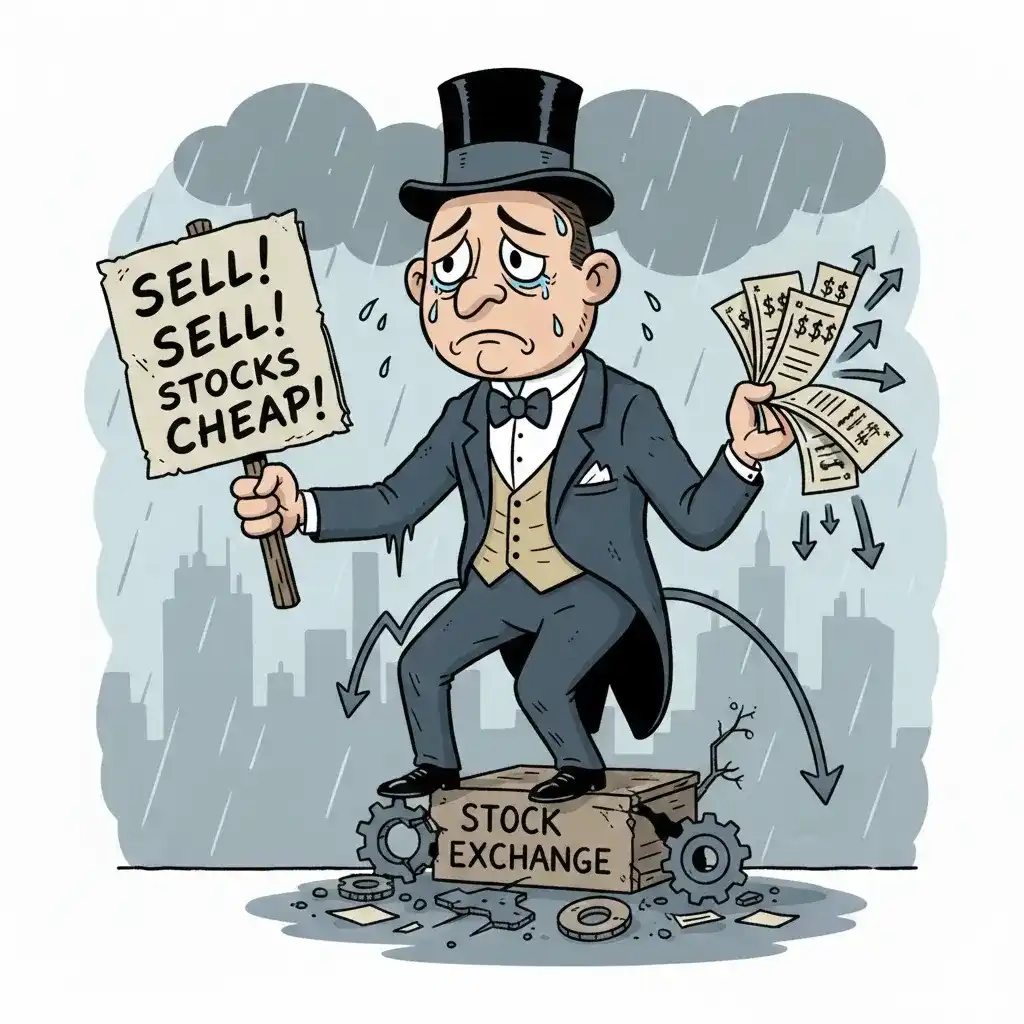
Generated by Gemini

The recent sell-off in software stocks due to AI concerns illustrates this point. Let's look at the 20-year history of drawdowns between FactSet (FDS, blue) and the S&P 500 (measured via the SPY ETF, orange).
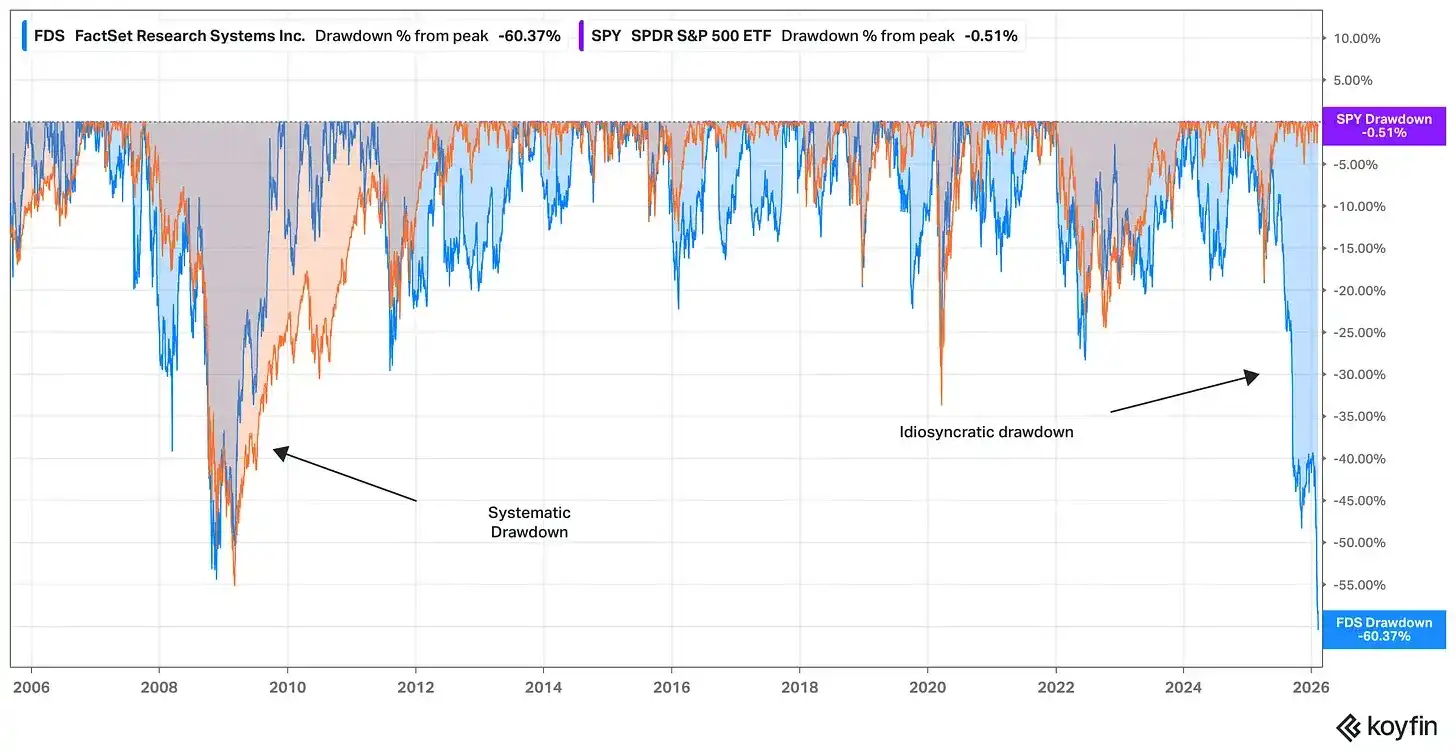
Source: Koyfin, as of February 12, 2026

FactSet's drawdown during the financial crisis was primarily systematic. In 2008/09, the entire market was worried about the durability of the financial system, and FactSet could not be immune to these concerns, especially since it sells products to financial professionals.

At that time, the stock's drawdown had less to do with FactSet's economic moat and more about whether FactSet's moat would matter if the financial system collapsed.

The 2025/26 FactSet drawdown is the opposite case. Here, the concerns are almost entirely focused on FactSet's moat and growth runway, alongside broader fears about accelerating AI capabilities disrupting pricing power in the software industry.

In a systematic drawdown, you can more reasonably make a time arbitrage bet. History shows that markets tend to rebound, and companies with intact moats may emerge even stronger than before, so if you are willing and able to remain patient while others panic, you can leverage a strong stomach to exploit a behavioral advantage.

Photo by Walker Fenton on Unsplash

However, in an idiosyncratic drawdown, the market is telling you that something is wrong with the business itself. Specifically, it suggests increasing uncertainty about the business's terminal value.

Therefore, if you hope to take advantage of an idiosyncratic drawdown, you need to possess an analytical advantage in addition to a behavioral one.

To succeed, you need to have a more accurate vision of what the company will look like in ten years than the current market price implies.

Even if you know a company well, this is not easy to do. Stocks don't typically fall 50% relative to the market for no reason. A lot of once-steadfast holders—even investors you might respect for their deep research—had to capitulate for this to happen.

If you are going to step in as a buyer during an idiosyncratic drawdown, you need to have an answer for why these otherwise informed and thoughtful investors were wrong to sell and why your vision is correct.

There's a fine line between conviction and arrogance.

Whether you are holding a stock in a drawdown or looking to initiate a new position in one, it's important that you understand what type of bet you are making.

Idiosyncratic drawdowns can tempt value investors to start looking for opportunities. Before you take the plunge, make sure you aren't using a blunt behavioral solution to solve a problem that requires nuanced analysis.

Stay patient, stay focused.

Todd

Preguntas relacionadas

QAccording to the article, what are the two main types of risk in academic financial theory?

ASystematic risk and idiosyncratic risk.

QWhat is the key difference in the type of advantage an investor needs to exploit a systematic drawdown versus an idiosyncratic one?

AAn investor can exploit a systematic drawdown with a behavioral advantage (patience), but to exploit an idiosyncratic drawdown, they need an analytical advantage (a more accurate vision of the company's future).

QUsing the example from the article, what was the primary cause of FactSet's drawdown during the 2008/09 financial crisis?

AFactSet's drawdown during the 2008/09 crisis was primarily systematic, driven by market-wide fears about the durability of the financial system.

QWhat does the article suggest is the market implying about a business during an idiosyncratic drawdown?

ADuring an idiosyncratic drawdown, the market is implying that there is a problem with the business itself and that its terminal value is becoming increasingly uncertain.

QWhat is the 'fine line' the article warns investors about when considering a purchase during an idiosyncratic drawdown?

AThe fine line is between conviction and arrogance. An investor must be able to explain why the sellers were wrong and their own vision is correct, without being overconfident.

Lecturas Relacionadas

Korean Youth, Making a 'Last Stand' in an Epic Bull Market

South Korea is experiencing an unprecedented stock market boom in the first half of 2026, with the KOSPI index doubling in six months, driven primarily by tech giants Samsung Electronics and SK Hynix. This "epic bull run," tied to the semiconductor cycle, has sparked a nationwide frenzy for stock trading. The country, with a population of just over 50 million, now has over 105 million securities accounts. The article, from the perspective of a Chinese national living in Seoul, explores how this speculative fever reflects deeper societal anxieties among Korean youth. Facing stagnant wages, high costs of living, housing pressures, and rigid social stratification, many young people see the volatile market as a "last chance" to alter their predetermined life trajectories and escape financial precarity. Stories include a young office worker investing her meager savings, a couple delaying marriage due to financial pressures, and a seasoned trader navigating exclusive social circles where market information is currency. However, the boom also exposes and exacerbates existing inequalities. While some achieve windfalls, others face devastating losses, with borrowing to invest reaching record highs. The narrative contrasts the illusion of equal opportunity with the harsh reality that the ability to absorb risk is unevenly distributed. Ultimately, the market frenzy is portrayed not as a solution, but as a symptom of a generation's struggle against a system offering limited upward mobility, where daily life is a precarious balance of bills, debts, and societal expectations.

marsbitHace 5 min(s)

Korean Youth, Making a 'Last Stand' in an Epic Bull Market

marsbitHace 5 min(s)

Young South Koreans, Making a 'Last-Ditch Effort' in an Epic Bull Market

This article explores how an unprecedented stock market boom in South Korea during the first half of 2026, driven by the semiconductor industry, is transforming the lives of ordinary people, particularly the youth. The KOSPI index doubled in six months, fueled by giants Samsung and SK Hynix, leading to a frenzy of retail investing. With over 105 million stock accounts in a population of just over 50 million, a sense of "FOMO" (fear of missing out) is pervasive. Through the perspective of Li Yuning, a Chinese woman living in Seoul, the piece follows several young Koreans who see the market as a last chance to escape stifling economic pressures, high housing costs, and narrow social mobility. Individuals like Minji, a low-paid office worker, and Junho, saving for marriage, invest their limited savings, while experienced traders like Suhu navigate exclusive social circles. The narrative reveals that this speculative fever stems less from greed and more from deep-seated anxiety about being left behind in a society with growing wealth inequality and rigid class structures. However, the boom also exposes stark social divides. It exacerbates wealth gaps, as those with family support or existing capital fare better. The pressure to succeed is immense, with stories of devastating losses leading to personal tragedy. Ultimately, the article suggests the牛市 acts as a pressure valve and a temporary illusion of opportunity in a system where traditional paths to advancement seem increasingly closed, leaving young people to gamble on the market as a final, desperate bid for a better future.

链捕手Hace 12 min(s)

Young South Koreans, Making a 'Last-Ditch Effort' in an Epic Bull Market

链捕手Hace 12 min(s)

Doubao Charges More than GPT, While DeepSeek Slashes Prices Dramatically: Who Will Win?

The article discusses the divergent pricing strategies of two major Chinese AI companies. In May, Doubao (by ByteDance) began testing fees, with its professional tier priced higher than ChatGPT Plus. Meanwhile, DeepSeek permanently cut prices for its V4-Pro API to a quarter of the original, setting new global lows. Doubao, with high user traffic from ByteDance apps like TikTok, leads in monthly active users but faces massive compute costs from its free model. Its move to a freemium model targets heavy users, aiming to balance scale and monetization amid substantial investments. DeepSeek's price cut is attributed to architectural innovations that slash inference costs, adaptation to domestic hardware reducing dependency, and engineering optimizations. It focuses on the enterprise (B2B) market, aiming to become a leading model base. Both companies are currently unprofitable. The article contrasts their approaches with Anthropic, which is profitable by primarily serving enterprises with high-value use cases like coding and agents. It argues that sustainable AI business models require integrating AI into real workflows to deliver tangible ROI, rather than just offering chat services. DeepSeek's recent $7 billion funding round, including investments from Tencent, is noted to bolster its B2B position. The ultimate winner will be the player that successfully transforms AI into measurable returns, whether through consumer productivity ecosystems or enterprise platforms.

marsbitHace 21 min(s)

Doubao Charges More than GPT, While DeepSeek Slashes Prices Dramatically: Who Will Win?

marsbitHace 21 min(s)

Promised Year of Crypto IPOs? Only One Went Public in Six Months, Down 70%

The much-anticipated wave of crypto IPOs in 2026 has failed to materialize, with market conditions worsening dramatically. While SpaceX prepares for the largest IPO in history, raising $75 billion at a $1.75 trillion valuation, the crypto sector faces a frozen pipeline. The sole crypto IPO success this year, BitGo, serves as a cautionary tale. After launching on the NYSE in January at $18, its stock has plummeted approximately 70%. Other major contenders have stalled or delayed. Kraken, which secretly filed in late 2025, has put its plans on ice, seeing its valuation drop 33% to $13.3 billion. Consensys has postponed its filing until autumn at the earliest, and Bitpanda is poised to miss its self-imposed H1 deadline for a Frankfurt listing. This widespread retreat is driven by a severe liquidity crunch. Bitcoin has fallen below $60,000, with capital being diverted to AI stocks and the massive SpaceX offering. The poor performance of earlier crypto listings like Gemini and the stagnant price of Coinbase further dampen investor appetite. A key underlying pressure is the impending US midterm elections in November, which could alter the currently favorable regulatory landscape. Companies had hoped to go public during this window of policy certainty, but challenging market dynamics have overridden those plans. The transparency that comes with being a public company is now seen as a potential liability rather than a benefit in a down market. The industry's fate now hinges on a few critical watchpoints: whether Kraken restarts its process in H2, if Consensys files in the fall, and if SpaceX's debut can revitalize market liquidity. Otherwise, the promised "crypto IPO year" will likely be pushed beyond the election.

marsbitHace 35 min(s)

Promised Year of Crypto IPOs? Only One Went Public in Six Months, Down 70%

marsbitHace 35 min(s)

Trading

Spot
Futuros
活动图片





