Dalio's Latest Interview: 3 Major Signs of an AI Bubble Bursting, and How to Respond?

marsbitPublicado a 2026-08-03Actualizado a 2026-08-03

Resumen

In a recent interview, Ray Dalio discusses the current AI investment bubble, drawing parallels to past speculative frenzies like the dot-com bubble. He explains that such bubbles form when revolutionary technology, like AI, sparks massive investor excitement and debt-fueled investment, driving prices beyond fundamentals. Dalio outlines three key signs of an impending bubble burst: 1) Rising interest rates forcing asset sales, 2) A significant increase in stock supply from companies issuing shares, and 3) Ownership shifting from strong hands to inexperienced, often leveraged, retail investors. To navigate this uncertainty, he advocates for a diversified portfolio across assets like stocks, bonds, real estate, and notably gold (5-15% allocation), which he views as a true "hard asset." He expresses skepticism towards Bitcoin as "digital gold," citing potential technological and governmental risks. Regarding AI's impact, Dalio believes the primary beneficiaries will be the capitalists who own the automating technology, potentially widening wealth inequality as AI replaces both physical and cognitive labor. However, he contends that humans with exceptional interpersonal skills, emotional intelligence, and collaboration abilities will remain highly valuable. Finally, on his theory of ~80-year major cycles in world order, Dalio notes that while timing isn't precise, current indicators suggest we are in the vicinity of a significant transitional period. His core investment advice...

Original from the podcast The Diary Of A CEO

Compiled / Odaily Planet Daily Golem (@web 3_golem)
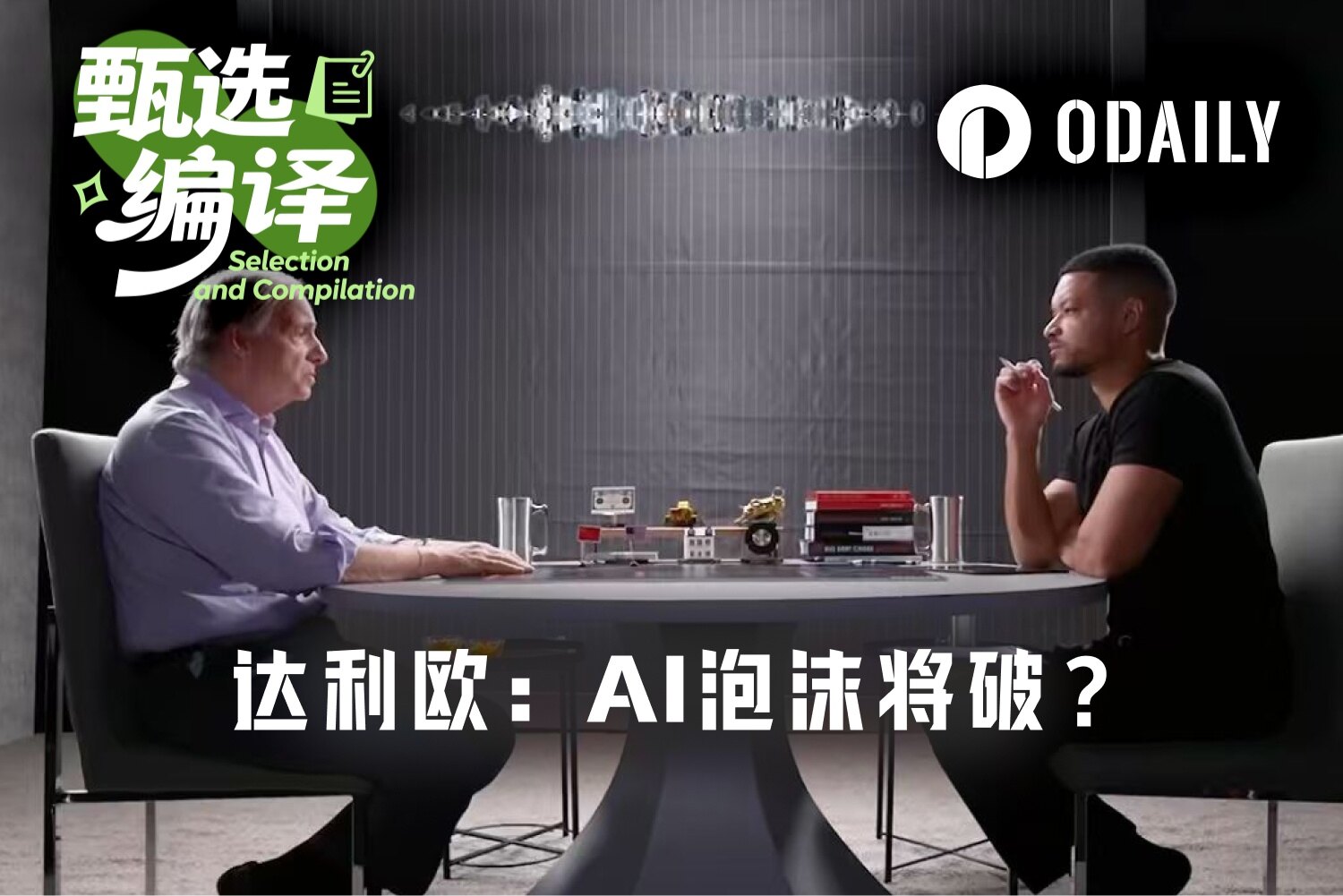
Editor's Note: Ray Dalio, founder of Bridgewater Associates, recently gave an in-depth interview to the renowned business podcast The Diary Of A CEO, sharing his views on the AI bubble, the 80-year major cycle shift, and Bitcoin. In the interview, Dalio explained why we are in an AI bubble, outlined the three major signs that the bubble is about to burst, and expressed his belief that while capitalists will be the biggest beneficiaries of the AI transformation, people with exceptional human intelligence and the ability to collaborate with others will still excel in the future. Odaily Planet Daily has compiled the core content of Dalio's interview below. Enjoy~

Learning from History: How Did the AI Bubble Form?

The commonly referred to bubble is when prices rise sharply, company performances are excellent, then the bubble bursts, which impacts the economy and markets, followed by a great depression, such as the 1929 bubble or the 2000 dot-com bubble.

This happens because when a revolutionary new technology emerges, everyone bets it will surely succeed, rushes to invest, even borrows money to invest, but they overlook the importance of price. Ultimately, prices soar, creating a bubble.

Now we are equally excited about AI, and we should be, as it will bring revolutionary changes, which it indeed has. So, again, everyone wants to invest, but they still ignore the price. This is a certain mechanism hidden within different cycles.

In an economic bubble, people borrow heavily to invest. You see many people becoming wealthy, but wealth is not equivalent to real money because they cannot spend this wealth. When they must sell their wealth to get money, it depreciates. So, when they need cash for reasons like tax changes, rising interest rates, or debt repayment, the bubble starts to burst, and the market declines.

When the bubble bursts, the wealth accumulation process reverses. When they made a lot of money, they had highly valued collateral for loans; this compounding effect continues. But when the bubble bursts, this process also reverses.

Economic recessions typically also follow a bubble burst because when people start repaying debts and selling assets, consumption demand decreases, and spending naturally drops.

For example, during the Great Depression in the US, the late 1920s were a time of great prosperity. Households were electrified for the first time, refrigerators and lighting entered homes, cars, airplanes, and radios became popular. Everyone believed these technologies had a great future. But simultaneously, as people kept buying assets, stock prices kept rising, and people leveraged themselves to buy stocks, corporate profits ultimately couldn't support the corresponding stock prices, triggering a chain reaction that eventually led to the Great Depression.

My point is, in these massive trend shifts, people know very little. Anyone in the AI field cannot plan accurately. They simply don't know what future revenues will be. Ultimately, only two outcomes occur: either underinvestment, falling far behind competitors; or heavy investment, still lacking precise control. When this happens, problems arise.

The 3 Major Signs of a Bubble Bursting

In the initial stage, what punctures the bubble is often situations that force people to sell assets to raise cash, and this is generally rising interest rates. It could also be policies like wealth taxes, but broadly speaking, it's a tightening of monetary conditions. Because at this stage, there is often inflationary pressure, and central banks decide to tighten monetary policy. Thus, when interest rates rise, the returns investors can get from holding bonds can exceed the returns from equity investments.

Additionally, there is a significant increase in stock issuance. We have been discussing how demand pushes up stock prices and how wealth is created, but the market also has a supply side. Companies can issue stock; there is almost nothing easier for creating wealth than issuing stock. Nowadays, people can even announce they are starting a company and taking it public, then say to their audience they will issue shares. It is precisely this large supply of stock, along with increased fundraising needs from other companies, that will ultimately cause the bubble to burst.

Another classic way to gauge the extent of a bubble is to examine the ownership of these companies' shares, to see if the shares are held by steadfast investors or by fickle retail investors. But I must also emphasize that a bubble is not a black-and-white existence; it's a matter of degree.

Classic characteristics of fickle holdings are a massive influx of retail investors lacking expertise, especially through leverage. They either borrow money to buy stocks or purchase leveraged financial products. For example, there are now leveraged ETFs tracking the stock market. Investors participating in such products are essentially no different from rolling dice in gambling.

All of the above are major signs that a bubble will burst. When it bursts, panic sets in, leading to massive asset liquidation. Conversely, at that point, all assets become cheap, and everyone can afford them.

But in investing, people always like to get ahead, buying the bottom too early, and this behavior often further fuels bubbles. So I would like to add that the future is uncertain. Investors should not try to 'time the market.' Even experienced investors find it extremely difficult to precisely time a bubble burst. Therefore, the best investment approach in the face of a bubble is diversification.

Responding to a Bubble Burst Through Diversification

Ordinary people often think cash deposits are the safest asset, but in the long run, it's the worst investment because inflation erodes its value.

Besides the stock market, investors have many assets to choose from, such as gold, bonds, real estate, and Bitcoin. Their respective values fluctuate for various reasons. Typically, when gold rises, bonds often fall, and real estate depreciates; these changes follow certain patterns.

Therefore, the best practice is to build a diversified investment portfolio. This not only doesn't reduce returns but actually lowers risk. Diversification means holding a certain proportion of each asset type. Due to different volatilities, investors must know how to balance them. My suggestion is to start by investing in a real asset: gold.

Gold is very interesting because when all assets perform poorly, gold often performs well. It is a very effective diversification tool. Gold cannot be hacked by technology; you can hold it, own it. It is the only financial asset that is not someone else's liability.

So for most people, if they want to ensure they have some 'hard currency,' gold should make up 5% to 15% of their investment portfolio.

Views on Bitcoin

Some investors view Bitcoin as 'digital gold,' but I prefer investing in real gold bars, not Bitcoin.

Bitcoin is just a gold-like asset; it's also a form of currency that cannot be printed. But some technologies could harm it. For example, if quantum computing emerges and governments can monitor it, it could be taxed. Any digital currency is somewhat similar.

Moreover, when a government says 'I don't need Bitcoin,' they have the authority to deal with it as they wish. Also, central banks won't hold large amounts of such assets because central banks need to ensure the privacy of their transactions and keep them firmly under their control. Look at Russia's situation; their other assets were seized/frozen, but their gold, no one could touch.

Who Benefits Most from the AI Transformation?

In this AI transformation, only a very small number of people (less than one percent of the population) master cutting-edge technologies and can apply and accelerate their development. As for others, if your job involves thinking, you are at risk of being replaced.

We are entering a world where everything can be automated. Human evolution began in the agricultural age, where there was almost no real innovation. Later, humans invented machines that replaced human physical labor. People used to work in fields like cattle; later, they were replaced by tractors. Then we entered the industrial age. First, the invention of printing allowed people to learn knowledge, then various inventions emerged, the first industrial revolution arrived, where machines began replacing human physical labor in factories, etc.

So in my view, it's as if machines first replaced human physical functions, then replaced higher and higher levels, and then began replacing parts of human thinking that can be computerized. And this trend continues to develop, gradually replacing higher-order thinking and reasoning abilities. This development trajectory is part of the ongoing evolutionary process.

The ultimate beneficiaries are capitalists who own the ideas that replace workers. For example, when people shop in stores, merchants earn revenue. But if you look at the share allocated to workers, you'll find this share is declining, while the share allocated to merchants is rising. So we are going through a stage where, on one hand, the top tier creates astonishing wealth; on the other hand, the bottom tier faces enormous pressure.

This is the challenge we face. Although the economic situation is relatively good, the difficulty for college graduates finding jobs has increased significantly. For instance, new graduates need training when starting jobs, and now many jobs can be quickly performed by AI and computerization. As robotics advances, this will intensify. The disruptive change we see now is happening so fast precisely because massive funds are pouring into frontier AI models like Anthropic and OpenAI.

Simultaneously, the wealth gap is widening because capitalism, although I love capitalism, the reality is, it creates huge disparities in income and wealth. When a worker's mind and body are both replaced, as a human, what can they sell?

But don't be too pessimistic. What humans still possess are emotions and intuition. Some services AI cannot provide. So, if we explore what these 'services' are, for example, can robots provide a good massage SPA? What remains, people can explore further. In summary, I believe that in the foreseeable future, those with exceptional human intelligence and the ability to collaborate with others will still perform excellently.

Regarding the 80-Year Major Cycle

I previously said that world order shifts occur about every 80 years, but this number is not absolute. The cycle length has an average floating range. It's like human lifespan; each person's life expectancy or lifespan varies individually.

I wouldn't overemphasize the length of time; I would focus more on the current situation. In terms of symptoms or relevant indicators, where are we currently in this process? Where will the next important node appear?

The answer is somewhere near the current time zone we are in.

Criptos en tendencia

Preguntas relacionadas

QWhat are the three major signs that indicate an AI bubble is about to burst, according to Ray Dalio?

AAccording to Ray Dalio, the three major signs are: 1) Rising interest rates, which force people to sell assets to raise cash. 2) A significant increase in stock issuance, where companies create wealth by issuing shares, increasing supply. 3) A high concentration of holdings in the hands of unsteady, non-professional retail investors, especially those using leverage.

QHow does Ray Dalio suggest ordinary investors should respond to the potential bursting of an AI bubble?

ARay Dalio suggests that the best investment strategy for ordinary investors is diversification. He advises against trying to time the market and recommends building a diversified portfolio including assets like stocks, gold, bonds, real estate, and Bitcoin. He specifically highlights gold as a crucial 'hard asset' that performs well when other assets falter, suggesting it should make up 5% to 15% of a portfolio.

QWhy does Ray Dalio prefer investing in physical gold over Bitcoin?

ARay Dalio prefers physical gold over Bitcoin because gold is a tangible asset that cannot be hacked or compromised by technology like quantum computing. It is also not a liability of anyone else. He notes that governments can choose to reject or regulate digital currencies like Bitcoin and that central banks value the privacy and control they have over their own transactions, which Bitcoin does not provide. He uses the example of Russia, whose gold reserves remained untouched while other assets were frozen.

QWho does Ray Dalio believe will be the biggest beneficiaries of the AI revolution?

ARay Dalio believes that the biggest beneficiaries of the AI revolution will be the capitalists—the less than 1% of the population who own and control the capital and the cutting-edge AI technology. He explains that as machines and AI replace both physical and cognitive human labor, the share of wealth going to capital owners increases, while the share for workers declines, thereby widening the wealth gap.

QWhat unique human qualities does Ray Dalio think will allow people to remain valuable in an AI-dominated future?

ARay Dalio believes that human emotional intelligence, intuition, and the ability to collaborate effectively with others are qualities that AI cannot replicate. He suggests that services requiring these distinctly human traits, such as certain personal care or relational services, will remain valuable. Therefore, individuals with exceptional human intelligence and strong collaborative skills will continue to excel in the foreseeable future.

Lecturas Relacionadas

In-depth: The Foreign Guest Genspark

The article "The Foreign Guest: Genspark" investigates the identity and business practices of AI startup Genspark, which presents itself as a Palo Alto-based "AI Costco" offering a subscription bundle of over 70 models and numerous AI agent tools. Despite its official Silicon Valley narrative, Genspark's founding team has deep roots in Chinese tech giant Baidu, a history systematically downplayed in its branding. The company actively cultivates an image as an elite US firm, heavily publicizing partnerships and endorsements from OpenAI, Anthropic, and Microsoft, while distancing itself from the Chinese AI community and obscuring its connections to Chinese investors and open-weight models (like those from DeepSeek, Moonshot AI, and MiniMax) that power its services. Genspark's core strategy involves rapidly cloning and integrating successful AI product concepts (e.g., from Perplexity, Manus, Plaud) into its unified platform, supported by aggressive marketing, including Super Bowl ads and paid native content in publications like The Wall Street Journal. Critically, the article suggests a significant portion of its engineering and product development is conducted by a team in Beijing, operating outside its official US corporate structure. This duality allows Genspark to leverage Chinese talent and models for efficiency and cost reduction while constructing a public facade as a purely American success story. The piece concludes that Genspark's most effective agent is its own corporate identity, meticulously engineered to obscure its Chinese underpinnings and be perceived solely as a Silicon Valley company.

marsbitHace 9 min(s)

In-depth: The Foreign Guest Genspark

marsbitHace 9 min(s)

Debate: Korean Workers Fear Unemployment, While Musk Envisions a Society 'Without Work'?

While South Korean auto workers fear job losses from robotics, Elon Musk envisions a future where AI and robots render most work optional. This article explores the growing tension between immediate anxieties over automation and long-term visions of a post-work society. The piece begins with recent strikes at Hyundai's Korean plants, where unions, amid standard wage negotiations, also sought job guarantees against advancing robotics—specifically mentioning Boston Dynamics' Atlas. This reflects how anxiety about technological displacement is emerging even before robots are fully capable of replacing skilled labor on assembly lines. The author argues that while current robotics still struggle with the nuanced, experiential knowledge of veteran workers, the *perception* of imminent replacement is fueling social conflict prematurely. This modern "Luddite" sentiment is compared to the 19th-century English textile workers who smashed machines. Historically, Luddites weren't simply anti-technology; they were protesting the rapid devaluation of their skills and the unequal distribution of productivity gains. Similarly, today's workers ask who will bear the cost of transition and share in the new wealth created by machines. In contrast, figures like Elon Musk propose an optimistic endpoint: with AI and robotics driving extreme abundance, the link between work and survival could break. He suggests concepts like "Universal High Income" could allow society to share the technological bounty, transforming work from a necessity into a choice. The core challenge, however, lies in the transition. The author notes that technology's benefits diffuse slowly, while its disruptive costs—job losses, skill obsolescence—can be concentrated and immediate. The risk is a painful interim period where productivity gains are captured by a few before new social contracts, safety nets, and retraining systems are established. The conclusion calls for proactive governance. Just as past industrial revolutions gave rise to labor standards and social safety nets, the robotics era needs its own frameworks. These should address job transition support, distribution of productivity gains, safety liability, and ethical deployment. Embracing such "constraints" is not opposition to progress but a necessary step to ensure technology benefits society broadly. The discussion sparked by Hyundai's workers, therefore, is not premature but essential.

marsbitHace 22 min(s)

Debate: Korean Workers Fear Unemployment, While Musk Envisions a Society 'Without Work'?

marsbitHace 22 min(s)

CATL Invests in a 00s Graduate from Harbin Institute of Technology

Contemporary Amperex Technology Co., Limited (CATL) has exclusively invested in the Pre-A round of RoboParty, a company founded by 22-year-old Huang Yi. A former student at Harbin Institute of Technology, Huang built a bipedal humanoid robot in his dorm room and later dropped out to launch RoboParty in Shanghai. The company focuses on developing a fully open-source platform for humanoid robots, combining self-developed hardware, operating systems (Party OS), and foundational models. RoboParty's strategy emphasizes open-source collaboration to accelerate development and build a developer ecosystem, positioning itself as foundational infrastructure for embodied AI. Since its 2025 founding, the team—composed largely of top-tier university graduates—has secured six funding rounds in eight months, with investors including Matrix Partners, Xiaomi, and now CATL. This investment by CATL's corporate venture arm signals strong industry confidence in RoboParty's potential for real-world manufacturing and complex scenarios. Huang Yi prioritizes technological excellence and developer community growth over rapid commercialization. The company has already garnered significant interest from developers and research institutions globally. With a focus on continuous, rapid iteration and open innovation, RoboParty aims to prove the versatility of humanoid robots and drive the field toward an open-source future.

marsbitHace 25 min(s)

CATL Invests in a 00s Graduate from Harbin Institute of Technology

marsbitHace 25 min(s)

Will SpaceX's First Quarterly Report Rescue Its Stock Price Under the Pressure of 1.2 Billion Shares Unlocking?

SpaceX is set to release its first quarterly earnings report since going public, a key test for its stock which has declined 20% from its IPO price. Approximately 9.12 billion shares are set to unlock on August 6, with an additional 3.19 billion following a week later, creating potential selling pressure from early investors. A strong report may be the only catalyst to reverse the downtrend. The report will cover three segments: Space, Connectivity (Starlink), and AI. The AI business, centered on the merged xAI, is the biggest uncertainty. While it generated $818 million in revenue last quarter, it also reported a $2.5 billion operating loss and $7.7 billion in capital expenditures. New data center rental agreements with Anthropic and Google, particularly the substantial $1.25 billion monthly deal with Anthropic, add significant revenue variability this quarter. Investors await guidance on AI's future outlook and the timeline for launching AI computing satellites via Starship. Starlink remains the stable profit driver, ending last quarter with 10.3 million subscribers. Key metrics will be user growth, average revenue per user (ARPU), and enterprise/government contract backlogs. The Space segment, which posted a $657 million operating loss last quarter, will be scrutinized for updates on Starship development following its 13th test flight and the pace of Falcon 9 launches, many of which support internal Starlink deployment. Wall Street expects Q2 revenue of around $6.9 billion and EBITDA of $2.1 billion. However, as this is the first earnings report, analyst forecasts lack a historical baseline and could see significant variance. With a current market cap of ~$1.4 trillion and a high valuation, the market's reaction post-earnings will hinge on the report's strength, the magnitude of post-lockup selling, and ongoing investor concerns.

marsbitHace 26 min(s)

Will SpaceX's First Quarterly Report Rescue Its Stock Price Under the Pressure of 1.2 Billion Shares Unlocking?

marsbitHace 26 min(s)

Trading

Spot

Artículos destacados

Qué es $S$

Entendiendo SPERO: Una Visión General Completa Introducción a SPERO A medida que el panorama de la innovación continúa evolucionando, la aparición de tecnologías web3 y proyectos de criptomonedas juega un papel fundamental en la configuración del futuro digital. Un proyecto que ha atraído la atención en este campo dinámico es SPERO, denotado como SPERO,$$s$. Este artículo tiene como objetivo reunir y presentar información detallada sobre SPERO, para ayudar a entusiastas e inversores a comprender sus fundamentos, objetivos e innovaciones dentro de los dominios web3 y cripto. ¿Qué es SPERO,$$s$? SPERO,$$s$ es un proyecto único dentro del espacio cripto que busca aprovechar los principios de descentralización y tecnología blockchain para crear un ecosistema que promueva la participación, la utilidad y la inclusión financiera. El proyecto está diseñado para facilitar interacciones de igual a igual de nuevas maneras, proporcionando a los usuarios soluciones y servicios financieros innovadores. En su esencia, SPERO,$$s$ tiene como objetivo empoderar a los individuos al proporcionar herramientas y plataformas que mejoren la experiencia del usuario en el espacio de las criptomonedas. Esto incluye habilitar métodos de transacción más flexibles, fomentar iniciativas impulsadas por la comunidad y crear caminos para oportunidades financieras a través de aplicaciones descentralizadas (dApps). La visión subyacente de SPERO,$$s$ gira en torno a la inclusividad, buscando cerrar brechas dentro de las finanzas tradicionales mientras aprovecha los beneficios de la tecnología blockchain. ¿Quién es el Creador de SPERO,$$s$? La identidad del creador de SPERO,$$s$ sigue siendo algo oscura, ya que hay recursos públicos limitados que proporcionan información de fondo detallada sobre su(s) fundador(es). Esta falta de transparencia puede derivarse del compromiso del proyecto con la descentralización, una ética que muchos proyectos web3 comparten, priorizando las contribuciones colectivas sobre el reconocimiento individual. Al centrar las discusiones en torno a la comunidad y sus objetivos colectivos, SPERO,$$s$ encarna la esencia del empoderamiento sin señalar a individuos específicos. Como tal, comprender la ética y la misión de SPERO sigue siendo más importante que identificar a un creador singular. ¿Quiénes son los Inversores de SPERO,$$s$? SPERO,$$s$ cuenta con el apoyo de una diversa gama de inversores que van desde capitalistas de riesgo hasta inversores ángeles dedicados a fomentar la innovación en el sector cripto. El enfoque de estos inversores generalmente se alinea con la misión de SPERO, priorizando proyectos que prometen avances tecnológicos sociales, inclusión financiera y gobernanza descentralizada. Estas fundaciones de inversores suelen estar interesadas en proyectos que no solo ofrecen productos innovadores, sino que también contribuyen positivamente a la comunidad blockchain y sus ecosistemas. El respaldo de estos inversores refuerza a SPERO,$$s$ como un contendiente notable en el dominio de proyectos cripto que evoluciona rápidamente. ¿Cómo Funciona SPERO,$$s$? SPERO,$$s$ emplea un marco multifacético que lo distingue de los proyectos de criptomonedas convencionales. Aquí hay algunas de las características clave que subrayan su singularidad e innovación: Gobernanza Descentralizada: SPERO,$$s$ integra modelos de gobernanza descentralizada, empoderando a los usuarios para participar activamente en los procesos de toma de decisiones sobre el futuro del proyecto. Este enfoque fomenta un sentido de propiedad y responsabilidad entre los miembros de la comunidad. Utilidad del Token: SPERO,$$s$ utiliza su propio token de criptomoneda, diseñado para servir diversas funciones dentro del ecosistema. Estos tokens permiten transacciones, recompensas y la facilitación de servicios ofrecidos en la plataforma, mejorando la participación y la utilidad general. Arquitectura en Capas: La arquitectura técnica de SPERO,$$s$ apoya la modularidad y escalabilidad, permitiendo la integración fluida de características y aplicaciones adicionales a medida que el proyecto evoluciona. Esta adaptabilidad es fundamental para mantener la relevancia en el cambiante paisaje cripto. Participación de la Comunidad: El proyecto enfatiza iniciativas impulsadas por la comunidad, empleando mecanismos que incentivan la colaboración y la retroalimentación. Al nutrir una comunidad sólida, SPERO,$$s$ puede abordar mejor las necesidades de los usuarios y adaptarse a las tendencias del mercado. Enfoque en la Inclusión: Al ofrecer tarifas de transacción bajas e interfaces amigables para el usuario, SPERO,$$s$ busca atraer a una base de usuarios diversa, incluyendo a individuos que anteriormente pueden no haber participado en el espacio cripto. Este compromiso con la inclusión se alinea con su misión general de empoderamiento a través de la accesibilidad. Cronología de SPERO,$$s$ Entender la historia de un proyecto proporciona información crucial sobre su trayectoria de desarrollo y hitos. A continuación se presenta una cronología sugerida que mapea eventos significativos en la evolución de SPERO,$$s$: Fase de Conceptualización e Ideación: Las ideas iniciales que forman la base de SPERO,$$s$ fueron concebidas, alineándose estrechamente con los principios de descentralización y enfoque comunitario dentro de la industria blockchain. Lanzamiento del Whitepaper del Proyecto: Tras la fase conceptual, se lanzó un whitepaper completo que detalla la visión, los objetivos y la infraestructura tecnológica de SPERO,$$s$ para generar interés y retroalimentación de la comunidad. Construcción de Comunidad y Primeras Interacciones: Se realizaron esfuerzos de divulgación activa para construir una comunidad de primeros adoptantes y posibles inversores, facilitando discusiones en torno a los objetivos del proyecto y obteniendo apoyo. Evento de Generación de Tokens: SPERO,$$s$ llevó a cabo un evento de generación de tokens (TGE) para distribuir sus tokens nativos a los primeros seguidores y establecer liquidez inicial dentro del ecosistema. Lanzamiento de la dApp Inicial: La primera aplicación descentralizada (dApp) asociada con SPERO,$$s$ se puso en marcha, permitiendo a los usuarios interactuar con las funcionalidades centrales de la plataforma. Desarrollo Continuo y Alianzas: Actualizaciones y mejoras continuas a las ofertas del proyecto, incluyendo alianzas estratégicas con otros actores en el espacio blockchain, han moldeado a SPERO,$$s$ en un jugador competitivo y en evolución en el mercado cripto. Conclusión SPERO,$$s$ se erige como un testimonio del potencial de web3 y las criptomonedas para revolucionar los sistemas financieros y empoderar a los individuos. Con un compromiso con la gobernanza descentralizada, la participación comunitaria y funcionalidades diseñadas de manera innovadora, allana el camino hacia un paisaje financiero más inclusivo. Como con cualquier inversión en el espacio cripto que evoluciona rápidamente, se anima a los posibles inversores y usuarios a investigar a fondo y participar de manera reflexiva con los desarrollos en curso dentro de SPERO,$$s$. El proyecto muestra el espíritu innovador de la industria cripto, invitando a una mayor exploración de sus innumerables posibilidades. Mientras el viaje de SPERO,$$s$ aún se desarrolla, sus principios fundamentales pueden, de hecho, influir en el futuro de cómo interactuamos con la tecnología, las finanzas y entre nosotros en ecosistemas digitales interconectados.

236 Vistas totalesPublicado en 2024.12.17Actualizado en 2024.12.17

Qué es $S$

Qué es AGENT S

Agent S: El Futuro de la Interacción Autónoma en Web3 Introducción En el paisaje en constante evolución de Web3 y las criptomonedas, las innovaciones están redefiniendo constantemente cómo los individuos interactúan con las plataformas digitales. Uno de estos proyectos pioneros, Agent S, promete revolucionar la interacción humano-computadora a través de su marco agente abierto. Al allanar el camino para interacciones autónomas, Agent S busca simplificar tareas complejas, ofreciendo aplicaciones transformadoras en inteligencia artificial (IA). Esta exploración detallada profundizará en las complejidades del proyecto, sus características únicas y las implicaciones para el dominio de las criptomonedas. ¿Qué es Agent S? Agent S se presenta como un marco agente abierto innovador, diseñado específicamente para abordar tres desafíos fundamentales en la automatización de tareas informáticas: Adquisición de Conocimiento Específico del Dominio: El marco aprende inteligentemente de diversas fuentes de conocimiento externas y experiencias internas. Este enfoque dual le permite construir un rico repositorio de conocimiento específico del dominio, mejorando su rendimiento en la ejecución de tareas. Planificación a Largo Plazo de Tareas: Agent S emplea planificación jerárquica aumentada por la experiencia, un enfoque estratégico que facilita la descomposición y ejecución eficiente de tareas complejas. Esta característica mejora significativamente su capacidad para gestionar múltiples subtareas de manera eficiente y efectiva. Manejo de Interfaces Dinámicas y No Uniformes: El proyecto introduce la Interfaz Agente-Computadora (ACI), una solución innovadora que mejora la interacción entre agentes y usuarios. Utilizando Modelos de Lenguaje Multimodal de Gran Escala (MLLMs), Agent S puede navegar y manipular diversas interfaces gráficas de usuario sin problemas. A través de estas características pioneras, Agent S proporciona un marco robusto que aborda las complejidades involucradas en la automatización de la interacción humana con las máquinas, preparando el terreno para una multitud de aplicaciones en IA y más allá. ¿Quién es el Creador de Agent S? Si bien el concepto de Agent S es fundamentalmente innovador, la información específica sobre su creador sigue siendo elusiva. El creador es actualmente desconocido, lo que resalta ya sea la etapa incipiente del proyecto o la elección estratégica de mantener a los miembros fundadores en el anonimato. Independientemente de la anonimidad, el enfoque sigue siendo en las capacidades y el potencial del marco. ¿Quiénes son los Inversores de Agent S? Dado que Agent S es relativamente nuevo en el ecosistema criptográfico, la información detallada sobre sus inversores y patrocinadores financieros no está documentada explícitamente. La falta de información disponible públicamente sobre las bases de inversión u organizaciones que apoyan el proyecto plantea preguntas sobre su estructura de financiamiento y hoja de ruta de desarrollo. Comprender el respaldo es crucial para evaluar la sostenibilidad del proyecto y su posible impacto en el mercado. ¿Cómo Funciona Agent S? En el núcleo de Agent S se encuentra una tecnología de vanguardia que le permite funcionar de manera efectiva en diversos entornos. Su modelo operativo se basa en varias características clave: Interacción Humano-Computadora Similar a la Humana: El marco ofrece planificación avanzada de IA, esforzándose por hacer que las interacciones con las computadoras sean más intuitivas. Al imitar el comportamiento humano en la ejecución de tareas, promete elevar las experiencias de los usuarios. Memoria Narrativa: Empleada para aprovechar experiencias de alto nivel, Agent S utiliza memoria narrativa para hacer un seguimiento de las historias de tareas, mejorando así sus procesos de toma de decisiones. Memoria Episódica: Esta característica proporciona a los usuarios una guía paso a paso, permitiendo que el marco ofrezca apoyo contextual a medida que se desarrollan las tareas. Soporte para OpenACI: Con la capacidad de ejecutarse localmente, Agent S permite a los usuarios mantener el control sobre sus interacciones y flujos de trabajo, alineándose con la ética descentralizada de Web3. Fácil Integración con APIs Externas: Su versatilidad y compatibilidad con varias plataformas de IA aseguran que Agent S pueda encajar sin problemas en ecosistemas tecnológicos existentes, convirtiéndolo en una opción atractiva para desarrolladores y organizaciones. Estas funcionalidades contribuyen colectivamente a la posición única de Agent S dentro del espacio cripto, ya que automatiza tareas complejas y de múltiples pasos con una intervención humana mínima. A medida que el proyecto evoluciona, sus posibles aplicaciones en Web3 podrían redefinir cómo se desarrollan las interacciones digitales. Cronología de Agent S El desarrollo y los hitos de Agent S pueden encapsularse en una cronología que resalta sus eventos significativos: 27 de septiembre de 2024: El concepto de Agent S fue lanzado en un documento de investigación integral titulado “Un Marco Agente Abierto que Usa Computadoras Como un Humano”, mostrando las bases del proyecto. 10 de octubre de 2024: El documento de investigación fue puesto a disposición del público en arXiv, ofreciendo una exploración profunda del marco y su evaluación de rendimiento basada en el benchmark OSWorld. 12 de octubre de 2024: Se lanzó una presentación en video, proporcionando una visión visual de las capacidades y características de Agent S, involucrando aún más a posibles usuarios e inversores. Estos marcadores en la cronología no solo ilustran el progreso de Agent S, sino que también indican su compromiso con la transparencia y la participación comunitaria. Puntos Clave Sobre Agent S A medida que el marco Agent S continúa evolucionando, varios atributos clave destacan, subrayando su naturaleza innovadora y potencial: Marco Innovador: Diseñado para proporcionar un uso intuitivo de las computadoras similar a la interacción humana, Agent S aporta un enfoque novedoso a la automatización de tareas. Interacción Autónoma: La capacidad de interactuar de manera autónoma con las computadoras a través de GUI significa un salto hacia soluciones informáticas más inteligentes y eficientes. Automatización de Tareas Complejas: Con su metodología robusta, puede automatizar tareas complejas y de múltiples pasos, haciendo que los procesos sean más rápidos y menos propensos a errores. Mejora Continua: Los mecanismos de aprendizaje permiten a Agent S mejorar a partir de experiencias pasadas, mejorando continuamente su rendimiento y eficacia. Versatilidad: Su adaptabilidad en diferentes entornos operativos como OSWorld y WindowsAgentArena asegura que pueda servir a una amplia gama de aplicaciones. A medida que Agent S se posiciona en el paisaje de Web3 y criptomonedas, su potencial para mejorar las capacidades de interacción y automatizar procesos significa un avance significativo en las tecnologías de IA. A través de su marco innovador, Agent S ejemplifica el futuro de las interacciones digitales, prometiendo una experiencia más fluida y eficiente para los usuarios en diversas industrias. Conclusión Agent S representa un audaz avance en la unión de la IA y Web3, con la capacidad de redefinir cómo interactuamos con la tecnología. Aunque aún se encuentra en sus primeras etapas, las posibilidades para su aplicación son vastas y atractivas. A través de su marco integral que aborda desafíos críticos, Agent S busca llevar las interacciones autónomas al primer plano de la experiencia digital. A medida que nos adentramos más en los reinos de las criptomonedas y la descentralización, proyectos como Agent S sin duda desempeñarán un papel crucial en la configuración del futuro de la tecnología y la colaboración humano-computadora.

640 Vistas totalesPublicado en 2025.01.14Actualizado en 2025.01.14

Qué es AGENT S

Cómo comprar S

¡Bienvenido a HTX.com! Hemos hecho que comprar Sonic (S) sea simple y conveniente. Sigue nuestra guía paso a paso para iniciar tu viaje de criptos.Paso 1: crea tu cuenta HTXUtiliza tu correo electrónico o número de teléfono para registrarte y obtener una cuenta gratuita en HTX. Experimenta un proceso de registro sin complicaciones y desbloquea todas las funciones.Obtener mi cuentaPaso 2: ve a Comprar cripto y elige tu método de pagoTarjeta de crédito/débito: usa tu Visa o Mastercard para comprar Sonic (S) al instante.Saldo: utiliza fondos del saldo de tu cuenta HTX para tradear sin problemas.Terceros: hemos agregado métodos de pago populares como Google Pay y Apple Pay para mejorar la comodidad.P2P: tradear directamente con otros usuarios en HTX.Over-the-Counter (OTC): ofrecemos servicios personalizados y tipos de cambio competitivos para los traders.Paso 3: guarda tu Sonic (S)Después de comprar tu Sonic (S), guárdalo en tu cuenta HTX. Alternativamente, puedes enviarlo a otro lugar mediante transferencia blockchain o utilizarlo para tradear otras criptomonedas.Paso 4: tradear Sonic (S)Tradear fácilmente con Sonic (S) en HTX's mercado spot. Simplemente accede a tu cuenta, selecciona tu par de trading, ejecuta tus trades y monitorea en tiempo real. Ofrecemos una experiencia fácil de usar tanto para principiantes como para traders experimentados.

1.3k Vistas totalesPublicado en 2025.01.15Actualizado en 2026.06.02

Cómo comprar S

Discusiones

Bienvenido a la comunidad de HTX. Aquí puedes mantenerte informado sobre los últimos desarrollos de la plataforma y acceder a análisis profesionales del mercado. A continuación se presentan las opiniones de los usuarios sobre el precio de S (S).

活动图片