Cutting Off OpenAI, Anthropic Acquires the Tool Provider Used by a Quarter of Global Developers

marsbitPublicado a 2026-05-21Actualizado a 2026-05-21

Resumen

Anthropic has acquired Stainless, a developer tool company that automatically generated official SDKs (Software Development Kits) for AI giants including OpenAI, Anthropic, Meta, and Cloudflare. The deal, reportedly valued at around $300 million, marks a strategic shift for Anthropic as it builds its "AI agent" infrastructure. Stainless acted as a "translator," converting complex API specifications into ready-to-use code libraries for developers. Its tools indirectly reached about a quarter of professional software developers globally. Following the acquisition, Stainless will shut down its public products and its team will join Anthropic to focus on internal platform development, notably for the Claude Platform. Existing SDKs remain with their respective client companies but will no longer receive updates from Stainless. This move is part of Anthropic's broader 18-month strategy to assemble a complete "agent stack." The stack consists of the Claude model at its core, the newly acquired Stainless for standardized API interfaces, and the Model Context Protocol (MCP), an open standard for connecting agents to external tools and data. This contrasts with OpenAI's focus on model generations and consumer-scale compute. Anthropic believes an agent's ultimate utility depends on its ability to connect to external systems. By internalizing the SDK layer and promoting MCP as a connection standard, Anthropic aims to lock in long-term ecosystem advantages and create path dependency, m...

You may not have heard of Stainless, but if you've used the official SDKs of Claude, OpenAI, or Cloudflare, you've likely indirectly used code it generated.

Beyond OpenAI and Anthropic, Stainless's client list includes Meta, Groq, Runway, Cerebras, and others, covering nearly all the top players in AI infrastructure.

It acts as a "translator" between large models and developers: converting obscure API specifications into ready-to-use code libraries for developers.

Now, Anthropic has acquired Stainless, with both companies announcing the completion of the acquisition.

The Stainless founding team will join Anthropic, and Stainless will begin sunsetting its managed products, including the SDK generator.

This is not a simple tool company acquisition.

In its official blog post about acquiring Stainless, Anthropic mentioned that the upper limit of an agent's capabilities depends on how many external systems it can connect to: acquiring Stainless is about strengthening the agent's interfaces.
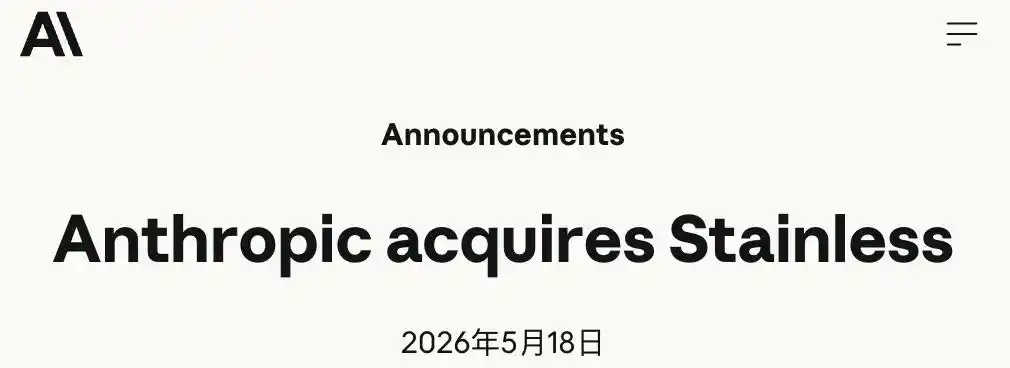
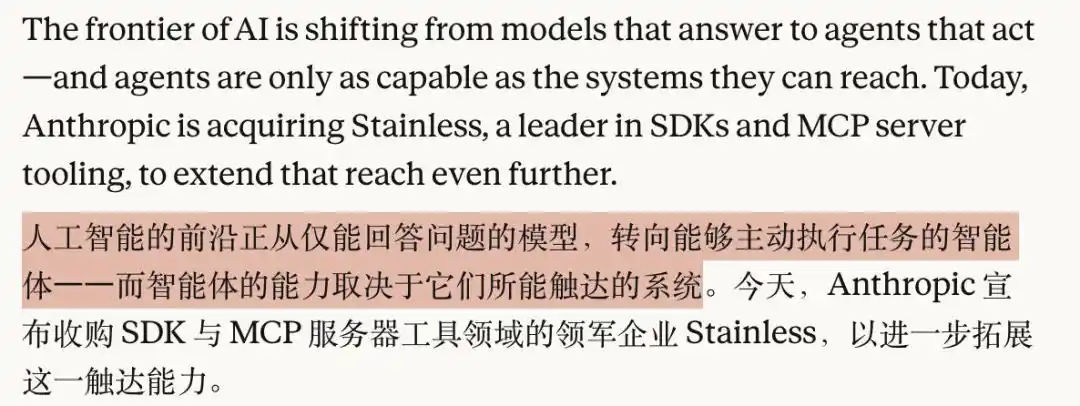
The AI frontier is shifting from models that can only answer questions to agents that can proactively execute tasks—and an agent's capabilities depend on the systems it can reach. Acquiring Stainless is precisely to expand this reach further.
If we place this acquisition within the context of Anthropic's actions over the past 18 months, the three-piece agent suite is now complete: Claude is the model, Stainless is the interface, and MCP is the connection.

The Company That Wrote SDKs for Multiple AI Giants Has Been Bought by Anthropic

Stainless was founded in New York in 2022 by Alex Rattray, who came from Stripe, where he led the redesign of the API documentation and personally built Stripe's SDK code generation system.

During user research, he discovered that developers never directly call API endpoints: for them, the SDK is the API itself.

This insight directly led him to later found Stainless, turning that capability into a product.

Stainless founder Alex Rattray

Developers feed it an OpenAPI specification, and it outputs official SDKs in Python, TypeScript, Go, Java, Ruby, and other languages.

The model company only needs to maintain one API description; Stainless handles all language versions, error handling, retry logic, documentation generation, and more.

OpenAI, Anthropic, Meta, Cloudflare, DocuSign, Square—these AI giants or software vendors are all Stainless clients.

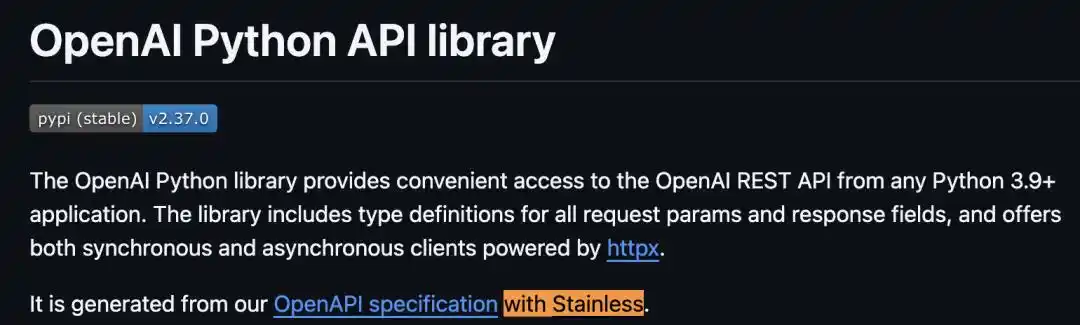
Open the GitHub repository for OpenAI's official Python SDK, and the README states: "Generated by Stainless based on the OpenAPI specification."
Similarly, the header of any source file in the Anthropic SDK also states: "Automatically generated by Stainless from the OpenAPI specification."
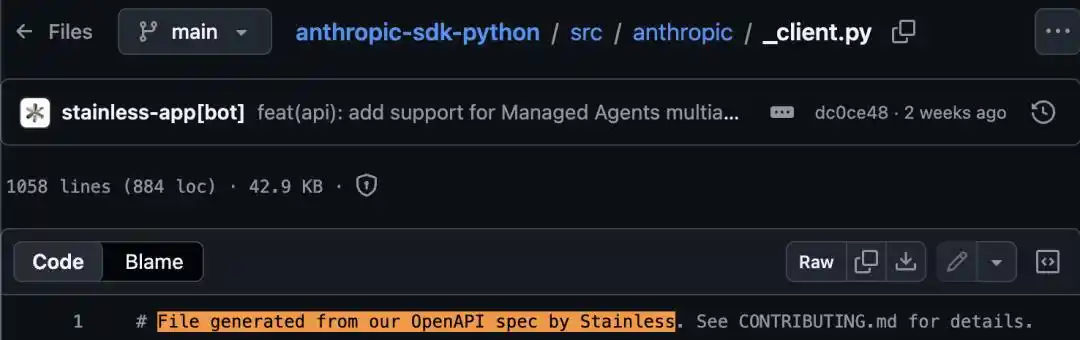
This means that over the past few years, OpenAI and Anthropic, as rivals, have long used the same developer tool platform for their official SDK generation.

After the acquisition, Stainless founder Alex Rattray informed existing clients that all previously generated SDKs fully belong to the clients, who can modify and extend them independently, but Stainless will no longer provide subsequent support.

The Stainless team will continue working as an internal organization within Anthropic, focusing on building out Claude Platform capabilities and connecting agents to APIs.
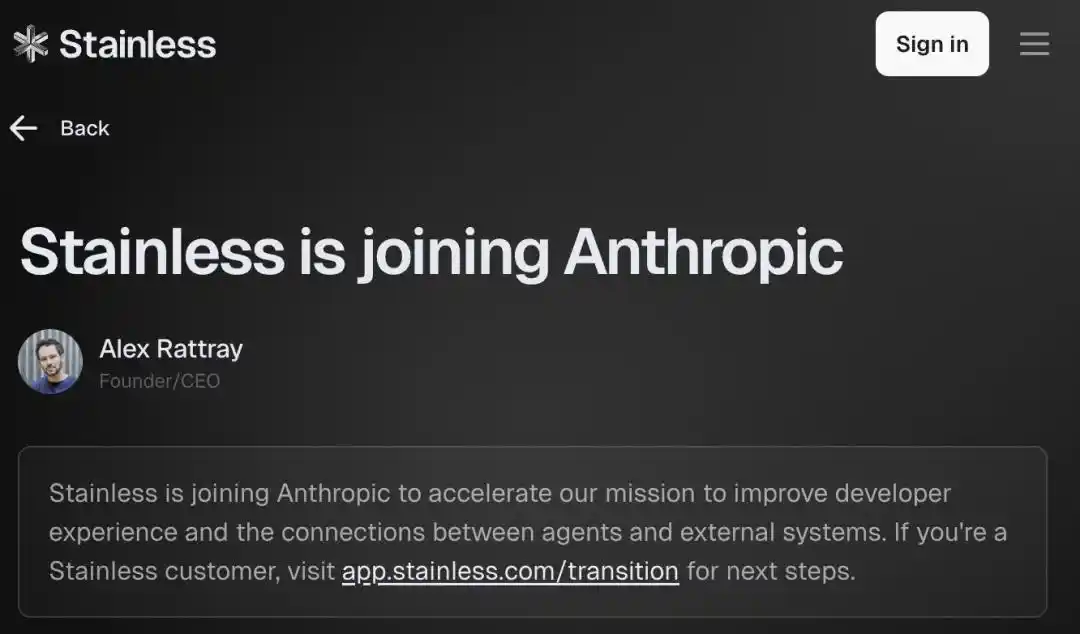
https://www.stainless.com/blog/stainless-is-joining-anthropic/
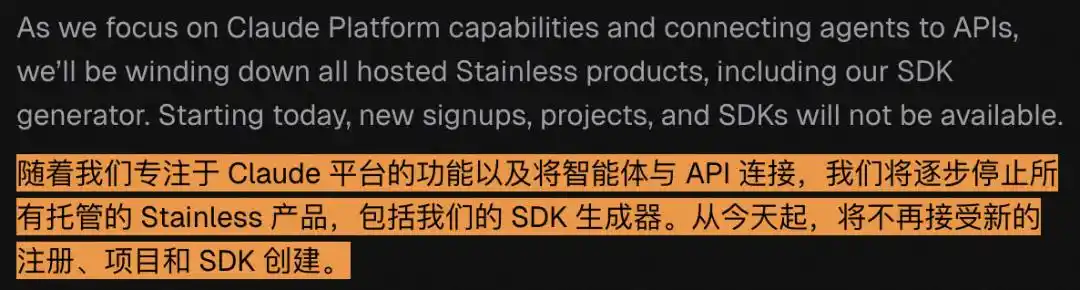
This tool company's products indirectly reached about a quarter of professional software developers worldwide. On its first day joining Anthropic, it closed its doors to the entire industry: from a shared infrastructure to an internal department of Anthropic.

The Agent Three-Piece Suite Is Complete: Model, Interface, Connection

This acquisition is not an isolated event.

Placing the Stainless acquisition back on the strategic path Anthropic has taken over the past 18 months reveals a completed three-piece suite.
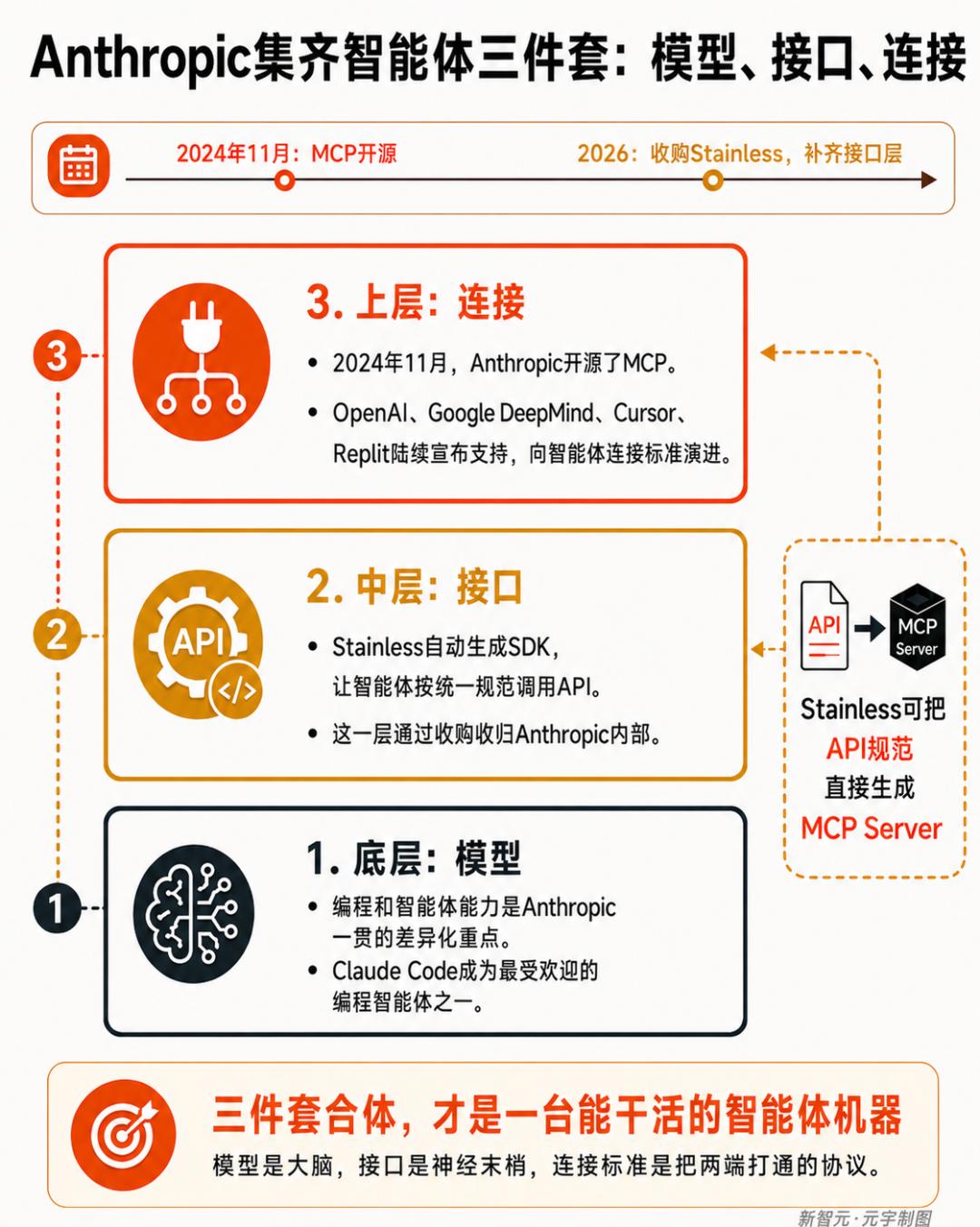
The foundational layer is the model.

From Claude 3.5 Sonnet all the way to Claude 4.7, programming and agent capabilities have been consistent differentiators for Anthropic. Claude Code has also become one of the most popular programming agents among developers this past year.

The middle layer is the interface.

Stainless's SDK auto-generation capability makes it possible for agents to call various APIs using a unified specification. This layer was previously outsourced; now it's brought in-house at Anthropic.

The top layer is the connection.

In November 2024, Anthropic open-sourced MCP (Model Context Protocol), standardizing how models connect to external data sources, tools, and file systems, so agents don't need to write separate adapters for every external service.

After MCP was open-sourced, OpenAI, Google DeepMind, Cursor, and Replit announced support. MCP is evolving into an agent connectivity standard.

And Stainless can directly generate an MCP server from an API specification. The model is the brain, the interface is the nerve endings, and the connection standard is the protocol that links them. Combined, these three pieces form a functional agent machine.

Katelyn Lesse, Head of Platform Engineering at Anthropic, stated plainly: "How useful an agent is depends on what it can connect to."

Stainless founder and CEO Alex Rattray said that Anthropic was one of the earliest teams to bet on Stainless, and "bringing the two teams together was an easy decision."

This acquisition is the final move in a strategic game that began 18 months ago.

Why Is an "SDK Translation Company" Worth $300 Million?

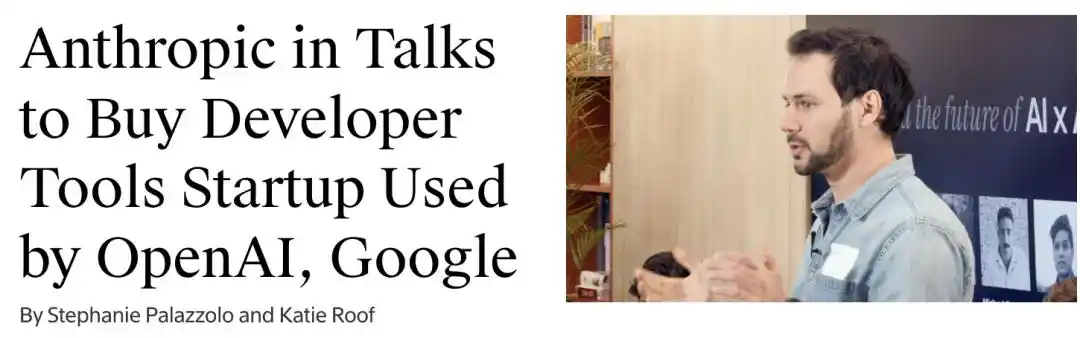
According to a previous report by The Information, the negotiation amount for this acquisition was at least $300 million. Anthropic has not disclosed the specific figure officially, but even this magnitude is enough to make people reevaluate the value of the SDK layer.
In the past, SDKs were an insignificant engineering problem.

The API was the model company's business; the SDK was just a "wrapper layer" translating the API into various programming languages. Model companies could write it themselves or outsource it to Stainless; no one cared.

But the agent era is different. When Claude or GPT acts as an agent to call third-party services, the SDK is no longer a "tool for humans to read" but an "interface for agents to use."

Whether an agent task succeeds largely depends on whether every API's SDK it calls is robust: is error handling complete? Is retry logic reasonable? Are parameter definitions strict? Are types inferable?

Any non-standard SDK can cause an agent to get stuck mid-task.

If the reported $300 million negotiation amount is accurate, what Anthropic sees is clearly not just an SDK generator, but the developer interface infrastructure layer between APIs and agents.

There's a subtler point: The official SDKs of companies like OpenAI, Meta, and Cloudflare were all previously generated by Stainless.

On the first day after the acquisition, with Stainless closing its doors externally, these companies face a practical problem: will they take over SDK maintenance themselves, or find another supplier?

So far, none have responded to this question.

OpenAI Doubles Down on Models, Anthropic Secures the Foundation

Looking back at the final ASI showdown between the two giants, OpenAI and Anthropic have distinct strategic focuses.

OpenAI's focus is on model generations and compute investment.

From GPT-5, GPT-5.4 to GPT-5.5 incremental updates, the Stargate project's massive compute procurement, ChatGPT's weekly active users growing from 400 million a year ago to 900 million—it concentrates resources on the consumer-facing entry point and the model itself.

Anthropic is taking a different path: enterprise agent infrastructure. Strengthening developer tools with Claude Code, standardizing the connection protocol with MCP, and now bringing the SDK layer in-house with Stainless.

The underlying logic of these two paths is completely different.

The model layer follows a logic of generational disruption: when the next generation arrives, the previous generation's advantages can vanish instantly. The gaps between generations are shrinking, windows are getting shorter, and can only be achieved through compute and data.

The infrastructure layer's logic is the opposite. Once established as a de facto standard, the compounding returns are long-term. With MCP now adopted industry-wide, each new adopter adds switching costs. Once the SDK layer is internalized within Anthropic, the entire agent ecosystem could develop a path dependency on Anthropic's interface specifications.
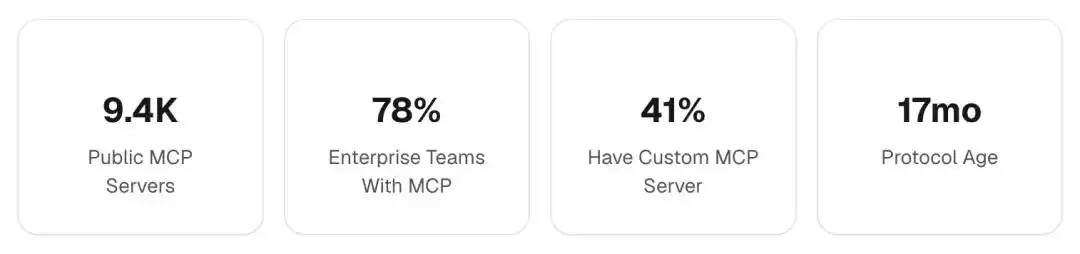
According to Digital Applied statistics, the number of public MCP servers grew from 1,200 in Q1 2025 to over 9,400 by April 2026, with 78% of enterprise AI teams deploying at least one MCP agent in production.

The gap in model capabilities is becoming easier to close.

Once this connection layer gateway is locked, it becomes very hard to bypass.

References:

https://www.anthropic.com/news/anthropic-acquires-stainless

https://www.stainless.com/blog/stainless-is-joining-anthropic/

https://www.digitalapplied.com/blog/mcp-adoption-statistics-2026-model-context-protocol

This article is from the WeChat public account "AI Era", author: ASI Revelation

Preguntas relacionadas

QWhat is the main purpose of Stainless as described in the article, and why was it significant for AI companies?

AStainless acts as a 'translator' between complex API specifications and developers, automatically generating official SDKs in multiple programming languages. It was significant for AI companies like OpenAI and Anthropic because it allowed them to maintain just one API description while Stainless handled all language versions, error handling, retry logic, and documentation, greatly simplifying developer integration.

QWhy did Anthropic acquire Stainless, according to the article's analysis of their strategic roadmap?

AAnthropic acquired Stainless to strengthen its 'agent' infrastructure. The article states that an agent's usefulness depends on what it can connect to. By bringing Stainless in-house, Anthropic gains control over the 'interface' layer—the SDKs that agents use to call APIs—completing its 'agent trifecta' of model (Claude), interface (Stainless), and connection protocol (MCP).

QWhat immediate impact does the acquisition have on Stainless's existing clients, such as OpenAI and Meta?

AThe acquisition means Stainless will begin winding down its hosted products, including the SDK generator. While existing clients retain full ownership of previously generated SDKs and can modify them, Stainless will no longer provide future support or updates. These companies must now decide whether to maintain the SDKs themselves or find an alternative supplier.

QHow does the article contrast the strategic focuses of OpenAI and Anthropic in the AI race?

AThe article contrasts their strategies: OpenAI focuses on model generation leaps and massive compute investment (e.g., GPT-5 series, Stargate project) to dominate the consumer-facing market. Anthropic focuses on building enterprise-grade agent infrastructure, strengthening developer tools (Claude Code), standardizing the connection protocol (MCP), and now internalizing the SDK layer (Stainless) to create long-term ecosystem lock-in.

QWhat is MCP, and why is its growth cited as important for Anthropic's strategy?

AMCP (Model Context Protocol) is an open-source protocol standardized by Anthropic for connecting AI models to external data sources, tools, and file systems. Its growth is important because it's becoming a de facto standard for agent connectivity. With a reported increase from 1,200 to over 9,400 public servers and widespread enterprise adoption, it creates network effects and switching costs, solidifying Anthropic's position in the agent infrastructure layer.

Lecturas Relacionadas

The Value Distribution of Stablecoins

**Summary: The Value Distribution of Stablecoins** The article argues that stablecoins are evolving from mere trading tools into broader channels for dollar access. It divides the stablecoin ecosystem into four layers to analyze how value is distributed: 1. **Issuance Layer:** Mints stablecoins, holds reserve assets, and captures the spread between reserve yield and user costs (e.g., Tether, Circle). This layer currently earns the largest profit margin. 2. **Infrastructure Layer:** Connects stablecoins to the traditional financial system, handling fiat on/off-ramps, banking integration, compliance (KYC/AML), and asset management (e.g., Bridge, BVNK). This is the "unglamorous" but critical work, building the essential bridges between crypto and real-world finance. 3. **Acquiring/Distribution Layer:** Integrates stablecoins into merchant systems, manages payment flows, and provides enterprise financial software (e.g., Stripe, Coinbase). They act as the access point for businesses. 4. **Application Layer:** The end-users and businesses that ultimately use stablecoins for payments, settlements, or as a store of value. They benefit from convenience but have little pricing power. The core thesis is that while the issuance layer currently dominates profits, the often-overlooked **infrastructure layer holds significant long-term potential**. The real challenge and barrier to mass adoption is not the on-chain transfer of stablecoins (which is simple), but the complex "last mile" integration into existing business workflows, banking systems, and regulatory frameworks across different countries. Companies in this layer are currently in a "land grab" phase, investing heavily to build networks, secure bank partnerships, and establish compliance pathways. While their position is currently pressured by the profitable issuers above and distribution platforms below, the article suggests that if stablecoins become a default financial rail for businesses, the infrastructure providers who have done the hard work of integration will ultimately gain strong pricing power and become entrenched, essential players.

marsbitHace 4 hora(s)

The Value Distribution of Stablecoins

marsbitHace 4 hora(s)

The Value Distribution of Stablecoins

The Value Distribution of Stablecoins The article argues that stablecoins are evolving from a mere trading tool into a broad "dollar channel." It analyzes the industry's value chain through four layers: 1. **Issuance Layer (e.g., Tether, Circle):** The top layer that mints stablecoins, holds reserve assets, and captures the thickest interest rate spread. 2. **Infrastructure Layer (e.g., Bridge, BVNK):** Connects stablecoins to the traditional financial system, handling critical but complex "dirty work" like fiat on/off-ramps, banking integration, compliance (KYC/AML), and cross-border settlement. 3. **Acquiring/Distribution Layer (e.g., Stripe, Coinbase):** Embeds stablecoins into merchant systems, manages payment flows, and integrates with enterprise software. 4. **Application Layer:** End-users and businesses that ultimately use stablecoins for payments, settlement, or storing value. The author posits that while the issuance layer currently captures the most profit, the most overlooked and potentially critical layer is infrastructure. The core challenge for stablecoin adoption isn't the on-chain transfer (which is simple), but bridging the gap between blockchain and the real-world financial system. This involves solving practical problems for businesses: fiat conversion, reconciliation, tax handling, and user onboarding. Infrastructure companies are currently in a difficult "land-grab" phase—building networks, securing banking relationships, and achieving compliance country-by-country. They face pressure from both the profitable issuance layer above and distribution platforms below. However, the author suggests this layer is building a crucial moat. Once stablecoins become a default business rail, the infrastructure players who have done the hard work of integration may gain significant, durable value and pricing power.

链捕手Hace 4 hora(s)

The Value Distribution of Stablecoins

链捕手Hace 4 hora(s)

How to Do Research Well: Deliberately Practice the Real Skills That Matter

No one truly teaches you how to do research. You're often given a desk, a pre-selected problem, and vague instructions to "create something new." Consequently, many people reverse-engineer the job based on visible outputs—papers, posts, announcements—learning only how to *appear* like a researcher rather than how to *become* one. True research capability is built from stacking small, trainable skills, nearly all of which can be developed through deliberate practice. **Pick Your Own Problem:** Most researchers absorb problems from advisors or trends, lacking the underlying reasoning. Choosing a problem you genuinely care about, as John Schulman advises, leads to original work. Develop "taste" like a muscle: predict experiment outcomes, guess paper results from methods, and track which findings remain important over time. **Upgrade Your Inputs:** Relying on shared reading lists (arXiv hot lists, filtered group chats) leads to unoriginal conclusions. Undervalued old literature often holds crucial insights (e.g., MoE, LSTM, backpropagation). Richard Sutton's "The Bitter Lesson" or Claude Shannon's 1952 talk on creative thinking are more predictive than lengthy modern surveys. Breadth matters as much as depth: draw from neuroscience, mechanism design, hardware knowledge, and honest statistics. Read papers directly, especially appendices and limitations sections. **Write Everything Down:** As Paul Graham noted, writing exposes flaws in seemingly mature ideas. Writing is the cheapest defense against self-deception. Following Feynman's principle, Darwin programmatically wrote down facts contradicting his theory to combat memory bias. Maintain a detailed log of hypotheses, setups, predictions, results, and updated understandings. Reviewing past logs fosters essential humility.

marsbitHace 6 hora(s)

How to Do Research Well: Deliberately Practice the Real Skills That Matter

marsbitHace 6 hora(s)

Trading

Spot
Futuros
活动图片