Currency and Stock Barometer丨Vanguard's US Mid-Cap Index Fund Acquires Over $500 Million in Strategy Stocks for the First Time; Bitmine's Total Staking Exceeds 1.77 Million ETH, Valued at Over $5.6 Billion (January 20)

marsbitPublicado a 2026-01-20Actualizado a 2026-01-20

Resumen

Crypto-linked stocks showed signs of rebound last week, with companies like BTC treasury firm Strategy seeing share price recoveries. Key market influences include the Fed chair nomination, reduced expectations for rate cuts, and progress on the U.S. CLARITY Crypto Act. Vanguard’s mid-cap index fund purchased $505 million worth of Strategy shares. Strive acquired Semler Scientific, becoming the 11th largest public BTC holder. Steak ‘n Shake added $10 million in BTC to its corporate treasury. BitMine staked an additional 86,848 ETH, bringing its total staked to over 1.77 million ETH valued at $5.65 billion. It also led a $200 million investment into Beast Industries. Meanwhile, FG Nexus sold 2,500 ETH, realizing losses. Solana treasury firm Sharps Technology entered a 90-day lock-up agreement with SOL Markets. Forward Industries reported holding nearly 6.98 million SOL with significant staking rewards. Upexi raised $36 million to expand its SOL holdings. AlphaTON Capital, a TON treasury company, raised $15 million through a public stock offering.

Editor's Note: After experiencing a continuous decline and volatility, last week, crypto concept stocks saw a phased broad-based rebound. Stocks of BTC treasury companies, represented by Strategy, warmed up one after another. Although there is still a considerable distance from the high point, signs of a rebound are emerging. At the same time, the main influencing factors in the market are gradually focusing on events such as the nomination of the new Federal Reserve Chairman, expectations for Federal Reserve interest rate cuts, and the progress of the US CLARITY Crypto Act. Considering the overall market situation, crypto concept stocks will continue to face pressure. It is recommended to maintain the previous "short-term rebound博弈 (gaming/strategy)" strategy and avoid going all-in.

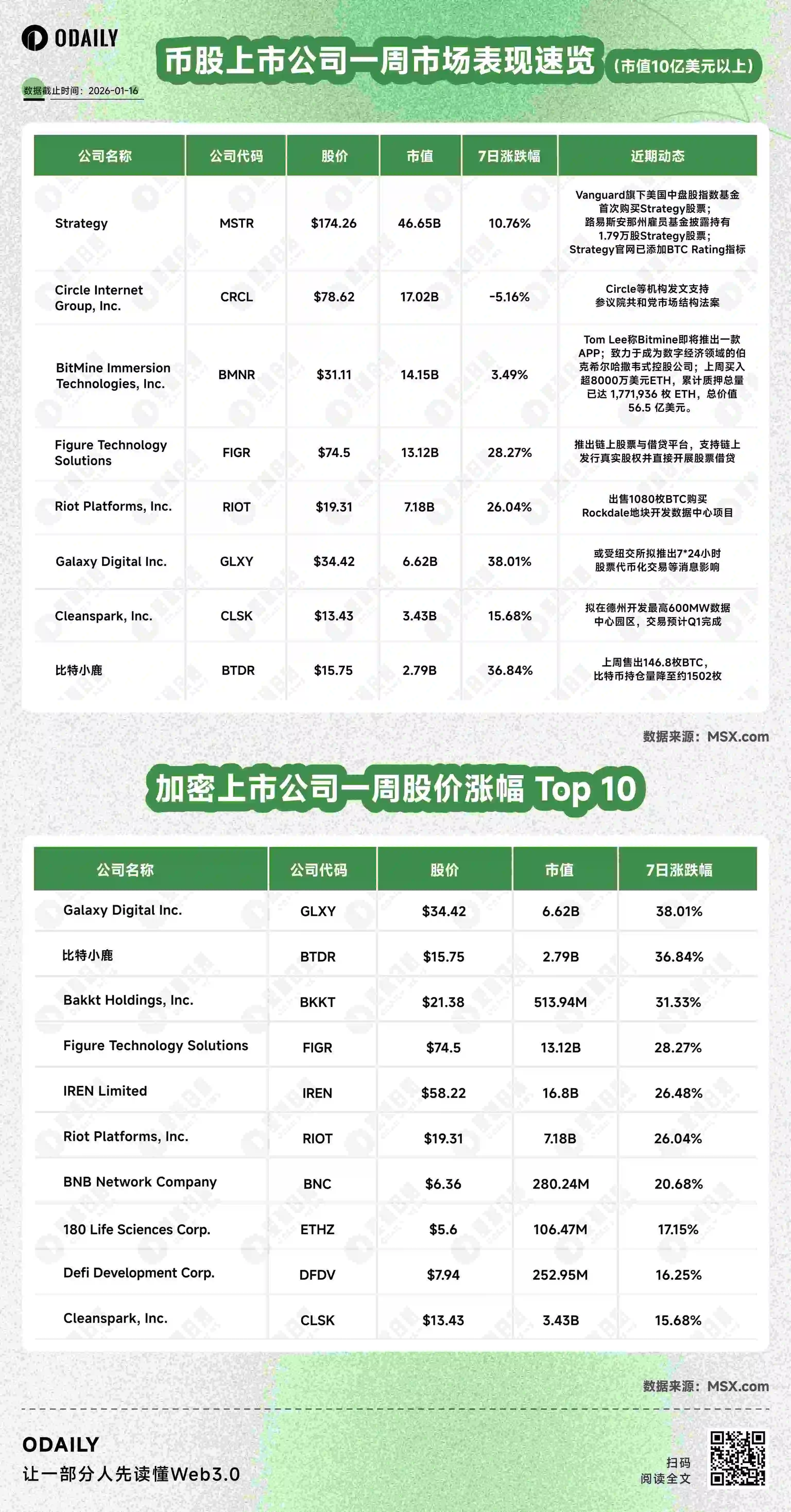
Below is a summary of last week's currency and stock market information compiled by Odaily Planet Daily. All US stock data are from msx.com.
Overview of Main Factors Affecting Crypto Concept Stocks

Trump's Rejection of Hassett Leads to Significant "Shrinkage" in Fed Rate Cut Expectations

As Trump hinted at nominating someone other than National Economic Council Director Hassett to succeed Powell, US bond prices fell, and traders reduced their expectations for two US rate cuts in 2026. The decline in US Treasuries pushed the two-year yield up by 5 basis points to 3.61% at one point, hitting its highest level since the Fed's last rate cut in December. After Trump's comments on Hassett, short-term interest rate contracts reflected a decreased probability of the Fed implementing two 25-basis-point rate cuts this year. Meanwhile, the Treasury market continues to be troubled by the employment data released a week ago, which prompted Wall Street banks that had previously predicted a Fed rate cut at the next meeting on January 28 to abandon this view. Morgan inflation economists predict that the Fed will not cut rates further, despite the change in leadership. John Fath, Managing Partner of BTG Pactual Asset Management US, said: "The previous trade was betting that whoever becomes the next Fed chair would be dovish. This dynamic has reversed in the past few days."

Crypto Industry Divided on Market Structure Bill: a16z, Ripple, etc. Take Opposite Stance to Coinbase

Coinbase CEO Brian Armstrong had stated that he intends to withdraw support for the crypto market structure bill (CLARITY), saying "I'd rather have no bill than a bad bill." However, several major industry players hold the opposite view to Coinbase. Kraken CEO Arjun Sethi said legacy issues should be resolved through negotiation, not by abandoning years of bipartisan progress. a16z Managing Partner Chris Dixon, Ripple CEO Brad Garlinghouse, and White House Special Advisor for AI and Crypto David Sacks expressed similar views, urging all parties to resolve differences before the end of the month. Ledger Global Policy Head Seth Hertlein pointed out that it is hard to imagine a future environment as favorable as the current one. There is a widespread feeling in the industry that if legislation is not completed now, it will either not happen in the future or will happen under very unfavorable conditions. The crypto industry does not want software usability or content publishing permissions to change with each administration.

Additionally, the NYSE plans to open 7*24 tokenized stock trading and launch an on-chain settlement platform, which may impact crypto concept stocks to some extent. Related concept stocks may rise on this positive news. For details, recommended reading "NYSE Plans to Start 7*24 Hour Tokenized Stock Trading, 'Competitors' Are Stunned" and "NYSE Launches 7*24 Crypto-Stock Trading, Which Crypto Businesses Will Be Directly Benefited and Hurt?".

Weekly Updates on Listed Companies in Currency and Stock Markets

Representative BTC Treasury Listed Companies

Vanguard's US Mid-Cap Index Fund Makes First Purchase of Strategy Stock

Vanguard's US Mid-Cap Index Fund, Vanguard Group Mid-Cap Index Fund Institutional Shares (VMCIX), disclosed its first purchase of Strategy stock. It is reported that the fund bought 2.91 million shares, worth approximately $505 million.

Furthermore, Strategy announced that it will report its financial results for the fourth quarter of 2025 after the US financial market closes on Thursday, February 5, 2026, and will hold an online conference at 5:00 PM Eastern Time to discuss the performance. The company currently holds 687,410 bitcoins, with a持仓 (holding) market value of approximately $66.47 billion.

Strive Completes Acquisition of Semler Scientific and Becomes the 11th Largest Public Company by BTC Holdings

On January 16, Nasdaq-listed bitcoin financial services company Strive announced the formal completion of its acquisition of Semler Scientific. The merged company now holds a total of 12,797.9 bitcoins and has become the 11th largest public company globally by BTC holdings. The company also announced the appointment of Avik Roy as Chief Strategy Officer, while Semler Scientific's former chairman, Eric Semler, joined Strive as an independent director, and Bitcoin Strategy Director Joe Burnett became Strive's Vice President of Bitcoin Strategy.

Steak'n Shake Buys $10 Million in Bitcoin, Advancing Corporate BTC Treasury Strategy

US fast-food chain Steak ‘n Shake announced that this week it allocated $10 million to bitcoin, officially adding BTC to its corporate balance sheet. This move continues its crypto strategy of accepting bitcoin payments at all US stores over the past eight months.

The company stated that this decision is part of its so-called "self-reinforcing cycle": consumer payments with bitcoin drive sales growth, and related revenue is continuously invested into the company's Bitcoin Reserve (SBR), thereby providing funds for operational inputs such as ingredient upgrades and store renovations without raising menu prices.

Steak'n Shake has accepted bitcoin payments via the Lightning Network at all US stores since May 2025, aiming to reduce credit card fees and attract young crypto users. The company disclosed that same-store sales in the second quarter of 2025 increased by over 10% year-over-year. When customers choose to pay with bitcoin, payment processing fees can be saved by about 50%.

US Listed Company DDC Enterprise Completes Additional Purchase of 200 BTC, Total Holdings Increase to 1,383 BTC

On January 16, US listed company DDC Enterprise Limited announced the completion of its first bitcoin purchase in 2026, adding 200 BTC. After the transaction, DDC's total bitcoin holdings increased to 1,383 BTC.

The announcement showed that DDC's current average bitcoin holding is approximately $88,998, with a阶段性 (phase/period) bitcoin收益率 (return rate) of 16.9%. Every 1,000 shares of DDC stock correspond to approximately 0.046482 BTC. The company stated that this purchase continues its prudent, disciplined capital allocation strategy and regards bitcoin as a strategic reserve asset aligned with long-term value creation.

Representative ETH Treasury Listed Companies

BitMine Total Staking Exceeds 1.77 Million ETH, Total Value $5.65 Billion

According to OnchainLens monitoring, BitMine recently staked an additional 86,848 ETH, worth $279.4 million. Currently, its cumulative staking total has reached 1,771,936 ETH, with a total value of $5.65 billion. Last week, Bitmine purchased 24,068 ETH ($80.57 million) via FalconX.

On January 17, Ethereum treasury company Bitmine Chairman Tom Lee announced at a recent shareholders' meeting that the company is about to launch an APP, but no further details have been disclosed yet. However, based on shareholder reactions, they seem dissatisfied with this move and believe it is unnecessary to invest significant costs in an APP. Additionally, Tom Lee revealed that Bitmine no longer wishes to扮演 (play) the role of a单一 (single) Ethereum yield tool but is considering positioning itself as a Berkshire Hathaway-style holding company in the digital economy field. In this model, Ethereum would serve as the cash flow-providing base layer and capital allocation, driving the next stage of growth.

Furthermore, on January 15, Beast Industries announced the completion of a $200 million financing round, led by BitMine. This project's main business is media and consumer holdings, covering content production, consumer brand Feastables, MrBeast Burger, and commercial investments.

BitMine stated that it has agreed to invest $200 million in Beast Industries, a media and consumer holding company founded by YouTube creator MrBeast. BitMine currently holds over 4 million ETH, worth approximately $13 billion, making it the world's largest Ethereum treasury holder. Beast Industries CEO Jeff Housenbold said the funds will be used to support growth plans and explore the integration of decentralized finance functions into future financial service products. The transaction is expected to be completed around January 19.

Treasury Company FG Nexus, Holding $120 Million in ETH, Sells 2,500 ETH

On-chain analyst Yu Jian monitored that Ethereum treasury company FG Nexus (fg-nexus) sold 2,500 ETH on January 20, worth $8.04 million. FG Nexus储备 (reserved) 50,770 ETH at an average price of $3,944 during August to September last year, worth $200 million. As the ETH price fell, the company has so far减持 (reduced holdings) 13,475 ETH at a price of $3,089, realizing a loss of $11.52 million. Currently, FG Nexus still holds 37,594 ETH, worth $120 million. The company's mNAV is 0.84, meaning its stock market value is lower than the value of the ETH it holds.

Representative SOL Treasury Listed Companies

SOL Treasury Company Sharps Technology Reaches 90-Day Stock Lock-Up Agreement with SOL Markets

According to a Globenewswire report, Nasdaq-listed Solana treasury company Sharps Technology (STSS) announced that it has reached a 90-day stock lock-up agreement with SOL Markets. According to the agreement, SOL Markets agrees to restrict the sale of its advisor warrants and related shares for 90 days. The agreement is effective from January 16, 2026. Previously, Sharps Technology's board approved a stock repurchase plan of up to $100 million. It is currently developing a universal digital identity and authentication framework through strategic partnerships with Coinbase, Crypto.com, and Jupiter.

Forward Industries: SOL Holdings Increase to Nearly 6.98 Million, Staking Rewards Reach 133,450 SOL

Nasdaq-listed Solana treasury company Forward Industries公布 (published) its financial performance report, disclosing that as of January 15, the company holds a total of 6,979,967.46 SOL. Since establishing the Solana treasury, it has staked almost all SOL and received 133,450 SOL in staking rewards. Additionally, Forward Industries disclosed that its SEC-registered stock was launched on the Solana blockchain last December via the Opening Bell platform under Superstate.

Solana Treasury Company Upexi Reaches Securities Purchase Agreement Aiming to Raise $36 Million

Last week, Nasdaq-listed Solana treasury company Upexi announced that it has reached a securities purchase agreement with Hivemind Capital Partners aiming to raise $36 million. The note issuance is expected to be completed around January 14, 2026, subject to customary closing conditions. The notes are backed by locked SOL tokens and will be incorporated into the company's Solana treasury after the transaction is completed. The transaction is expected to increase Upexi's SOL holdings by 12%, to over 2.4 million SOL, making it the second-largest corporate SOL holder after Forward Industries, which holds 6.9 million SOL.

Representative Altcoin Treasury Listed Companies

TON Treasury Company AlphaTON Capital Raises $15 Million Through Registered Offering of Common Stock

On January 16, Nasdaq-listed TON treasury company AlphaTON Capital announced that it raised $15 million through a registered offering of common stock, issuing a total of 15,000,000 shares of common stock at a price of $1 per share. HC Wainwright & Co. acted as the exclusive placement agent for this offering. The company stated that it plans to use the net proceeds from this offering to expand the GPU deployment scale of Cocoon AI, supplement working capital, and for general corporate purposes.


Preguntas relacionadas

QWhat was the significant investment made by Vanguard's Mid-Cap Index Fund in Strategy, and what was its value?

AVanguard's Mid-Cap Index Fund (VMCIX) made its first purchase of Strategy stock, buying 2.91 million shares valued at approximately $505 million.

QWhat is the total amount of ETH staked by BitMine and what is its total value in USD?

ABitMine has staked a total of 1,771,936 ETH, with a total value of $5.65 billion.

QWhich company became the 11th largest public company by BTC holdings after completing an acquisition?

AStrive became the 11th largest public company by BTC holdings after it completed its acquisition of Semler Scientific.

QWhat major reason caused traders to reduce their expectations for U.S. interest rate cuts in 2026?

ATraders reduced their expectations for two U.S. rate cuts in 2026 after former President Trump hinted he would nominate someone other than Kevin Hassett to replace Jerome Powell as Fed Chair.

QWhat controversial stance did Coinbase take regarding the CLARITY Crypto Bill, and how did other industry players like a16z and Ripple respond?

ACoinbase CEO Brian Armstrong stated he would withdraw support for the CLARITY Bill, preferring no bill to a bad one. In contrast, other industry players like a16z, Ripple, and Kraken urged continued negotiation to resolve differences and pass the bill.

Lecturas Relacionadas

You Bet on the News, the Pros Read the Rules: The True Cognitive Gap in Losing Money on Polymarket

The article explains that the key to profiting on Polymarket, a prediction market platform, lies not just predicting real-world events correctly, but in meticulously understanding the specific rules that govern how each market will be resolved. It illustrates this with examples, such as a market on Venezuela's 2026 leader, where the official rules defining "officially holds" the office overruled the intuitive answer of who was in practical control. Other examples include debates over the definition of a "token" or what constitutes an "agreement." The core argument is that a "reality vs. rules" gap creates pricing discrepancies that savvy traders ("车头" or "whales") exploit. The platform has a formal dispute resolution process managed by UMA token holders to settle ambiguous outcomes. This process involves proposal submission, a challenge window, a discussion period, and a final vote. However, the article highlights a critical flaw in this system compared to a traditional court: the lack of separation between the arbiters (UMA voters) and the interested parties (traders with financial stakes in the outcome). This conflict of interest undermines the discussion phase, leads to herd mentality, and results in opaque final decisions without explanatory rulings. Consequently, the system lacks a body of precedent, making it difficult for users to learn from past disputes. The ultimate takeaway is that success on Polymarket requires a lawyer-like scrutiny of the rules to identify and capitalize on the cognitive gap between how events appear and how they are contractually defined for settlement.

marsbitHace 4 min(s)

You Bet on the News, the Pros Read the Rules: The True Cognitive Gap in Losing Money on Polymarket

marsbitHace 4 min(s)

Will the Fed Still Cut Interest Rates? Tonight's Data Is Crucial

The core debate surrounding the Federal Reserve's potential interest rate cuts is intensifying amid geopolitical conflict and rebounding inflation. The key question is whether high energy prices will cause persistent inflation or weaken consumer demand enough to force the Fed to cut rates. Citigroup presents a bullish case for cuts, arguing that oil supply disruptions from the Strait of Hormuz are temporary and will not lead to lasting inflationary pressure. They point to receding bond yields and oil prices as evidence the market is pricing in a short-lived shock. Citi's data also shows tightening financial conditions, a stabilizing labor market, and healthy tax returns, supporting their view that the path to lower rates remains open. Conversely, Deutsche Bank offers a starkly contrasting, more hawkish outlook. They argue the Fed's current policy is already neutral and expect rates to remain unchanged indefinitely. Their view is based on stalled disinflation progress and a shift toward more hawkish rhetoric from key Fed officials like Waller, who cited risks from prolonged Middle East conflict and tariffs. Other officials, including Williams and Hammack, signaled rates would likely stay on hold for a "considerable time." The market pricing has shifted dramatically, now forecasting zero cuts in 2026. The imminent release of the March retail sales "control group" data is highlighted as a critical test. This metric, which excludes gas station sales, will reveal if high gasoline prices are eroding consumer spending in other areas. A weak reading could support the case for imminent rate cuts, while a strong one would bolster the argument for the Fed to hold steady. This data is pivotal for determining the near-term policy path.

marsbitHace 24 min(s)

Will the Fed Still Cut Interest Rates? Tonight's Data Is Crucial

marsbitHace 24 min(s)

The Second Half of Macro Influencer Fu Peng's Career

Fu Peng, a prominent Chinese macroeconomist and former chief economist of Northeast Securities, has joined Hong Kong-based digital asset management firm Bitfire Group (formerly New Huo Group) as its chief economist. This move, announced in April 2026, triggered an 11% surge in Bitfire's stock price. Fu, known for his accessible macroeconomic commentary and large social media following, will focus on integrating digital assets into global asset allocation frameworks, particularly combining FICC (fixed income, currencies, and commodities) with cryptocurrencies for institutional clients. His career includes roles at Lehman Brothers and Solomon International, with significant influence gained through public communication. However, in late 2024, Fu faced temporary social media bans after a controversial private speech at HSBC on China's economic challenges, though he denied regulatory sanctions. He later left Northeast Securities citing health reasons. Bitfire, a licensed virtual asset manager serving high-net-worth clients, seeks to build trust and attract traditional capital through Fu’s expertise and credibility. The partnership represents a strategic shift for both: Fu enters the crypto sector after a traditional finance peak, while Bitfire aims to leverage his macro framework for institutional adoption. Outcomes remain uncertain regarding capital inflows and compatibility within corporate structure.

marsbitHace 1 hora(s)

The Second Half of Macro Influencer Fu Peng's Career

marsbitHace 1 hora(s)

Trading

Spot
Futuros

Artículos destacados

Qué es ETH 2.0

ETH 2.0: Una Nueva Era para Ethereum Introducción ETH 2.0, conocido ampliamente como Ethereum 2.0, marca una actualización monumental para la blockchain de Ethereum. Esta transición no es solo una mejora superficial; busca mejorar fundamentalmente la escalabilidad, seguridad y sostenibilidad de la red. Con un cambio del mecanismo de consenso intensivo en energía Prueba de Trabajo (PoW) a una Prueba de Participación (PoS) más eficiente, ETH 2.0 promete un enfoque transformador para el ecosistema blockchain. ¿Qué es ETH 2.0? ETH 2.0 es un conjunto de actualizaciones interconectadas y distintivas centradas en optimizar las capacidades y el rendimiento de Ethereum. La reestructuración está diseñada para abordar desafíos críticos que el mecanismo actual de Ethereum ha enfrentado, particularmente en lo que respecta a la velocidad de transacción y la congestión de la red. Objetivos de ETH 2.0 Los objetivos principales de ETH 2.0 giran en torno a mejorar tres aspectos clave: Escalabilidad: Con el objetivo de aumentar significativamente el número de transacciones que la red puede manejar por segundo, ETH 2.0 busca superar la limitación actual de aproximadamente 15 transacciones por segundo, potencialmente alcanzando miles. Seguridad: Las medidas de seguridad mejoradas son fundamentales para ETH 2.0, particularmente a través de una mejor resistencia contra ciberataques y la preservación del ethos descentralizado de Ethereum. Sostenibilidad: El nuevo mecanismo PoS está diseñado no solo para mejorar la eficiencia, sino también para reducir drásticamente el consumo de energía, alineando el marco operativo de Ethereum con consideraciones ambientales. ¿Quién es el Creador de ETH 2.0? La creación de ETH 2.0 se puede atribuir a la Fundación Ethereum. Esta organización sin fines de lucro, que desempeña un papel crucial en el apoyo al desarrollo de Ethereum, es liderada por el notable cofundador Vitalik Buterin. Su visión de un Ethereum más escalable y sostenible ha sido la fuerza motriz detrás de esta actualización, involucrando contribuciones de una comunidad global de desarrolladores y entusiastas dedicados a mejorar el protocolo. ¿Quiénes son los Inversores de ETH 2.0? Si bien los detalles sobre los inversores de ETH 2.0 no se han hecho públicos, se sabe que la Fundación Ethereum recibe apoyo de varias organizaciones e individuos en el ámbito de blockchain y tecnología. Estos socios incluyen firmas de capital de riesgo, compañías tecnológicas y organizaciones filantrópicas que comparten un interés mutuo en apoyar el desarrollo de tecnologías descentralizadas e infraestructura blockchain. ¿Cómo Funciona ETH 2.0? ETH 2.0 se distingue por introducir una serie de características clave que lo diferencian de su predecesor. Prueba de Participación (PoS) La transición a un mecanismo de consenso PoS es uno de los cambios más destacados de ETH 2.0. A diferencia de PoW, que se basa en la minería intensiva en energía para la verificación de transacciones, PoS permite a los usuarios validar transacciones y crear nuevos bloques de acuerdo con la cantidad de ETH que apuestan en la red. Esto conduce a una mayor eficiencia energética, reduciendo el consumo en aproximadamente un 99.95%, convirtiendo a Ethereum 2.0 en una alternativa considerablemente más verde. Cadenas Shard Las cadenas shard son otra innovación crítica de ETH 2.0. Estas cadenas más pequeñas operan en paralelo con la cadena principal de Ethereum, lo que permite que múltiples transacciones sean procesadas simultáneamente. Este enfoque mejora la capacidad general de la red, abordando las preocupaciones de escalabilidad que han afectado a Ethereum. Cadena Beacon En el núcleo de ETH 2.0 se encuentra la Cadena Beacon, que coordina la red y gestiona el protocolo PoS. Funciona como un organizador de cierta manera: supervisa a los validadores, asegura que los shards permanezcan conectados a la red y monitorea la salud general del ecosistema blockchain. Cronología de ETH 2.0 El viaje de ETH 2.0 ha estado marcado por varios hitos clave que trazan la evolución de esta importante actualización: Diciembre 2020: El lanzamiento de la Cadena Beacon marcó la introducción de PoS, preparándose para la migración hacia ETH 2.0. Septiembre 2022: La finalización de “La Fusión” representa un momento crucial en el que la red Ethereum se trasladó exitosamente de un marco PoW a uno PoS, anunciando una nueva era para Ethereum. 2023: El lanzamiento esperado de cadenas shard tiene como objetivo mejorar aún más la escalabilidad de la red Ethereum, consolidando a ETH 2.0 como una plataforma robusta para aplicaciones y servicios descentralizados. Características Clave y Beneficios Escalabilidad Mejorada Una de las ventajas más significativas de ETH 2.0 es su escalabilidad mejorada. La combinación de PoS y cadenas shard permite que la red expanda su capacidad, permitiendo acomodar un volumen mucho mayor de transacciones en comparación con el sistema heredado. Eficiencia Energética La implementación de PoS representa un gran paso hacia la eficiencia energética en la tecnología blockchain. Al reducir drásticamente el consumo de energía, ETH 2.0 no solo disminuye los costos operativos, sino que también se alinea más estrechamente con los objetivos de sostenibilidad global. Seguridad Mejorada Los mecanismos actualizados de ETH 2.0 contribuyen a mejorar la seguridad en toda la red. El despliegue de PoS, junto con las medidas de control innovadoras establecidas a través de cadenas shard y la Cadena Beacon, asegura un mayor grado de protección contra posibles amenazas. Costos Más Bajos para los Usuarios A medida que la escalabilidad mejora, los efectos sobre los costos de transacción también serán evidentes. Se espera que una mayor capacidad y una menor congestión se traduzcan en tarifas más bajas para los usuarios, haciendo que Ethereum sea más accesible para transacciones cotidianas. Conclusión ETH 2.0 marca una evolución significativa en el ecosistema blockchain de Ethereum. A medida que aborda problemas fundamentales como la escalabilidad, el consumo de energía, la eficiencia en las transacciones y la seguridad general, la importancia de esta actualización no puede ser subestimada. La transición a la Prueba de Participación, la introducción de cadenas shard y el trabajo fundamental de la Cadena Beacon son indicativos de un futuro donde Ethereum puede satisfacer las crecientes demandas del mercado descentralizado. En una industria impulsada por la innovación y el progreso, ETH 2.0 se erige como un testimonio de las capacidades de la tecnología blockchain para allanar el camino hacia una economía digital más sostenible y eficiente.

166 Vistas totalesPublicado en 2024.04.04Actualizado en 2024.12.03

Qué es ETH 2.0

Qué es ETH 3.0

ETH3.0 y $eth 3.0: Un Examen Profundo del Futuro de Ethereum Introducción En el paisaje en rápida evolución de las criptomonedas y la tecnología blockchain, ETH3.0, a menudo denotado como $eth 3.0, ha surgido como un tema de considerable interés y especulación. El término abarca dos conceptos principales que merecen aclaración: Ethereum 3.0: Esto representa una posible actualización futura destinada a aumentar las capacidades de la blockchain existente de Ethereum, enfocándose particularmente en mejorar la escalabilidad y el rendimiento. ETH3.0 Meme Token: Este proyecto de criptomoneda distinto busca aprovechar la blockchain de Ethereum para crear un ecosistema centrado en memes, promoviendo la participación dentro de la comunidad de criptomonedas. Comprender estos aspectos de ETH3.0 es esencial no solo para los entusiastas de las criptomonedas, sino también para aquellos que observan tendencias tecnológicas más amplias en el espacio digital. ¿Qué es ETH3.0? Ethereum 3.0 Ethereum 3.0 se presenta como una actualización propuesta para la red de Ethereum ya establecida, que ha sido la columna vertebral de muchas aplicaciones descentralizadas (dApps) y contratos inteligentes desde su inicio. Las mejoras previstas se concentran principalmente en la escalabilidad, integrando tecnologías avanzadas como sharding y pruebas de conocimiento cero (zk-proofs). Estas innovaciones tecnológicas tienen como objetivo facilitar un número sin precedentes de transacciones por segundo (TPS), potencialmente alcanzando millones, abordando así una de las limitaciones más significativas que enfrenta la tecnología blockchain actual. La mejora no es meramente técnica, sino también estratégica; está destinada a preparar la red de Ethereum para su adopción generalizada y utilidad en un futuro marcado por una mayor demanda de soluciones descentralizadas. ETH3.0 Meme Token En contraste con Ethereum 3.0, el ETH3.0 Meme Token se aventura en un ámbito más ligero y juguetón al combinar la cultura de memes de internet con la dinámica de las criptomonedas. Este proyecto permite a los usuarios comprar, vender e intercambiar memes en la blockchain de Ethereum, proporcionando una plataforma que fomenta la participación comunitaria a través de la creatividad y los intereses compartidos. El ETH3.0 Meme Token tiene como objetivo demostrar cómo la tecnología blockchain puede intersectarse con la cultura digital, creando casos de uso que son tanto entretenidos como financieramente viables. ¿Quién es el Creador de ETH3.0? Ethereum 3.0 La iniciativa hacia Ethereum 3.0 es impulsada principalmente por un consorcio de desarrolladores e investigadores dentro de la comunidad de Ethereum, incluyendo notablemente a Justin Drake. Conocido por sus ideas y contribuciones a la evolución de Ethereum, Drake ha sido una figura prominente en las discusiones sobre la transición de Ethereum a una nueva capa de consenso, denominada “Beam Chain.” Este enfoque colaborativo para el desarrollo significa que Ethereum 3.0 no es el producto de un creador singular, sino más bien una manifestación de ingenio colectivo centrado en avanzar la tecnología blockchain. ETH3.0 Meme Token Los detalles sobre el creador del ETH3.0 Meme Token son actualmente inidentificables. La naturaleza de los tokens de memes a menudo conduce a una estructura más descentralizada y dirigida por la comunidad, lo que podría explicar la falta de atribución específica. Esto se alinea con la ética de la comunidad cripto más amplia, donde la innovación a menudo surge de esfuerzos colaborativos en lugar de individuales. ¿Quiénes son los Inversores de ETH3.0? Ethereum 3.0 El apoyo a Ethereum 3.0 proviene principalmente de la Fundación Ethereum junto con una entusiasta comunidad de desarrolladores e inversores. Esta asociación fundamental proporciona un grado significativo de legitimidad y mejora la perspectiva de una implementación exitosa, ya que aprovecha la confianza y credibilidad construidas a lo largo de años de operaciones en la red. En el clima cambiando rápidamente de las criptomonedas, el apoyo de la comunidad juega un papel crucial en impulsar el desarrollo y la adopción, posicionando a Ethereum 3.0 como un contendiente serio para futuros avances en blockchain. ETH3.0 Meme Token Si bien las fuentes actualmente disponibles no proporcionan información explícita sobre las fundaciones o organizaciones de inversión que respaldan el ETH3.0 Meme Token, es indicativo del modelo de financiamiento típico para tokens de memes, que a menudo depende del apoyo de base y la participación comunitaria. Los inversores en tales proyectos suelen consistir en individuos motivados por el potencial de innovación impulsada por la comunidad y el espíritu de cooperación que se encuentra dentro de la comunidad cripto. ¿Cómo Funciona ETH3.0? Ethereum 3.0 Las características distintivas de Ethereum 3.0 radican en su implementación propuesta de sharding y tecnología zk-proof. Sharding es un método de particionamiento de la blockchain en piezas más pequeñas y manejables o “shards,” que pueden procesar transacciones de manera concurrente en lugar de secuencial. Esta descentralización del procesamiento ayuda a prevenir la congestión y asegura que la red permanezca receptiva incluso bajo una carga pesada. La tecnología de prueba de conocimiento cero (zk-proof) contribuye con otra capa de sofisticación al permitir la validación de transacciones sin revelar los datos subyacentes involucrados. Este aspecto no solo mejora la privacidad, sino que también aumenta la eficiencia general de la red. También se habla de incorporar una Máquina Virtual de Ethereum de conocimiento cero (zkEVM) en esta actualización, amplificando aún más las capacidades y utilidad de la red. ETH3.0 Meme Token El ETH3.0 Meme Token se distingue al capitalizar la popularidad de la cultura de memes. Establece un mercado para que los usuarios participen en el comercio de memes, no solo por entretenimiento sino también por el posible beneficio económico. Al integrar características como staking, provisión de liquidez y mecanismos de gobernanza, el proyecto fomenta un entorno que incentiva la interacción y participación de la comunidad. Al ofrecer una mezcla única de entretenimiento y oportunidad económica, el ETH3.0 Meme Token tiene como objetivo atraer a una audiencia diversa, que abarca desde entusiastas de las criptomonedas hasta conocedores casuales de memes. Línea de Tiempo de ETH3.0 Ethereum 3.0 11 de noviembre de 2024: Justin Drake insinúa la próxima actualización de ETH 3.0, centrada en mejoras de escalabilidad. Este anuncio significa el comienzo de las discusiones formales sobre la futura arquitectura de Ethereum. 12 de noviembre de 2024: Se espera que la propuesta anticipada para Ethereum 3.0 se desvele en Devcon en Bangkok, preparando el escenario para una mayor retroalimentación de la comunidad y posibles próximos pasos en el desarrollo. ETH3.0 Meme Token 21 de marzo de 2024: El ETH3.0 Meme Token se lista oficialmente en CoinMarketCap, marcando su incursión en el dominio público de las criptomonedas y mejorando la visibilidad de su ecosistema basado en memes. Puntos Clave En conclusión, Ethereum 3.0 representa una evolución significativa dentro de la red de Ethereum, enfocándose en superar las limitaciones en términos de escalabilidad y rendimiento a través de tecnologías avanzadas. Sus actualizaciones propuestas reflejan un enfoque proactivo hacia las demandas y la usabilidad futura. Por otro lado, el ETH3.0 Meme Token encapsula la esencia de la cultura impulsada por la comunidad en el espacio de las criptomonedas, aprovechando la cultura de memes para crear plataformas atractivas que fomentan la creatividad y participación del usuario. Comprender los distintos propósitos y funcionalidades de ETH3.0 y $eth 3.0 es fundamental para cualquiera interesado en los desarrollos en curso dentro del espacio cripto. Con ambas iniciativas abriendo caminos únicos, subrayan colectivamente la naturaleza dinámica y multifacética de la innovación en blockchain.

178 Vistas totalesPublicado en 2024.04.04Actualizado en 2024.12.03

Qué es ETH 3.0

Cómo comprar ETH

¡Bienvenido a HTX.com! Hemos hecho que comprar Ethereum (ETH) sea simple y conveniente. Sigue nuestra guía paso a paso para iniciar tu viaje de criptos.Paso 1: crea tu cuenta HTXUtiliza tu correo electrónico o número de teléfono para registrarte y obtener una cuenta gratuita en HTX. Experimenta un proceso de registro sin complicaciones y desbloquea todas las funciones.Obtener mi cuentaPaso 2: ve a Comprar cripto y elige tu método de pagoTarjeta de crédito/débito: usa tu Visa o Mastercard para comprar Ethereum (ETH) al instante.Saldo: utiliza fondos del saldo de tu cuenta HTX para tradear sin problemas.Terceros: hemos agregado métodos de pago populares como Google Pay y Apple Pay para mejorar la comodidad.P2P: tradear directamente con otros usuarios en HTX.Over-the-Counter (OTC): ofrecemos servicios personalizados y tipos de cambio competitivos para los traders.Paso 3: guarda tu Ethereum (ETH)Después de comprar tu Ethereum (ETH), guárdalo en tu cuenta HTX. Alternativamente, puedes enviarlo a otro lugar mediante transferencia blockchain o utilizarlo para tradear otras criptomonedas.Paso 4: tradear Ethereum (ETH)Tradear fácilmente con Ethereum (ETH) en HTX's mercado spot. Simplemente accede a tu cuenta, selecciona tu par de trading, ejecuta tus trades y monitorea en tiempo real. Ofrecemos una experiencia fácil de usar tanto para principiantes como para traders experimentados.

3.9k Vistas totalesPublicado en 2024.12.10Actualizado en 2025.03.21

Cómo comprar ETH

Discusiones

Bienvenido a la comunidad de HTX. Aquí puedes mantenerte informado sobre los últimos desarrollos de la plataforma y acceder a análisis profesionales del mercado. A continuación se presentan las opiniones de los usuarios sobre el precio de ETH (ETH).

活动图片