Author: Claude, Shenchao TechFlow
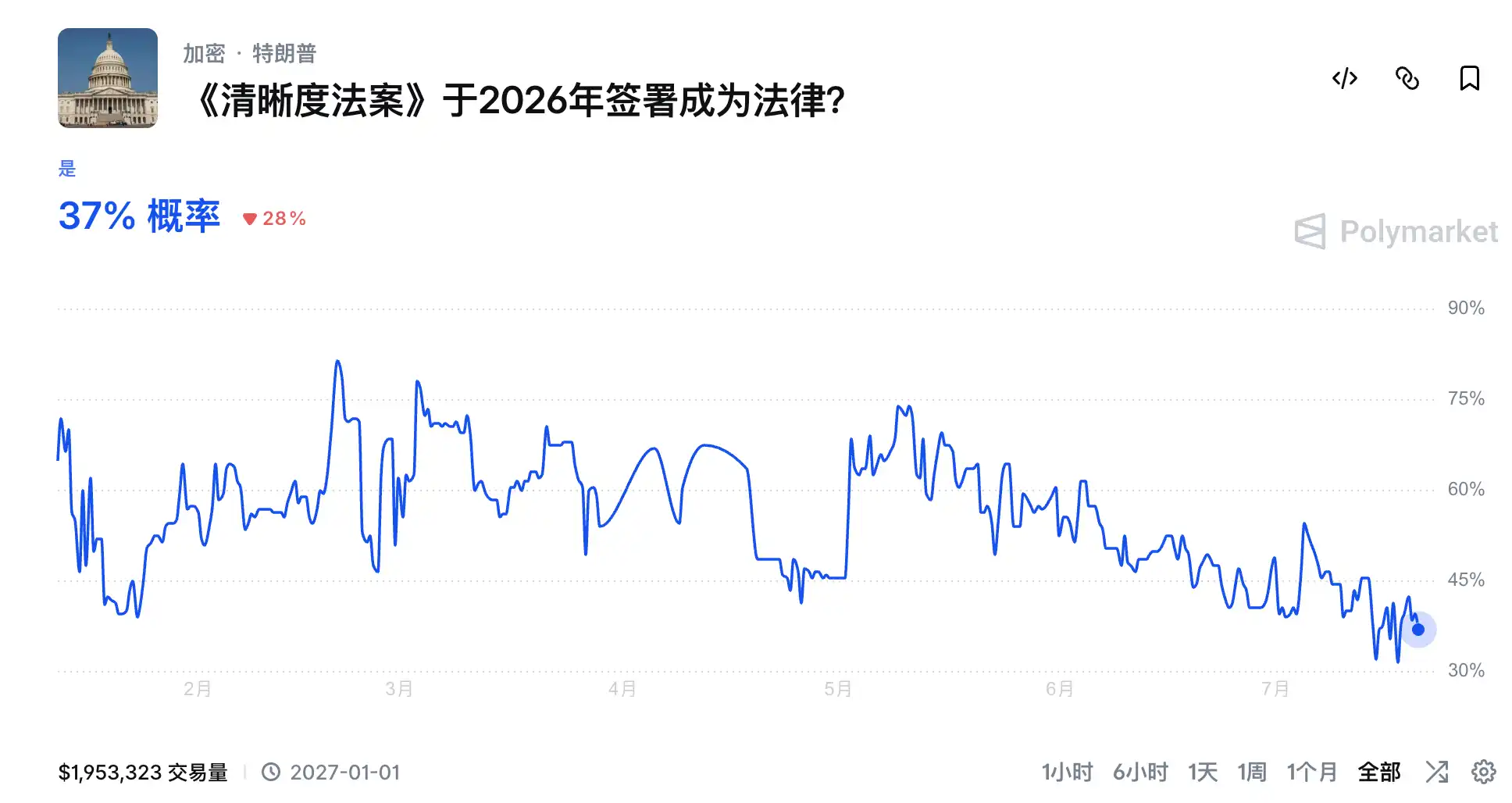
Shenchao TechFlow: Crypto KOL @TheDeFiInvestor listed this week's catalyst rundown, with 6 projects releasing positive news intensively, but the main theme of this week is regulation and revenue. Uniswap initiates on-chain voting today, proposing to channel V2/V3 protocol fees on Robinhood Chain into the UNI burn mechanism, while simultaneously activating V4 protocol fees on 7 chains. Robinhood Chain, live for only 18 days, has already seen cumulative Uniswap trading volume exceed $60 billion. On the macro front, Representative Bryan Steil expressed optimism about the CLARITY Act passing the Senate next week, but Polymarket gives it only a 34% probability of being signed into law this year. The Morpho Midnight fixed-rate lending protocol is set to go live publicly, Derive's V3 upgrade is imminent, and Pendle's community call on July 22 will disclose its roadmap.
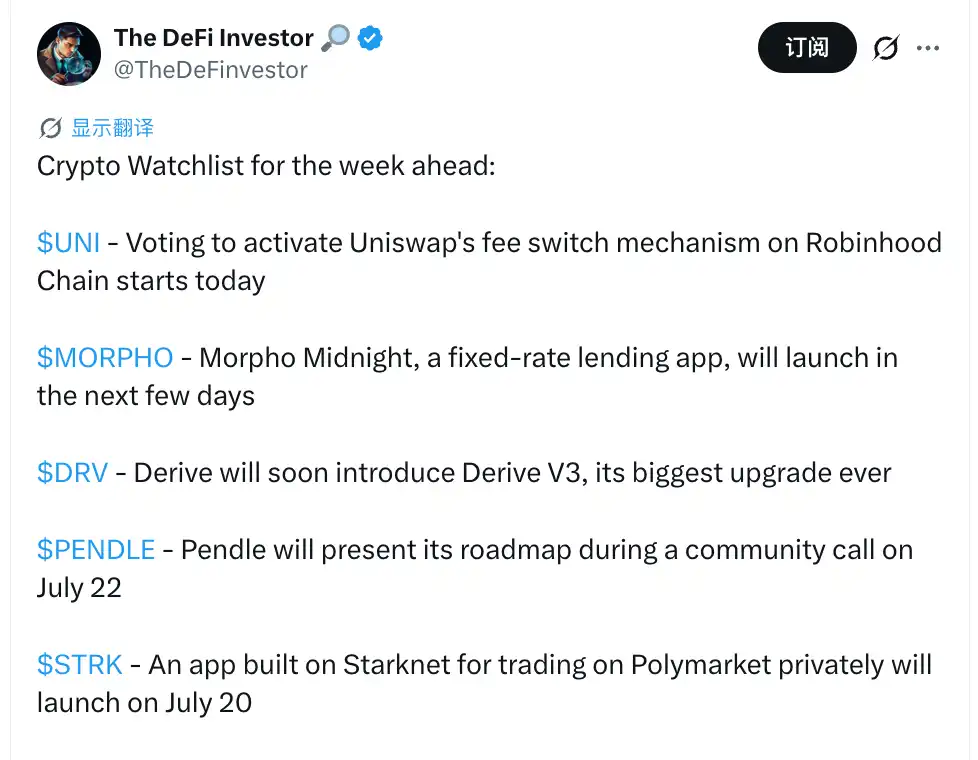
UNI: Fee Switch Vote Starts Today, Robinhood Chain's $60B Trading Volume to Enter Burn Mechanism
The most significant catalyst this week is Uniswap.
According to Crypto News on July 19, Uniswap founder Hayden Adams submitted two governance proposals on July 17, entering the final on-chain voting phase: the first to activate V2 and V3 protocol fees on Robinhood Chain, the second to activate V4 protocol fees on 7 chains including Ethereum, Base, Arbitrum, Robinhood Chain, BNB Chain, Polygon, and Optimism. The voting window is from July 19 to July 26, requiring a quorum of 40 million UNI to pass.
According to Crypto Times, Uniswap, deployed on Robinhood Chain for only 18 days, has seen cumulative trading volume surpass $60 billion. Robinhood Chain even briefly surpassed Hyperliquid in daily DEX volume, breaking $375 million in a single day. If the proposals pass, protocol fees collected on Robinhood Chain will flow into the TokenJar contract and eventually be bridged back to the Ethereum mainnet to burn UNI.
The backdrop of these proposals is the UNIfication proposal passed in December 2025. UNIfication passed with 125 million UNI votes in favor (only 742 against), first linking protocol fees to UNI burning, transforming UNI from a pure governance token into a cash-flow asset. According to Crypto News, Adams revealed on July 12 that Uniswap's daily average fee revenue had reached $5.2 million, surpassing all crypto protocols except the top two stablecoin issuers.
Risk reminder for holders: Voting is not yet concluded; after passing, there is a 2-day timelock. V4 fee structure is more complex due to hooks mechanism, with actual rates varying significantly by pool type. UNI has rebounded about 30% from the $2.70 low in July. Standard Chartered analyst Geoff Kendrick gave a year-end 2026 target price of $6.50, but this represents a single analyst view. Short-term sentiment appears relatively fully priced.
Macro Event: CLARITY Act Could Face Full Senate Vote This Week, But Polymarket Gives Only 34% Odds
The US crypto market structure bill, the CLARITY Act, is in its final sprint.
According to Benzinga on July 18, House Financial Services Committee Digital Assets Subcommittee Chairman Bryan Steil stated at a hearing in New York's Federal Hall that he is optimistic the Senate will pass the bill next week. Senator Cynthia Lummis is also reported to expect a full Senate vote during the week of July 20. Senate Republicans released an updated bill text following talks with the Trump White House.
According to CoinDesk on July 9, the bill needs to merge versions from the Senate Banking and Agriculture Committees and secure 60 votes to overcome the filibuster threshold. Republicans currently hold 53 seats, but Senators Josh Hawley and Rand Paul are expected to vote no, meaning at least 7 to 9 Democratic votes are needed. Currently, only two Democrats, Ruben Gallego and Angela Alsobrooks, voted in favor at the committee stage. According to Yahoo Finance, Stifel's chief Washington policy strategist Brian Gardner believes the bill "likely needs to pass the Senate by the end of July," or its prospects will "materially deteriorate."
On Polymarket, the odds for the CLARITY Act being signed into law this year stand at 34%, having previously touched 44% before quickly retreating.
For the crypto market, the bill would delineate digital asset regulatory boundaries between the SEC and CFTC, the most anticipated legislation in years for the industry. However, Democratic concerns over Trump's crypto conflicts of interest remain the biggest obstacle.
MORPHO: Morpho Midnight Fixed-Rate Lending Protocol Set for Public Launch
According to Bankless on July 17, Morpho CEO Paul Frambot announced that Morpho Midnight will end its months-long testing period and officially launch publicly "in the coming days." According to CoinMarketCap, the mainnet launch date for Midnight is July 18.
Morpho Midnight is the third-generation paradigm for DeFi lending. Frambot describes it as: first-gen protocols (like Compound) set risk, rates, and maturity by the protocol; Morpho Blue delegated risk management to vault curators; Midnight further delegates rate and maturity to the market. Lenders and borrowers trade around fixed rates and real maturity dates set by the market, introducing the long-missing duration dimension to DeFi.
The initial release is deliberately restrained: launching only one market on Base chain (cbBTC/USDC, also the largest market on Morpho Blue), offering multiple maturities, no vault adapter integration, no auto-rolling, and no cross-chain functionality. The subsequent roadmap includes vault adapters (connecting tens of billions in Morpho Vaults liquidity), more chains and collateral types, compliance gating, APIs, etc.
Morpho's current TVL is approximately $7.7 billion, second only to Aave, ranking second among DeFi lending protocols. According to CoinMarketCap data, Galaxy Curator integrated with Fireblocks Earn on July 17, directly connecting Morpho vault yields to over 2,400 institutions.
Risk reminder for holders: Fixed-rate lending has been attempted multiple times in DeFi but never truly scaled. Attracting sustained liquidity is the core challenge. The initial launch features only a single market on a single chain, limiting short-term impact on protocol revenue.
DRV: Derive to Launch V3 Soon, Its Largest Upgrade Ever
@TheDeFiInvestor states that Derive will launch V3 "soon," defining it as its largest upgrade ever.
Derive (formerly Lyra) is an on-chain options and derivatives protocol built on Derive L2 (an Ethereum Rollup based on OP Stack). According to CoinMarketCap, V3 will introduce 0DTE (Zero Days to Expiry) options and a more retail-oriented user experience.
Recent developments: DRV began trading on Coinbase on May 27, its largest centralized exchange listing. On April 23, the DAO passed a proposal to increase the proportion of protocol fees used for DRV buybacks from 25% to 35%, while cutting weekly staking emissions from 250k to 100k tokens. The DAO has cumulatively repurchased over 23 million DRV.
Risk reminder for holders: DRV market cap is approximately $116 million, with daily trading volume only about $170k, indicating relatively thin liquidity. The specific launch date and full feature list for V3 have not been officially released. The phrasing "soon" is akin to Aave App's "soon"—don't treat vague expectations as definite catalysts.
PENDLE: Community Call on July 22 to Disclose Roadmap, RWA Momentum is Focus
According to an official Pendle X post (published July 16), Pendle will hold a community call on Discord on July 22 at 1 PM UTC. Pendle previewed in the post that it will share "new updates" covering the next steps for RWA momentum and the roadmap to make Pendle "the greatest yield trading platform in global finance."
According to CoinMarketCap analysis, Pendle's recent expansion directions include distributing 470k MON tokens on Monad as incentives for YT holders (starting July 23), and expanding into commodity and stock perps (WTI Crude, Brent Crude, Gold, Silver, NVDA, TSLA, etc.) via Boros. Sierra integrated with Pendle in early July, offering structured yield products.
Risk reminder for holders: Community calls are inherently informational events. If the roadmap lacks substantive content beyond known expectations, it could trigger a "buy the rumor, sell the news" reaction. PENDLE's current price is approximately $1.52, market cap around $260 million, with 7-day price change nearly flat.
STRK: Starknet-Based Polymarket Privacy Trading App to Launch Privately on July 20
Public information indicates an application built on Starknet will launch privately on July 20, enabling users to trade on Polymarket in a privacy-preserving manner.
The specific project name and detailed information for this catalyst have not been publicly disclosed; it's a single-source report. However, the context is plausible: Starknet just rolled out a suite of privacy features (Private Yield, Private Swaps, Private Transfers) on July 3, and released the STRK20 private token standard on July 15, providing native support for protected ERC-20 transfers. A Polymarket frontend leveraging Starknet's ZK privacy capabilities is technically feasible.
Risk reminder for holders: The app's name, team, and functional scope have not been confirmed by independent sources. STRK faced approximately 127 million early investor token unlocks in mid-July, presenting supply-side pressure independent of the app launch. STRK's current price is around $0.029, down about 5.5% over 7 days, trading in its historical low range.






