Crypto Prices Drop On The Weekend As Iran Shuts Strait Of Hormuz Again

bitcoinistPublicado a 2026-04-20Actualizado a 2026-04-20

Resumen

Cryptocurrency prices declined over the weekend following Iran's decision to reclose the Strait of Hormuz, reversing the positive market reaction to its brief reopening. Bitcoin fell below $76,000 after reaching a 10-week high of $77,500, while Ethereum dropped to around $2,350. The global crypto market cap decreased by more than 2%, with major altcoins like XRP and Solana also experiencing losses. The renewed geopolitical tension has reintroduced volatility and uncertainty, casting doubt on earlier optimism about a market recovery. Further price fluctuations are expected if diplomatic tensions between the U.S. and Iran continue.

The crypto market suffered a slight dip on Saturday, April 18th, after the tensions in the Middle East took an interesting turn over the weekend. On Friday, United States President Donald Trump announced that Iran fully reopened the Strait of Hormuz (for the first time since March) for the free passage of oil vessels, with the global financial markets and crypto reacting positively to the news. However, Iran announced on Saturday that it has closed the Strait again, with digital asset prices dropping on the back of the fresh development.

Bitcoin Falls Below $76k As Iran Closes Strait Again

On Saturday, Iran’s military announced the closure of the Strait of Hormuz again, with reports suggesting at least three attacks on commercial ships along the waterway. After President Trump’s several announcements going into the weekend, the Iranian Speaker of the Parliament, Mohammad Ghalibaf, said the US president made “seven claims in one hour, all seven of which were false.”

What’s interesting is that the crypto and global financial markets have been seeing a return of bullish momentum after a ceasefire agreement was reached between the United States and Iran in recent weeks. However, with the ceasefire agreement set to expire in a couple of days and negotiations looking broken down, volatility and uncertainty seem set to return to the markets in the coming days.

According to data from CoinGecko, the global cryptocurrency market capitalization is down by more than 2%, with the Bitcoin and Ethereum prices showing dips of 2% and 3%, respectively. Specifically, the premier cryptocurrency, which ran up to a 10-week high of around $77,500 on Friday, is now back below $76,000.
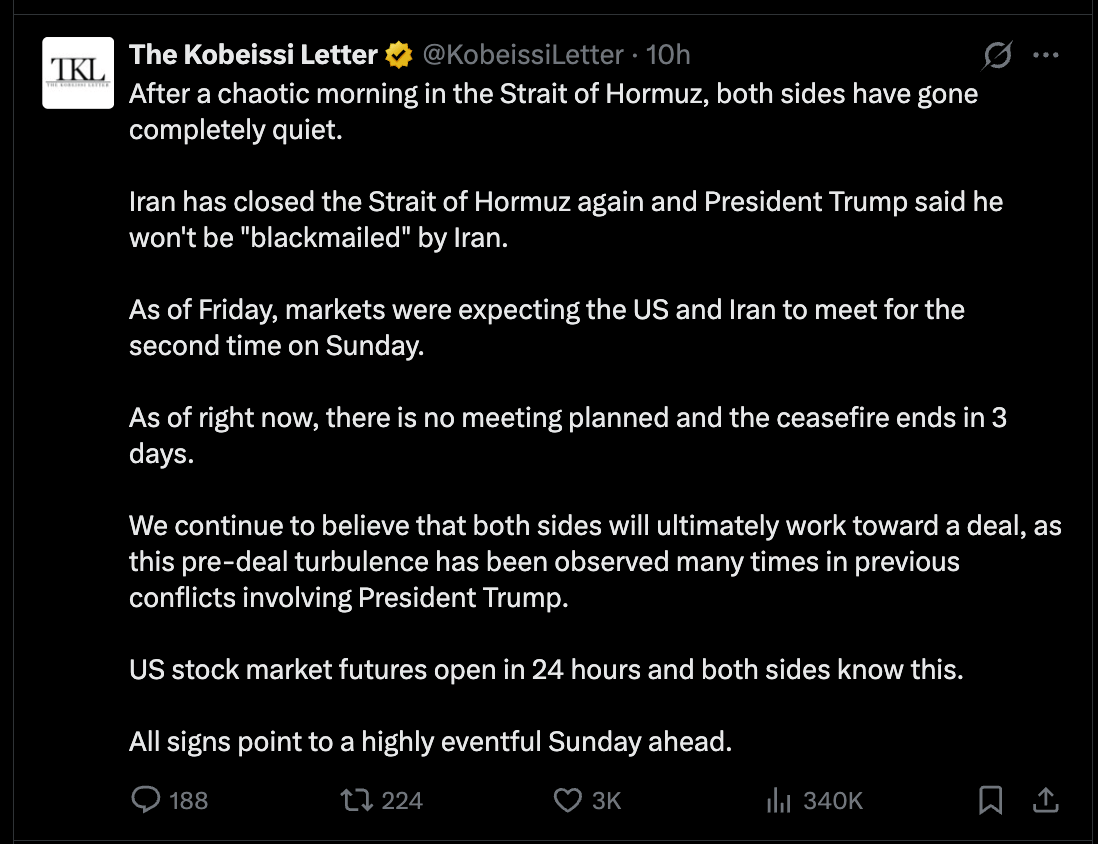
Source: @KobeissiLetter on X

Despite the crypto market gaining notoriety for slow price actions during the weekends, it’s interesting to see asset prices move in line with the latest developments in the Gulf. With no clear resolution in sight, the next few days could come with some degree of volatility.

Crypto Market Back To Point Zero?

Following these recent developments in the Middle East, conversations around the potential formation of a bottom in this current bear market now appear premature. Bitcoin, for instance, seems to have formed a local top around $77,500, with its current value at around $75,760.

Meanwhile, Ethereum, the second-largest cryptocurrency by market cap, sits at around $2,350, as of this writing. Other large-cap cryptocurrencies that have faced significant declines over the weekend include XRP and Solana, each falling by at leaast 3% in the past 24 hours.

The total crypto market cap on the daily timeframe | Source: TOTAL chart on TradingView

Preguntas relacionadas

QWhat event triggered the drop in cryptocurrency prices over the weekend?

AIran's announcement that it has closed the Strait of Hormuz again, with reports of attacks on commercial ships.

QHow did the global cryptocurrency market capitalization and the prices of Bitcoin and Ethereum change according to CoinGecko?

AThe global cryptocurrency market capitalization dropped by more than 2%, with Bitcoin and Ethereum prices falling by 2% and 3%, respectively.

QWhat had initially caused a positive reaction in the global financial and crypto markets on Friday?

AUnited States President Donald Trump's announcement that Iran fully reopened the Strait of Hormuz for the free passage of oil vessels.

QWhat is the current status of the ceasefire agreement between the United States and Iran mentioned in the article?

AThe ceasefire agreement is set to expire in a couple of days, and negotiations appear to have broken down, leading to increased volatility and uncertainty.

QWhat price levels did Bitcoin reach on Friday and where did it fall to after the news on Saturday?

ABitcoin reached a 10-week high of around $77,500 on Friday and fell back below $76,000 after the news on Saturday.

Lecturas Relacionadas

After 50x Storage Surge, Justin Sun Always Looks to the Next Decade

Sun Yuchen, known for his controversial stunts like a $30 million lunch with Warren Buffett (canceled due to a kidney stone) and eating a $6.2 million duct-taped banana, is often overshadowed by a significant fact: his decade-long track record of spotting major investment trends. In 2016, he famously advised young people to invest in Bitcoin, Nvidia, Tesla, and Tencent instead of buying property. A hypothetical $20,000 investment in Nvidia and Tesla from that list would now be worth over 50 million RMB. His latest major call was on November 6, 2025, predicting a "50x storage opportunity" tied to the AI boom, which materialized with Sandisk's stock surging nearly 50-fold by 2026. Looking ahead, Sun now focuses on the next frontier: Physical AI. He identifies four key areas: 1. **Embodied AI/Robotics**: He sees this reaching its "iPhone moment," with companies like UBTech and Galaxy General leading in commercialization. 2. **Drones**: Viewed as the first commercially viable form of Physical AI, revolutionizing sectors from warfare (e.g., AeroVironment's Switchblade) to logistics. 3. **Spatial Computing**: Beyond VR, it's about AI understanding physical space, a foundational technology for robotics and autonomous systems, exemplified by Apple's Vision Pro. 4. **Space Exploration**: After a 2025 suborbital flight with Blue Origin, Sun advocates for space as the ultimate frontier, discussing blockchain's potential role in space asset management and data transactions. His investment philosophy involves betting on entire, inevitable trends rather than single companies. For robotics, he sees Tesla (the body/manufacturer) and Nvidia (the brain/AI platform) as complementary plays. In defense drones, he highlights companies making tanks obsolete (AeroVironment) and those augmenting fighter jets (Kratos). For space, he participated in Blue Origin's flight and anticipates SpaceX's potential IPO to redefine the sector's valuation. Sun Yuchen's vision frames the next two decades not as a revolution in information flow (like the internet), but in the fundamental operation of the physical world through AI-powered robots, autonomous systems, and spatial intelligence, ultimately extending human and AI activity into space. While many still focus on conventional assets, he continues to look toward the next technological horizon.

marsbitHace 29 min(s)

After 50x Storage Surge, Justin Sun Always Looks to the Next Decade

marsbitHace 29 min(s)

The Billionaires Behind the Most Expensive Midterm Election in History

"The Most Expensive Midterm Elections and Their Billionaire Backers" This analysis details the unprecedented scale of spending in the 2026 midterm elections, highlighting the key billionaire donors shaping the political landscape. Jeff Yass, founder of Susquehanna International Group, has contributed over $81 million, ranking third among individual donors behind George Soros ($102.6M) and Elon Musk ($84.8M). Yass is a major donor to Trump's MAGA Inc. and supports school choice and various candidates. Overall, federal committees have raised over $4.7 billion this cycle, with political ad spending projected to reach $10.8 billion. Republican-aligned groups are significantly out-raising their Democratic counterparts. "Dark money" from undisclosed sources continues to grow. The core stakes involve control of Congress and policy direction for Trump's final term. Donors are also motivated by specific issues: Sergey Brin and Chris Larsen are funding opposition to a proposed California wealth tax and supporting crypto-friendly policies. Other top donors include OpenAI's Greg Brockman and his wife Anna ($50M total to MAGA Inc. and an AI-focused PAC), Richard Uihlein ($45.3M to conservative causes), venture capitalists Marc Andreessen and Ben Horowitz (each over $44M to crypto/AI PACs and MAGA Inc.), Miriam Adelson ($42.6M to GOP leadership PACs), Paul Singer ($33.9M), and Diane Hendricks ($25.8M to MAGA Inc.). The article notes that the peak fundraising period is still ahead, with major primaries approaching.

marsbitHace 31 min(s)

The Billionaires Behind the Most Expensive Midterm Election in History

marsbitHace 31 min(s)

The Largest IPO in History Is Approaching, Surpassing SpaceX, 28 Years of AI Self-Iteration, Countdown to Intelligence Explosion

"Anthropic Nears Trillion-Dollar IPO, Fueled by Explosive Growth and 2028 'Intelligence Explosion' Warning Anthropic is considering a deal valuing the AI company near $1 trillion, potentially leading to one of the largest IPOs ever and surpassing SpaceX. Its revenue has skyrocketed, with Annual Recurring Revenue (ARR) reaching $45 billion in May 2026—a 500% increase in just five months. This vertical growth curve is attributed to its key products, Claude Code and Cowork, dominating AI coding and enterprise collaboration. Beyond commercial success, co-founder Jack Clark issued a pivotal warning in an interview: there is a greater than 50% chance that by the end of 2028, AI systems will achieve recursive self-improvement—the ability to autonomously build a 'better version' of themselves, initiating an 'intelligence explosion.' This prophecy underpins the company's astronomical valuation, as the market prices in the potential for transformative and disruptive AI. Further signaling its ambition, Anthropic formed a $1.5 billion joint venture with Goldman Sachs and Blackstone, aiming to disrupt traditional consulting firms like McKinsey by deploying Claude AI for complex strategic work. This move tests AI's capacity to replace high-level cognitive labor, a precursor to its predicted autonomous evolution. The narrative presents a dual future: unprecedented economic opportunity alongside significant risks like economic restructuring and security threats. Anthropic's meteoric rise and Clark's 2028 prediction frame the coming years as a countdown to a potential technological singularity."

marsbitHace 43 min(s)

The Largest IPO in History Is Approaching, Surpassing SpaceX, 28 Years of AI Self-Iteration, Countdown to Intelligence Explosion

marsbitHace 43 min(s)

Trading

Spot
Futuros
活动图片