Crypto Markets Catch A Breather As Outflows Begin To Slow: Analysts

bitcoinistPublicado a 2026-02-10Actualizado a 2026-02-10

Resumen

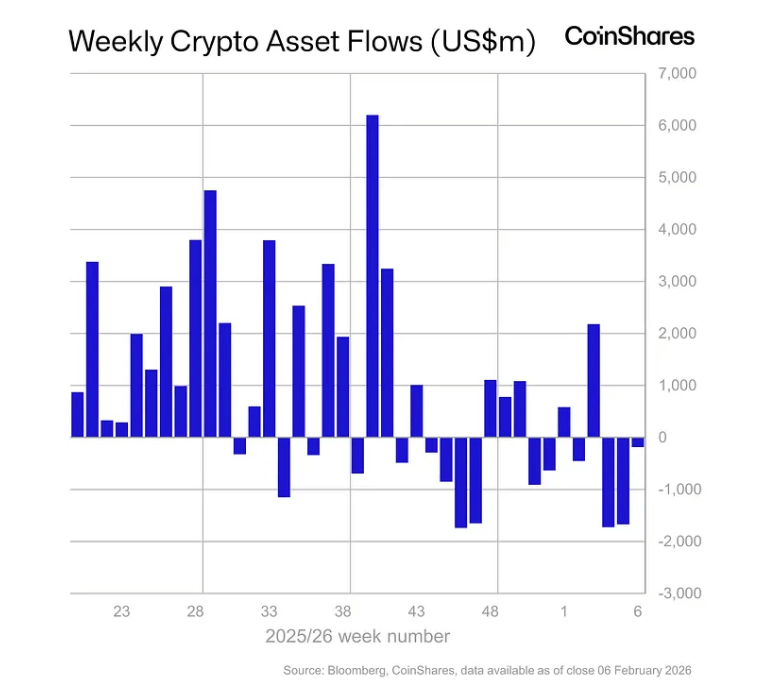
Crypto investment products experienced another week of net outflows, though the pace of withdrawals slowed significantly as prices stabilized. Trading activity reached a record high, with volumes exceeding $63 billion. Bitcoin-focused funds bore the brunt of the outflows, with approximately $264 million withdrawn. Meanwhile, some altcoins like XRP attracted fresh capital, suggesting a partial rotation by investors. Global crypto ETP assets declined to around $130 billion, the lowest since March 2025. Despite the downturn, new product filings, such as 21Shares' ETF application for Ondo, indicate continued industry development amid ongoing political and regulatory influences.

Crypto investment products saw another week of net withdrawals, but the rush out the door slowed sharply as prices found firmer footing. Trading activity stayed heavy, and a handful of altcoins drew fresh interest even while Bitcoin-focused funds lost ground.

Record Trading Activity

According to CoinShares, exchange-traded products logged a record week of trading, with volumes topping $63 billion. That was higher than the prior high set last October.

High turnover was mixed with net selling. James Butterfill, head of research at CoinShares, said a change in the speed of withdrawals can be more revealing than the raw outflows themselves.

Market watchers took that as a hint that investor mood might be shifting after several rough weeks.

Source: CoinShares
Bitcoin Takes The Brunt

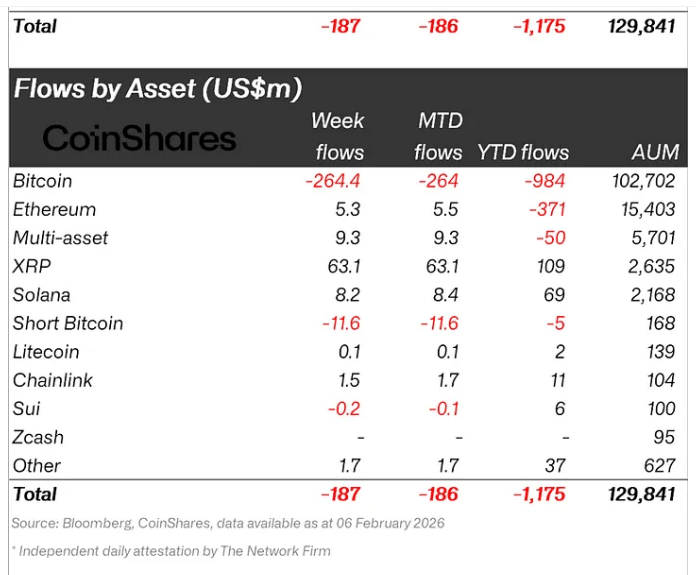
Bitcoin-linked ETPs were the main source of outflows. Reports say Bitcoin funds saw withdrawals around $264 million while spot Bitcoin ETFs accounted for about $318 million of that move, based on SoSoValue data.

The token’s price briefly touched $60,000 last Thursday on Coinbase, marking its lowest point since November 2024. That drop clearly weighed on funds tied directly to Bitcoin exposure.
Source: CoinShares

Altcoins Attract Some Fresh Capital

XRP led the inflows, drawing $63 million. Ether and Solana-linked products picked up smaller amounts, attracting $5.3 million and $8.2 million, respectively.

The flow mix suggests some investors are trimming big Bitcoin positions and shifting small slices into other tokens. That behavior was visible even as overall assets under management slid.

BTCUSD trading at $69,061 on the 24-hour chart: TradingView

Crypto AUM And Year-To-Date Flows

Global crypto ETP assets fell to close to $130 billion by week’s end, the lowest since March 2025. Bitcoin ETP AUM stood at about $102.7 billion, while ETF totals fell below $90 billion.

After three consecutive weeks of withdrawals, crypto ETPs have shed roughly $1.2 billion year-to-date, compared with almost $2 billion pulled from Bitcoin ETFs over the same span.

Industry Moves Continue

Beyond flows and prices, the market kept adding new product filings. Reports note that 21Shares filed with the US Securities and Exchange Commission for an ETF tied to Ondo. That kind of filing shows issuers still see demand for more varied crypto tools even in a cooling period.

Political signals have also been part of the backdrop. Markets remain sensitive to comments from US political figures, including US President Donald Trump, and to US regulatory talk that can shape investor appetite.

Featured image from TalkShop, chart from TradingView

Preguntas relacionadas

QWhat was the main reason analysts suggested a potential shift in investor sentiment despite continued outflows from crypto investment products?

AAnalysts pointed to the sharp slowdown in the speed of withdrawals as a more revealing indicator than the raw outflow numbers, hinting that investor mood might be shifting after several rough weeks as prices found firmer footing.

QWhich cryptocurrency's investment products were the primary source of outflows, and what was the approximate amount withdrawn from its ETFs according to SoSoValue data?

ABitcoin-linked ETPs were the main source of outflows. Spot Bitcoin ETFs accounted for approximately $318 million in withdrawals.

QWhich altcoin led the inflows for the week, and how much capital did it attract?

AXRP led the inflows for the week, attracting $63 million in fresh capital.

QWhat was the total value of assets under management (AUM) for global crypto ETPs by the end of the week, and what was significant about this level?

AGlobal crypto ETP assets fell to close to $130 billion by week’s end, which was the lowest level since March 2025.

QBeyond market flows, what action did 21Shares take that indicates continued issuer interest in new crypto products?

A21Shares filed with the US Securities and Exchange Commission for an ETF tied to Ondo, showing that issuers still see demand for more varied crypto tools even during a cooling period.

Lecturas Relacionadas

The Verdict in Choi Tae-won's Divorce Case: Revealing the Inheritance Undercurrent Behind SK Hynix's Trillion-Won Empire

SK Group Chairman Chey Tae-won's high-profile divorce case, involving a record 1.38 trillion won settlement, has drawn attention to the succession plans for Korea's second-largest conglomerate, especially its crown jewel, SK hynix. Unlike traditional chaebol scripts centered on the eldest son, Chey's three children from his marriage to former President Roh Tae-woo's daughter, Roh Soh-yeong, are carving distinct, non-traditional paths. Eldest daughter Chey Yun-jung (b. 1989) is seen as the most evident successor. With a scientific and consulting background, she holds executive roles at SK bioscience and SK Inc.'s growth support department, focusing on future strategy and biopharma. Her marriage is to an AI infrastructure entrepreneur, not a traditional business alliance. Second daughter Chey Min-jung (b. 1991) took a unique route, voluntarily serving as a South Korean naval officer, including an anti-piracy deployment. She later worked on policy and strategy for SK hynix in Washington D.C. before co-founding an AI-driven healthcare startup. She married a former U.S. Marine Corps officer, connecting her to U.S. defense and policy circles—networks crucial for a global semiconductor giant. The only son, Chey In-geun (b. 1995), who studied physics like his father, worked briefly at SK E&S before joining McKinsey. Despite fitting the traditional "heir" profile as the eldest son, he remains silent and holds no public position or shares in SK, suggesting the old succession playbook is obsolete. As SK hynix's valuation soars, becoming a geopolitical asset in the AI era, the heirs' legitimacy is no longer automatic. They must prove themselves in fields like AI biotech, global policy, and strategic consulting. Their marriages also reflect new elite networks in tech and defense, not old political alliances. Their inheritance is the complex challenge of navigating a globalized, tech-driven world, not just a corporate throne.

marsbitAyer 09:06

The Verdict in Choi Tae-won's Divorce Case: Revealing the Inheritance Undercurrent Behind SK Hynix's Trillion-Won Empire

marsbitAyer 09:06

From OpenSea to OpenRouter: Is Alex Atallah Repeating His 'Exit at the Peak' Playbook?

From OpenSea to OpenRouter: Is Alex Atallah Repeating His "Exit at the Peak" Playbook? According to the Wall Street Journal, payments giant Stripe is in talks to acquire the AI model aggregation platform OpenRouter in a potential deal valuing the company near $100 billion. This would mark founder Alex Atallah's second creation of a company reaching a $100 billion valuation, following his co-founding of NFT marketplace OpenSea. OpenRouter, founded just over three years ago, has grown rapidly by acting as a unified gateway for developers to access over 400 AI models. It currently has about 10 million users and processes over 200 trillion tokens monthly. While the platform's annualized revenue is around $50 million, its valuation has skyrocketed from $1.3 billion in March 2026. The potential acquisition by Stripe, a company OpenRouter's founder once likened it to, represents a major expansion into AI infrastructure for the payments leader. This move echoes Atallah's previous timing with OpenSea, where he departed before the NFT market's significant downturn. For OpenRouter, selling now may be strategic. Despite its scale, its business model—charging a 5-5.5% fee on AI inference calls—faces pressure from competition, open-source models, and potential price wars among model providers, limiting its profitability narrative for an IPO. A key asset for potential acquirers like Stripe is OpenRouter's vast repository of real-world AI usage data, which offers unique insights into model performance and developer preferences that are difficult to replicate. Whether this potential deal signifies a new valuation benchmark for AI infrastructure or another market peak signal remains to be seen.

链捕手Ayer 08:42

From OpenSea to OpenRouter: Is Alex Atallah Repeating His 'Exit at the Peak' Playbook?

链捕手Ayer 08:42

Trading

Spot
活动图片





