Crypto Investors Cheer As South Korea Scraps Punishing Tax Plan

bitcoinistPublicado a 2026-03-20Actualizado a 2026-03-20

Resumen

South Korea's main opposition party, the People Power Party, has proposed a bill to abolish the planned 20% tax on cryptocurrency gains, which was scheduled to take effect in 2027. The tax had been repeatedly delayed due to political debates and concerns over fairness, as it imposed a lower threshold compared to stock gains. The proposal aims to integrate crypto income into a unified financial investment tax framework instead of maintaining a separate regime. While this offers short-term relief for investors, the country continues to advance broader crypto regulations, including user protection laws and AI-powered tracking systems, indicating that a more comprehensive and integrated tax environment may still emerge in the future.

South Korean right-wing lawmakers have proposed a bill to abolish the taxation of crypto assets scheduled to take effect on January 1, 2027.

A Long Chain Of Regulation Delays

According to Korean outlet Digital Asset, Korea’s main opposition party the People Power Party is advancing a plan that would effectively abolish the dedicated 20% “crypto tax” by merging virtual‐asset income into a unified financial investment tax framework, instead of enforcing a separate regime just for digital assets.

The proposal comes after multiple postponements. Ruling and opposition parties alternated between promising delays and demanding quick implementation, repeatedly using crypto tax timelines as an election wedge with youth voters. The original 20% tax on gains over roughly ₩2.5 million was pushed from 2022 to 2023, then to 2025, and then again toward 2027 amid political infighting and concerns over investor protection.

The core issue has lays in parity. Crypto gains were set to be taxed at 20% above a very low threshold, while stock gains only paid similar rates above ₩50 million, fueling claims that young, retail‐heavy crypto traders were being unfairly targeted. Song Eon-seok, floor leader of the party and the responsible for introducing the bill, explained:

Given that the financial investment income tax has been abolished for the development of the capital market and the protection of investors, imposing a separate income tax on digital assets raises issues regarding equity and consistency in the tax system.

Kim Han-gyu, senior deputy floor leader for policy of the Democratic Party, responded to the proposal saying that they ruling party will discuss the bill now that it’s been introduced, although “there is no serious discussion or consensus within the party”, local media reported.

South Korea In The Forefront Of Crypto Regulation

South Korea has already rolled out the Virtual Asset User Protection Act and is still fighting over a second‐phase “Virtual Asset Law” covering stablecoins and more comprehensive oversight, underscoring that taxation is only one piece of a much tougher framework.

While many jurisdictions are tightening tax enforcement on digital assets, South Korea is prioritizing regulatory safeguards and market structure first. It’s worth noting, however, that South Korea’s National Tax Service is also moving ahead with a strong AI Crypto Tracking System, as reported by Bitcoinist on March 12.

A more balanced tax design could reduce incentives for Korean traders to move volume offshore or into grey‐area platforms, potentially supporting onshore liquidity and institutional participation. The apparent end of a standalone crypto tax is a short‐term relief, but once the unified financial investment tax kicks in, sophisticated reporting and on‐chain tracing tools mean evasion risks will climb. Active traders should prepare for stricter KYC, better record‐keeping, and the possibility that today’s relief turns into tomorrow’s more robust, integrated tax regime.
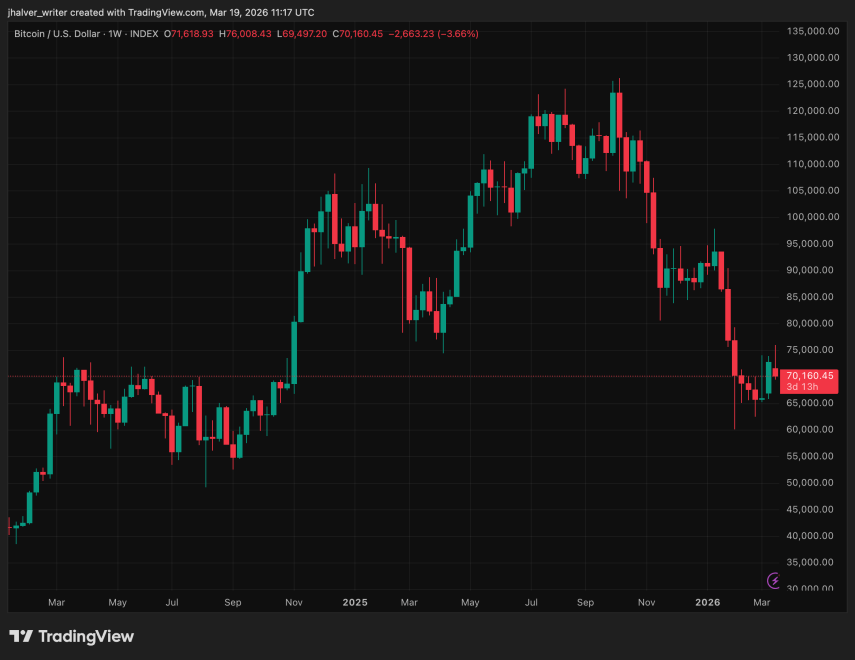
At the moment of writing, BTC’s trades for $70k on the daily chart. Source: BTCUSD on Tradingview

Cover image from Perplexity, BTCUSD chart from Tradingview

Preguntas relacionadas

QWhat is the main reason South Korean lawmakers are proposing to abolish the dedicated crypto tax?

AThey aim to address issues of equity and consistency in the tax system by merging virtual-asset income into a unified financial investment tax framework, rather than having a separate regime just for digital assets.

QHow many times has the implementation of South Korea's 20% crypto tax been postponed?

AThe tax has been postponed multiple times, originally from 2022 to 2023, then to 2025, and again to 2027.

QWhat was the key disparity between crypto and stock taxation that fueled claims of unfair targeting?

ACrypto gains were set to be taxed at 20% above a very low threshold (around ₩2.5 million), while stock gains only paid similar rates above a much higher threshold of ₩50 million.

QWhat broader regulatory framework is South Korea implementing alongside the tax discussion?

ASouth Korea has rolled out the Virtual Asset User Protection Act and is developing a second-phase 'Virtual Asset Law' covering stablecoins and more comprehensive oversight.

QWhat potential market impact could a more balanced tax design have according to the article?

AIt could reduce incentives for Korean traders to move volume offshore or into grey-area platforms, potentially supporting onshore liquidity and institutional participation.

Lecturas Relacionadas

The AI Agent Era Accelerates Its Arrival: Questflow Defines a New Paradigm of Financial Intelligence with On-Chain AI Brokerage

The AI Agent era is accelerating, with the CB Insights AI 100 list highlighting global investment confidence. The focus has shifted from whether AI works to its speed of deployment and ability to manage complex workflows, with autonomous AI Agents driving this transformation. At the forefront is Questflow, a Singapore-based startup redefining financial intelligence through its on-chain AI brokerage. Unlike tools that merely provide data dashboards, Questflow deploys AI Agents that proactively scan markets, form judgments, and execute trades via a conversational interface—operating 24/7 without requiring manual confirmation for each decision. This embodies the new AI paradigm of agents capable of executing multi-step workflows autonomously. Questflow's mission is to democratize institutional-grade trading intelligence. Historically reserved for the ultra-wealthy, this capability is now accessible starting from just $1 through Questflow's "AI Clone + Copy Trade" model. The platform charges only a 1% execution fee, aligning its incentives directly with users and eliminating traditional management or performance fees. The timing is opportune, aligning with key trends identified by CB Insights: the scalable deployment of AI Agents, accelerated AI adoption in financial services, and the maturation of on-chain infrastructure. With robust liquidity on platforms like Hyperliquid and Polymarket, alongside advancements in AI reasoning and non-custodial wallet security, Questflow is positioned to merge the roles of broker, fund, and exchange into a single, accessible platform for millions.

链捕手Hace 40 min(s)

The AI Agent Era Accelerates Its Arrival: Questflow Defines a New Paradigm of Financial Intelligence with On-Chain AI Brokerage

链捕手Hace 40 min(s)

Why Pricing Social Interactions is Doomed to Fail?

Titled "Why Putting a Price on Social Interaction Is Doomed to Fail," this article critiques attempts to monetize social networks directly through SocialFi models, arguing their inevitable failure stems from a fundamental misunderstanding of media dynamics. Using Marshall McLuhan's theory of "hot" and "cold" media, the author posits that social networks are inherently "cold" media. Their value isn't contained in individual posts but is co-created through user participation, interpretation, and fragmented, ongoing interaction (e.g., replies, shares). This ambiguity and need for user involvement are core to their function. The article asserts that SocialFi projects like Friend.tech failed because introducing real-time, tradable financial pricing (a definitive "hot" signal) into this "cold" environment doesn't add a layer—it replaces the medium's essence. The unambiguous price signal overshadows and nullifies the nuanced, participatory social signal. Users become traders, not participants, and when speculative profits vanish, the underlying social ecosystem—never genuinely cultivated—collapses entirely. This principle extends beyond crypto. The author argues platforms like Twitter have gradually "heated up" through metrics (likes, retweets counts, algorithmically defined value), shifting users from participants to performers and eroding organic engagement. The solution isn't to abandon capital but to manage its entry point. Successful models like Substack, Patreon, or Bandcamp allow capital to "condense" at specific, isolated nodes (e.g., subscriptions, one-time payments) without permeating and "heating" every social interaction. They preserve the core "cold," participatory medium while enabling monetization at designated boundaries. The NFT boom and bust serves as a stark parallel: the ancient "cold" medium of collecting (valued for story, community, gradual accumulation) was rapidly destroyed by platforms that introduced real-time floor prices, rarity scores, and trading dashboards, transforming collectors into speculators and vaporizing cultural value when prices fell. The core lesson: "Liquidity equals heat." Injecting high liquidity and definitive pricing into a "cold" participatory medium doesn't optimize it; it fundamentally alters and destroys its value-creating mechanism. The future lies not in pricing every social gesture but in finding precise, non-invasive points for capital to condense without overheating the entire ecosystem.

marsbitHace 48 min(s)

Why Pricing Social Interactions is Doomed to Fail?

marsbitHace 48 min(s)

Trading

Spot
Futuros
活动图片





