Crypto Goes Davos: Ripple And Hedera Step Into WEF Week

bitcoinistPublicado a 2026-01-15Actualizado a 2026-01-15

Resumen

Ripple CEO Brad Garlinghouse will participate in a World Economic Forum (WEF) panel titled "Is Tokenization the Future?" during Davos 2026, alongside leaders from Coinbase, Standard Chartered, and the ECB. The discussion will focus on tokenization's transition from pilots to mainstream financial infrastructure. Ripple is also a sponsor of the privately organized USA House venue. Hedera is an official sponsor of USA House and will contribute to high-level discussions on digital assets, AI, and central banking. It is also sponsoring the Global Blockchain Business Council’s "Blockchain Central Davos." Additionally, Hedera's carbon-market initiative, EcoGuard Global, will launch at Davos, offering end-to-end digital infrastructure for high-integrity carbon markets, built on the Hedera network.

Ripple CEO Brad Garlinghouse is slated to appear on a World Economic Forum (WEF) panel on tokenization during Davos 2026, while Hedera says it will sponsor and participate in a slate of senior-level events running alongside the annual gathering. The WEF Annual Meeting 2026 is scheduled for Jan. 19–23 in Davos-Klosters.

Ripple Joins WEF Davos Tokenization Panel

Garlinghouse is once again listed among the public speakers for a WEF session titled “Is Tokenization the Future?” set for Jan. 21 (10:15–11:00 CET). The panel also lists Coinbase CEO Brian Armstrong, Standard Chartered CEO Bill Winters, ECB Governor François Villeroy de Galhau, Eurazeo CEO Valérie Urbain, and moderator Karen Tso.

The session framing is explicitly market-structure oriented, positioning tokenization as something moving beyond pilots and into mainstream financial rails. In the WEF description, organizers write: “Asset tokenization is accelerating quickly, moving from early experiments to full deployment across major asset classes. As adoption expands, it promises new ways for individuals to invest while presenting traditional firms and emerging innovators with complex new dynamics.”

A separate thread of Ripple’s Davos presence may run through “USA House,” a privately organized venue that typically operates in parallel with the official WEF perimeter. Venue materials list Ripple among sponsors of USA House for Davos 2026.

Hedera Brings EcoGuard Global To Davos

Hedera, for its part, is leaning into Davos week as a convening calendar rather than a single stage appearance. In a statement via X, Hedera announced: “Hedera is proud to be an official sponsor of the USA House during the WEF Annual Meeting in Davos, and will contribute to senior-level discussions on digital assets, AI, central banking, and G20 coordination.”

Hedera is also sponsoring Global Blockchain Business Council’s “Blockchain Central Davos,” which runs Jan. 19–22 alongside the WEF meeting, according to Hedera and GBBC materials.

Separately, a Hedera-built carbon-market initiative called EcoGuard Global is scheduled to officially launch in Davos on Jan. 20 at Turmhotel Victoria (3:00–6:00 PM), per EcoGuard’s announcement.

The EcoGuard description pitches an end-to-end infrastructure play around integrity and lifecycle accounting:

“EcoGuard Global is a full carbon lifecycle company building and operating digital infrastructure and managed marketplaces—while actively participating in carbon markets as a developer, investor, and market enabler for high-integrity climate projects... Built on the Hedera network by The Hashgraph Group, EcoGuard Global combines trusted digital infrastructure with market operations, capital, and partnerships to support credible, investable, and scalable carbon markets.”

At press time, HBAR traded at $0.12134.
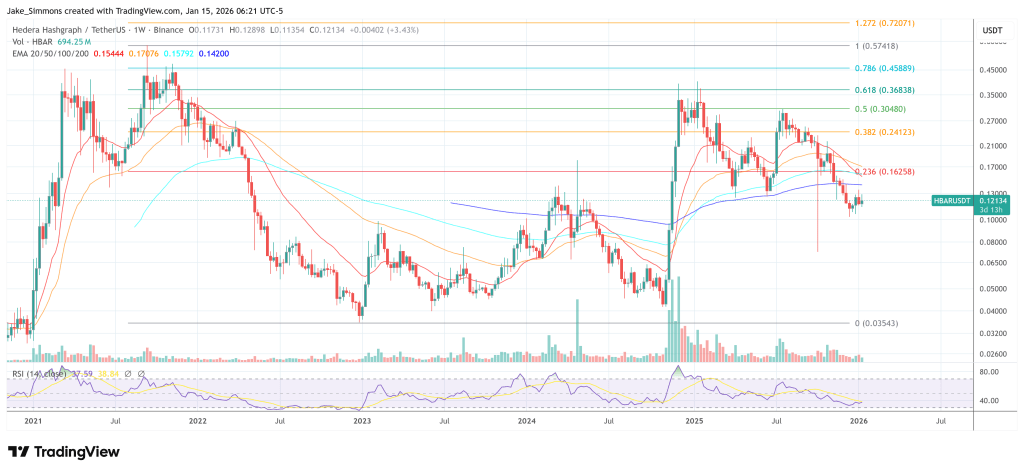
HBAR remains below the 200-week EMA, 1-week chart | Source: HBARUSDT on TradingView.com

Lecturas Relacionadas

From Payment to Deployment: Stripe Bets on the AI Agent Economy

From Payments to Deployment: Stripe Bets on the AI Agent Economy Stripe is redefining economic infrastructure for the AI era, shifting its focus from serving primarily human users and software companies to enabling machine agents as active economic participants. The core thesis is that AI agents are evolving from tools into independent buyers and builders on the internet, necessitating a complete overhaul of traditional payment, billing, and deployment models. To empower agents as **buyers**, Stripe, in collaboration with Tempo, developed the Machine Payments Protocol. This protocol allows businesses to programmatically accept payments from agents without human intervention, using machine-readable payment instructions. Furthermore, Stripe's consumer wallet, Link, is being adapted to let users securely authorize agents to spend on their behalf. To empower agents as **builders**, Stripe Projects aims to simplify the deployment process. It allows developers and their agents to register, manage, and integrate the services needed to deploy applications directly from the command line, making "vibe-deploying" as seamless as "vibe-coding." This agent-driven economy, where products have real, variable costs (like AI tokens), disrupts traditional SaaS models. **Token-based monetization** is becoming central, requiring usage-based billing that charges for actual resource consumption, as seen with companies like Lovable and ElevenLabs. However, this model introduces new challenges like **token theft**, where fraudsters exploit services and vanish before billing. Stripe Radar helps combat this by assessing new accounts and predicting abuse risks. A critical innovation to balance customer experience and financial risk is **streaming payments**. By combining Metronome (for real-time usage tracking) with Tempo (for low-cost, high-frequency stablecoin payments), Stripe enables AI companies to collect fees *as tokens are consumed*. This eliminates the trade-off between imposing hard usage caps and risking unpaid invoices. In summary, Stripe's vision for AI economic infrastructure now encompasses providing a commercial framework for agents, wallets for agents, deployment tools for agents, token-based billing, fraud prevention for token abuse, and streaming payment capabilities. As AI transforms both commerce and software creation, Stripe is building the foundational infrastructure to support it.

marsbitHace 18 min(s)

From Payment to Deployment: Stripe Bets on the AI Agent Economy

marsbitHace 18 min(s)

Trading

Spot
Futuros
活动图片





