Crypto Funds Extend Three-Week Run With $1B Inflows Despite Geopolitical Stress

bitcoinistPublicado a 2026-03-17Actualizado a 2026-03-17

Global crypto funds attracted a remarkable $1 billion in inflows last week, marking their third consecutive week of positive net flows and best performance in two months, while underscoring resilience amid geopolitical challenges.

Crypto Funds’ Positive Streak Extends

According to the latest CoinShares data, crypto funds drew $1.06 billion in inflows last week, continuing their positive net flows run for the third consecutive week and extending their best performance since the year started.

Notably, crypto Exchange-Traded Products (ETPs) had a five-week run of negative net flows from January 19 to February 20 amid market weakness and broader negative sentiment. The investment products had cumulative outflows of $4 billion, registering their worst performance since the October 10 crash.

The US market experienced most of the negative net flows during this period, while Bitcoin-based ETPs saw the weakest performance among major cryptocurrencies, with over $3.80 billion in outflows.

However, US investors’ renewed demand for digital asset investment products since the end of February, particularly Bitcoin Exchange-Traded Funds (ETFs), has reduced the prior one-month outflows streak, bringing the three-week run of inflows to $2.62 billion.
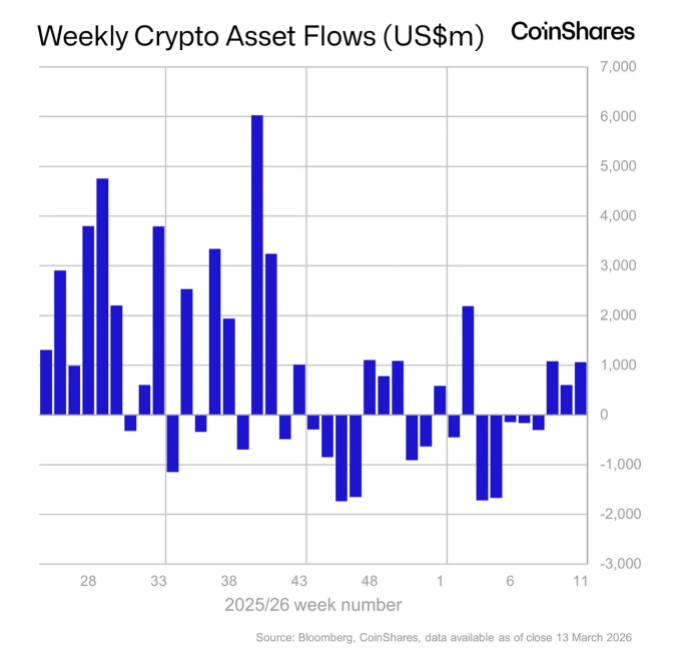
Crypto funds attract massive inflows for the third consecutive week.  Source: CoinShares

Regionally, 96% of the inflows originated from the US, with Canada and Switzerland following with $19.4 million and $10.4 million, respectively. Hong Kong also attracted $23.1 million in inflows, marking the best performance since August 2025. In contrast, Germany recorded outflows of $17.1 million, its first negative net flows in 2026, according to CoinShares’ data.

Funds based on the flagship cryptocurrency showed the strongest performance this week, with $793 million in inflows. This accounts for 75% of total inflows, bringing BTC’s three-week inflows to $2.2 billion.

The report noted that short Bitcoin investment products also attracted $8.1 million in inflows last week, highlighting that market opinion remains somewhat polarized.

Meanwhile, Ethereum funds also saw meaningful inflows worth $315 million, partially driven by BlackRock’s debut of its staked Ether ETF in the US. This brings the category’s year-to-date (YTD) flows, which are on a net outflow position, near a net-neutral position.

Digital Assets, Bitcoin’s ‘Safe Haven’ Narrative Reinforced

James Butterfill, head of research at CoinShares, highlighted crypto funds’ strong performance despite the increasing Middle East tensions, explaining that “significant geopolitical disruption has reinforced digital assets, particularly Bitcoin, as a relative safe haven compared with other asset classes.”

Since the beginning of the Iran crisis, total assets under management (AuM) in crypto ETPs have risen by 9.4% to $140 billion, Butterfill noted on Monday. Notably, Nate Geraci, co-founder of the ETF Institute, recently affirmed that ETF investors have “largely displayed diamond hands” since the October correction began.

The expert emphasized that 50% drawdowns “are a walk in the park for long-time BTC investors,” but observed that newer ETF investors also appear unfazed by the recent market volatility.

Bloomberg Intelligence Senior ETF Analyst Eric Balchunas also shared a similar perspective on the performance of spot Bitcoin ETFs, calling the investment products’ resilience “absurd” amid the market conditions.

The latest QCP Market Colour highlighted that crypto is rallying and institutional liquidity is also returning, while equities and gold remain under pressure. According to the Monday analysis, recent price actions suggest a resurgence of Bitcoin’s narrative as a “digital safe haven” or “geopolitical hedge,” with “markets stress-testing that thesis in real time.”

“If this pattern persists, it would be a late-quarter plot twist, given crypto’s underdog status and its familiar habit of correlating with traditional assets mostly on the way down,” the report stated.
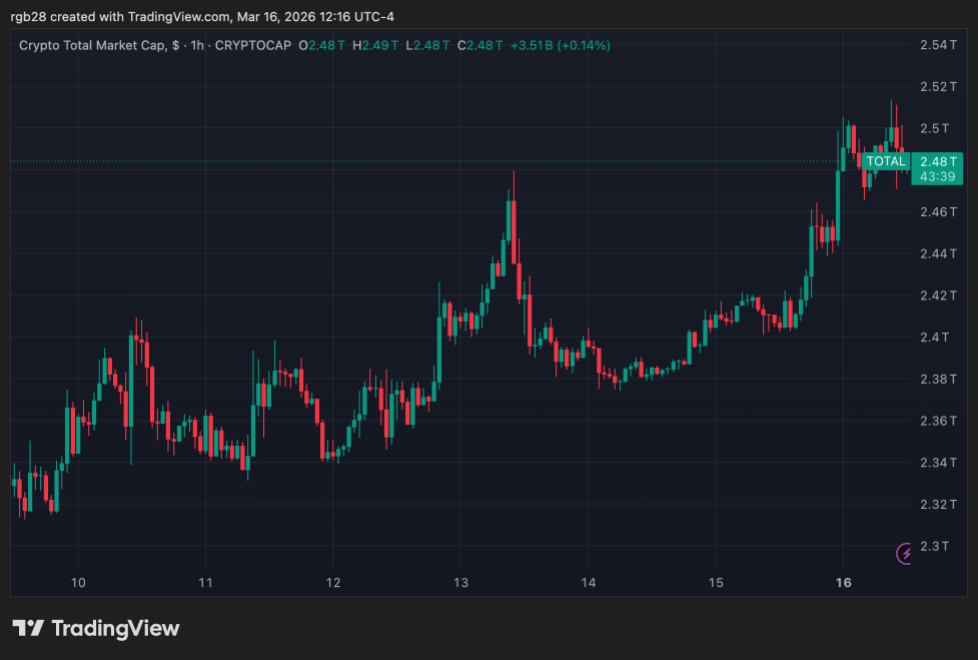
The total crypto market capitalization is at $2.48 trillion on the one-week chart. Source: TOTAL on TradingView


Preguntas relacionadas

QHow much in inflows did crypto funds attract last week, and what does this represent?

ACrypto funds attracted $1.06 billion in inflows last week, marking their third consecutive week of positive net flows and their best performance in two months.

QWhich region was the primary source of the crypto fund inflows, and how much did it contribute?

AThe United States was the primary source, contributing 96% of the total inflows.

QWhat was the performance of Bitcoin-based funds specifically, and how much did they attract in inflows?

ABitcoin-based funds showed the strongest performance, attracting $793 million in inflows, which accounts for 75% of the total inflows for the week.

QAccording to the head of research at CoinShares, how has recent geopolitical disruption affected the perception of digital assets?

AJames Butterfill stated that significant geopolitical disruption has reinforced digital assets, particularly Bitcoin, as a relative safe haven compared to other asset classes.

QWhat notable inflow did Ethereum funds see, and what was a key driver behind this activity?

AEthereum funds saw inflows of $315 million, partially driven by BlackRock's debut of its staked Ether ETF in the US.

Lecturas Relacionadas

Stuck Polymarket: The Real Test After Riding the Traffic Boom Has Arrived

Polymarket, a leading prediction market platform, is facing significant technical challenges as its growth outpaces its current infrastructure on Polygon. Users are experiencing laggy transactions, unresponsive orders, and delayed confirmations, severely impacting the trading experience. In response, DeFi Engineering VP Josh Stevens outlined a comprehensive engineering overhaul. The plan includes reducing on-chain data delays, fixing order cancellation issues, rebuilding the central limit order book (CLOB), improving website performance, and developing a unified SDK and API. A major revelation was the ongoing "chain migration," indicating a potential move away from Polygon. The core issue is that Polymarket has evolved from a simple prediction market into a high-frequency trading platform, making Polygon's limitations—such as block space, gas fees, and block time—a ceiling for further growth. The migration is not just a simple chain switch but a fundamental rebuild of its trading system to support more complex products like perpetual contracts (Perps). This announcement has sparked competition among chains like Solana, Sui, and Algorand, all vying to host Polymarket. For Polygon, losing this key application, which contributes significantly to its gas fee revenue, would be a major setback. The real test for Polymarket is no longer attracting users but proving it can provide a stable, reliable trading environment that retains them.

Odaily星球日报Hace 59 min(s)

Stuck Polymarket: The Real Test After Riding the Traffic Boom Has Arrived

Odaily星球日报Hace 59 min(s)

Lowering Expectations for BTC's Next Bull Market

The author, Alex Xu, explains his decision to significantly reduce his Bitcoin holdings (from full to ~30% of his portfolio) during the current bull cycle, citing a lowered long-term outlook for BTC's price appreciation in the next cycle. He outlines six key reasons for this reduced expectation: 1. **Diminished Growth Drivers:** The narrative of exponential user adoption has largely played out with institutional ETF adoption. The next major growth phase—adoption by sovereign national reserves or central banks—seems unlikely in the near future. 2. **Personal Opportunity Cost:** More attractive investment opportunities have emerged in other assets, such as undervalued companies. 3. **Industry-Wide Contraction:** The broader crypto industry is struggling, with most Web3 business models (SocialFi, GameFi, DePIN) failing. This overall萧条 (depression) reduces the fundamental demand and consensus for Bitcoin. 4. **Strain on Major Buyer:** MicroStrategy, a major corporate buyer of BTC, faces rising financing expenses for its debt, which could slow its purchasing rate and create significant marginal pressure on the market. 5. **Increased Competition from Gold:** The emergence of "tokenized gold" has closed the functional gap (portability, divisibility) between physical gold and Bitcoin, offering a strong competitor in the non-sovereign store-of-value space. 6. **Security Budget Concerns:** The block reward halving continues to exacerbate the long-standing issue of funding Bitcoin's network security, with new fee source explorations like Ordinals and L2s largely failing. The author's decision to hold a significant (though reduced) position reflects a cautious, not bearish, outlook. He remains open to increasing his exposure if the fundamental reasons for his skepticism change or if new positive catalysts emerge.

marsbitHace 1 hora(s)

Lowering Expectations for BTC's Next Bull Market

marsbitHace 1 hora(s)

Trading

Spot
Futuros
活动图片




