Crypto Exchange Backpack Targets Token Launch Soon, as BMIC Fires Up Quantum Defense

bitcoinistPublicado a 2026-02-10Actualizado a 2026-02-10

Resumen

Crypto exchange Backpack is signaling an imminent token launch, leveraging growing activity and trading on the Solana ecosystem. The platform, known for its points-based rewards system, is positioning itself as a regulated "super app" combining a non-custodial wallet with exchange services. Meanwhile, a growing security threat is emerging: the risk posed by quantum computing to current encryption standards. Hackers are already using a "Harvest Now, Decrypt Later" strategy, collecting encrypted blockchain data to decrypt later when quantum computers become powerful enough. In response, BMIC is developing a quantum-secure financial infrastructure, featuring a wallet with post-quantum cryptography that avoids public-key exposure and integrates AI-driven threat detection. Its ongoing presale has raised over $445K, reflecting investor interest in long-term security solutions. The trend highlights a market split between short-term speculative trading on platforms like Backpack and long-term investments in infrastructure aimed at mitigating future technological risks.

Trusted Editorial content, reviewed by leading industry experts and seasoned editors. Ad Disclosure

Quick Facts:

  • ➡️ Backpack exchange is signaling an imminent token launch, capitalizing on increased Solana ecosystem activity and trading volume.
  • ➡️ The ‘Harvest Now, Decrypt Later’ strategy by hackers necessitates an urgent upgrade to blockchain encryption standards before quantum computing matures.
  • ➡️ BMIC provides a necessary solution with its quantum-secure wallet and AI-driven threat detection, aiming to protect assets from future decryption threats.
  • ➡️ The industry is seeing a bifurcated trend: immediate speculative trading on exchanges versus long-term infrastructure hedging against existential tech risks.

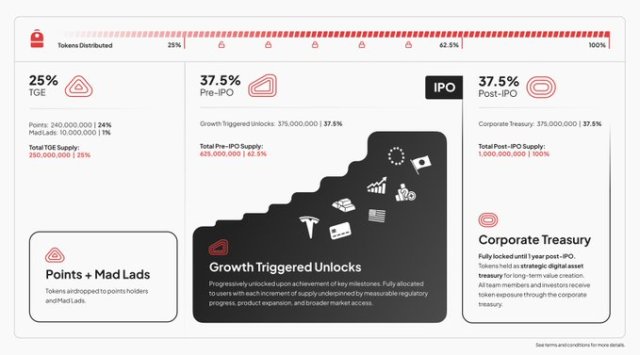
The Solana ecosystem is bracing for another liquidity injection as the highly anticipated Backpack exchange token launch moves closer to reality. For months, the platform, founded by the creators of the Mad Lads NFT collection, has run a points program rewarding volume.

Traders know the drill: points usually mean a native token generation event (TGE) is just around the corner. It’s a strategy that has successfully siphoned volume from established giants, positioning Backpack not just as a centralized exchange (CEX), but as a regulated ‘super app’ blending a non-custodial wallet with a trading venue.

The timing is impeccable. With Bitcoin hovering near all-time highs and liquidity rotating back into high-performance chains like Solana, the appetite for infrastructure plays is peaking. Smart money isn’t just chasing speculative fervor anymore; it’s positioning itself in protocols with tangible utility.

Backpack’s potential launch represents a shift toward platforms that actually blend a compliant user experience with a decentralized ethos.
But while capital floods into these next-gen exchanges, the security architecture supporting them faces a quieter, darker threat. The looming arrival of quantum computing poses a severe risk to the standard encryption protecting nearly every digital asset in circulation.

While traders focus on the immediate upside of a Backpack airdrop, forward-thinking investors are asking a harder question: what protects those gains five years from now? This search for longevity has directed significant attention toward BMIC ($BMIC), a project engineering the first quantum-secure financial stack designed to survive the post-quantum era.

Learn more about BMIC here.

Post-Quantum Cryptography Redefines Wallet Security

The crypto industry faces a ‘Harvest Now, Decrypt Later’ threat vector that most retail participants overlook. Nation-states and malicious actors are currently scraping encrypted blockchain data, which is immutable and public, to store it until quantum computers are powerful enough to break the RSA and Elliptic Curve Cryptography (ECC) standards securing Bitcoin and Ethereum.

BMIC addresses this inevitability by deploying a quantum-secure wallet infrastructure utilizing post-quantum cryptography (PQC). Unlike legacy wallets that leave public keys exposed after transactions, this protocol ensures zero public-key exposure.

And it doesn’t stop at encryption. The project integrates an AI-enhanced threat detection system directly into its Quantum Meta-Cloud.

This creates a dual-layer defense: cryptographic hardness against brute force attacks and active, algorithmic monitoring for anomalous transaction patterns. For enterprises and high-net-worth holders, this distinction is critical. Current security solutions focus on phishing and seed phrase management, but they remain fundamentally vulnerable to the mathematical breakthroughs quantum computing will bring.

This project’s approach to ERC-4337 Smart Accounts further modernizes the user experience, allowing for abstracting gas fees and social recovery without compromising the quantum-proof shield.

$BMIC is available here.

Early Investors Target BMIC Presale for Future-Proof Gains

As the narrative shifts from speed to security, capital is beginning to flow into the BMIC presale, which has already raised $445K+. The project is currently offering tokens at $0.049474, a price point reflecting an early-stage valuation for infrastructure that aims to become an industry standard.
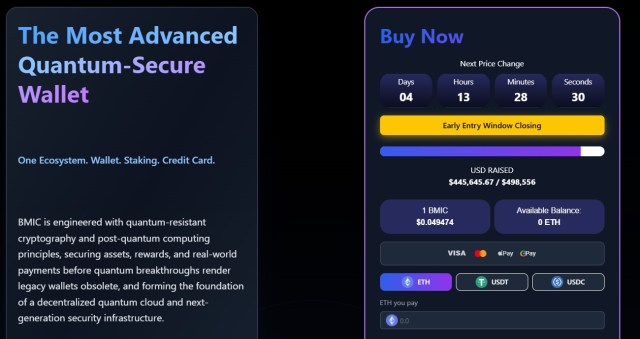
The utility of the token extends beyond simple governance; it functions as ecosystem fuel for the entire stack, including the ‘Burn-to-Compute’ mechanism and access to quantum-secure payment layers.

The robust raise indicates the market is waking up to the necessity of PQC. While exchanges like Backpack capture the current trading zeitgeist, infrastructure protocols like this are hedging against the technological obsolescence of current blockchain security.

The integration of staking and governance within a quantum-secure environment solves the dilemma of having to choose between earning yield and maintaining maximum security. With the presale ongoing, participants are effectively betting that the transition to quantum-resistant ledgers isn’t a matter of ‘if,’ but ‘when.’

Buy your $BMIC here.

Disclaimer: The information provided in this article is for educational purposes only and does not constitute financial advice. Cryptocurrency investments carry high risk, including the potential loss of all invested capital. Always conduct independent research.

Editorial Process for bitcoinist is centered on delivering thoroughly researched, accurate, and unbiased content. We uphold strict sourcing standards, and each page undergoes diligent review by our team of top technology experts and seasoned editors. This process ensures the integrity, relevance, and value of our content for our readers.

patrubogdan

Follow

Full Profile

Related Posts

US Debt Spiral Eyes $39T: Why Bitcoin Hyper ($HYPER) Is The Hedge to Watch

Ethereum Foundation Backs SEAL Initiative as LiquidChain L3 Protocol Gains Traction

Vitalik Buterin Outlines Ethereum’s AI Future, While SUBBD Token Targets the Creator Economy

Binance Dominates Trump’s USD1 Supply as Bitcoin Hyper Breaks Records

Cathie Wood’s Ark Invest Buys More Bullish Assets Just Days After Last Purchase, While LiquidChain Turns Heads

Polymarket Sues Massachusetts Over Prediction Market Regulation – SUBBD Token Takes Advantage

Preguntas relacionadas

QWhat is the main purpose of the Backpack exchange's points program, and what event does it typically signal?

AThe Backpack exchange's points program rewards trading volume and typically signals an imminent native token generation event (TGE).

QWhat is the 'Harvest Now, Decrypt Later' threat mentioned in the article, and why is it a concern for blockchain security?

AThe 'Harvest Now, Decrypt Later' threat is a strategy where hackers scrape and store encrypted blockchain data now, with the intention of decrypting it later when quantum computers become powerful enough to break current encryption standards like RSA and Elliptic Curve Cryptography (ECC).

QHow does the BMIC project propose to protect digital assets from the threat of quantum computing?

ABMIC proposes a quantum-secure wallet infrastructure that utilizes post-quantum cryptography (PQC) to ensure zero public-key exposure, and an AI-enhanced threat detection system within its Quantum Meta-Cloud for a dual-layer defense.

QWhat are the two distinct investment trends the article identifies in the current crypto market?

AThe article identifies a bifurcated trend: immediate speculative trading on exchanges (e.g., anticipating a Backpack token) versus long-term infrastructure investments hedging against existential technological risks (e.g., investing in quantum-secure protocols like BMIC).

QWhat is the current status of the BMIC token presale and its price, according to the article?

AThe BMIC token presale has raised over $445,000 and is currently offering tokens at a price of $0.049474.

Lecturas Relacionadas

Platform Token Soars 15x in Half a Month, Pons Tops Robinhood Chain Charts for Both Token Launches and Trading

In just half a month, the Pons platform token (PONS) surged over 15x in value as Pons solidified its position as the leading token launch and trading platform on Robinhood Chain, capturing both the highest daily token creation volume and transaction volume. Following the exit of previous leader NOXA, competition initially favored Flap before Pons emerged dominant around mid-July. By July 26th, Pons accounted for 77.1% of total trading volume across all Robinhood Chain launchpads. Pons's success is attributed to its streamlined, one-transaction process for deploying a token contract and its corresponding Uniswap V3 liquidity pool simultaneously, eliminating the need for bonding curves or complex migrations. This simplicity, combined with low creation costs and immediate tradability, attracted significant creation activity and speculative trading. The meteoric rise of its native token, PONS, further fueled platform growth. A tokenomics model directing 80% of protocol fees to buy back and burn PONS created a reinforcing cycle: platform usage boosted PONS value, which in turn attracted more users. Looking ahead, Pons V2 aims to expand beyond meme tokens by integrating support for paying fees in stablecoins (USDG) and RWA assets, aligning with Robinhood Chain's broader focus on on-chain finance and stock tokens.

Odaily星球日报Hace 21 min(s)

Platform Token Soars 15x in Half a Month, Pons Tops Robinhood Chain Charts for Both Token Launches and Trading

Odaily星球日报Hace 21 min(s)

Qualcomm Chip Price Hike Deals a Blow to Android Phones

Qualcomm has officially announced a new round of price increases for its entire chip portfolio, effective September 1. The hikes, reaching up to 18% for the flagship Snapdragon 8 Elite Gen 6 Pro, follow similar moves by MediaTek, intensifying cost pressures on the already strained smartphone industry. CEO Cristiano Amon confirmed the plan, citing the need to offset rising industry-wide costs and restore declining profit margins. Qualcomm's Q3 FY2026 results showed a 25% drop in net profit, with mobile revenue plunging 20% year-over-year, hitting its lowest level since 2021. The surge in AI computing demand has led memory manufacturers to prioritize HBM production, creating a shortage in general-purpose DRAM and NAND Flash chips. Their prices soared by 93%-98% and 55%-60% respectively in Q1 2026, causing the memory cost share in smartphones to jump from 10%-15% to over 30%. Coupled with the soaring cost of advanced nodes like TSMC's 2nm and packaging, overall chip costs have reached historic highs. These upstream pressures are forcing downstream smartphone brands like Xiaomi, OPPO, and vivo to cut orders for mid-to-low-end models by up to 20% and use cost-saving measures like older chipsets. Reportedly, the Snapdragon 8E5 will be repurposed as a "long-lasting" chip for sub-brand phones in H2 2026. Amid this cost crisis, the Android market remains sluggish. Q2 2026 smartphone shipments in China fell 4.3% year-over-year, marking five consecutive quarters of decline. Major Android brands saw market share drop, while Huawei and Apple, with their in-house chip advantages, gained share. Qualcomm is diversifying into automotive and IoT sectors to reduce reliance on smartphones, but these new segments cannot yet fill the mobile revenue gap. Industry observers warn that the full impact of component cost hikes will hit in the second half of 2026, likely leading to higher-than-expected price increases for Android flagships and a further contraction in the Chinese smartphone market.

marsbitHace 32 min(s)

Qualcomm Chip Price Hike Deals a Blow to Android Phones

marsbitHace 32 min(s)

Breaking: GPT-5.6 Prices Slashed Effective Today

OpenAI has announced significant price cuts for its GPT-5.6 model API, effective immediately. The entry-level **GPT-5.6 Luna** sees the most drastic reduction, with input prices dropping 80% to $0.20 per million tokens and output prices falling to $1.20 per million tokens. The mid-tier **GPT-5.6 Terra** is reduced by 20%, now costing $2.00 (input) and $12.00 (output) per million tokens. The flagship **GPT-5.6 Sol** maintains its original price but introduces a new **Fast mode**, offering speeds up to 2.5 times faster for double the cost. The company attributes these price reductions to efficiency gains achieved through **GPT-5.6 Sol's own involvement in optimizing its production systems**. The model assisted in rewriting GPU kernels and improving speculative decoding, leading to a 20% reduction in end-to-end service costs and over 15% improvement in token generation efficiency. OpenAI emphasizes this process remained human-led. A key focus of the降价 is to lower the barrier for running **AI agent workflows**. By making the capable, tool-calling Luna model significantly cheaper, OpenAI aims to enable more frequent use in cost-sensitive, high-volume tasks like code review and monitoring. This creates a potential feedback loop: model-assisted efficiency gains lead to lower costs, which enables broader agent deployment, which in turn drives further optimization. The new pricing and features will also apply to Codex and ChatGPT Work subscriptions. The changes intensify competition in the large language model market, with OpenAI directly challenging rivals like Anthropic to respond.

marsbitHace 1 hora(s)

Breaking: GPT-5.6 Prices Slashed Effective Today

marsbitHace 1 hora(s)

Trading

Spot
活动图片