Crypto ETFs Continue to Decline with Major New Outflows

bitcoinistPublicado a 2026-02-02Actualizado a 2026-02-02

Resumen

Crypto ETFs, particularly U.S. spot bitcoin ETFs, are experiencing significant and sustained outflows, with a notable peak of approximately $818 million in net withdrawals on January 29th. This trend reflects a broader tactical pullback by investors amid renewed market volatility and a shift towards risk reduction, coinciding with turbulence in other risk-sensitive assets. While ETFs remain a crucial gateway for institutional crypto access due to their convenience and compliance benefits, their flows have become procyclical—amplifying bullish trends and exacerbating downturns. Meanwhile, the memecoin sector continues to develop actively, with new projects like MAXI Doge emerging. In January, U.S. spot bitcoin ETFs saw an estimated $1.6 billion in net outflows, indicating a more defensive start to the year than anticipated.

After a turbulent start to the year, exchange-traded funds (ETFs) backed by cryptocurrencies continue to record significant outflows. The movement, concentrated on spot Bitcoin ETFs, fuels the idea of a tactical withdrawal by investors in the face of renewed volatility. In this context, the market is watching a key indicator: the ability of ETFs to cushion stress phases, rather than amplify them.

Repeated Outflows from Spot Bitcoin ETFs

Withdrawals have accelerated over several sessions, with a notable peak on January 29, when U.S.-listed spot Bitcoin ETFs recorded approximately $818 million in net outflows, according to data tracked by Farside Investors and cited by market aggregators.
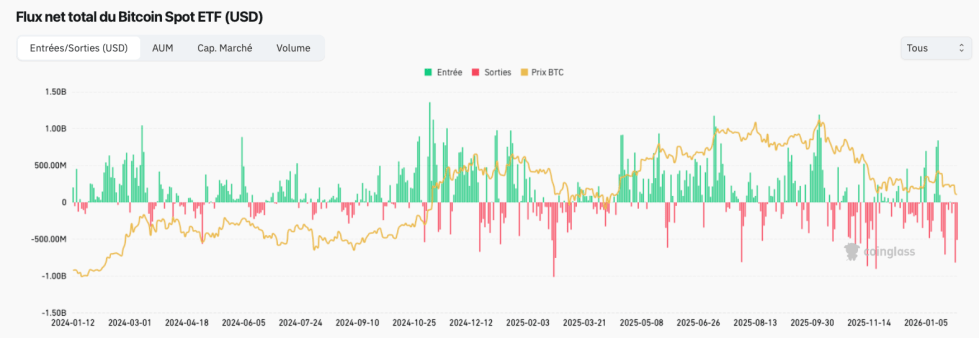
This mechanism is important because net redemptions mean that intermediaries are reducing exposure, which can lead to sales of underlying Bitcoins when shares are destroyed. In other words, the ETF becomes a rapid transition mechanism between market sentiment and the pressure that builds on-chain, especially when leverage deflates across the entire ecosystem.

The concentration of outflows on the largest vehicles is also being scrutinized. Even though major managers like BlackRock, Fidelity, or Grayscale remain structural for institutional access, short-term arbitrage is taking over during correction phases.

A Reduction in On-Chain Risk for Crypto Investors

These outflows are part of a broader climate of risk reduction, where investors are arbitrating towards more liquidity as the trajectory of U.S. monetary policy becomes uncertain again. Movements in Bitcoin and Ether have thus coincided with shocks in other assets deemed riskier, and with renewed nervousness in traditional markets.

Nevertheless, the interpretation remains open. ETFs retain a gateway role, as they simplify ownership, compliance, and portfolio integration. The question is therefore less about their utility and more about the pace, with flows becoming procyclical again, favorable in an upward trend, unfavorable when volatility dominates.

Another factor is the monthly reading. Several market summaries indicate that in January, U.S. spot Bitcoin ETFs would have accumulated approximately $1.6 billion in net outflows, a sign of a more defensive start to the year than expected given the geopolitical context.

Amid ETFs, Memecoins Show No Weakness and Accelerate Development

While ETFs are gaining ground, the world of memecoins is far from buried; on the contrary. The future is being built with new presales, notably MAXI Doge, which aims to do even better than DOGE in 2026. With a TGE approaching at high speed, this new figure in the crypto ecosystem is very promising.

Indeed, the Maxi Doge project features a token called MAXI, presented as a meme-inspired token. Its communication emphasizes a highly speculative identity and a market culture focused on performance. So, is a gain of over 300% within reach? This makes it an asset to watch closely.


This article does not constitute investment advice in any way. The information provided here should not be used as a basis for making financial decisions. Cryptocurrency investments carry risks and can lead to significant losses. You should only invest what you can afford to lose and conduct your own research before making any investment decision.


Preguntas relacionadas

QWhat is the main trend observed in cryptocurrency ETFs according to the article?

ACryptocurrency ETFs are experiencing significant outflows, particularly spot Bitcoin ETFs, indicating a tactical pullback by investors due to increased market volatility.

QWhat was the peak net outflow amount for US spot Bitcoin ETFs on January 29th?

AUS spot Bitcoin ETFs recorded approximately $818 million in net outflows on January 29th.

QHow does the outflows from ETFs impact the underlying Bitcoin market?

ANet redemptions mean intermediaries are reducing their exposure, which can lead to sales of the underlying Bitcoins when the shares are destroyed, making ETFs a rapid transition tool between market sentiment and on-chain selling pressure.

QWhat broader market context are these crypto ETF outflows a part of?

AThe outflows are part of a broader climate of risk reduction, where investors are moving towards more liquidity as the trajectory of US monetary policy becomes uncertain, coinciding with shake-ups in other risky assets and traditional markets.

QDespite the outflows from ETFs, what other part of the crypto ecosystem is showing strong development?

AThe memecoin sector is not weakening but accelerating its growth, with new projects like MAXI Doge emerging and aiming for high performance, presenting itself as a promising asset to watch.

Lecturas Relacionadas

In Conversation with Ray Dalio: We Are Currently in an AI Bubble, with 1% of My Portfolio in Bitcoin

Ray Dalio, founder of Bridgewater Associates, warns in an interview that the current AI boom shows classic bubble characteristics, which could lead to significant economic downturns as seen in past cycles like 1929 or 2000. He explains that speculative enthusiasm, fueled by debt and overvaluation, often precedes a crash when rising rates or taxation force asset sales, causing widespread losses and recession. Dalio also outlines his "Big Cycle" theory, describing an approximate 80-year pattern where widening wealth gaps, massive government deficits, and shifting geopolitical power (like China's rise) create internal conflict and global instability. He emphasizes that we are in a late-cycle, transitional phase where traditional powers like the US and UK face decline. For personal wealth protection, Dalio advises diversification beyond cash into assets like stocks, bonds, real estate, and particularly gold, which he prefers over Bitcoin. While he holds about 1% of his portfolio in Bitcoin as a non-printable hard asset, he views gold as more secure from technological or governmental threats. Regarding AI's impact, Dalio believes it will disproportionately benefit capital owners, worsening inequality by replacing both physical and cognitive labor. He suggests that human intuition and emotional intelligence, combined with AI, will be key for future workers. On taxation, Dalio argues that wealth taxes are impractical and risk triggering asset sell-offs, reducing productive investment. He points to the UK as a cautionary example of debt, low productivity, and political strife. Geopolitically, Dalio foresees a more regionalized world, with the US showing weakness in prolonged conflicts like with Iran, akin to past imperial declines. The ideal outcome, he suggests, is coexisting powerful blocs (e.g., Americas, China-Asia Pacific) without major war.

marsbitHace 3 hora(s)

In Conversation with Ray Dalio: We Are Currently in an AI Bubble, with 1% of My Portfolio in Bitcoin

marsbitHace 3 hora(s)

Daily 7.2 Trillion KRW: Foreign Capital's Record Net Buying on Friday! Wall Street Says Headwinds for Korean Stock Fund Flows Have Subsided

South Korean stock market sees a dramatic shift in fund flows. On July 31, foreign investors made a record net purchase of approximately KRW 7.2 trillion in KOSPI stocks, marking a fundamental reversal from the persistent large-scale net outflows seen in previous months. This contributed to a significant narrowing of foreign net selling in July to KRW 9.8 trillion, down sharply from KRW 48.4 trillion in June and KRW 44.5 trillion in May. Simultaneously, domestic institutional pressure eased. South Korean pension funds and asset managers turned to a net buying position in July, purchasing KRW 1.0 trillion worth of KOSPI shares, contrasting with net sales in May and June. Market volatility is expected to be dampened by new financial regulations. Effective July 31, the Financial Services Commission tightened access for retail investors to single-stock leveraged ETFs by raising the minimum cash deposit requirement. Trading volumes for these products subsequently dropped to about 50% of their monthly average. Citigroup Research maintains its year-end KOSPI target of 10,000 points. The firm cites several supportive factors: the substantial easing of headwinds from capital outflows, a robust fundamental outlook for the semiconductor sector, historically low market valuations, strong economic fundamentals, and the potential for policy support from financial authorities if needed.

marsbitHace 3 hora(s)

Daily 7.2 Trillion KRW: Foreign Capital's Record Net Buying on Friday! Wall Street Says Headwinds for Korean Stock Fund Flows Have Subsided

marsbitHace 3 hora(s)

Thanks to Dice Rolls, Bitcoin Keys Are Stored Offline, But Not Everyone Will Do It

The article discusses using dice rolls to generate secure Bitcoin wallet seeds, providing entropy independent of potentially flawed hardware random number generators. It explains that each fair dice roll offers about 2.585 bits of entropy, with around 50 rolls needed for a standard 12-word seed phrase and 99+ recommended for higher security. This method gained attention after a vulnerability was revealed in some Coldcard hardware wallets, where a faulty firmware RNG (dating back to 2021) compromised generated keys. The analysis notes that while a dice-generated main seed was safe from this specific flaw, other Coldcard functions (like creating paper wallets, backup keys, or passwords) could still be vulnerable if they used the defective RNG. The piece argues that while dice-based entropy is technically robust, the manual process is error-prone, tedious, and unrealistic for most new users, who might make mistakes in recording or inputting rolls. It concludes that while manual entropy generation should remain an option for advanced users, the long-term goal is to develop reliable, user-friendly hardware and software that securely generates randomness without requiring specialized knowledge. Coldcard users are advised to check their firmware version and replace any secondary secrets (like paper wallet keys) created with vulnerable devices, while also considering multi-signature setups with devices from different manufacturers for added security.

cryptonews.ruHace 8 hora(s)

Thanks to Dice Rolls, Bitcoin Keys Are Stored Offline, But Not Everyone Will Do It

cryptonews.ruHace 8 hora(s)

Trading

Spot
活动图片




