Crypto Continues to Expand in Asia as Thailand Clears Path for Digital Asset Derivatives

bitcoinistPublicado a 2026-02-13Actualizado a 2026-02-13

Resumen

Thailand's Cabinet has approved amendments to the Derivatives Act, allowing digital assets like Bitcoin to serve as underlying instruments for regulated derivatives contracts. The Securities and Exchange Commission (SEC) will update licensing and supervision rules to enable crypto-linked futures and options on platforms such as the Thailand Futures Exchange. This move aims to enhance crypto's recognition as an investable asset class, expand investor access, and improve risk management tools. The reform aligns with Thailand's growing crypto market, valued at $3.19 billion as of August 2025, and supports plans for future crypto ETFs. The SEC will implement safeguards to address volatility and protect investors.

Thailand has taken a further step toward integrating crypto into its mainstream financial system, after the Cabinet approved changes that allow digital assets to underpin regulated derivatives contracts. The move positions the country among a growing number of Asian markets adapting crypto-linked financial products.

On Feb. 10, Thailand’s Cabinet endorsed a Finance Ministry proposal to expand the scope of assets permitted under the Derivatives Act B.E. 2546 (2003). The amendment enables digital assets, including cryptos such as Bitcoin, to serve as underlying instruments for futures and options traded on regulated platforms.

The Securities and Exchange Commission (SEC) will now amend the Derivatives Act and draft supporting regulations to govern participation, licensing, and supervision.
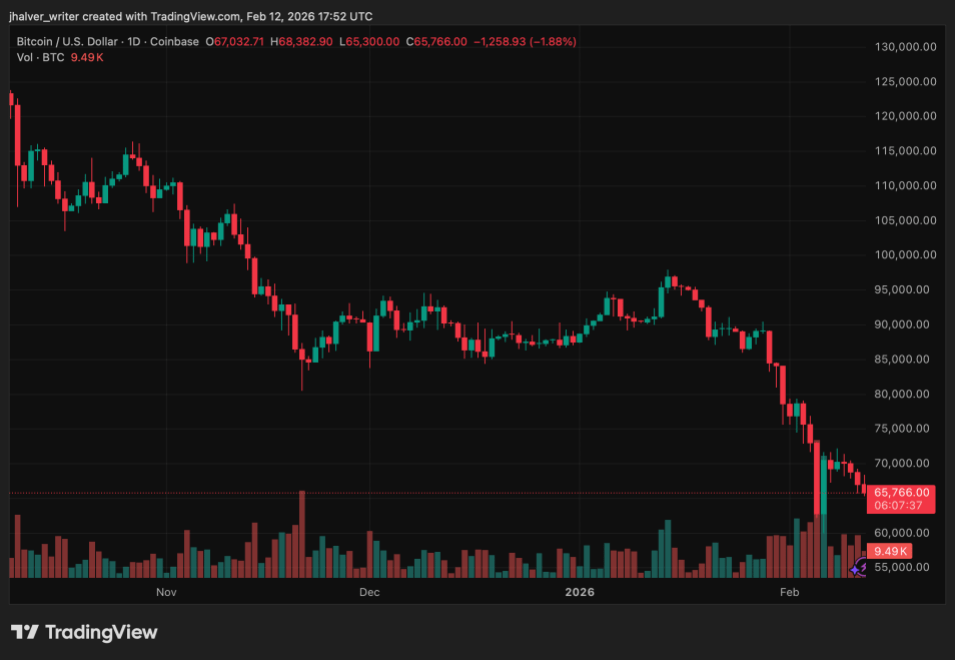
BTC's price trends to the downside on the daily chart. Source: BTCUSD on Tradingview

Thailand Integrates Crypto Into Regulated Derivatives Market

Under the revised framework, digital assets will be recognized as permissible underlying assets for derivatives products listed on exchanges such as the Thailand Futures Exchange (TFEX).

The SEC said it will revise derivatives business licenses to allow digital asset operators to offer crypto-linked contracts and will review supervisory standards for exchanges and clearinghouses.

SEC Secretary-General Pornanong Budsaratragoon said the expansion is intended to strengthen the recognition of cryptocurrencies as an investment asset class, broaden investor access, and enhance risk management tools.

The regulator will also work with TFEX to determine contract specifications that account for the volatility and risk characteristics of digital assets. Officials indicated that supervisory safeguards and investor protection measures will remain central as the market evolves.

In addition to cryptocurrencies, the amendment reclassifies carbon credits, enabling the introduction of physically delivered futures contracts alongside cash-settled products. The measure aligns with Thailand’s draft Climate Change Act and its broader carbon-neutrality objectives.

Growing Institutional Focus and Market Expansion

Thailand’s latest reform builds on a regulatory framework introduced in 2018, when the country enacted rules governing digital asset businesses. Oversight has since expanded to include stricter operational requirements and investor protection measures, while crypto payments remain prohibited by the central bank.

The SEC’s broader 2026 capital markets roadmap includes plans to introduce crypto exchange-traded funds (ETFs), subject to legal amendments. Officials have indicated that crypto ETFs could launch later this year.

Thailand’s domestic crypto market has also grown steadily. As of August 2025, the SEC valued the market at approximately $3.19 billion, with average daily trading volumes near $95 million. Active accounts rose to 230,000, reflecting increased participation from retail investors, foreign entities, and domestic institutions.

Industry participants say integrating crypto into the derivatives market could improve liquidity and provide hedging tools, but some have cautioned that capital requirements and disclosure standards must keep pace to manage systemic risk.

Cover image from ChatGPT, BTCUSD chart from Tradingview

Preguntas relacionadas

QWhat recent regulatory change did Thailand's Cabinet approve regarding digital assets?

AThailand's Cabinet approved changes to the Derivatives Act to allow digital assets, including cryptocurrencies like Bitcoin, to serve as underlying instruments for regulated futures and options contracts.

QWhich regulatory body is responsible for amending the Derivatives Act and drafting supporting regulations for this new framework?

AThe Securities and Exchange Commission (SEC) is responsible for amending the Derivatives Act and drafting the supporting regulations to govern participation, licensing, and supervision.

QWhat are the stated goals of integrating crypto into the derivatives market, according to SEC Secretary-General Pornanong Budsaratragoon?

AThe goals are to strengthen the recognition of cryptocurrencies as an investment asset class, broaden investor access, and enhance risk management tools.

QBesides cryptocurrencies, what other asset was reclassified by this amendment, and for what purpose?

ACarbon credits were also reclassified to enable the introduction of physically delivered futures contracts, aligning with Thailand's climate change and carbon-neutrality objectives.

QWhat is the estimated value of Thailand's domestic crypto market as of August 2025, according to the SEC?

AAs of August 2025, the SEC valued Thailand's domestic crypto market at approximately $3.19 billion.

Lecturas Relacionadas

Jensen Huang's CMU Speech: In the AI Era, Don't Just Watch, Build

Jensen Huang, CEO of NVIDIA and a first-generation immigrant, delivered the commencement address to Carnegie Mellon University's class of 2026. He shared his personal journey from a humble background to founding NVIDIA, emphasizing resilience, learning from failure, and the responsibility that comes with leadership. Huang framed the present moment as the dawn of the AI revolution, a shift he believes is more profound than previous computing waves. He described AI as fundamentally resetting computing—moving from human-written software to machines that understand, reason, and use tools. This will create a new industry for generating intelligence and transform every sector. While acknowledging AI's potential to automate tasks and displace some jobs, Huang distinguished between the *tasks* of a job and its core *purpose*. He argued AI will augment human capability, not replace humans. The real risk, he stated, is not AI itself, but people being left behind by those who effectively use AI. He presented AI as a generational opportunity for massive infrastructure investment—in chip factories, data centers, energy grids, and advanced manufacturing—that could re-industrialize nations like the U.S. and bridge the digital divide by making computing and intelligent tools accessible to all. Huang called for a balanced approach: advancing AI safely and responsibly, establishing prudent policies, ensuring broad access, and encouraging universal participation. He urged the graduates not to fear the future but to engage with optimism and ambition, reminding them of CMU's motto, "My heart is in the work." His core message was clear: this is their moment to actively build and shape the AI-powered future, not merely observe it.

marsbitHace 6 min(s)

Jensen Huang's CMU Speech: In the AI Era, Don't Just Watch, Build

marsbitHace 6 min(s)

The Era Has Arrived Where Human Writers Must Prove They Are Not Machines

The article describes an era where AI-generated content is flooding the market, forcing human authors to prove they are not machines. It begins with the example of dozens of AI-written, error-ridden biographies of Henry Kissinger appearing on Amazon within hours of his death, a pattern repeated for other deceased celebrities and even living experts who find fraudulent books under their names. This spam content has exploded, with monthly new book releases on platforms like Amazon reaching 300,000 by late 2025. The issue spans genres, from suspiciously high proportions of AI-written teen romance and self-help books to dangerous, AI-generated foraging guides containing lethal advice. The platforms' automated review systems, designed to catch plagiarism and banned words, are ill-equipped to detect AI-generated text that avoids these pitfalls while being nonsensical or fraudulent. The problem has infiltrated traditional publishing. A major publisher, Hachette, had to recall a bestselling horror novel after AI detection tools suggested 78% of its content was machine-generated. An acclaimed European philosophy book was later revealed to be entirely written by AI under a fake author persona. In response, authors are fighting back. At the 2026 London Book Fair, 10,000 writers published a blank book titled "Don't Steal This Book" containing only their signatures—using emptiness as a protest weapon in an age of AI overproduction. Initiatives like the "Human Author Certification" program have emerged, ironically placing the burden on humans to prove their work is not machine-made. The article warns of a vicious cycle: AI-generated low-quality books pollute the data used to train future AI models, leading to "model collapse" and an ever-worsening flood of digital waste, eroding trust in publishing and devaluing human creativity.

marsbitHace 32 min(s)

The Era Has Arrived Where Human Writers Must Prove They Are Not Machines

marsbitHace 32 min(s)

Trading

Spot
Futuros
活动图片





