Crypto Clarity Act: No Deal in White House Yield Meeting

bitcoinistPublicado a 2026-02-11Actualizado a 2026-02-11

Resumen

A White House meeting on the Clarity Act, focused on the contentious issue of stablecoin rewards, ended without a deal. Banking groups pushed for a near-total ban on offering any form of reward to stablecoin holders, arguing such payments could destabilize traditional banking and reduce lending. Crypto advocates sought broader definitions for "permissible activities" that would allow rewards. Despite the lack of a compromise, participants from both sides described the talks as productive and a shift toward serious problem-solving. The White House urged stakeholders to reach an agreement by March 1, with further discussions expected soon.

A White House meeting aimed at breaking the logjam over stablecoin rewards under pending crypto market structure legislation aka Clarity Act ended without a compromise, even as both banking and crypto participants described the session as “productive,” according to details shared by Crypto In America reporter Eleanor Terrett citing sources in the room.

The follow-up gathering, smaller than the first meeting last week, zoomed in on what has become the most combustible line item in the Clarity Act debate: whether, and under what constraints, crypto firms can offer “rewards” tied to stablecoin usage. The White House urged both sides to reach a deal by March 1, Terrett reported, though it remains unclear whether another meeting of this scale will occur before the end of the month.

Crypto Clarity Act Update

Terrett said banks and banking trade groups came prepared with a written handout titled “Yield and Interest Prohibition Principles,” framing “payment stablecoins” as payment instruments and pushing for a bright-line ban on consideration paid to holders.

“In the GENIUS Act, Congress specifically designed payment stablecoins to be payment instruments,” the document states. “Consistent with this design, market structure legislation should incorporate the following yield and interest prohibition principles to limit deposit outflows that reduce the availability of credit for communities.”

The handout’s core demand is sweeping: “No person may provide any form of financial or non-financial consideration to a payment stablecoin holder in connection with the payment stablecoin holder’s purchase, use, ownership, possession, custody, holding, or retention of a payment stablecoin.” It pairs that with a call for regulator enforcement authority and civil monetary penalties, anti-evasion language, and strict marketing and disclosure rules that would bar firms from implying rewards are “interest,” “risk-free,” or comparable to insured deposits.

One source highlighted a narrow shift in bank posture: the inclusion of “any proposed exemptions” language, which Terrett said was viewed as a concession because banks had previously been unwilling to discuss exemptions “with respect to offering rewards on a transaction-based basis at all.” Even so, the handout insists exemptions must be “extremely limited in scope” and must not “drive deposit flight that would undercut Main Street lending.”

Terrett reported that a major share of the discussion centered on “permissible activities”: the types of account behavior that could qualify a crypto firm to offer rewards. Crypto representatives want those definitions broad; banks want them narrowed. That framing captures the heart of the dispute: whether rewards can be designed as functional incentives for payments activity, or whether any such consideration is inherently deposit-like and therefore destabilizing for traditional funding models.

Ripple Chief Legal Officer Stuart Alderoty struck an optimistic tone after the session, writing via X: “Productive session at the White House today – compromise is in the air. Clear, bipartisan momentum remains behind sensible crypto market structure legislation. We should move now – while the window is still open – and deliver a real win for consumers and America.”

Dan Spuller, EVP of the Blockchain Association, described the meeting as a shift from general debate to “serious problem-solving,” while underscoring the gap that remains. “Stablecoin rewards were front and center,” he wrote. “Banks did not come to negotiate from the bill text, instead arriving with broad prohibitive principles, which remains a key disagreement.”

The meeting was led by Patrick Witt, Executive Director of the President’s Crypto Council, and included Senate Banking Committee staff, Terrett reported. Crypto-side attendees included Coinbase’s Paul Grewal, a16z’s Miles Jennings, Ripple’s Alderoty, Paxos’s Josh Rosner, Blockchain Association CEO Summer Mersinger, and Ji Kim of the Crypto Council. Banks represented included Goldman Sachs, JPMorgan, Bank of America, Wells Fargo, Citi, PNC Bank, and U.S. Bank, alongside trade groups including the Bank Policy Institute, the American Bankers Association, and ICBA.

Mersinger said the continued convenings signal momentum even without a deal. “Today’s second White House meeting reflects continued, meaningful momentum toward delivering bipartisan digital asset market structure legislation, and we’re encouraged by the progress being made as stakeholders remain constructively engaged on resolving outstanding issues,” she said. “We’re thankful to Patrick Witt and the Administration for their continued leadership and commitment to keeping this process moving forward.”

For now, the White House appears to be applying time pressure rather than dictating terms. Further discussions are expected “in the coming days,” Terrett reported, setting up a race to define “permissible activities” narrowly enough to satisfy banks, but broadly enough for crypto firms to preserve rewards as a competitive product feature before the March 1 target date.

At press time, the total crypto market cap stood at $2.26 trillion.
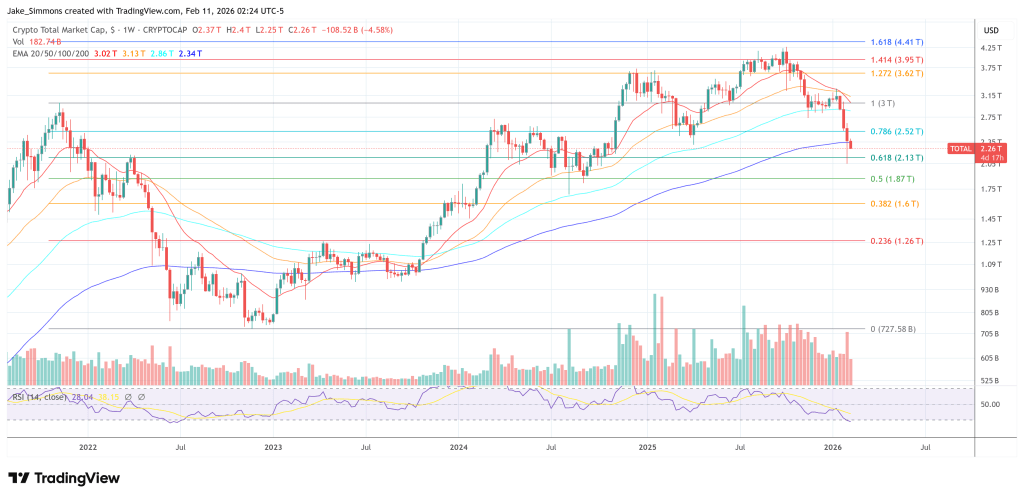
Total crypto market cap falls below the 200-week EMA, 1-week chart | Source: TOTAL on TradingView.com

Preguntas relacionadas

QWhat was the main topic of disagreement discussed in the White House meeting regarding the Crypto Clarity Act?

AThe main topic of disagreement was whether, and under what constraints, crypto firms can offer 'rewards' tied to stablecoin usage.

QWhat was the core demand of the banking trade groups' document titled 'Yield and Interest Prohibition Principles'?

AThe core demand was a sweeping prohibition: 'No person may provide any form of financial or non-financial consideration to a payment stablecoin holder' in connection with their use of the stablecoin, effectively pushing for a ban on rewards.

QHow did Ripple's Chief Legal Officer, Stuart Alderoty, characterize the meeting?

AStuart Alderoty struck an optimistic tone, calling it a 'productive session' and stating that 'compromise is in the air' with 'clear, bipartisan momentum' behind sensible legislation.

QWhat did Dan Spuller of the Blockchain Association identify as a 'key disagreement' with the banks?

AHe identified that the banks 'did not come to negotiate from the bill text, instead arriving with broad prohibitive principles,' which was a key point of disagreement.

QWhat is the deadline the White House urged both sides to reach a deal by, and what is the focus of the ongoing discussions?

AThe White House urged both sides to reach a deal by March 1. The ongoing discussions are focused on defining 'permissible activities' narrowly enough to satisfy banks but broadly enough for crypto firms to preserve rewards as a competitive product.

Lecturas Relacionadas

It's Not Jensen Huang Who Wants to Change the PC, But the PC That's Revolting Against Itself

The 40-year-old PC industry is undergoing a fundamental transformation, driven by the rise of AI PCs. At the GTC Taipei 2026 event, NVIDIA, backed by Microsoft and major PC OEMs, announced the RTX Spark super chip for Windows PCs, marking its official entry into the PC core processor market. This move aims to redefine the AI PC by shifting its core from the CPU to an AI-focused SoC (System on Chip). NVIDIA envisions the PC evolving from a personal computer to a "personal AI"—a platform where local AI Agents can autonomously perform tasks. While Intel pioneered the AI PC concept earlier in 2026, NVIDIA's aggressive push, leveraging its vast CUDA developer ecosystem of 6 million, positions it to potentially reshape the industry's long-standing Wintel (Windows-Intel) power structure. NVIDIA's strategy extends beyond hardware; it's about embedding its CUDA, RTX, and AI software stack into the PC platform itself. The article identifies key shifts: 1) The move from a CPU-centric to an AI SoC-centric architecture, similar to Apple's approach with its M-series chips. 2) The PC's evolution from a human-operated tool to a platform for human-Agent collaboration. 3) The extension of NVIDIA's data center-centric CUDA ecosystem to personal devices via RTX Spark. Ultimately, the change is driven by the broader trend of AI moving to personal devices. Companies like Intel, AMD, Qualcomm, and Apple are all participating in this shift. NVIDIA's entry accelerates the competition, but the core driver is the technology itself finding its optimal expression in the PC. The industry is reinventing itself, with the outcome hinging on execution, ecosystem development, and the creation of compelling local AI applications.

marsbitHace 36 min(s)

It's Not Jensen Huang Who Wants to Change the PC, But the PC That's Revolting Against Itself

marsbitHace 36 min(s)

Popular Interaction Collection | Interstate Launches Points Event; Flip Early Waitlist Application (June 12)

**Interstate Launches Points Event, Flip Opens Early Waitlist Applications** *Originally published by Odaily Planet Daily, author Asher.* **Interstate**, an infrastructure platform integrating on-chain transactions for assets like Meme tokens, prediction markets, and xStocks, has launched a points event. Each trade on the platform now rewards users with points. The project has completed a $1.5 million seed round from investors including MH Ventures, Alchemy Ventures, and Marshland Capital. Users can visit the official website to connect their wallets and start earning points through trading tasks (note: the site may experience high traffic). **Flip**, an AI-powered financial assistant, has opened applications for its early waitlist. The platform allows users to manage finances via chat, helping with spending tracking, bill management, investment portfolio monitoring (including stocks and crypto), and more. Flip recently raised $1.4 million in a pre-seed round led by The House Fund and participated in a16z's Speedrun accelerator. Interested users can join the waitlist via the official website. **ArcNova**, an AI-native infrastructure platform for short-form video and entertainment, continues to offer tasks for earning points. Users can sign in daily, complete social and app tasks, and refer friends to accumulate points. The project announced a $15 million funding round in May, backed by Adaverse Ventures, Animoca Brands, and others. The task portal is accessible through the ArcNova website. These updates highlight ongoing opportunities for user engagement and potential rewards across emerging crypto and AI projects.

Odaily星球日报Hace 3 hora(s)

Popular Interaction Collection | Interstate Launches Points Event; Flip Early Waitlist Application (June 12)

Odaily星球日报Hace 3 hora(s)

Trading

Spot
Futuros

Artículos destacados

Cómo comprar HOUSE

¡Bienvenido a HTX.com! Hemos hecho que comprar Housecoin (HOUSE) sea simple y conveniente. Sigue nuestra guía paso a paso para iniciar tu viaje de criptos.Paso 1: crea tu cuenta HTXUtiliza tu correo electrónico o número de teléfono para registrarte y obtener una cuenta gratuita en HTX. Experimenta un proceso de registro sin complicaciones y desbloquea todas las funciones.Obtener mi cuentaPaso 2: ve a Comprar cripto y elige tu método de pagoTarjeta de crédito/débito: usa tu Visa o Mastercard para comprar Housecoin (HOUSE) al instante.Saldo: utiliza fondos del saldo de tu cuenta HTX para tradear sin problemas.Terceros: hemos agregado métodos de pago populares como Google Pay y Apple Pay para mejorar la comodidad.P2P: tradear directamente con otros usuarios en HTX.Over-the-Counter (OTC): ofrecemos servicios personalizados y tipos de cambio competitivos para los traders.Paso 3: guarda tu Housecoin (HOUSE)Después de comprar tu Housecoin (HOUSE), guárdalo en tu cuenta HTX. Alternativamente, puedes enviarlo a otro lugar mediante transferencia blockchain o utilizarlo para tradear otras criptomonedas.Paso 4: tradear Housecoin (HOUSE)Tradear fácilmente con Housecoin (HOUSE) en HTX's mercado spot. Simplemente accede a tu cuenta, selecciona tu par de trading, ejecuta tus trades y monitorea en tiempo real. Ofrecemos una experiencia fácil de usar tanto para principiantes como para traders experimentados.

246 Vistas totalesPublicado en 2025.04.27Actualizado en 2026.06.02

Cómo comprar HOUSE

Discusiones

Bienvenido a la comunidad de HTX. Aquí puedes mantenerte informado sobre los últimos desarrollos de la plataforma y acceder a análisis profesionales del mercado. A continuación se presentan las opiniones de los usuarios sobre el precio de HOUSE (HOUSE).

活动图片













