Crypto Bear Market Startup Guide Part 1: Pre-Market Price Spread Market for Tokenized Stocks

marsbitPublicado a 2026-03-16Actualizado a 2026-03-16

Resumen

"Encrypted Bear Market Startup Guide Part 1: Pre-IPO Stock Price Arbitrage Market" Despite the challenges of a crypto bear market, over 80% of startups that raised seed rounds in 2022 are still building. This period can foster focus on product development and survival skills. This series explores potential business opportunities, starting with the pre-IPO stock price arbitrage market. This market bridges crypto and traditional finance, with major stock exchanges and crypto platforms participating. The upcoming 2026 "IPO boom," featuring companies like OpenAI, Anthropic, SpaceX(xAI), and crypto exchanges, is driving demand for pre-IPO trading. Platforms like PreStocks, Jarsy, and Tessera have emerged, offering more flexible trading than traditional venues like Hiive. Significant price discrepancies exist for the same stock across different pre-IPO platforms. For example: - Kalshi shows a $148 (37%) difference between PreStocks ($397) and Jarsy ($545). - Polymarket has a $94 (50.5%) spread between PreStocks ($186) and Jarsy ($280). - SpaceX(xAI) has a $75 (12.7%) gap between PreStocks ($666) and Tessera ($591). This creates an opportunity for a new platform to act as an arbitrage marketplace for these price differences. The potential business model could include trading fees, LP fees, and profiting from the platform's own arbitrage positions, though current market liquidity remains in the millions.

Original|Odaily Planet Daily (@OdailyChina)

Author|Wenser(@wenser 2010)

Not long ago, Mysten Labs CEO evan.sui shared his views on the "bear market." He mentioned that he does not agree with the notion that "the bear market is great, just keep building." In fact, the bear market is not "great"; packaging it as good for everyone overlooks the real costs (such as discouraging builders and users). Many retail investors and excellent teams face cash flow problems and are forced to exit, ultimately harming the long-term development of the crypto industry.

However, data evidence does not align with this view. A report released by Lattice VC in October 2024 showed that over 80% of crypto startups that announced seed round funding during the 2022 bear market were still building at that time. In other words, if project teams can ensure relatively stable personnel and funding, the bear market is more conducive to project development and growth. The reasons might be that during a bear market, project teams focus more on product development and experience optimization; or perhaps the bear market hones the project teams' abilities to survive through various means. In any case, being in a crypto bear market, determined startup teams might find opportunities in adversity and carve out their own path to development.

In light of this, we will use a series of articles titled "Crypto Bear Market Startup Guide" to explore potential entrepreneurial tracks and project directions with our readers. If any crypto projects emerge and grow rapidly as a result in the future, Odaily Planet Daily also welcomes project teams to discuss cooperation.

Today, let's first discuss one of the hottest potential entrepreneurial directions besides prediction markets—the pre-market price spread market for tokenized stocks.

The Real Demand for Tokenized Stock Pre-Market: Platform Differentiation and Liquidity Bridge

As an intermediate bridge connecting the crypto market with traditional financial markets, tokenized stock trading platforms have not only attracted high attention and active participation from crypto project teams but have also seen involvement from global leading securities platforms including Nasdaq and the New York Stock Exchange, aiming to capture incremental markets while further activating liquidity in traditional financial markets.

Furthermore, not only have listed cryptocurrency concept stocks undergone tokenization and on-chain contract transformation, but many pre-IPO hot concept stocks have also garnered enthusiasm from both crypto and traditional financial markets, giving rise to several pre-market stock tokenization trading platforms.

Considering that the capital market is about to welcome a wave of U.S. stock listings this year, including OpenAI, Anthropic, SpaceX (xAI), Kalshi, Polymarket, OKX, Kraken, and a series of AI model companies, commercial aerospace companies, prediction market platforms, and crypto exchanges, there is no doubt that 2026 is destined to be a "big year for IPOs."

Against the backdrop of a fluctuating and occasionally rebounding crypto market and a consistently rising stock market, the热度 of the pre-market stock trading further supports the above view—there is strong demand from both crypto and traditional financial markets for pre-market trading of hot concept stocks.

This is the main reason for the emergence of pre-market stock trading platforms such as PreStocks, Jarsy, Tessera, and others. Additionally, compared to traditional financial market pre-market trading platforms like Hiive and Nasdaq Private Market, crypto pre-market trading platforms offer more flexible trading methods, purchase limits, and entry barriers, with relatively higher premiums, which attracts many users to participate enthusiastically.

However, just as the same token can have different prices on different exchanges, before mechanisms like oracles are introduced into the pre-market stock market, regardless of the reason, we can clearly see that different platforms have certain price differences for the same underlying stock.

Based on the above information, we can somewhat boldly conclude—the crypto market still lacks one or more "bridge platforms between pre-market stock trading platforms."

This might be a necessary step in advancing the tokenization of stocks and the tokenization of pre-market stock markets—a unified comprehensive platform covering pre-market trading in traditional financial markets and pre-market trading in crypto markets.

Below, we will use the two leading prediction market platforms, Kalshi and Polymarket, which are seeking $20 billion in funding, and SpaceX (xAI), valued at $1.25 trillion, as examples to explore the feasibility and real demand of this "entrepreneurial direction."

Comparing Pre-Market Price Spreads on PreStocks, Jarsy, Tessera: Maximum Spread Rate Exceeds 50%, Price Difference Up to Nearly $150

Kalshi Pre-Market Spread: Up to $148, Spread Rate Around 37%

Taking the Kalshi pre-market as an example, its prices on different platforms are as follows—

PreStocks platform, the pre-market price of the stock token is around $397; (compared to the $369 we mentioned one month ago in the article "Kalshi Trading Volume Continues to Hit New Highs, What Is a Reasonable Pre-IPO Stock Price?", it has increased by nearly $30, a rise of 7.6%)
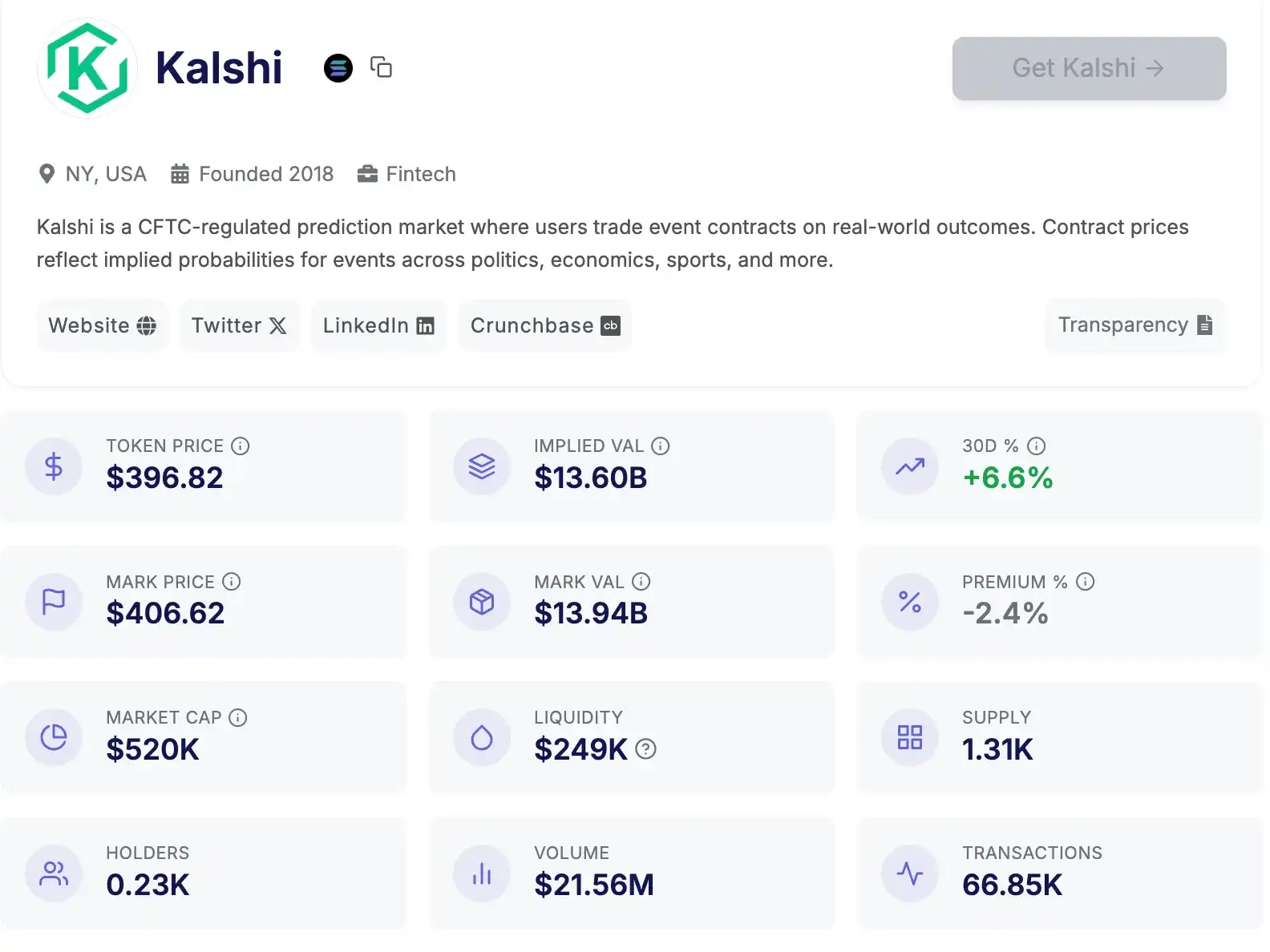
Jarsy platform, the pre-market price is quoted at around $545. (compared to the $504 we mentioned one month ago in the article "Kalshi Trading Volume Continues to Hit New Highs, What Is a Reasonable Pre-IPO Stock Price?", it has increased by over $40, a rise of 8.1%)

In other words, the price difference for Kalshi's pre-market stock on the two major trading platforms is as high as $148 (Odaily Planet Daily Note: Considering that the two platforms use order book trading mechanisms and on-chain liquidity token trading mechanisms respectively, we are only making an abstract comparison here, temporarily not involving specific asset settlement forms, same below). If calculated based on the $360 price on the traditional financial market pre-market trading platform Hiive, the pre-market price difference even reaches $185.

Polymarket Pre-Market Spread: Up to $94, Spread Rate Over 50%

Taking the Polymarket pre-market as an example, its prices on different platforms are as follows—

PreStocks platform, the pre-market price of the stock token is around $186 (Odaily Planet Daily Note: up 23% in the past 30 days);
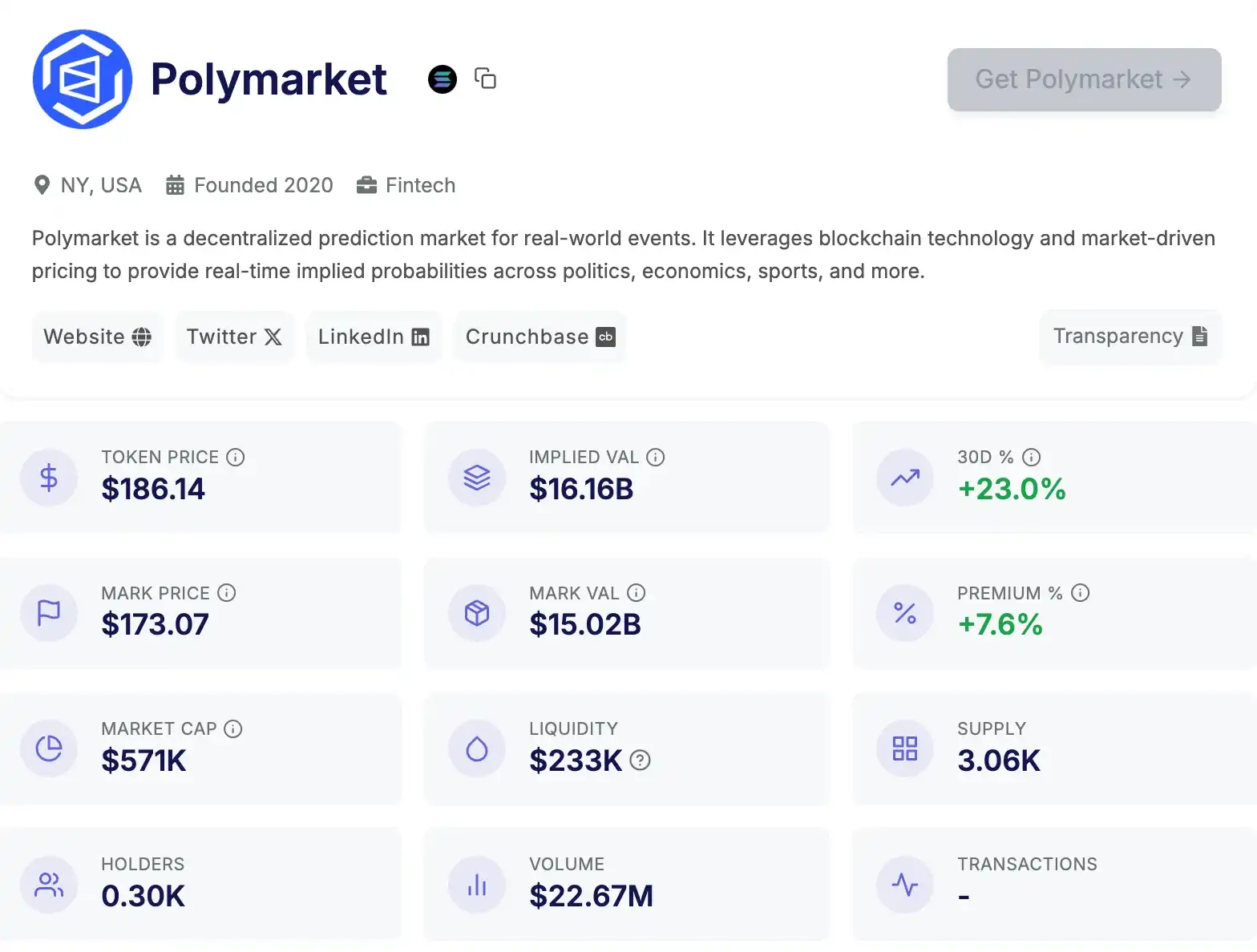
Jarsy platform, the pre-market price is quoted at around $280.

In other words, the price difference for Polymarket's pre-market stock on the two major platforms is about $94, with a spread rate of approximately 50.5%.

SpaceX(xAI) Pre-Market Spread: About $75, Spread Rate 12.7%

Taking SpaceX(xAI) as an example, its prices on different platforms are as follows—

PreStocks platform, the pre-market price of the stock token is around $666 (Odaily Planet Daily Note: up 4.1% in the past 30 days);
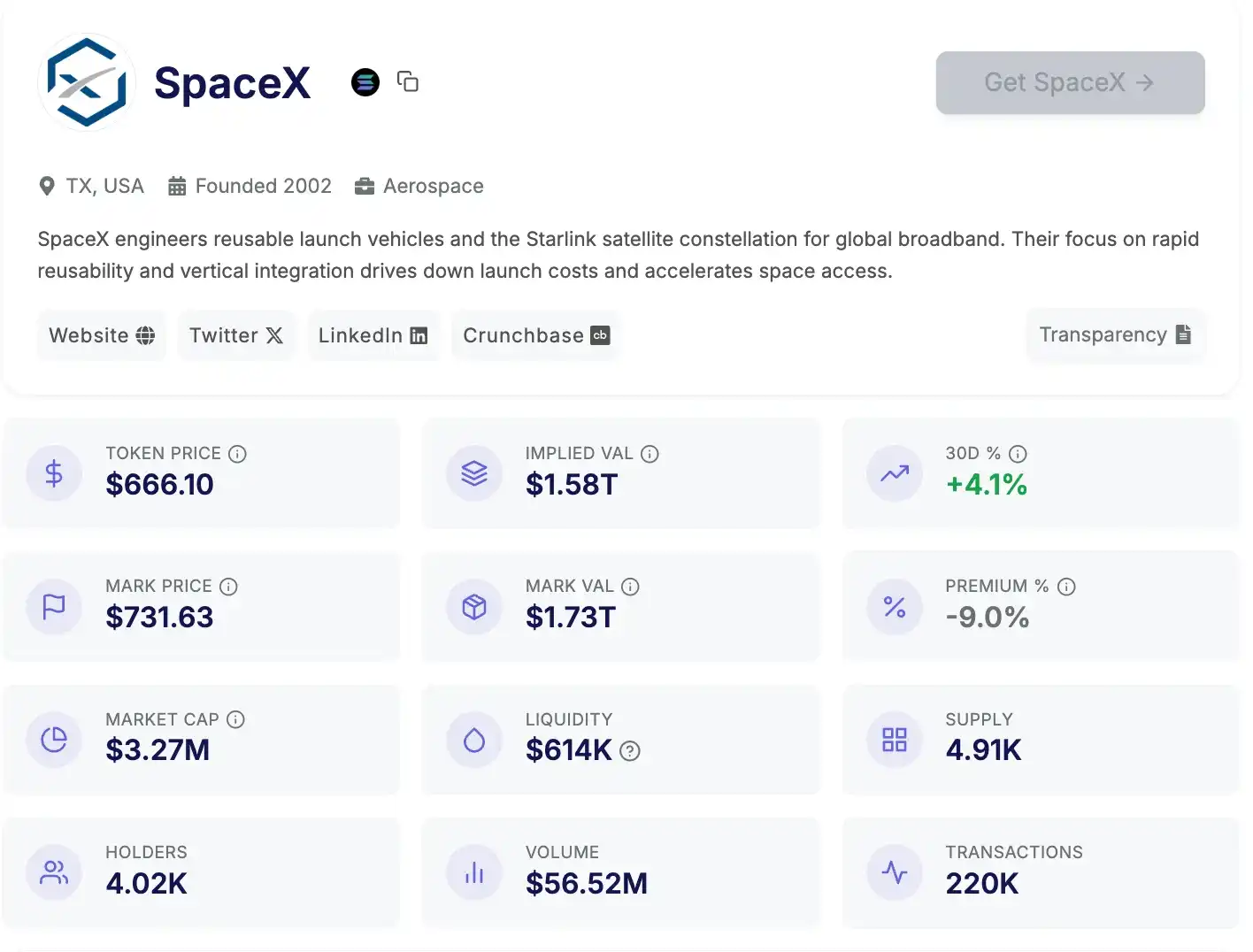
Tessera platform, the pre-market price of the stock token is temporarily reported at around $591 (Odaily Planet Daily Note: up about 14.5% in the past 30 days).
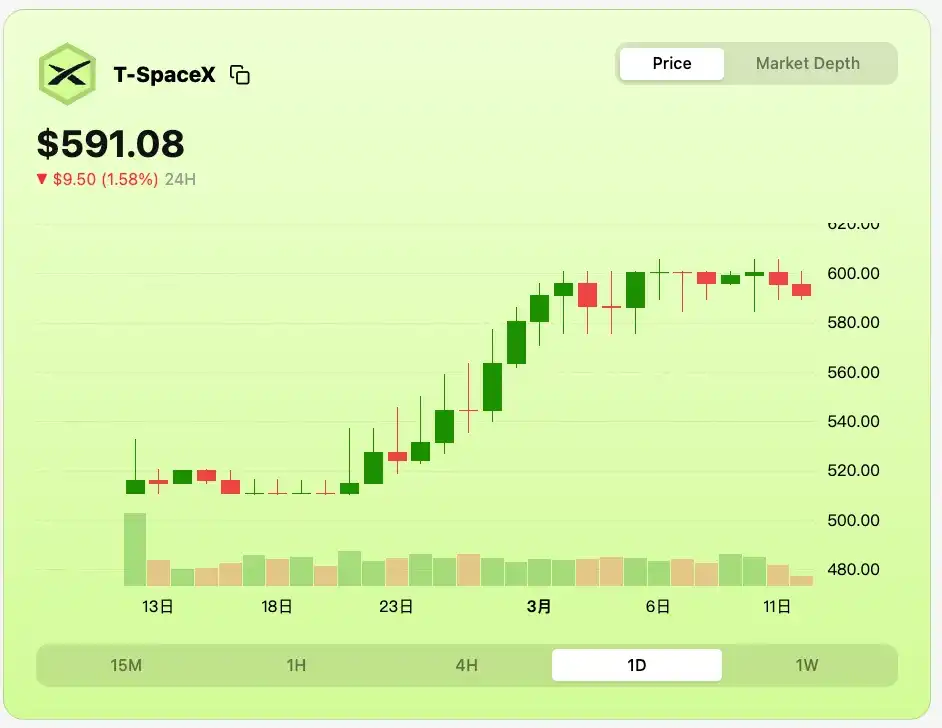
In other words, the price difference for SpaceX's pre-market stock on the two major platforms is about $75, with a spread rate of approximately 12.7%.

In summary, based on existing pre-market trading platforms, it might be possible to build a pre-market price spread market for tokenized stocks to meet market trading and speculation demands after securing sufficient pre-market tokens or pre-market equity capital.

Of course, considering that the current market liquidity remains within the million-dollar range, the main business model of this platform might focus on transaction fees, LP fees, and realizing price differences from the platform's own investment quotas, among other aspects.


Preguntas relacionadas

QWhat is the main argument presented by Mysten Labs CEO evan.sui regarding the crypto bear market?

AMysten Labs CEO evan.sui argues that the bear market is not 'great' and that the narrative that it is good for everyone ignores the real costs, such as driving away builders and users, causing cash flow problems for retail investors and excellent teams, and ultimately harming the long-term development of the crypto industry.

QAccording to the Lattice VC report from October 2024, what percentage of crypto startups that announced seed funding during the 2022 bear market are still building?

AAccording to the Lattice VC report, over 80% of crypto startups that announced seed funding during the 2022 bear market are still building.

QWhat is the proposed new entrepreneurial direction discussed in the article, besides prediction markets?

AThe proposed new entrepreneurial direction is the pre-market price difference market for tokenized stocks (币股盘前价差市场), which aims to act as a bridge between different pre-market trading platforms to capitalize on pricing discrepancies.

QWhat was the approximate price difference (in USD) and the difference rate for Kalshi's pre-market stock tokens between the PreStocks and Jarsy platforms?

AThe price difference for Kalshi's pre-market stock tokens between PreStocks ($397) and Jarsy ($545) was approximately $148, with a difference rate of about 37%.

QWhat potential business models are suggested for a platform that capitalizes on pre-market price differences?

AThe potential business models suggested are transaction fees, liquidity provider (LP) fees, and profiting from the price differences of the platform's own investment allocations.

Lecturas Relacionadas

Must-Watch Events Next Week|CLARITY Act Could Face Senate Vote; SpaceX, Circle to Report Earnings (8.3-8.9)

**Summary: Key Events and Developments to Watch (August 3-9)** The upcoming week is marked by significant financial disclosures, key legislative deadlines, and notable product updates. **Major Financial Events:** Several companies are scheduled to release their Q2 2026 earnings. American Bitcoin (ABTC) will report on August 3, followed by SpaceX and Hut 8 Mining Corp. on August 4, and Circle on August 5. Notably, a significant portion of SpaceX shares (up to 12% of total shares) will be unlocked on August 6 following their earnings release. **Key Legislative Deadline:** The U.S. Senate faces an August 7 deadline to secure 60 votes for the CLARITY Act, a bipartisan bill aiming to establish a federal regulatory framework for cryptocurrencies. The Senate may hold a full vote on the bill during the week. **Economic Data:** The U.S. July Non-Farm Payrolls report will be released on August 7, providing crucial labor market data. **Technology & Product Updates:** * **Shutdowns:** DeFi portfolio tracker Zapper and wallet app Ctrl Wallet will cease operations on August 3. * **Upgrades:** LayerZero will deprecate its v1 relayers on August 3. XRP Ledger's new version 3.3.0, featuring five new functions, is expected next week. * **AI:** Elon Musk announced that the advanced Grok 4.6 AI model is set for release around August 7. * **Bitcoin:** The BIP-110 forced signaling for a potential Bitcoin network change is scheduled to begin around August 8. **Other Notable Events:** Chinese robotics firm Unitree Tech has set its preliminary price inquiry for its IPO for August 5. South Korean exchange Upbit will delist AQT and AERGO tokens on August 3.

marsbitHace 1 hora(s)

Must-Watch Events Next Week|CLARITY Act Could Face Senate Vote; SpaceX, Circle to Report Earnings (8.3-8.9)

marsbitHace 1 hora(s)

Stocks Are Plummeting More Sharply Than Cryptocurrencies. Where Has the Money Gone?

Stock Markets Plunge Deeper Than Cryptocurrencies: Where Did the Money Go? In late July, Seoul's Kospi index triggered circuit breakers for two consecutive days, plummeting over 40% from its June high. The collapse was led by heavyweight stocks like SK Hynix, whose record profits still disappointed investors, and devastating leveraged ETFs, with one major product losing over 83% of its value. This signaled a global, forced deleveraging targeting the most crowded trades. Interestingly, while stocks exhibited extreme volatility akin to crypto markets, Bitcoin rose nearly 15% in July after a prior steep drop. Analysis shows the money fleeing equities did not flow into Bitcoin. Instead, Bitcoin had already absorbed its sell-off in May-June, when U.S. spot Bitcoin ETFs saw historic outflows. The true safe-haven beneficiary was gold, whose price rose over 20% year-on-year, highlighting a decoupling between Bitcoin and gold as "digital gold." The sell-off was a targeted unwinding of leveraged positions in tech and semiconductors, accelerated by broker-dealer risk management and shifts in the AI narrative, including new competition from Chinese memory chipmakers. The retreat path was clear: from high-valuation tech stocks to cash and U.S. Treasuries, then to gold. For Bitcoin to attract sustained institutional inflows, conditions like eased global liquidity pressure, a "soft-landing" Fed rate cut, and U.S. regulatory clarity via legislation like the stalled CLARITY Act are needed. Currently, Bitcoin is not a safe haven but an already-cleared asset. Its low correlation with tech stocks, however, makes it a potential diversification play for institutional portfolios once the storm passes. The money isn't here yet, but the positioning is underway.

marsbitHace 1 hora(s)

Stocks Are Plummeting More Sharply Than Cryptocurrencies. Where Has the Money Gone?

marsbitHace 1 hora(s)

In Conversation with Ray Dalio: We Are Currently in an AI Bubble, with 1% of My Portfolio in Bitcoin

Ray Dalio, founder of Bridgewater Associates, warns in an interview that the current AI boom shows classic bubble characteristics, which could lead to significant economic downturns as seen in past cycles like 1929 or 2000. He explains that speculative enthusiasm, fueled by debt and overvaluation, often precedes a crash when rising rates or taxation force asset sales, causing widespread losses and recession. Dalio also outlines his "Big Cycle" theory, describing an approximate 80-year pattern where widening wealth gaps, massive government deficits, and shifting geopolitical power (like China's rise) create internal conflict and global instability. He emphasizes that we are in a late-cycle, transitional phase where traditional powers like the US and UK face decline. For personal wealth protection, Dalio advises diversification beyond cash into assets like stocks, bonds, real estate, and particularly gold, which he prefers over Bitcoin. While he holds about 1% of his portfolio in Bitcoin as a non-printable hard asset, he views gold as more secure from technological or governmental threats. Regarding AI's impact, Dalio believes it will disproportionately benefit capital owners, worsening inequality by replacing both physical and cognitive labor. He suggests that human intuition and emotional intelligence, combined with AI, will be key for future workers. On taxation, Dalio argues that wealth taxes are impractical and risk triggering asset sell-offs, reducing productive investment. He points to the UK as a cautionary example of debt, low productivity, and political strife. Geopolitically, Dalio foresees a more regionalized world, with the US showing weakness in prolonged conflicts like with Iran, akin to past imperial declines. The ideal outcome, he suggests, is coexisting powerful blocs (e.g., Americas, China-Asia Pacific) without major war.

marsbitHace 5 hora(s)

In Conversation with Ray Dalio: We Are Currently in an AI Bubble, with 1% of My Portfolio in Bitcoin

marsbitHace 5 hora(s)

Trading

Spot
活动图片




