Crypto activity in Brazil rises 43% with average investment surpassing $1,000: Report

cointelegraphPublicado a 2025-12-21Actualizado a 2025-12-21

Resumen

Cryptocurrency activity in Brazil surged by 43% in 2025, with the average investment per user exceeding $1,000 (around 5,700 BRL), according to a Mercado Bitcoin report. The market is shifting from speculation to structured investing, with 18% of users diversifying across multiple assets. Bitcoin remained the most-traded asset, followed by USDT, ETH, and SOL. Stablecoins saw triple the previous year’s transactions as investors sought lower volatility. Lower-risk digital fixed-income products grew 108%, with $325 million distributed to investors. Younger investors (under 24) increased by 56%, and participation expanded beyond major cities. Itaú Asset Management recommended a 1–3% Bitcoin allocation due to geopolitical and monetary risks.

Crypto activity in Brazil expanded sharply in 2025, with total transaction volume climbing 43% year over year as average investment per user crossed the $1,000 mark, according to a new report from crypto platform Mercado Bitcoin.

The report, titled “Raio-X do Investidor em Ativos Digitais 2025,” claimed that the Brazilian crypto market is no longer driven purely by speculation but increasingly shaped by structured investing and portfolio planning. The data was based on activity across Mercado Bitcoin’s platform, the largest digital asset exchange in Latin America.

Per the report, the average amount invested per person reached roughly 5,700 Brazilian reais, equivalent to more than $1,000. At the same time, 18% of investors allocated funds across more than one crypto asset, indicating a gradual shift toward diversification rather than single-asset bets.

Bitcoin (BTC) remained the most traded asset, followed by the US dollar-pegged stablecoin USDt (USDT), Ether (ETH) and Solana (SOL), the report showed. Stablecoins also stood out as a key on-ramp for new and existing investors, accounting for roughly three times more transactions than in the prior year, as users sought lower volatility amid uncertain macro conditions.
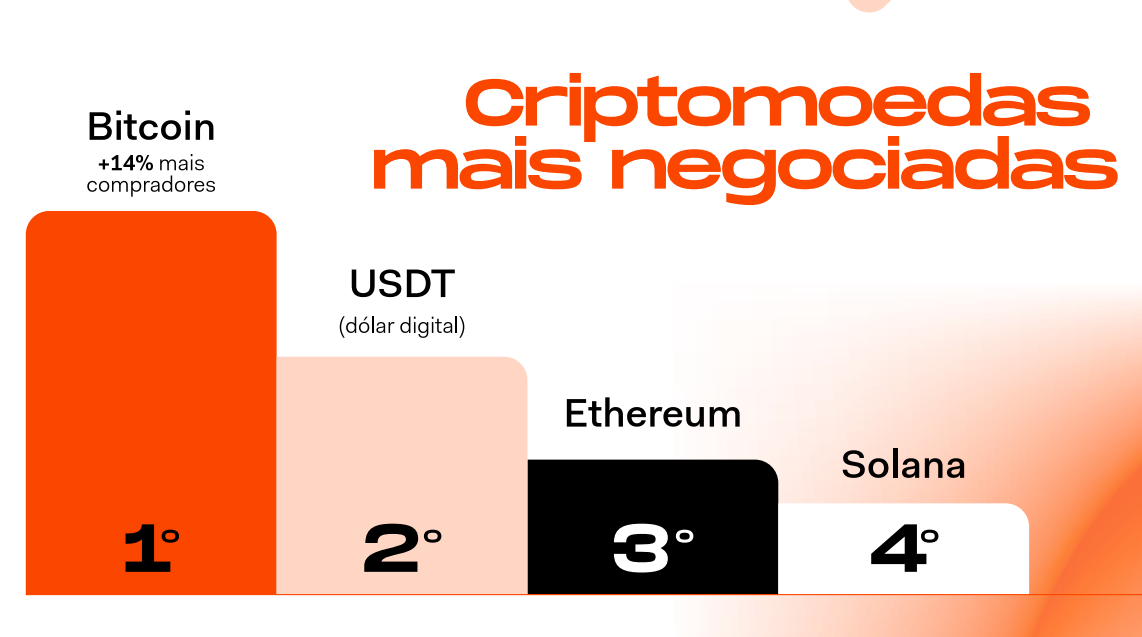
Bitcoin remains most-traded asset in Brazil. Source: Mercado Bitcoin

Related: Brazilian stock exchange to launch tokenization platform and stablecoin

Brazil’s low-risk crypto products see 108% growth

The report revealed that lower-risk crypto products gained momentum in 2025. Digital fixed-income offerings, known locally as Renda Fixa Digital (RFD), recorded a 108% increase in investment volume, with Mercado Bitcoin distributing about $325 million to investors in 2025.

Demographics also shifted. Investors aged 24 and under posted a 56% increase year over year. However, Mercado Bitcoin noted that demand expanded across all age groups, including high-net-worth and institutional profiles.

Regionally, Brazil’s Southeast and South remained dominant by transaction volume, led by São Paulo and Rio de Janeiro, while states in the Central-West and Northeast gained visibility as crypto participation spread geographically.

Related: Solana enters Brazil’s main exchange as Valour expands regulated crypto access

Itaú Asset advises 1%–3% Bitcoin allocation

As Cointelegraph reported, Itaú Asset Management has recommended that investors allocate between 1% and 3% of their portfolios to Bitcoin, citing rising geopolitical risks, shifting monetary policy and ongoing currency volatility.

In a research note, strategist Renato Eid described Bitcoin as a distinct asset with its own return profile and a potential hedging role due to its global and decentralized nature, despite sharp price swings throughout 2025.

Magazine: 2026 is the year of pragmatic privacy in crypto — Canton, Zcash and more

Preguntas relacionadas

QWhat was the percentage increase in crypto transaction volume in Brazil in 2025, according to the Mercado Bitcoin report?

ACrypto transaction volume in Brazil increased by 43% year over year in 2025.

QWhat was the average amount invested per person in Brazilian reais, and what was its approximate equivalent in US dollars?

AThe average amount invested per person was roughly 5,700 Brazilian reais, which is equivalent to more than $1,000.

QWhich four crypto assets were reported as the most traded in Brazil, listed in order?

AThe most traded assets were Bitcoin (BTC), followed by the stablecoin USDt (USDT), Ether (ETH), and Solana (SOL).

QWhat was the reported growth percentage for lower-risk crypto products like Digital Fixed-Income (RFD) in 2025?

ALower-risk crypto products, specifically Digital Fixed-Income offerings (RFD), recorded a 108% increase in investment volume.

QWhat Bitcoin allocation range did Itaú Asset Management recommend for investors' portfolios and what reasons did they cite?

AItaú Asset Management recommended an allocation of between 1% and 3% to Bitcoin, citing rising geopolitical risks, shifting monetary policy, and ongoing currency volatility.

Lecturas Relacionadas

When Inference Becomes a Scarce Resource, Who Captures the Value?

When Inference Becomes the Scarce Resource, Who Captures the Value? The core AI bottleneck has shifted from model training to inference (runtime execution). While concerns persisted about an "AI compute gap"—initially a $200B, now a $600B problem—the market is now recognizing that the solution and value lie in the inference layer. Nvidia's financial restructuring around "serving tokens" and Cerebras's successful IPO highlight this shift. Inference is a recurring, usage-based cost, estimated to be 10-50x larger than the one-time training market, especially with the rise of agentic AI. The inference stack spans six layers: silicon (e.g., Nvidia), bare metal (e.g., CoreWeave), GPU rental/aggregation, deployment/optimization, model APIs, and end applications. Most companies operate in one layer. However, Hyperbolic uniquely spans three layers (GPU rental, deployment, and model APIs) without owning any hardware. It aggregates fragmented GPU supply from multiple cloud providers into a standardized pool, offering developers the cheapest available compute through intelligent routing. Its multi-cloud aggregation creates a data moat and a flywheel: more supply leads to better pricing data and liquidity, attracting more developers and providers. In contrast, applications like Venice operate at the top of the stack, reselling privacy-wrapped inference but remaining dependent on and constrained by the underlying compute costs they purchase. As inference demand explodes, value accrues not just to consumer applications but increasingly to the aggregation and routing layer that captures their cost of revenue. The coming potential GPU oversupply reinforces this dynamic. While hardware owners may suffer from depreciation, asset-light aggregators like Hyperbolic benefit from price arbitrage, routing workloads to the cheapest available capacity. The ultimate winner in the inference economy may not be the entity with the most GPUs, but the one that can most efficiently discover, aggregate, and route the world's fragmented compute.

链捕手Hace 7 min(s)

When Inference Becomes a Scarce Resource, Who Captures the Value?

链捕手Hace 7 min(s)

Trading

Spot
Futuros
活动图片





