Convicted FTX CEO SBF Cries ‘Biden Lawfare’ In Trump Pardon Pitch

bitcoinistPublicado a 2026-02-10Actualizado a 2026-02-10

Resumen

Sam Bankman-Fried (SBF) claimed in a February 9th X thread that his criminal conviction was part of "Biden’s political lawfare," comparing his case to those of Donald Trump and former FTX executive Ryan Salame in what many interpreted as a direct appeal for a future pardon. He argued that the Biden administration and the DOJ brought bogus charges and prevented him from presenting evidence, specifically claiming the court "gagged" him and hid proof that FTX was solvent and that no money was stolen. SBF criticized Judge Lewis Kaplan, who also presided over a Trump case, for rubber-stamping DOJ requests and imposing a gag order. He drew parallels between his pretrial detention and Trump's legal battles. The thread was widely seen as a political maneuver rather than a legal argument, with critics accusing him of angling for a pardon from Trump.

Sam Bankman-Fried (SBF) used a new X thread on Feb. 9 to reframe his criminal case as “Biden’s political lawfare,” positioning himself alongside Donald Trump and former FTX executive Ryan Salame in what read like a direct appeal for a future pardon.

“Biden’s lawfare machine threw bogus charges at me, Donald Trump, Ryan Salame, etc.,” Bankman-Fried wrote. “To make the charges stick, they prevented us from even being allowed to respond.” He opened with a blunt claim about process rather than facts: “Rule No. 1 of Biden’s political lawfare: Don’t let them present evidence.”

SBF Cries ‘Gagged Trial,’ Claims DOJ Hid Evidence

SBF’s argument hinges on the idea that authorities and the court curtailed what the jury could hear. He repeatedly singled out Judge Lewis Kaplan, who presided over his trial, claiming the court “rubber-stamped everything Biden’s DOJ wanted” and “made sure I couldn’t show the jury the truth.”

The “truth,” as SBF cast it, is a solvency narrative: “So they lied, said I stole billions of dollars and bankrupted FTX. But the money was always there and FTX was always solvent.” He also argued that restrictions prevented him from advancing that line at trial, writing that he was “prohibited” from “pointing out FTX was solvent” and from “even mentioning lawyers.”

In the thread, SBF linked to a court filing he said was authored by his prosecutor, “Sassoon,” describing it as “a 70-page document on all the evidence they didn’t want the jury to see,” and he framed the episode as part of a broader political effort to “silence the truth.”

A significant chunk of the thread is dedicated to Trump’s New York hush-money bookkeeping case, which Bankman-Fried portrayed as a routine classification dispute blown into criminality. “Charged him with 34 crimes over his bookkeeping of an NDA expense—should it be legal, campaign, or personal?,” he wrote. “These questions come up all the time when you’re running a business, and it’s often unclear.”

He then drew a parallel between court-imposed limits on Trump and his own pre-trial detention. “They then got the judge to impose a gag order on Donald Trump,” he wrote. “Biden’s DOJ silenced me, too—getting Judge Kaplan to gag and then jail me before trial. President Trump also had Kaplan as a judge.”

Bankman-Fried also amplified Salame’s complaints about licensing advice and charging decisions, alleging prosecutors leaned on pressure tactics to force a plea, including claims involving Salame’s fiancée, assertions presented as fact in the thread but not accompanied by supporting documentation beyond links to Salame’s posts.

The reaction underneath was unsparing, with multiple industry figures interpreting the thread less as a legal critique than a political pitch. “You’re a Delusional criminal who is now angling for a pardon,” wrote trader Bob Loukas. Attorney Ariel Givner was even more direct: “We GET it. You want a pardon from Trump.”

At press time, FTT traded at $0.3021.
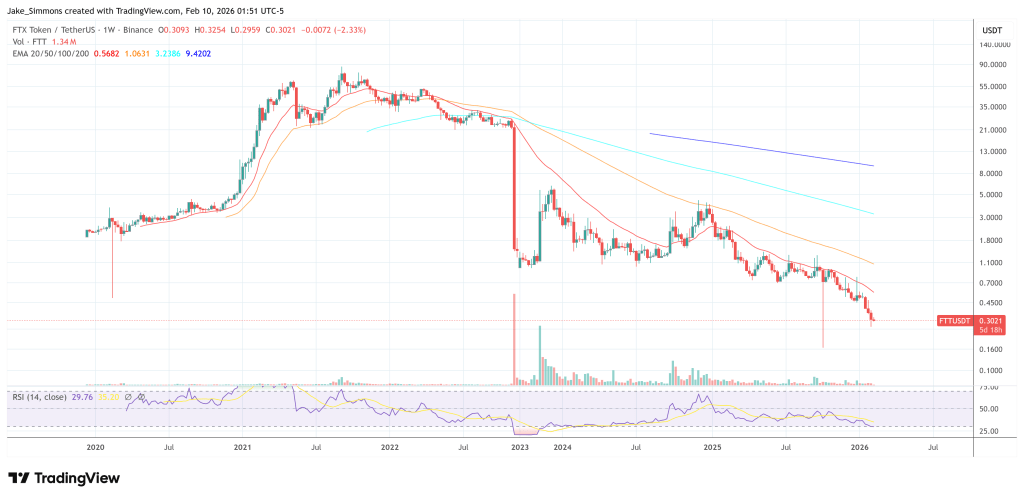
FTT continues its freefall, 1-week chart | Source: FTTUSDT on TradingView.com

Preguntas relacionadas

QWhat is the main argument in his recent X thread regarding his criminal case?

AHe argues that his criminal case is 'Biden's political lawfare,' claiming the Biden administration prevented him from presenting evidence and responding to the charges.

QWho did SBF specifically single out as being responsible for curtailing what the jury could hear in his trial?

AHe singled out Judge Lewis Kaplan, claiming the judge 'rubber-stamped everything Biden's DOJ wanted' and ensured he 'couldn't show the jury the truth.'

QWhat does SBF claim was the 'truth' about FTX that he was prevented from presenting in court?

AHe claims the 'truth' was that 'the money was always there and FTX was always solvent,' and he was prohibited from pointing this out or even mentioning lawyers.

QHow does SBF attempt to draw a parallel between his own case and that of former President Donald Trump?

AHe draws a parallel by claiming both were subjected to Biden's 'lawfare machine,' faced gag orders and pre-trial detention, and were prevented from presenting evidence, noting that Trump also had Judge Kaplan in one of his cases.

QHow did some industry figures interpret SBF's thread, according to the article?

AIndustry figures like trader Bob Loukas and attorney Ariel Givner interpreted it less as a legal critique and more as a political pitch, specifically an attempt to angle for a pardon from Donald Trump.

Lecturas Relacionadas

The Tao (τ) Law Makes EDA Go Viral

In May 2026, Huawei's semiconductor division introduced the "Tao (τ) Law" at IEEE ISCAS, shifting the industry focus from Moore's Law's geometric scaling to "time scaling." Unlike traditional approaches relying on transistor miniaturization, τ Law optimizes the time constant (τ) across device, circuit, chip, and system levels to improve information processing speed and efficiency. Huawei has already applied this principle, mass-producing 381 chips across various applications, with a target to achieve performance equivalent to 1.4nm technology by 2031. The implementation of τ Law, involving techniques like Chiplet, 3DIC, and Logic Folding, places new demands on EDA tools, highlighting gaps in current offerings. Traditional 2D or pseudo-3D EDA flows lack native support for true 3D design, cross-layer co-optimization (STCO), and coupled multi-physics analysis (thermal, power, stress), which are crucial for advanced integration. Chinese EDA companies, such as Empyrean Software, Primarius Technologies, and Xpeedic, are evolving from point-tool specialists to providing full-flow, system-level solutions. For instance, Peking University has developed a prototype "true 3D" EDA tool showing significant improvements in wirelength and timing. Empyrean Software has also launched a comprehensive 3DIC design and verification platform. The τ Law framework presents an opportunity for the domestic EDA industry to transition from achieving basic functionality to developing robust, integrated toolsets essential for next-generation chip design.

marsbitHace 52 min(s)

The Tao (τ) Law Makes EDA Go Viral

marsbitHace 52 min(s)

It's Not Jensen Huang Who Wants to Change the PC, But the PC That's Revolting Against Itself

The 40-year-old PC industry is undergoing a fundamental transformation, driven by the rise of AI PCs. At the GTC Taipei 2026 event, NVIDIA, backed by Microsoft and major PC OEMs, announced the RTX Spark super chip for Windows PCs, marking its official entry into the PC core processor market. This move aims to redefine the AI PC by shifting its core from the CPU to an AI-focused SoC (System on Chip). NVIDIA envisions the PC evolving from a personal computer to a "personal AI"—a platform where local AI Agents can autonomously perform tasks. While Intel pioneered the AI PC concept earlier in 2026, NVIDIA's aggressive push, leveraging its vast CUDA developer ecosystem of 6 million, positions it to potentially reshape the industry's long-standing Wintel (Windows-Intel) power structure. NVIDIA's strategy extends beyond hardware; it's about embedding its CUDA, RTX, and AI software stack into the PC platform itself. The article identifies key shifts: 1) The move from a CPU-centric to an AI SoC-centric architecture, similar to Apple's approach with its M-series chips. 2) The PC's evolution from a human-operated tool to a platform for human-Agent collaboration. 3) The extension of NVIDIA's data center-centric CUDA ecosystem to personal devices via RTX Spark. Ultimately, the change is driven by the broader trend of AI moving to personal devices. Companies like Intel, AMD, Qualcomm, and Apple are all participating in this shift. NVIDIA's entry accelerates the competition, but the core driver is the technology itself finding its optimal expression in the PC. The industry is reinventing itself, with the outcome hinging on execution, ecosystem development, and the creation of compelling local AI applications.

marsbitHace 3 hora(s)

It's Not Jensen Huang Who Wants to Change the PC, But the PC That's Revolting Against Itself

marsbitHace 3 hora(s)

Trading

Spot
Futuros
活动图片





