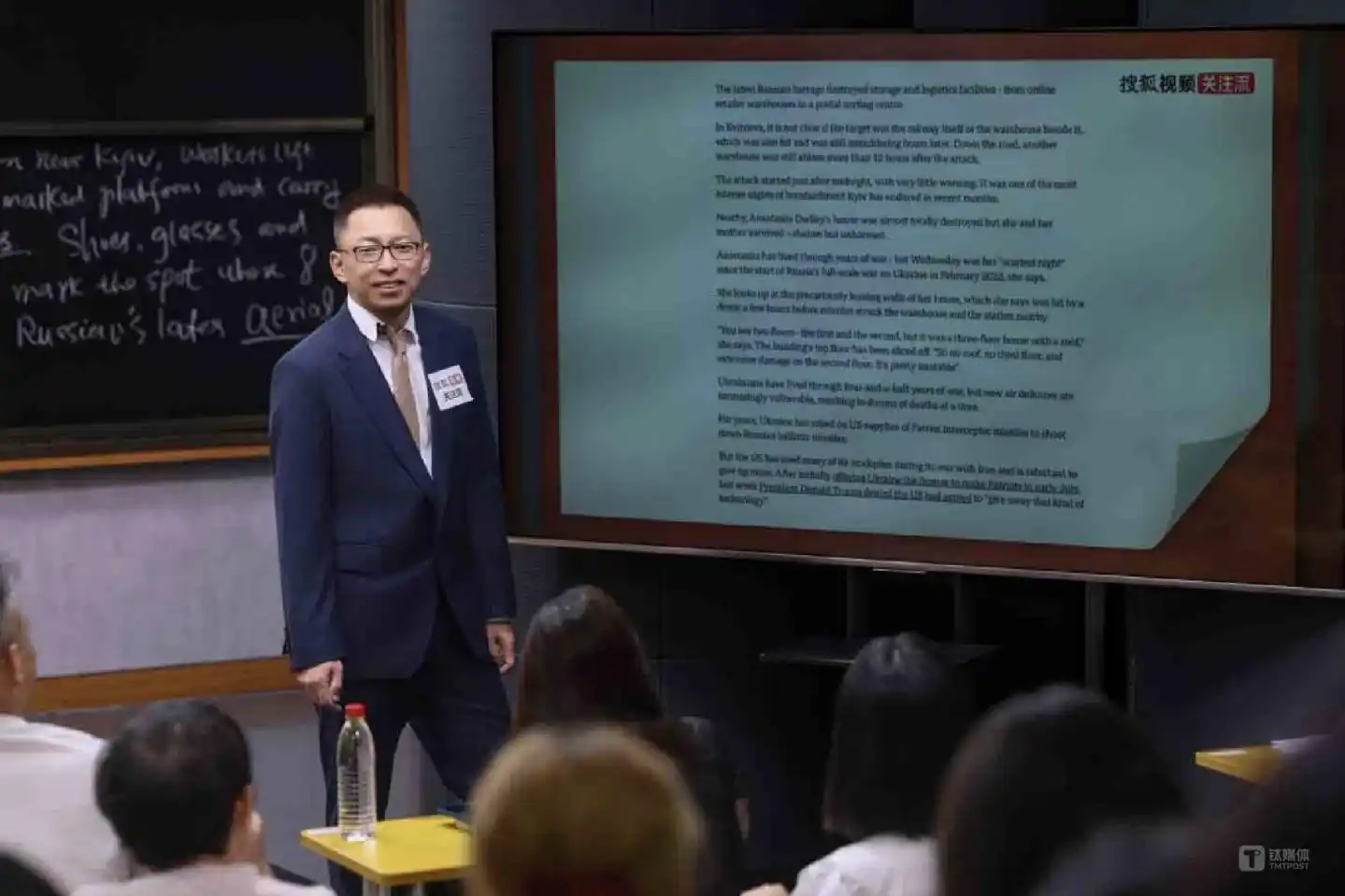
Charles Zhang, Founder, Chairman of the Board, and CEO of Sohu
Looking at the present moment, among China's first-generation internet titans, Charles Zhang has always been a figure with distinct personal characteristics.
He maintains a consistent level of public exposure and fits all the traits of a high-energy individual: sleeping only four to five hours a day, persistently walking/running 5 kilometers or running a marathon, while also intensively organizing offline technology forums and engaging in dialogues with Nobel laureates.
He has voluntarily relinquished the obsession with chasing every trend, shifting his focus from external business expansion to internal self-reconstruction. He arranges his life and career at a pace he endorses, stating, "People are not afraid of being busy; the busier they are, the healthier their body becomes. If people have nothing to do, they are prone to various emotions, and their health suffers instead."
On the occasion of the 10th anniversary of the launch of "Charles Zhang's English Class," he decided to take the class offline, testing the waters of a real-life classroom setting. Following this session, we conversed with Zhang. The discussion revolved around the ten-year journey of the English class, the product ecosystem of Sohu Video's feed, and the value of content in the AI era.
The Diligent Hand, The Diligent Tongue: A Class Against Instant Gratification
In August 2016, Zhang began his first live-streamed English class on Qianfan Live. Before each broadcast, he would spend about 40 minutes preparing, browsing over a dozen news headlines, reading five articles in detail, and finally selecting three to use as teaching materials for the live session.
Over ten years, "Charles Zhang's English" has cumulatively completed over 2,000 live sessions, totaling more than 110,000 minutes, with over 52 million cumulative views.
He mentioned that the initial purpose of the live English class was to "talk more," to combat emotional distress. Talking to himself was the first step; he would first speak along with the television, repeating after the news anchors on programs.
At that time, the internet live-streaming war was heating up, and Zhang also launched a product called "Qianfan Live" to compete. He thought, since he needed to talk, why not do a live stream? Live-streaming naturally has an audience and allows for interaction. Thus, he began his daily English live class.
Another 30% of the reason was his desire to bring authentic news to the audience; the remaining 30% was to promote Qianfan Live by personally "taking the plunge" to test it.
"Regulating daily emotions is like a monk chanting sutras," Zhang recalled, starting his day at 8 a.m., reading news and explaining English in front of the camera. This seemingly clumsy "daily ritual" ultimately helped him emerge from the shadow of depression. He even admitted to reaching the "peak state of his life."
From a product perspective, Zhang's start was somewhat counterintuitive. There was no preliminary market research or validation, nor specific growth strategies. It was born from the founder's own needs, finding a scenario that overlapped with user demands.
Yet, his content production follows an extremely standardized workflow. Each live session requires 40 minutes of preparation: browsing over a dozen headlines, reading five carefully, and finally choosing three to discuss.
The daily scope covers geopolitics, global economics, technological advancements, medical health, and various social phenomena... Accumulated over ten years, this constitutes a vast system of compound knowledge interest.
In today's world flooded with AI summaries and algorithmically recommended content, Zhang insists on a "diligent effort": meticulously reading original texts word by word and creating teaching materials by hand. As mentioned earlier, he persists in spending 40 minutes daily preparing for the live stream, reading articles thoroughly and handwriting notes on the board, refusing to use AI for one-click content generation.
To this day, the English class has become a fixed rhythm in Zhang's daily life. As for preparing for the physics class, Zhang must set aside an entire day each week, focusing solely on thinking through problems and performing derivations in front of the blackboard.
Within the live-streaming sphere, Zhang positions himself as a "content creator," not as a corporate CEO or a formal teacher. He sees the physics class as extreme mental training (even if 99% of people don't understand it) and the English class as a sensor for understanding the world.
This explains why a top entrepreneur can persist for 10 years doing something seemingly "irrelevant to his main business"—it is the method of information input and a means of psychological and intellectual therapy he found after hitting a low point.
At its core, it is a commitment to "anti-efficiency." He believes the meaning of reading lies in seeking kindred spirits and spiritual support, not merely obtaining a fleeting topic for conversation.
Relating this to the current media industry, he said, "Reading news is not the goal. Reading news is part of human life. We ourselves have many confusions; we need to find references, seek a group, find our kind, or find support—a nourishment for the spirit. These starting points cannot be satisfied by large models. They can only give you information."
Perhaps this offers some psychological solace and value defense for media practitioners currently impacted by AI summaries.
"Don't Think That With AI, the Earth Stops Turning"
At the event, a content creator confessed his anxiety to Zhang: "I found that after feeding my articles to AI, it can articulate things more comprehensively and profoundly than I can. A lot of my content turns into AI language; the entire article feels very distant from me. I feel my work has little value."
Upon hearing this, Zhang responded with an analogy: "When you go to the vegetable market, it's not the carrots forced by chemical fertilizers—those with a bit of dirt, not looking so shiny, but very tasty, full of flavor. Tomatoes forced by fertilizers have no taste at all."
In his view, AI is giving the world's content a kind of "plastic feel." However, he also acknowledges AI's significant role in improving the efficiency of information acquisition. Especially in physics and social science research, he often asks AI questions, and it quickly provides answers in specific professional fields.
The key, according to Zhang, is that we still need outsiders to guide us in viewing the world: large models provide "information," while outsiders provide "perspectives." What he cares deeply about is: What is this outsider's perspective? How do they think about something?
"Don't think that with AI, the Earth stops turning," he further analyzed. Currently, AI mainly replaces rule-based work. For instance, he clearly observes that the software industry has been significantly impacted in the first half of this year, with many programmers being laid off because decent code can now be written without years of experience.
But for arts, social sciences, emotional and creative content, AI cannot replace humans yet.
"Hollywood is still thriving, still producing great works. The Oscars will continue to award prizes; the Nobel Prize in Literature will continue to be awarded—all written by real people, works still conceived by real people," Zhang said.
In fact, despite maintaining vigilance and a degree of distance from AI, Zhang is not averse to technology and remains open to AI applications. Sohu itself has launched AI assistant-related applications: "Summary Hero" and "Little Fox."
In Sohu's AI practice, Zhang defines his role as a "large model corpus provider." He believes that training large models is inseparable from human-original content as a data foundation; therefore, original content always possesses irreplaceable value.
"The era of self-media has indeed brought new ways for everyone to discover their strengths and achieve certain growth," he suggested. "Nowadays, young people—every individual—should consider self-media."
Most importantly, the bottom line of content creation should be "authenticity." If using an AI digital human, it must be clearly labeled. Not labeling it and letting people mistakenly think it's a real person is a waste of the audience's time, especially when people still prefer content from real individuals.
In fact, behind the rapid advancement of AI technology, we face some unavoidable realities. When AI can quickly provide seemingly perfect answers, people are increasingly accustomed to accepting "summarized" results, omitting the processes of questioning, deduction, and trial and error. Deep thinking ability is declining imperceptibly.
Zhang's "anti-efficiency" practice with his two live shows is his answer to the AI frenzy: In an era where algorithms pursue ultimate efficiency, don't expect AI to fill inner emptiness. Go read, go speak in front of a camera, go sweat on the running track, go connect with real people.(Author | Li Chengcheng, Editor | Yang Lin)