‘Congress must pass the Clarity Act’ – U.S. Treasury Secretary’s plea decoded

ambcryptoPublicado a 2026-04-09Actualizado a 2026-04-09

Resumen

U.S. Treasury Secretary Scott Bessent urges Congress to pass the Digital Asset Market Clarity Act, arguing that clear federal rules are essential to prevent the relocation of crypto development to jurisdictions like Abu Dhabi and Singapore. He warns that regulatory uncertainty in the U.S. makes the risks of operating there outweigh the benefits. The call is supported by Senator Cynthia Lummis, who believes the act would serve as a "safe harbor" for innovation. However, prediction market Polymarket indicates the odds of the bill passing by 2026 have recently dropped to 57%. Despite this, key industry figures, including Coinbase's Chief Policy Officer, express confidence that legislative progress will be made.

The discussion around the CLARITY Act is intensifying day by day, and in a recent turn of events, U.S. Treasury Secretary Scott Bessent has also stepped in.

Urging Congress, Secretary Bessent has demanded the passage of the Digital Asset Market Clarity Act. Introduced in 2025, the bill is still finding common ground with both the crypto industry and the banking community, but consensus remains elusive.

Remarking on the same, Bessent said,

Congress must pass the Clarity Act. Senate floor time is scarce, and now is the time to act.

U.S. Treasury Secretary Scott Bessent’s point of argument

As reported by The Wall Street Journal, the Secretary drew comparisons with other countries, calling for clear federal rules for digital assets. This, in turn, he believes, would enable widespread developments and efficient investment, crucial for the largest economy by nominal GDP to prevail.

Comparing the U.S. with other countries, Bessent added,

A growing share of crypto development relocated to places ​with clear rules, such as Abu Dhabi and Singapore. Abroad, firms knew ​when and how to register, what standards to meet, and how to operate.

Highlighting the risks in the U.S., he summed it up best when he said,

The benefits of domiciling in the U.S. rarely outweighed the risks.

Needless to say, this isn’t the first time Bessent has stepped in to highlight the importance of clear rules in the digital assets space. Back in February, he had underlined that the bill would provide “great comfort to the market” in times of volatility.

Market conditions and others in support

Echoing similar sentiments, Senator Cynthia Lummis also noted,

We have the Administration, the momentum, and we’ve made bipartisan progress.

Lummis believes that the law is a one-pot solution for “developers, validators, and node operators.” And, once approved, the Act would work as “a safe harbor” to keep innovations anchored in the U.S.

All this comes on the heels of the crypto market fluctuating between $2 trillion and $3 trillion – thanks to increased volatility.

Polymarket odds

Meanwhile, the Polymarket odds for the passage of the CLARITY Act stood at 57% at the time of publication. However, if looked at carefully, the odds have dropped by 9% from their previous high, seen just weeks ago.
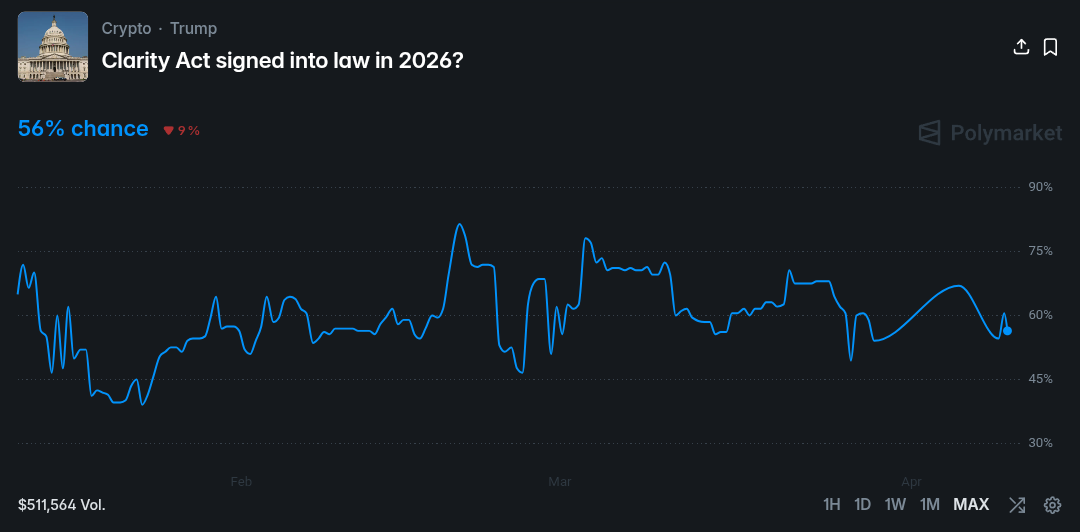
Source: Polymarket

At the same time, Coinbase’s Chief Policy Officer (CPO) also added to the ongoing demand when he noted,
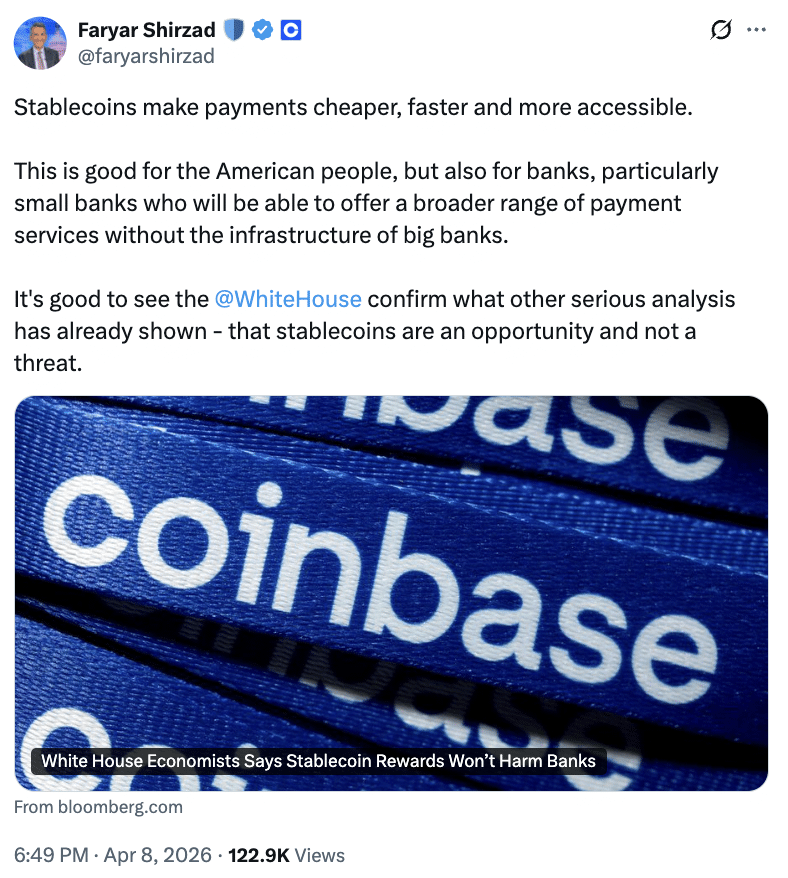
Source: X

This marks an interesting plot twist as Coinbase had recently stepped back from a recent compromise met on the CLARITY Act.

However, after the subtle threats between the White House and Coinbase, Coinbase’s CLO, Paul Grewal, turned bullish on the Act and put it best when he noted,

I’m very confident we’re going to see progress.

What’s more?

Additionally, a new report from the White House’s Council of Economic Advisers also highlighted that letting stablecoins offer yield isn’t a major threat to banks.

Thus, with so much optimism and understanding, it remains to be seen whether the CLARITY Act will be approved this year or get locked up in legislative headwinds.


Final Summary

  • The discussions around the CLARITY Act are heating up with Secretary Bessent now urging Congress to pass the Act.
  • Polymarket odds drop below 60%, adding more uncertainty to the passage of the bill by 2026.

Preguntas relacionadas

QWhat is the main demand made by U.S. Treasury Secretary Scott Bessent in the article?

AScott Bessent demanded that Congress pass the Digital Asset Market Clarity Act to establish clear federal rules for digital assets.

QAccording to Bessent, why are some crypto firms relocating to places like Abu Dhabi and Singapore?

ABecause these locations have clear rules, where firms know when and how to register, what standards to meet, and how to operate.

QWhat are the current Polymarket odds for the passage of the CLARITY Act, and how have they changed recently?

AThe Polymarket odds stand at 57%, which is a 9% drop from their previous high seen just weeks ago.

QWhich U.S. Senator expressed support for the CLARITY Act, and what did they call it?

ASenator Cynthia Lummis expressed support, calling the Act a 'one-pot solution' for developers, validators, and node operators, and a 'safe harbor' to keep innovations in the U.S.

QWhat was the stance of Coinbase's Chief Legal Officer, Paul Grewal, on the CLARITY Act after recent developments?

APaul Grewal turned bullish on the Act and expressed confidence, stating, 'I’m very confident we’re going to see progress.'

Lecturas Relacionadas

In Jinjiang, Fujian, a Storage Super Unicorn Lies Quiet

In Fujian's Jinjiang, a city known for sportswear, lies a quiet semiconductor giant: Fujian Jinhua Integrated Circuit Co. (JHICC). Once a promising domestic DRAM manufacturer alongside Yangtze Memory and ChangXin Memory Technologies (CXMT), its journey was derailed in 2018 when the U.S. placed it on an Entity List and filed criminal charges for alleged trade secret theft. This halted production for years. A turning point came in February 2024 when a U.S. federal court found JHICC not guilty. However, it had lost crucial time. While CXMT soared to become a top-valued A-share company in 2024, JHICC, with an estimated valuation of 80 billion RMB, was just restarting. Its current output is primarily customized DDR4 chips, not the advanced DDR5/HBM demanded for AI, but it still benefits from the broader memory chip upcycle. JHICC's story is tied to Chen Zhengkun, a veteran engineer who left Micron to lead the venture. Founded in 2016 with state-backed funding, JHICC partnered with Taiwan's UMC to develop DRAM technology. Rapid progress was cut short by the U.S. actions, which Micron initiated, partly due to its heavy reliance on the Chinese market. Post-sanctions, Chen's team worked to rebuild the production line with reduced reliance on U.S. technology. According to its records, JHICC achieved small-scale production and revenue growth under immense pressure. It now focuses on the stable "niche" DRAM market (e.g., TVs, routers) with a monthly capacity of ~40,000 wafers, aiming for 60,000 by 2026. It holds over 1,000 patents but remains on the Entity List. For Jinjiang, investing in JHICC was a bold industrial leap. The local government provided unwavering financial and logistical support during the crisis, helping the company survive. JHICC has become the anchor for a growing local semiconductor cluster. Though its scale lags behind domestic peers, JHICC's persistence symbolizes a hard-won foothold in a global market long dominated by Samsung, SK Hynix, and Micron. Having missed one boom, it seeks a place in the new AI-driven memory supercycle.

marsbitHace 1 min(s)

In Jinjiang, Fujian, a Storage Super Unicorn Lies Quiet

marsbitHace 1 min(s)

Must-Watch Events Next Week|CLARITY Act Could Face Senate Vote; SpaceX, Circle to Report Earnings (8.3-8.9)

**Summary: Key Events and Developments to Watch (August 3-9)** The upcoming week is marked by significant financial disclosures, key legislative deadlines, and notable product updates. **Major Financial Events:** Several companies are scheduled to release their Q2 2026 earnings. American Bitcoin (ABTC) will report on August 3, followed by SpaceX and Hut 8 Mining Corp. on August 4, and Circle on August 5. Notably, a significant portion of SpaceX shares (up to 12% of total shares) will be unlocked on August 6 following their earnings release. **Key Legislative Deadline:** The U.S. Senate faces an August 7 deadline to secure 60 votes for the CLARITY Act, a bipartisan bill aiming to establish a federal regulatory framework for cryptocurrencies. The Senate may hold a full vote on the bill during the week. **Economic Data:** The U.S. July Non-Farm Payrolls report will be released on August 7, providing crucial labor market data. **Technology & Product Updates:** * **Shutdowns:** DeFi portfolio tracker Zapper and wallet app Ctrl Wallet will cease operations on August 3. * **Upgrades:** LayerZero will deprecate its v1 relayers on August 3. XRP Ledger's new version 3.3.0, featuring five new functions, is expected next week. * **AI:** Elon Musk announced that the advanced Grok 4.6 AI model is set for release around August 7. * **Bitcoin:** The BIP-110 forced signaling for a potential Bitcoin network change is scheduled to begin around August 8. **Other Notable Events:** Chinese robotics firm Unitree Tech has set its preliminary price inquiry for its IPO for August 5. South Korean exchange Upbit will delist AQT and AERGO tokens on August 3.

marsbitHace 2 hora(s)

Must-Watch Events Next Week|CLARITY Act Could Face Senate Vote; SpaceX, Circle to Report Earnings (8.3-8.9)

marsbitHace 2 hora(s)

Trading

Spot
活动图片





