Coinbase to acquire The Clearing Company in prediction markets push

cointelegraphPublicado a 2025-12-22Actualizado a 2025-12-22

Resumen

Coinbase has agreed to acquire The Clearing Company, an on-chain prediction markets startup, as part of its strategy to become an "Everything Exchange." The acquisition, expected to close in January, will expand Coinbase’s offerings beyond digital assets to include prediction markets spanning politics, sports, and culture. The Clearing Company, founded earlier this year and backed by Coinbase Ventures, recently applied to become a Derivatives Clearing Organization with the CFTC. Coinbase views prediction markets as a major growth opportunity, citing regulatory developments and potential tax advantages over traditional gambling. The move aligns with broader industry interest in event-based markets, with players like Polymarket and Kalshi also active in the space.

Coinbase has agreed to acquire The Clearing Company, an on-chain prediction markets startup that spans digital assets, politics, sports, and culture, as it expands its push to become an “Everything Exchange” offering a broad range of investment products.

In an announcement shared with Cointelegraph, Coinbase said it has entered into a definitive agreement to acquire The Clearing Company, with the transaction expected to close in January. Financial terms of the deal were not disclosed.

The acquisition marks a rapid turnaround for The Clearing Company, which was founded earlier this year and counted Coinbase Ventures among its investors in a $15 million funding round alongside Union Square Ventures, Haun Ventures and several other venture firms and angel investors.

The Clearing Company is an on-chain prediction markets platform built by veterans of the cryptocurrency, prediction markets, and cloud infrastructure sectors. It was founded by Toni Gemayel, who previously worked with prediction market platforms Polymarket and Kalshi. Its broader team brings experience from companies including Polymarket, 0x, Dune and Coinbase.

Coinbase unveiled the acquisition less than a week after announcing its entry into prediction markets as part of its broader “Everything Exchange” strategy in partnership with Kalshi.

At the same time, Coinbase stated it will begin offering stock trading, further broadening its product lineup beyond digital assets.

Taken together, the acquisition highlights how event-based markets are moving closer to the regulated financial mainstream, with cryptocurrency infrastructure increasingly serving as the backbone for emerging market types.

“The Everything Exchange is a unified platform to trade crypto, equities, and everything else people want to trade,” Max Branzburg, Coinbase’s vice president of product management, told Cointelegraph. “Prediction markets are an important part of that platform.”

A Coinbase spokesperson added that markets tied to real-world outcomes represent “a natural extension of modern financial infrastructure.”

Source: Haun Ventures

This momentum is unfolding alongside a shifting regulatory landscape. Last month, The Clearing Company applied with the US Commodity Futures Trading Commission to become a Derivatives Clearing Organization, in a step that could further integrate prediction markets into established financial frameworks.

Related: Coinbase borrows Kalshi’s playbook, sues three states over prediction markets

Why Coinbase is betting on prediction markets

Coinbase’s push into prediction markets comes as the company increasingly views the sector as a major growth opportunity rather than a niche product.

In its latest market outlook report, which was covered by Cointelegraph, Coinbase identified prediction markets as one of the most important categories to watch through 2026, citing rising user engagement, regulatory clarity, and expanding real-world use cases.

In the report, Coinbase pointed to a tax provision in President Donald Trump’s “One Big Beautiful Bill,” which would limit the deductibility of gambling losses against winnings to 90%, down from the current 100%.

While the change may appear modest, Coinbase warned it could result in taxpayers being taxed on so-called “phantom income,” even in cases where net winnings are minimal or losses are incurred.

In this environment, Coinbase argued that prediction markets, which rely on contracts structurally similar to derivatives, could emerge as a more tax-efficient alternative to traditional sportsbooks and casinos, particularly if they are treated differently under the tax code.
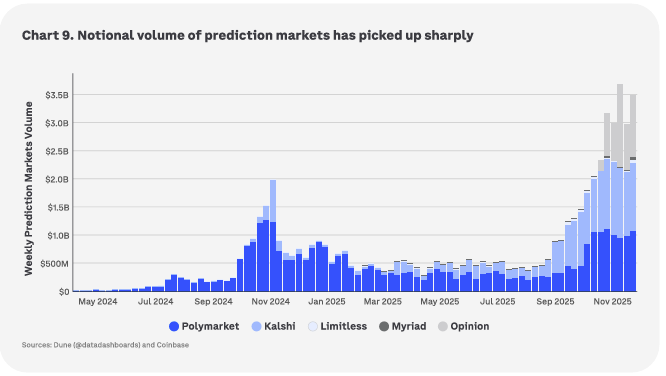
Prediction market activity has surged since the 2024 US presidential election. Source: Coinbase

While prediction markets remain a relatively nascent industry, the space is already dominated by a handful of major players. Chief among them is Polymarket, a decentralized platform built on the Polygon network that allows users to trade on political, economic, and cultural outcomes using blockchain-based contracts.

Kalshi has also emerged as a leading centralized player, operating under US regulatory oversight. Meanwhile, publicly traded sports betting company DraftKings has entered the prediction markets space, with plans to eventually offer crypto-linked contracts.

DraftKings would join a growing list of companies signaling interest in the sector, including Bitnomial Clearinghouse, a derivatives clearing organization, and crypto exchange Gemini.

Related: Polymarket shows stronger retention than most DeFi, wallets and exchanges

Preguntas relacionadas

QWhat is the main reason for Coinbase's acquisition of The Clearing Company?

ACoinbase is acquiring The Clearing Company to expand its push into prediction markets as part of its broader strategy to become an 'Everything Exchange' offering a wide range of investment products.

QWhen is the acquisition of The Clearing Company by Coinbase expected to be finalized?

AThe transaction is expected to close in January, though the specific financial terms of the deal were not disclosed.

QWhat regulatory step did The Clearing Company take recently to integrate prediction markets into established financial frameworks?

AThe Clearing Company applied with the US Commodity Futures Trading Commission (CFTC) to become a Derivatives Clearing Organization.

QAccording to Coinbase, why could prediction markets emerge as a more tax-efficient alternative to traditional sports betting?

ACoinbase argues that prediction markets, which use contracts similar to derivatives, could be more tax-efficient if treated differently under the tax code, especially in light of a proposed provision that would tax 'phantom income' from gambling even with minimal net winnings or losses.

QName two major existing players in the prediction markets space mentioned in the article.

ATwo major players mentioned are Polymarket, a decentralized platform on Polygon, and Kalshi, a centralized platform operating under US regulatory oversight.

Lecturas Relacionadas

The Value Distribution of Stablecoins

**Summary: The Value Distribution of Stablecoins** The article argues that stablecoins are evolving from mere trading tools into broader channels for dollar access. It divides the stablecoin ecosystem into four layers to analyze how value is distributed: 1. **Issuance Layer:** Mints stablecoins, holds reserve assets, and captures the spread between reserve yield and user costs (e.g., Tether, Circle). This layer currently earns the largest profit margin. 2. **Infrastructure Layer:** Connects stablecoins to the traditional financial system, handling fiat on/off-ramps, banking integration, compliance (KYC/AML), and asset management (e.g., Bridge, BVNK). This is the "unglamorous" but critical work, building the essential bridges between crypto and real-world finance. 3. **Acquiring/Distribution Layer:** Integrates stablecoins into merchant systems, manages payment flows, and provides enterprise financial software (e.g., Stripe, Coinbase). They act as the access point for businesses. 4. **Application Layer:** The end-users and businesses that ultimately use stablecoins for payments, settlements, or as a store of value. They benefit from convenience but have little pricing power. The core thesis is that while the issuance layer currently dominates profits, the often-overlooked **infrastructure layer holds significant long-term potential**. The real challenge and barrier to mass adoption is not the on-chain transfer of stablecoins (which is simple), but the complex "last mile" integration into existing business workflows, banking systems, and regulatory frameworks across different countries. Companies in this layer are currently in a "land grab" phase, investing heavily to build networks, secure bank partnerships, and establish compliance pathways. While their position is currently pressured by the profitable issuers above and distribution platforms below, the article suggests that if stablecoins become a default financial rail for businesses, the infrastructure providers who have done the hard work of integration will ultimately gain strong pricing power and become entrenched, essential players.

marsbitHace 5 hora(s)

The Value Distribution of Stablecoins

marsbitHace 5 hora(s)

The Value Distribution of Stablecoins

The Value Distribution of Stablecoins The article argues that stablecoins are evolving from a mere trading tool into a broad "dollar channel." It analyzes the industry's value chain through four layers: 1. **Issuance Layer (e.g., Tether, Circle):** The top layer that mints stablecoins, holds reserve assets, and captures the thickest interest rate spread. 2. **Infrastructure Layer (e.g., Bridge, BVNK):** Connects stablecoins to the traditional financial system, handling critical but complex "dirty work" like fiat on/off-ramps, banking integration, compliance (KYC/AML), and cross-border settlement. 3. **Acquiring/Distribution Layer (e.g., Stripe, Coinbase):** Embeds stablecoins into merchant systems, manages payment flows, and integrates with enterprise software. 4. **Application Layer:** End-users and businesses that ultimately use stablecoins for payments, settlement, or storing value. The author posits that while the issuance layer currently captures the most profit, the most overlooked and potentially critical layer is infrastructure. The core challenge for stablecoin adoption isn't the on-chain transfer (which is simple), but bridging the gap between blockchain and the real-world financial system. This involves solving practical problems for businesses: fiat conversion, reconciliation, tax handling, and user onboarding. Infrastructure companies are currently in a difficult "land-grab" phase—building networks, securing banking relationships, and achieving compliance country-by-country. They face pressure from both the profitable issuance layer above and distribution platforms below. However, the author suggests this layer is building a crucial moat. Once stablecoins become a default business rail, the infrastructure players who have done the hard work of integration may gain significant, durable value and pricing power.

链捕手Hace 5 hora(s)

The Value Distribution of Stablecoins

链捕手Hace 5 hora(s)

Trading

Spot
Futuros

Artículos destacados

Cómo comprar PUSH

¡Bienvenido a HTX.com! Hemos hecho que comprar Push Protocol (PUSH) sea simple y conveniente. Sigue nuestra guía paso a paso para iniciar tu viaje de criptos.Paso 1: crea tu cuenta HTXUtiliza tu correo electrónico o número de teléfono para registrarte y obtener una cuenta gratuita en HTX. Experimenta un proceso de registro sin complicaciones y desbloquea todas las funciones.Obtener mi cuentaPaso 2: ve a Comprar cripto y elige tu método de pagoTarjeta de crédito/débito: usa tu Visa o Mastercard para comprar Push Protocol (PUSH) al instante.Saldo: utiliza fondos del saldo de tu cuenta HTX para tradear sin problemas.Terceros: hemos agregado métodos de pago populares como Google Pay y Apple Pay para mejorar la comodidad.P2P: tradear directamente con otros usuarios en HTX.Over-the-Counter (OTC): ofrecemos servicios personalizados y tipos de cambio competitivos para los traders.Paso 3: guarda tu Push Protocol (PUSH)Después de comprar tu Push Protocol (PUSH), guárdalo en tu cuenta HTX. Alternativamente, puedes enviarlo a otro lugar mediante transferencia blockchain o utilizarlo para tradear otras criptomonedas.Paso 4: tradear Push Protocol (PUSH)Tradear fácilmente con Push Protocol (PUSH) en HTX's mercado spot. Simplemente accede a tu cuenta, selecciona tu par de trading, ejecuta tus trades y monitorea en tiempo real. Ofrecemos una experiencia fácil de usar tanto para principiantes como para traders experimentados.

218 Vistas totalesPublicado en 2024.12.13Actualizado en 2026.06.02

Cómo comprar PUSH

Discusiones

Bienvenido a la comunidad de HTX. Aquí puedes mantenerte informado sobre los últimos desarrollos de la plataforma y acceder a análisis profesionales del mercado. A continuación se presentan las opiniones de los usuarios sobre el precio de PUSH (PUSH).

活动图片