CME Group to Launch Own Digital Token and 24/7 Crypto Trading: Is $HYPER the Next Major Listing?

bitcoinistPublicado a 2026-02-05Actualizado a 2026-02-05

Resumen

CME Group, the world's largest derivatives exchange, is reportedly developing its own digital token to enable near-instant collateral movement and 24/7 trading, signaling a major shift in institutional finance. This move highlights the limitations of traditional settlement systems and emphasizes the need for high-speed blockchain infrastructure. Bitcoin Hyper ($HYPER) emerges as a key solution, serving as a high-performance Bitcoin Layer 2 that integrates Solana Virtual Machine (SVM) for sub-second transactions while leveraging Bitcoin’s security. It aims to support institutional demand for scalable liquidity and decentralized financial applications. The project has raised over $31M in its presale, with significant whale accumulation, indicating strong investor confidence. Staking mechanisms encourage long-term holding, positioning $HYPER as a potential infrastructure backbone for Bitcoin’s evolving ecosystem.

The line between traditional finance and the decentralized economy is blurring faster than regulators can keep up.

CME Group, the world’s largest derivatives exchange, is reportedly exploring the launch of its own digital token, signaling a fundamental shift in institutional market structure. The objective? Near-instant collateral movement to support 24/7 trading.

Crypto natives take this for granted, but for legacy institutions shackled by banking hours, it’s the holy grail.

It’s less about the token itself and more about what it unlocks. By tokenizing collateral, CME is effectively admitting that the existing plumbing of global finance, T+1 settlement cycles, and weekend closures, is cooked. The risk for traditional banks is real.

If a derivatives giant builds its own settlement rails, who needs intermediary clearing banks? Smart money is watching this not just as an infrastructure upgrade, but as a tacit endorsement of blockchain efficiency at the highest level of finance.

While CME focuses on the trading layer, a critical bottleneck remains on the execution layer of the world’s most valuable asset: Bitcoin itself. As institutions demand 24/7 liquidity, pressure mounts on Bitcoin’s network to handle high-frequency volume.

Frankly, the base layer’s 10-minute block times can’t support this throughput alone. That infrastructure gap triggered a rush into high-performance Layer 2 solutions. Leading the charge? Bitcoin Hyper ($HYPER), a protocol explicitly engineered to bring high-speed execution to the Bitcoin ecosystem, is positioning itself as the potential engine room for this new era of institutional liquidity.

Bitcoin Hyper Bridges The Gap Between Security And Speed

The narrative dominating this cycle isn’t just buying Bitcoin, it’s making it productive. CME Group handles how institutions trade; Bitcoin Hyper handles how the asset functions. As the first Bitcoin Layer 2 to integrate the Solana Virtual Machine (SVM), the project attempts to solve a decade-old trilemma: maintaining Bitcoin’s security while hitting the sub-second finality modern DeFi demands.
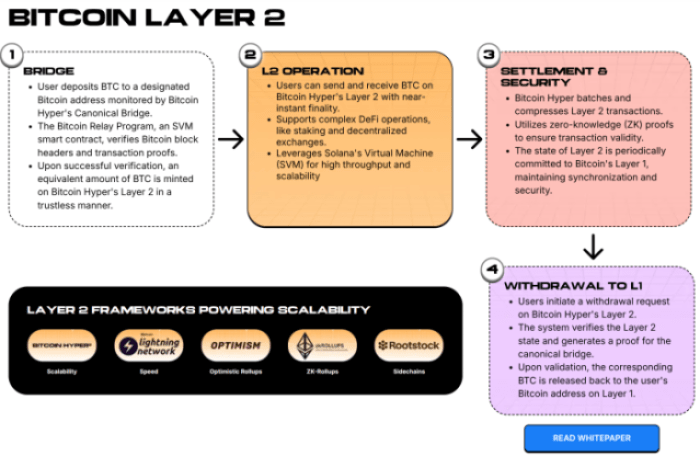
That convergence matters. It allows developers to write smart contracts in Rust, the language of choice for high-performance dApps, while anchoring final settlement on Bitcoin. Think of it as a shift from ‘digital gold’ to ‘digital oil.’

Using a modular blockchain architecture with a single trusted sequencer and periodic L1 state anchoring, Bitcoin Hyper delivers transaction speeds that reportedly outpace Solana itself, all while keeping gas fees negligible. Want a full breakdown of how it works? We’ve got you covered in our ‘What is Bitcoin Hyper‘ guide.

For an institutional market eyeing 24/7 trading, this utility is non-negotiable. A decentralized canonical bridge facilitates seamless $BTC transfers, allowing for the creation of wrapped $BTC payment rails and complex lending protocols that don’t rely on centralized custodians. The data points to a clear trend: as capital flows into Bitcoin via ETFs and futures, the demand for a scalable application layer (L2) creates an asymmetric opportunity for infrastructure plays like $HYPER.

EXplore the $HYPER presale

Smart Money Flows Into $HYPER Presale As Whales Accumulate

While legacy markets wait for regulatory clarity on CME’s potential token, on-chain metrics suggest crypto-native liquidity is already front-running the L2 narrative. Bitcoin Hyper has picked up serious steam, with the official presale raising over $31M to date. That level of capital injection hints at high conviction from investors looking for beta plays on Bitcoin’s success.

The current token price of $0.0136751 offers a low entry barrier relative to the roadmap. Whales are taking notice. Check the chain: Etherscan records show 3 whale wallets accumulated over $1M with the largest buy at $500K. High-net-worth individuals are positioning themselves before the token hits open markets.

It’s not just raw capital inflows—the protocol’s staking mechanics are driving retention too. Investors can snag high APY rewards immediately after the Token Generation Event (TGE), with a modest 7-day vesting period for presale stakers.

This structure encourages long-term holding over quick flips, aligning community interests with protocol stability. With the Bitcoin ecosystem evolving from a passive store of value to an active financial layer, projects that can successfully merge speed (SVM) with security (BTC) are likely to capture the lion’s share of developer activity.

HOP ON THE $HYPER TRAIL HERE

This article is for informational purposes only and does not constitute financial advice. Cryptocurrency investments carry inherent risks, including volatility and market unpredictability. Always conduct your own due diligence.

Criptos en tendencia

Preguntas relacionadas

QWhat is the primary objective behind CME Group's reported exploration of launching its own digital token?

AThe primary objective is to enable near-instant collateral movement to support 24/7 trading, addressing the limitations of traditional banking hours and settlement cycles.

QAccording to the article, which Bitcoin Layer 2 solution is positioning itself to handle high-speed execution for institutional liquidity?

ABitcoin Hyper ($HYPER) is the Bitcoin Layer 2 solution explicitly engineered to bring high-speed execution to the Bitcoin ecosystem and is positioning itself for this role.

QWhat key technological feature does Bitcoin Hyper ($HYPER) integrate to achieve high performance while maintaining security?

ABitcoin Hyper integrates the Solana Virtual Machine (SVM), allowing developers to write high-performance smart contracts in Rust while anchoring final settlement on the secure Bitcoin blockchain.

QHow much capital has the Bitcoin Hyper ($HYPER) presale raised to date, as mentioned in the article?

AThe official Bitcoin Hyper presale has raised over $31 million to date.

QWhat is one way the $HYPER tokenomics encourages long-term holding rather than short-term speculation?

AThe protocol's staking mechanics offer high APY rewards immediately after the Token Generation Event (TGE) with a modest 7-day vesting period for presale stakers, which encourages long-term holding.

Lecturas Relacionadas

The Verdict in Choi Tae-won's Divorce Case: Revealing the Inheritance Undercurrent Behind SK Hynix's Trillion-Won Empire

SK Group Chairman Chey Tae-won's high-profile divorce case, involving a record 1.38 trillion won settlement, has drawn attention to the succession plans for Korea's second-largest conglomerate, especially its crown jewel, SK hynix. Unlike traditional chaebol scripts centered on the eldest son, Chey's three children from his marriage to former President Roh Tae-woo's daughter, Roh Soh-yeong, are carving distinct, non-traditional paths. Eldest daughter Chey Yun-jung (b. 1989) is seen as the most evident successor. With a scientific and consulting background, she holds executive roles at SK bioscience and SK Inc.'s growth support department, focusing on future strategy and biopharma. Her marriage is to an AI infrastructure entrepreneur, not a traditional business alliance. Second daughter Chey Min-jung (b. 1991) took a unique route, voluntarily serving as a South Korean naval officer, including an anti-piracy deployment. She later worked on policy and strategy for SK hynix in Washington D.C. before co-founding an AI-driven healthcare startup. She married a former U.S. Marine Corps officer, connecting her to U.S. defense and policy circles—networks crucial for a global semiconductor giant. The only son, Chey In-geun (b. 1995), who studied physics like his father, worked briefly at SK E&S before joining McKinsey. Despite fitting the traditional "heir" profile as the eldest son, he remains silent and holds no public position or shares in SK, suggesting the old succession playbook is obsolete. As SK hynix's valuation soars, becoming a geopolitical asset in the AI era, the heirs' legitimacy is no longer automatic. They must prove themselves in fields like AI biotech, global policy, and strategic consulting. Their marriages also reflect new elite networks in tech and defense, not old political alliances. Their inheritance is the complex challenge of navigating a globalized, tech-driven world, not just a corporate throne.

marsbitHace 11 hora(s)

The Verdict in Choi Tae-won's Divorce Case: Revealing the Inheritance Undercurrent Behind SK Hynix's Trillion-Won Empire

marsbitHace 11 hora(s)

From OpenSea to OpenRouter: Is Alex Atallah Repeating His 'Exit at the Peak' Playbook?

From OpenSea to OpenRouter: Is Alex Atallah Repeating His "Exit at the Peak" Playbook? According to the Wall Street Journal, payments giant Stripe is in talks to acquire the AI model aggregation platform OpenRouter in a potential deal valuing the company near $100 billion. This would mark founder Alex Atallah's second creation of a company reaching a $100 billion valuation, following his co-founding of NFT marketplace OpenSea. OpenRouter, founded just over three years ago, has grown rapidly by acting as a unified gateway for developers to access over 400 AI models. It currently has about 10 million users and processes over 200 trillion tokens monthly. While the platform's annualized revenue is around $50 million, its valuation has skyrocketed from $1.3 billion in March 2026. The potential acquisition by Stripe, a company OpenRouter's founder once likened it to, represents a major expansion into AI infrastructure for the payments leader. This move echoes Atallah's previous timing with OpenSea, where he departed before the NFT market's significant downturn. For OpenRouter, selling now may be strategic. Despite its scale, its business model—charging a 5-5.5% fee on AI inference calls—faces pressure from competition, open-source models, and potential price wars among model providers, limiting its profitability narrative for an IPO. A key asset for potential acquirers like Stripe is OpenRouter's vast repository of real-world AI usage data, which offers unique insights into model performance and developer preferences that are difficult to replicate. Whether this potential deal signifies a new valuation benchmark for AI infrastructure or another market peak signal remains to be seen.

链捕手Hace 11 hora(s)

From OpenSea to OpenRouter: Is Alex Atallah Repeating His 'Exit at the Peak' Playbook?

链捕手Hace 11 hora(s)

Trading

Spot

Artículos destacados

Cómo comprar F

¡Bienvenido a HTX.com! Hemos hecho que comprar Synfutures (F) sea simple y conveniente. Sigue nuestra guía paso a paso para iniciar tu viaje de criptos.Paso 1: crea tu cuenta HTXUtiliza tu correo electrónico o número de teléfono para registrarte y obtener una cuenta gratuita en HTX. Experimenta un proceso de registro sin complicaciones y desbloquea todas las funciones.Obtener mi cuentaPaso 2: ve a Comprar cripto y elige tu método de pagoTarjeta de crédito/débito: usa tu Visa o Mastercard para comprar Synfutures (F) al instante.Saldo: utiliza fondos del saldo de tu cuenta HTX para tradear sin problemas.Terceros: hemos agregado métodos de pago populares como Google Pay y Apple Pay para mejorar la comodidad.P2P: tradear directamente con otros usuarios en HTX.Over-the-Counter (OTC): ofrecemos servicios personalizados y tipos de cambio competitivos para los traders.Paso 3: guarda tu Synfutures (F)Después de comprar tu Synfutures (F), guárdalo en tu cuenta HTX. Alternativamente, puedes enviarlo a otro lugar mediante transferencia blockchain o utilizarlo para tradear otras criptomonedas.Paso 4: tradear Synfutures (F)Tradear fácilmente con Synfutures (F) en HTX's mercado spot. Simplemente accede a tu cuenta, selecciona tu par de trading, ejecuta tus trades y monitorea en tiempo real. Ofrecemos una experiencia fácil de usar tanto para principiantes como para traders experimentados.

238 Vistas totalesPublicado en 2024.12.21Actualizado en 2026.06.02

Cómo comprar F

Discusiones

Bienvenido a la comunidad de HTX. Aquí puedes mantenerte informado sobre los últimos desarrollos de la plataforma y acceder a análisis profesionales del mercado. A continuación se presentan las opiniones de los usuarios sobre el precio de F (F).

活动图片