Claude to Mandate "Face-Scan ID Verification", No ID No Service Starting July?

链捕手Publicado a 2026-06-15Actualizado a 2026-06-15

Resumen

Anthropic, the creator of Claude AI, has sent privacy policy update emails to users, signaling a significant shift. The key change, effective July 8, is the potential requirement for consumer-level users (Free, Pro, Max plans) to verify their age or identity. This verification would be conducted through the third-party service Persona, involving uploading a government-issued photo ID and taking a live selfie for comparison. Anthropic states this data is for security purposes only, will not be used for model training, and is processed by Persona, not stored on its own servers. The update also clarifies data handling for Claude's new capabilities: when performing multi-step tasks or connecting to third-party apps, user data may flow between Anthropic and those external services. Additionally, more information may be collected from users who participate in Anthropic research. This move is seen as a major step towards establishing accountability as AI agents become more powerful and autonomous, capable of executing complex, real-world tasks. It follows previous enforcement actions, like the banning of the "Fable 5" account, and indicates a broader industry trend toward stricter user identification and safety measures. The verification is expected to apply in specific scenarios, particularly as users engage Claude in more complex agentic workflows.

Author: New Zhiyuan

Anthropic is in the headlines again!

In recent days, many Claude users opened their email to find a message from Anthropic. The title seemed innocuous - "Privacy Policy Update Notification". But the content left them stunned:

"We may ask you to verify your age or identity."
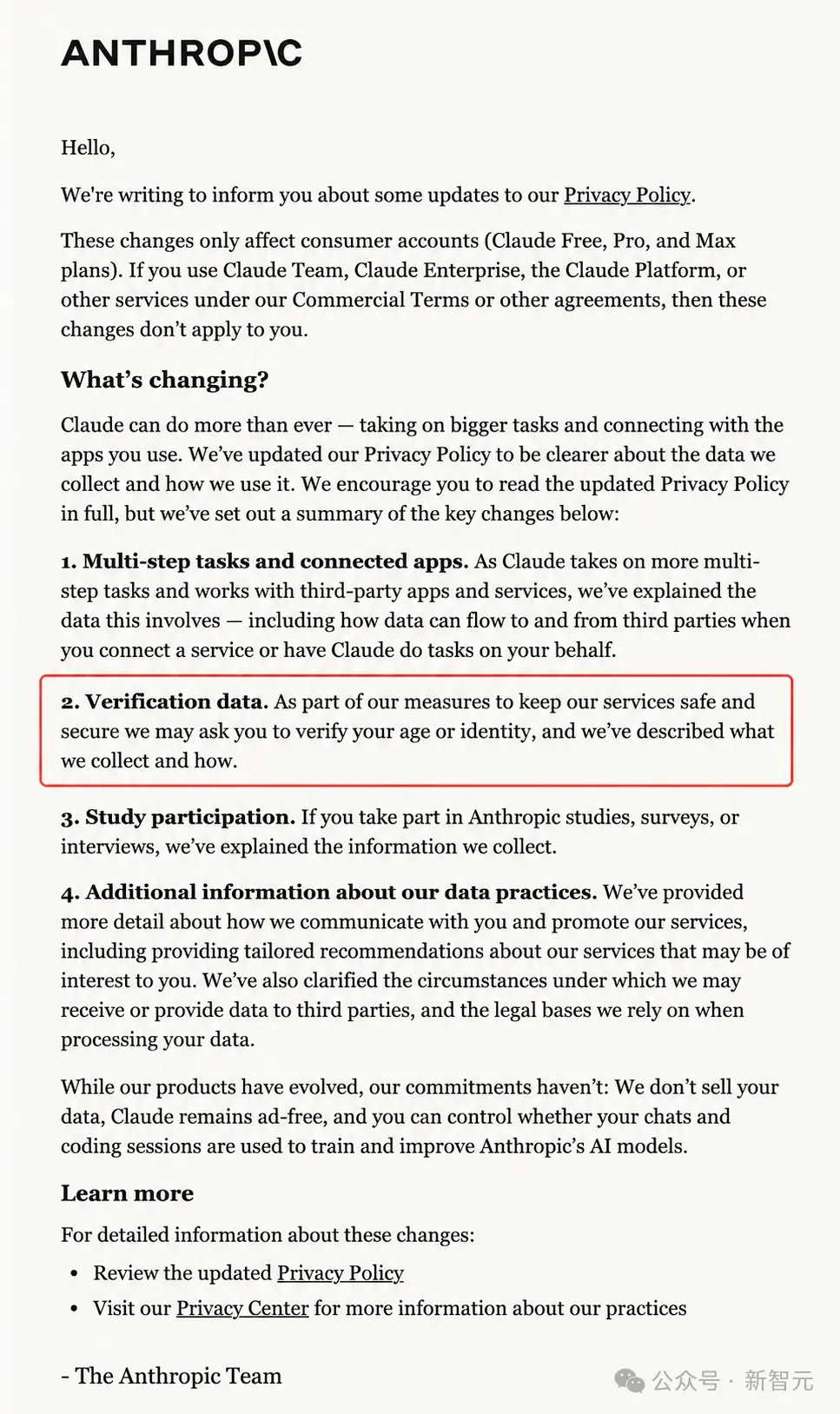
Someone shared a screenshot of the email on X, and the comments exploded. According to the email content, starting July 8th, Claude will likely start asking for your ID. Has Anthropic's real-name verification finally arrived?
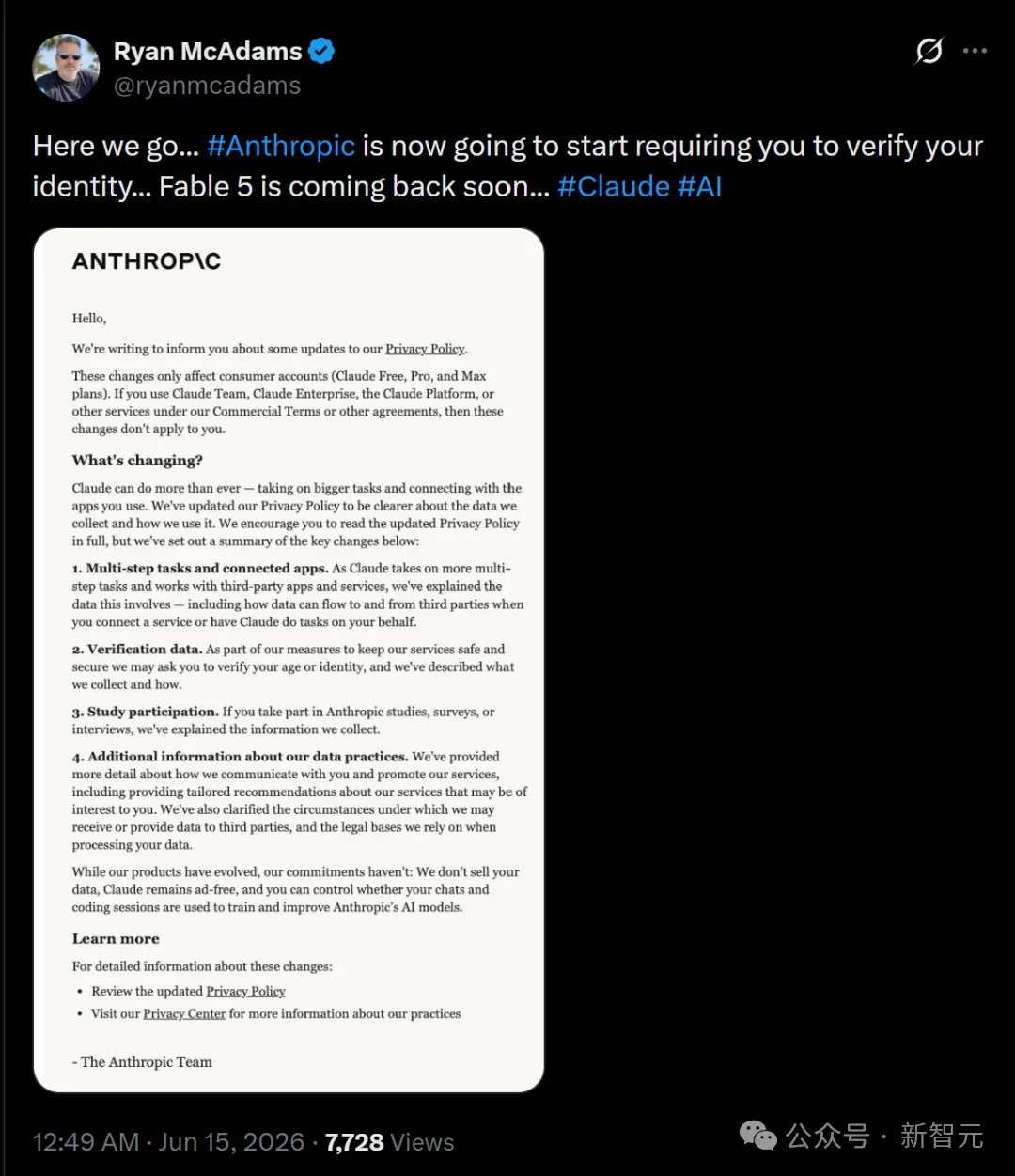
Anthropic Suddenly Announces, Is Real-Name Verification Really Coming?

On June 10th, many Claude users' inboxes received an email from Anthropic.

The email mentions that starting July 8th, Anthropic may ask users to verify their age or identity, citing the reason as "enhancing security." More interestingly, some found they just received this email today, while their other accounts hadn't received it at all before, suggesting it might be a batch rollout or an A/B test.

According to the officially updated privacy policy in the email, there are three core changes:
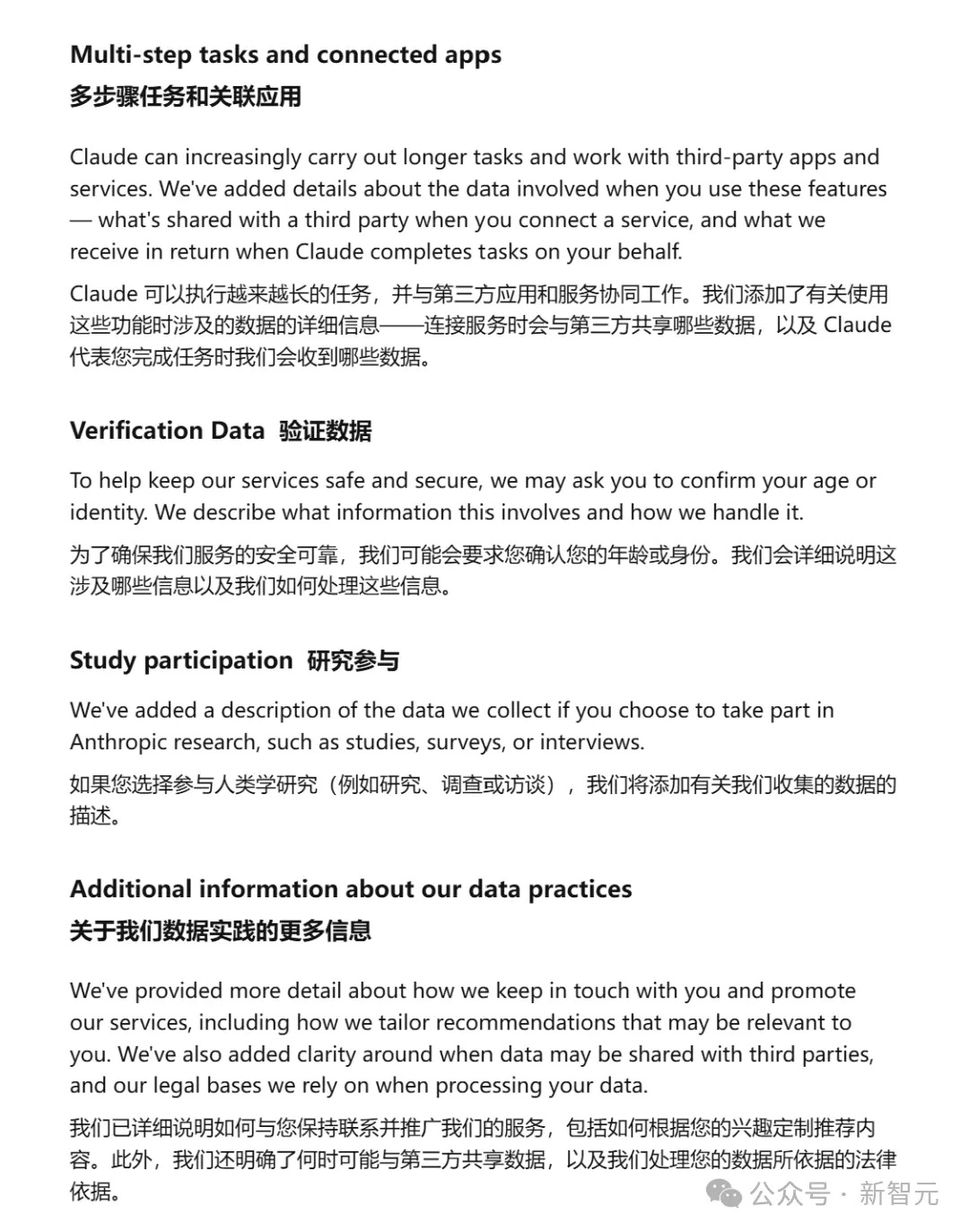
1. Data Flow for Multi-Step Tasks and Third-Party Apps

As Claude's capabilities improve, it can perform multi-step tasks on behalf of users (like helping you plan a full trip: checking flights, booking hotels, arranging itineraries), and can also connect to third-party apps (like Google Drive, Slack, Notion, etc.).

Moreover, your data no longer stays solely on Anthropic's servers. Anthropic explicitly states in the updated privacy policy: When you connect a service or have Claude perform tasks for you, data can flow between you and third parties.

This means your conversation content, uploaded files, and even your commands may leave Anthropic's servers and enter third-party app processing pipelines. For ordinary users, the more powerful the AI's "agentic capabilities," the broader your data footprint becomes.

2. Verification Data (Core Change)

This is the most impactful part of this update. The policy text reads:

As part of our efforts to maintain the security and reliability of our services, we may ask you to verify your age or identity. We are explaining here what information we collect and how.

How will verification be done?

According to Anthropic's official support page, verification will be conducted through the third-party service Persona. The specific process includes:

  • Uploading a government-issued, photo ID document (passport, driver's license, ID card, etc.)

  • Taking a real-time selfie (for comparison with the ID photo)

Anthropic attempts to reassure users, emphasizing that this data is only used to confirm identity, and will not be used for model training; data will not be stored on Anthropic's own servers (handled by Persona); and the entire process is only for specific security and compliance scenarios.

Nevertheless, this notification still shocked the user base. On platform X, one user shared an email screenshot with the caption: "Received on June 10th, thought it was just a regular update at the time... looking back now, terrifying to contemplate." Another user joked: They said they need to verify identity, so is Fable 5 coming back?

3. Research Participation Information

If you participate in Anthropic's research surveys or interviews, they will collect more information.
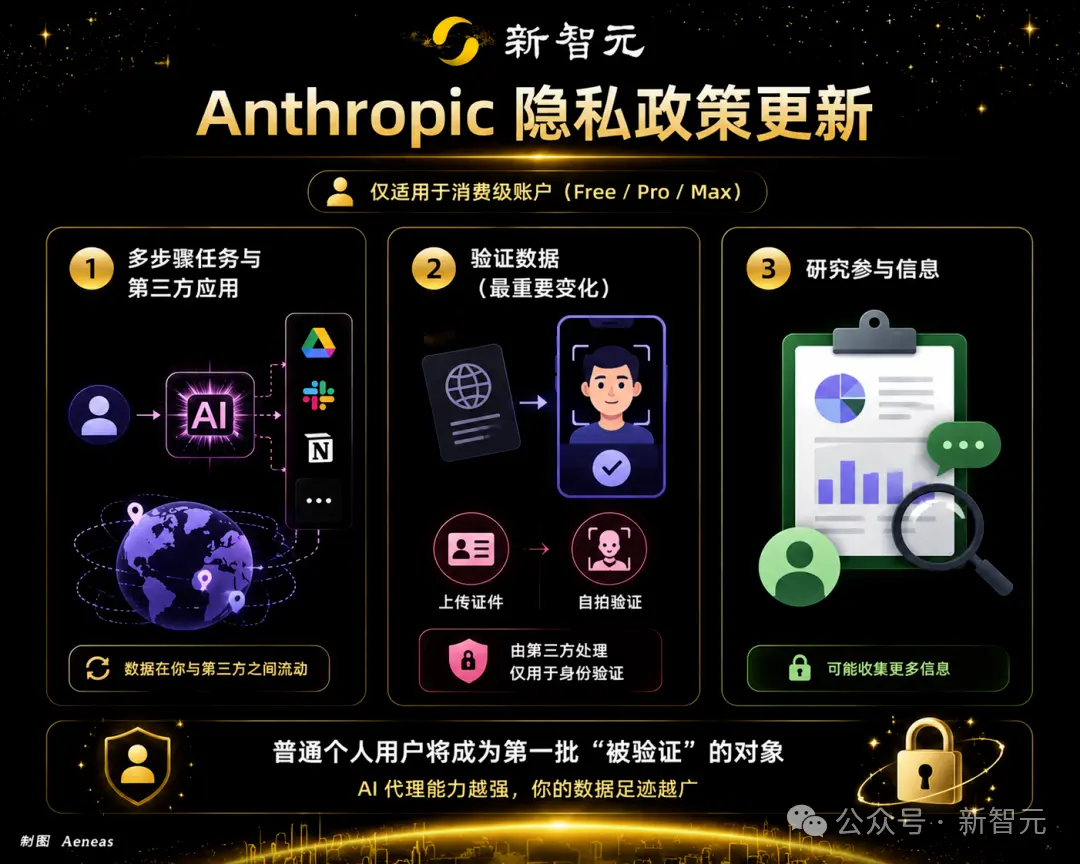
⚠️ Important Note:

The above three changes apply only to consumer accounts (Free, Pro, Max). Business customers (Team, Enterprise) are not affected. This means ordinary individual users will be the first batch to undergo "verification."

Anthropic explains on its official support page: Identity verification was previously only used in specific scenarios targeting minors, violators, or accounts in unsupported regions. In the future, as agent tasks become more complex, the scope of verification will gradually expand.

Identity verification is not something Anthropic is doing for the first time. Previously, when dealing with minor protection, violators, and accounts in some unsupported regions, similar verification methods have been used. The difference is that this time, the wording and scope are more explicit, and they specifically highlighted one sentence—in the future, as Agent tasks become increasingly complex, verification scenarios may continue to expand.

Many heavy Agent users worry: in the future, when using Claude to run automated tasks, will there be constant pop-ups asking for face scans? Currently, the official has not provided more detailed trigger conditions; after July 8th, there will likely be more specific explanations.

AI's "Wild West Era" Is Coming to an End

Thinking back to the recent uproar over the "Fable 5 Ban" incident, everything seems to have been foreshadowed.

When the Fable 5 account was banned by the authorities for crossing safety red lines, it shocked everyone. Many thought it might be a one-off disciplinary action for an extreme case, but now it appears that Fable 5's downfall is not an isolated incident, but rather a prelude to a comprehensive tightening by Anthropic and even the entire AI industry.

As AI's capabilities evolve from a "chat companion tool" to an "all-powerful agent" capable of operating third-party applications and executing complex tasks, the authorities will never allow another Fable 5 to run wild beyond legal boundaries.

The so-called "real-name system" and "face-scan verification" mark that on the eve of the full-scale explosion of AI Agents, major players must establish an unbreakable accountability tracing mechanism in advance. Once AI causes trouble while booking tickets, editing files, or even executing more complex business commands on your behalf, the platform must know exactly which real-life "person" is giving the orders behind the screen.

From July 8th onward, every time you attempt to have Claude help you complete multi-step complex tasks, it might be accompanied by a pop-up: Please upload your ID document.

Anthropic's message reveals—winter is coming. From now on, face-scan verification and account purging will likely become the norm for the AI industry in 2026.

In another month, when using Claude, one must be prepared to hold up their ID at any moment.

References:

  • https://x.com/ryanmcadams/status/2066201356034011370?s=20

  • https://privacy.claude.com/en/articles/10301952-updates-to-our-privacy-polic

Preguntas relacionadas

QWhat is the main announcement Anthropic made to its users regarding Claude's privacy policy, and what change is expected starting July 8th?

AAnthropic announced an update to Claude's privacy policy, notifying users that starting July 8th, the company may require them to verify their age or identity to enhance security. This verification would be conducted through the third-party service Persona and could involve uploading a government-issued photo ID and taking a live selfie.

QAccording to the article, what are the three key changes outlined in the updated privacy policy?

AThe three key changes are: 1) Clarification on how user data flows during multi-step tasks and interactions with third-party apps connected to Claude. 2) The introduction of identity and age verification for users. 3) Clarification on the collection of information for users participating in Anthropic's research programs, such as surveys and interviews.

QWhich group of Claude users will primarily be affected by the new identity verification requirement?

AThe new identity verification requirement will primarily affect consumer-level accounts, including Free, Pro, and Max plans. Business customers using Team or Enterprise plans are not impacted by this change.

QWhat is the stated reason Anthropic is implementing identity verification, and how does the company claim to handle the collected data?

AAnthropic states the reason for implementing identity verification is to enhance the safety and reliability of its services. The company claims the data will only be used to confirm identity, not for model training. The verification process is handled by the third-party service Persona, and the data is not stored on Anthropic's own servers.

QHow does the article connect this policy change to the broader trend in the AI industry, specifically mentioning the 'Fable 5' incident?

AThe article suggests this policy change is part of a broader industry-wide tightening of regulations. It connects it to the 'Fable 5' incident, where an account was banned for safety violations, implying that as AI agents like Claude become capable of performing complex, multi-step tasks, companies must establish clear accountability and traceability to prevent misuse, marking the end of a more 'wild' era for AI.

Lecturas Relacionadas

How to Do Research Well: Deliberately Practice the Real Skills That Matter

No one truly teaches you how to do research. You're often given a desk, a pre-selected problem, and vague instructions to "create something new." Consequently, many people reverse-engineer the job based on visible outputs—papers, posts, announcements—learning only how to *appear* like a researcher rather than how to *become* one. True research capability is built from stacking small, trainable skills, nearly all of which can be developed through deliberate practice. **Pick Your Own Problem:** Most researchers absorb problems from advisors or trends, lacking the underlying reasoning. Choosing a problem you genuinely care about, as John Schulman advises, leads to original work. Develop "taste" like a muscle: predict experiment outcomes, guess paper results from methods, and track which findings remain important over time. **Upgrade Your Inputs:** Relying on shared reading lists (arXiv hot lists, filtered group chats) leads to unoriginal conclusions. Undervalued old literature often holds crucial insights (e.g., MoE, LSTM, backpropagation). Richard Sutton's "The Bitter Lesson" or Claude Shannon's 1952 talk on creative thinking are more predictive than lengthy modern surveys. Breadth matters as much as depth: draw from neuroscience, mechanism design, hardware knowledge, and honest statistics. Read papers directly, especially appendices and limitations sections. **Write Everything Down:** As Paul Graham noted, writing exposes flaws in seemingly mature ideas. Writing is the cheapest defense against self-deception. Following Feynman's principle, Darwin programmatically wrote down facts contradicting his theory to combat memory bias. Maintain a detailed log of hypotheses, setups, predictions, results, and updated understandings. Reviewing past logs fosters essential humility.

marsbitHace 10 min(s)

How to Do Research Well: Deliberately Practice the Real Skills That Matter

marsbitHace 10 min(s)

Following US Ban on Fable 5, Zhipu AI's Stock Soars 47%

On June 15th, shares of Zhipu AI surged dramatically on the Hong Kong stock market, peaking at a 47.6% gain before closing 32.82% higher. This sharp increase was directly triggered by two recent industry events. On June 12th, Anthropic announced it was suspending global access to its latest flagship models, Claude Fable 5 and Claude Mythos 5, to comply with a U.S. government export control order. The next day, Zhipu AI announced it would open access to its latest open-source flagship model, GLM-5.2, under the permissive MIT license. The Anthropic incident highlighted a critical issue beyond raw model capability: the risk of sudden, unpredictable loss of access to advanced AI models, especially for developers and enterprises deeply integrated with them. This has shifted industry and market focus toward factors like stability, sustainable access, and controllability. Zhipu's move, promoting "frontier intelligence for all," positions its openly available model as a reliable and accessible alternative. The GLM-5.2 model emphasizes "Long Horizon Task" capabilities with a 1M context window, targeting complex, multi-step coding and engineering workflows where maintaining context is crucial. Analysts note this event exposes the risk of dependency on closed-source models subject to single jurisdictional controls, potentially accelerating a shift toward domestic base models and localized deployments. The market's reaction signals a new valuation dimension in AI: providers who can offer stable, long-term, and sustainably accessible AI capabilities are gaining strategic importance.

marsbitHace 34 min(s)

Following US Ban on Fable 5, Zhipu AI's Stock Soars 47%

marsbitHace 34 min(s)

Fully Entering the AI Era: Alipay Bets on Conversation, WeChat Holds Fast to Social

In May 2026, Alipay announced over 300 million AI payment transactions. Shortly after, WeChat opened its mini-programs for AI integration, sparking controversy by requiring developer source code access. This highlights their diverging approaches to AI integration. Alipay is testing "Project Treasure," an optional AI-native interface replacing traditional app grids with a conversational window. Users can command complex tasks (e.g., "book a ride and order coffee") handled end-to-end by AI. This shift follows an abandoned standalone AI app, focusing instead on enhancing its existing user base. For unmodified mini-programs, Alipay's AI uses "screen-reading" to simulate user interactions, bypassing the need for developer overhaul. It also introduced "Token Pay" for micro-transactions and "AI Wallets" for autonomous agent spending. WeChat, prioritizing its core social function, is taking an embedded approach. Its AI agent will operate within existing contexts like group chats and official accounts, assisting without a separate interface. To enable this, WeChat offers developers two paths: granting source code access for direct AI control ("Automatic Mode") or manually encapsulating services into standardized "Skills." Both place significant burden on developers. Key differences emerge in handling legacy services: WeChat demands developer cooperation (code or labor), while Alipay's screen-reading offers immediate, if potentially less stable, compatibility. Alipay's 3 billion AI transactions demonstrate user acceptance of AI-driven commercial actions. The divergent strategies may reshape mini-program ecosystems—Alipay passively "AI-fying" services, WeChat potentially favoring resource-rich developers—and set competing technical standards. Ultimately, the competition centers on where users entrust the command to "help me get things done."

marsbitHace 34 min(s)

Fully Entering the AI Era: Alipay Bets on Conversation, WeChat Holds Fast to Social

marsbitHace 34 min(s)

Trading

Spot
Futuros

Artículos destacados

Cómo comprar ID

¡Bienvenido a HTX.com! Hemos hecho que comprar SPACE ID (ID) sea simple y conveniente. Sigue nuestra guía paso a paso para iniciar tu viaje de criptos.Paso 1: crea tu cuenta HTXUtiliza tu correo electrónico o número de teléfono para registrarte y obtener una cuenta gratuita en HTX. Experimenta un proceso de registro sin complicaciones y desbloquea todas las funciones.Obtener mi cuentaPaso 2: ve a Comprar cripto y elige tu método de pagoTarjeta de crédito/débito: usa tu Visa o Mastercard para comprar SPACE ID (ID) al instante.Saldo: utiliza fondos del saldo de tu cuenta HTX para tradear sin problemas.Terceros: hemos agregado métodos de pago populares como Google Pay y Apple Pay para mejorar la comodidad.P2P: tradear directamente con otros usuarios en HTX.Over-the-Counter (OTC): ofrecemos servicios personalizados y tipos de cambio competitivos para los traders.Paso 3: guarda tu SPACE ID (ID)Después de comprar tu SPACE ID (ID), guárdalo en tu cuenta HTX. Alternativamente, puedes enviarlo a otro lugar mediante transferencia blockchain o utilizarlo para tradear otras criptomonedas.Paso 4: tradear SPACE ID (ID)Tradear fácilmente con SPACE ID (ID) en HTX's mercado spot. Simplemente accede a tu cuenta, selecciona tu par de trading, ejecuta tus trades y monitorea en tiempo real. Ofrecemos una experiencia fácil de usar tanto para principiantes como para traders experimentados.

181 Vistas totalesPublicado en 2024.12.12Actualizado en 2026.06.02

Cómo comprar ID

Discusiones

Bienvenido a la comunidad de HTX. Aquí puedes mantenerte informado sobre los últimos desarrollos de la plataforma y acceder a análisis profesionales del mercado. A continuación se presentan las opiniones de los usuarios sobre el precio de ID (ID).

活动图片













